STRESS MANAGMENT
AYESHA TARIQ (008)
FATIMA QAYYUM (011)
SHINZA GULFAM (038)
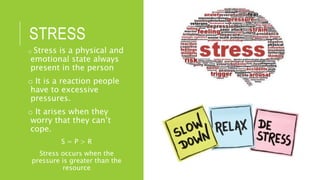
STRESS
o Stress is a physical and
emotional state always
present in the person
o It is a reaction people
have to excessive
pressures.
o It arises when they
worry that they can’t
cope.
S = P > R
Stress occurs when the
pressure is greater than the
resource
THE IMPACT OF STRESS
ON PERFORMANCE
Stress: the body’s reaction to a
tense situation
 Stress will affect work performance
 Stress in the workplace will carry
on to your personal life
 Stress-related losses cost
organizations billions of dollars
annually
TYPES OF STRESSORS
External
o Physical Environment
o Social Interaction
o Organisational
o Major Life Events
o Daily Hassles
Internal
o Lifestyle choices
o Negative self - talk
o Mind traps
o Personality traits
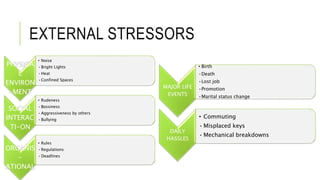
EXTERNAL STRESSORS
PHYSICA
L
ENVIRON
-MENT
• Noise
•Bright Lights
•Heat
•Confined Spaces
SOCIAL
INTERAC
TI-ON
• Rudeness
•Bossiness
•Aggressiveness by others
•Bullying
ORGANIS
-
ATIONAL
• Rules
•Regulations
•Deadlines
MAJOR LIFE
EVENTS
• Birth
•Death
•Lost job
•Promotion
•Marital status change
DAILY
HASSLES
• Commuting
• Misplaced keys
• Mechanical breakdowns
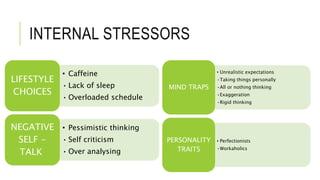
INTERNAL STRESSORS
• Caffeine
• Lack of sleep
• Overloaded schedule
LIFESTYLE
CHOICES
• Pessimistic thinking
• Self criticism
• Over analysing
NEGATIVE
SELF -
TALK
• Unrealistic expectations
•Taking things personally
•All or nothing thinking
•Exaggeration
•Rigid thinking
MIND TRAPS
• Perfectionists
•Workaholics
PERSONALITY
TRAITS
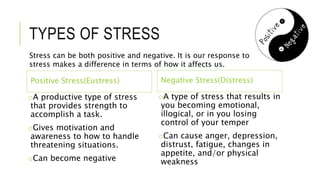
TYPES OF STRESS
Positive Stress(Eustress)
oA productive type of stress
that provides strength to
accomplish a task.
oGives motivation and
awareness to how to handle
threatening situations.
oCan become negative
Negative Stress(Distress)
oA type of stress that results in
you becoming emotional,
illogical, or in you losing
control of your temper
oCan cause anger, depression,
distrust, fatigue, changes in
appetite, and/or physical
weakness
Stress can be both positive and negative. It is our response to
stress makes a difference in terms of how it affects us.
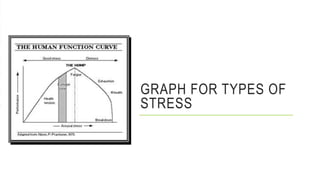
GRAPH FOR TYPES OF
STRESS
EVERY
INDIVIDUAL
VARY
oEveryone is different, with unique perceptions
of, and reactions to, events.
oThere is no single level of stress that is
optimal for all people.
oSome are more sensitive owing to experiences
in childhood, the influence of teachers,
parents and religion etc.
oMost of the stress we experience is self-
generated.
oHow we perceive life?
whether an event makes us feel threatened or
stimulated, encouraged or discouraged, happy
or sad
 depends to a large extent on how we
perceive ourselves.
COST OF STRESS
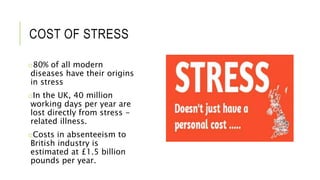
o80% of all modern
diseases have their origins
in stress
oIn the UK, 40 million
working days per year are
lost directly from stress -
related illness.
oCosts in absenteeism to
British industry is
estimated at £1.5 billion
pounds per year.
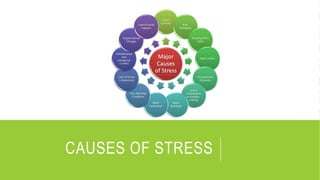
CAUSES OF STRESS
STRESS CONTROL (ABC
STRATEGY)
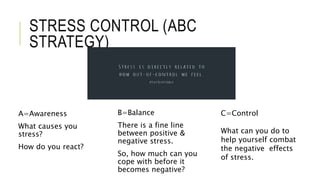
A=Awareness
What causes you
stress?
How do you react?
B=Balance
There is a fine line
between positive &
negative stress.
So, how much can you
cope with before it
becomes negative?
C=Control
What can you do to
help yourself combat
the negative effects
of stress.
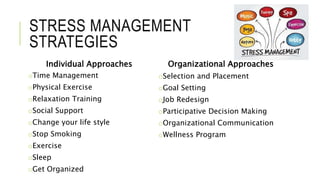
STRESS MANAGEMENT
STRATEGIES
Individual Approaches
oTime Management
oPhysical Exercise
oRelaxation Training
oSocial Support
oChange your life style
oStop Smoking
oExercise
oSleep
oGet Organized
Organizational Approaches
oSelection and Placement
oGoal Setting
oJob Redesign
oParticipative Decision Making
oOrganizational Communication
oWellness Program
INDIVIDUAL
APPROACHE
S
Time
Manageme
nt
An
understan
ding and
utilization
of basic
time
managem
ent
principles
can help
individuals
better
Physical
Exercise
Noncompeti
tive
physical
exercise
such as
aerobics,
race
walking,
jogging,
swimming,
and riding a
bicycle have
long been
recommend
Relaxation
Training
•Individuals can teach
themselves to relax
through techniques
such as meditation,
hypnosis, and
biofeedback. The
objective is to reach a
state of deep
relaxation, where one
feels physically relaxed,
somewhat detached
from the immediate
1
Social Support
• Having friends,
family, or work
colleagues to talk to
provides an outlet
when stress levels
become excessive.
Expanding your
social support
network, therefore,
can be a means for
tension reduction.
2
ORGANISATIONAL
APPROACHES
Selection and
Placement
•Individuals with
little experience
or an external
locus of control
tend to be more
stress-prone .
Selection and
placement
decisions should
take these facts
into
consideration.
Goal Setting
•The use of goals
can reduce stress
as well as provide
motivation.
Specific goals that
are perceived as
attainable clarify
performance
expectations.
Additionally, goal
feedback reduces
uncertainties as
to actual job
performance. The
result is less
employee
frustration, role
ambiguity, and
stress.
Participative
Decision
Making
By giving these employees a voice in
decisions that directly affect their job
performances, management can increase
employee control and reduce this role
stress.
Job
Redesign
Redesigning jobs to give employees
more responsibility, more meaningful
work, more autonomy, and increased
feedback can reduce stress, because
these factors give the employee greater
control over work activities and lessen
dependence on others.
CONT.
Organizational Communication
•Given the importance that perceptions play in
moderating the stress-response relationship,
management can also use effective
communications as a means to shape employee
perceptions .
1
Wellness Program
•These programs focus on the employee's total
physical and mental condition. For example, they
typically provide workshops to help people quit
smoking, control alcohol use, lose weight, eat
better, and develop a regular exercise program.
2
Stress managment

Stress managment

  • 1.
    STRESS MANAGMENT AYESHA TARIQ(008) FATIMA QAYYUM (011) SHINZA GULFAM (038)
  • 2.
    STRESS o Stress isa physical and emotional state always present in the person o It is a reaction people have to excessive pressures. o It arises when they worry that they can’t cope. S = P > R Stress occurs when the pressure is greater than the resource
  • 3.
    THE IMPACT OFSTRESS ON PERFORMANCE Stress: the body’s reaction to a tense situation  Stress will affect work performance  Stress in the workplace will carry on to your personal life  Stress-related losses cost organizations billions of dollars annually
  • 4.
    TYPES OF STRESSORS External oPhysical Environment o Social Interaction o Organisational o Major Life Events o Daily Hassles Internal o Lifestyle choices o Negative self - talk o Mind traps o Personality traits
  • 5.
    EXTERNAL STRESSORS PHYSICA L ENVIRON -MENT • Noise •BrightLights •Heat •Confined Spaces SOCIAL INTERAC TI-ON • Rudeness •Bossiness •Aggressiveness by others •Bullying ORGANIS - ATIONAL • Rules •Regulations •Deadlines MAJOR LIFE EVENTS • Birth •Death •Lost job •Promotion •Marital status change DAILY HASSLES • Commuting • Misplaced keys • Mechanical breakdowns
  • 6.
    INTERNAL STRESSORS • Caffeine •Lack of sleep • Overloaded schedule LIFESTYLE CHOICES • Pessimistic thinking • Self criticism • Over analysing NEGATIVE SELF - TALK • Unrealistic expectations •Taking things personally •All or nothing thinking •Exaggeration •Rigid thinking MIND TRAPS • Perfectionists •Workaholics PERSONALITY TRAITS
  • 7.
    TYPES OF STRESS PositiveStress(Eustress) oA productive type of stress that provides strength to accomplish a task. oGives motivation and awareness to how to handle threatening situations. oCan become negative Negative Stress(Distress) oA type of stress that results in you becoming emotional, illogical, or in you losing control of your temper oCan cause anger, depression, distrust, fatigue, changes in appetite, and/or physical weakness Stress can be both positive and negative. It is our response to stress makes a difference in terms of how it affects us.
  • 8.
    GRAPH FOR TYPESOF STRESS
  • 9.
    EVERY INDIVIDUAL VARY oEveryone is different,with unique perceptions of, and reactions to, events. oThere is no single level of stress that is optimal for all people. oSome are more sensitive owing to experiences in childhood, the influence of teachers, parents and religion etc. oMost of the stress we experience is self- generated. oHow we perceive life? whether an event makes us feel threatened or stimulated, encouraged or discouraged, happy or sad  depends to a large extent on how we perceive ourselves.
  • 10.
    COST OF STRESS o80%of all modern diseases have their origins in stress oIn the UK, 40 million working days per year are lost directly from stress - related illness. oCosts in absenteeism to British industry is estimated at £1.5 billion pounds per year.
  • 11.
  • 12.
    STRESS CONTROL (ABC STRATEGY) A=Awareness Whatcauses you stress? How do you react? B=Balance There is a fine line between positive & negative stress. So, how much can you cope with before it becomes negative? C=Control What can you do to help yourself combat the negative effects of stress.
  • 13.
    STRESS MANAGEMENT STRATEGIES Individual Approaches oTimeManagement oPhysical Exercise oRelaxation Training oSocial Support oChange your life style oStop Smoking oExercise oSleep oGet Organized Organizational Approaches oSelection and Placement oGoal Setting oJob Redesign oParticipative Decision Making oOrganizational Communication oWellness Program
  • 14.
    INDIVIDUAL APPROACHE S Time Manageme nt An understan ding and utilization of basic time managem ent principles canhelp individuals better Physical Exercise Noncompeti tive physical exercise such as aerobics, race walking, jogging, swimming, and riding a bicycle have long been recommend
  • 15.
    Relaxation Training •Individuals can teach themselvesto relax through techniques such as meditation, hypnosis, and biofeedback. The objective is to reach a state of deep relaxation, where one feels physically relaxed, somewhat detached from the immediate 1 Social Support • Having friends, family, or work colleagues to talk to provides an outlet when stress levels become excessive. Expanding your social support network, therefore, can be a means for tension reduction. 2
  • 16.
    ORGANISATIONAL APPROACHES Selection and Placement •Individuals with littleexperience or an external locus of control tend to be more stress-prone . Selection and placement decisions should take these facts into consideration. Goal Setting •The use of goals can reduce stress as well as provide motivation. Specific goals that are perceived as attainable clarify performance expectations. Additionally, goal feedback reduces uncertainties as to actual job performance. The result is less employee frustration, role ambiguity, and stress.
  • 17.
    Participative Decision Making By giving theseemployees a voice in decisions that directly affect their job performances, management can increase employee control and reduce this role stress. Job Redesign Redesigning jobs to give employees more responsibility, more meaningful work, more autonomy, and increased feedback can reduce stress, because these factors give the employee greater control over work activities and lessen dependence on others.
  • 18.
    CONT. Organizational Communication •Given theimportance that perceptions play in moderating the stress-response relationship, management can also use effective communications as a means to shape employee perceptions . 1 Wellness Program •These programs focus on the employee's total physical and mental condition. For example, they typically provide workshops to help people quit smoking, control alcohol use, lose weight, eat better, and develop a regular exercise program. 2