NEW
DIMENSIONS IN
ENGLISH
TEACHING AND
LEARNING
 :






Teaching English from the pre-primary level.
CONVENTIONAL METHOD of teaching
grammar
Rote learning

NEW DIMENSION:
 New dimension as activity oriented,
self learning are already introduced in
central schools.
 New method is the essence of ancient
gurukula system.

Teaching English as a language at the Secondary level –
A perspective

The National Curriculum Framework (NCF), 2005, recommends
that children life at school must be linked to their life outside the
school .This is the principle of a departure from the legacy
of bookish learning which continues to shape our system and
causes a gap between the school, home and community.
The text books developed on the basis of NCF signify an
attempt to implement this basic idea. They also attempt to
discourage rote learning and the maintenance of sharp
boundaries between different subject areas.
NCF 2005 on Teaching English
Objectives
* To understand the principles of teaching a second language To
read, comprehend and summarize the guidelines laid down in the
Position Paper on Teaching English - NCF 2005
* To be able to share one’s ideas with the co-participants on the
teaching of English.
Constructivism

• An approach to teach English as a Language Teaching for
Construction of Knowledge.
• In the constructivist perspective, learning is a process of the
construction of knowledge.
• Learners actively construct their own knowledge by connecting new
ideas to existing ideas on the basis of materials/activities presented
to them (experience)

• Construction indicates that each learner individually and socially
constructs meaning as he/she learns.
•Constructing meaning is learning. The constructivist perspective
provides strategies for promoting learning by all.










A child constructs her/his knowledge while engaged in the process
of learning.
Active engagement involves enquiry, exploration, questioning,
debates, application and reflection, leading to theory building and
the creation of ideas. Schools must provide opportunities to
question, enquire, debate, reflect, and arrive at concepts or create
new ideas.

The Value of Interactions in teaching
learning process:

Learning takes place more effectively through interactions
with the environment around, nature, things and people, both
through actions and through language.
The physical activity of moving, exploring and doing things,
on one’s own, with one’s peers or in the company of adults,
and using language — to read, to express or ask, to listen
and to interact — are the key processes through which
learning occurs.
SPIRAL APPROACH









Moving upward,keep returning to the
fundamentals.
Basic facts learnt without worrying about
details.
Learning by stages.
Learners are introduced to the details year by
year.
As we go up the ladder more complicates and
difficult aspects are taken up for learning.
INTEGRATED APPROACH
 Knowledge
 Interrelate

whole.

 Learns

discovered as a integrated whole.

different subjects with language

the language as a means of
communication without being conscious of it.
 ROLE

OF THE INSTRUCTER:



Role of facilitators.



Reciprocal questioning.



Peer discussion.



Debate at the school and class level .



Creating situations to understand the values.
The 4 skills involved in learning a language
Listening
 Listening is one of the important skills of language learning
that we can help students to develop.
 The listener has to employ different types of skills depending
on the purpose of his/herlistening.
The sub skills of listening are:
 Sub-skill
1. Listening for detail
2. Listening for gist (Identifying main ideas)
3. Listening for specific information
4. Prediction
5. Going beyond the surface meaning of what is listened to
SPEAKING






All languages are basically spoken. Most of the transactions are
done through the spoken version of the language – examples are,
business deals, ads through TV and Radio, consultation with
professionals like doctors, ministerial meetings discussion in
legislative wings, teaching, argument in courts. The list is long. So,
to come up in life one has to learn how to speak that language.
We have already been familiar with language functions like greeting,
introducing and persuading.
Now let us see how best we can speak so that the listeners or the
audience are able to understand, and as a result, respond or do, feel
or think
READING








Reading is a receptive skill, but it is the most and the
widely practiced of all the skills, particularly in
academics.

Comprehension at different levels is done through silent
reading.
Skimming, scanning, sequencing, comprehending the
main and subordinate points in a paragraph or in a
write up are some of the sub-skills of reading.
Reading wide varieties of texts enriches and
supplements other skills like listening, speak in and
writing.
Techniques of Reading












1. Initially reading is done to associate the symbols (graphics) with things,
actions and thoughts.Reading slowly and aloud is done at this stage. e.g. At
the primary level.
2. Once the skill of reading reaches a fair level of automaticity, such
techniques as skimming, Scanning, interpreting visuals and graphs etc are
adapted for communication.
3. Skimming is reading a text at a fairly fast rate to note the main and
subordinate points. E.g reading a story
4. Scanning is looking close at a selective part of the text to know the details.
e.g Looking for the meaning of a word in a dictionary.
5. Inferring and interpreting visuals such as maps, graphs, cartoons etc are
also important techniques.

6. Integrating the skills of reading with other skills like speaking and reading
is the way to ensure effective communication.
Factors influencing the reading process
} Interest


} Urge
} Necessity to read
} Motivation
} Concentration

} Preparedness to read
WRITING
Writing is an important skill. Writing is done
with a purpose. The purpose determines the type
of texts.
Writing different types of texts such as
letters, messages, notices, paragraphs, short
stories,dialogues, biography/ profiles, diary entry,
filling-in-forms, cheques, drawing flow charts etc.
provides required input to acquire language and
finally, develop the skills of writing
Activity type


Objectives:



•















To understand the different types of activities suggested in the textbook to
develop
language learning skills
• To know how to transact these activities in the classroom
• To understand the teacher’s and learner’s roles in the transaction of the new
textbook
Activity -Writing a Letter
• Divide the participants into four groups.
• Let them write down, individually, a few things that they know about .Ask them
to discuss these points with their friends in the groups.
• Let them write a short biography/profile of her/him in their groups.
• Encourage them to present the biography to the whole class and seek some
comments/suggestions from others.
• Give feedback on the profiles they have written.
• Collect more information from different sources such as newspapers/
magazines/websites/friends, rewrite the profile and hand over the
next day.
• The profile can be assessed by using the given rating scale.
• Draw attention to the self-assessment sheet.
A five-point rating scale

Points Descriptors
5 • All content points elaborated well
• Meets text type requirements
• Fully coherent text
• Wide range of structures, few inaccuracies that do not hinder
communication
• Accurate and wide range of vocabulary
4.5
4 • All content points elaborated
• Some inconsistencies in text type requirements
• Coherent text
• Good range of structures, occasional inaccuracies may not hinder communication
• Good range of vocabulary, occasionally inaccurate vocabulary
3.5
3 • Most content points elaborated
• Some inconsistencies in text type requirements
• Good paragraph-level cohesion
• Limited range of structures, frequent inaccuracies may hinder communication
• Limited range of vocabulary, mostly inaccurate vocabulary

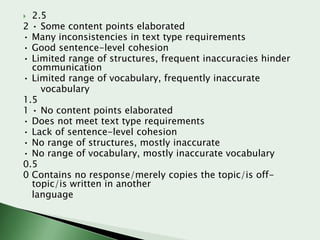
2.5
2 • Some content points elaborated
• Many inconsistencies in text type requirements
• Good sentence-level cohesion
• Limited range of structures, frequent inaccuracies hinder
communication
• Limited range of vocabulary, frequently inaccurate
vocabulary
1.5
1 • No content points elaborated
• Does not meet text type requirements
• Lack of sentence-level cohesion
• No range of structures, mostly inaccurate
• No range of vocabulary, mostly inaccurate vocabulary
0.5
0 Contains no response/merely copies the topic/is offtopic/is written in another
language

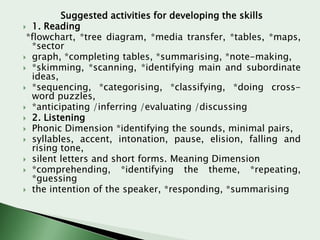
Suggested activities for developing the skills
 1. Reading
*flowchart, *tree diagram, *media transfer, *tables, *maps,
*sector
 graph, *completing tables, *summarising, *note-making,
 *skimming, *scanning, *identifying main and subordinate
ideas,
 *sequencing, *categorising, *classifying, *doing crossword puzzles,
 *anticipating /inferring /evaluating /discussing
 2. Listening
 Phonic Dimension *identifying the sounds, minimal pairs,
 syllables, accent, intonation, pause, elision, falling and
rising tone,
 silent letters and short forms. Meaning Dimension
 *comprehending,
*identifying the theme, *repeating,
*guessing
 the intention of the speaker, *responding, *summarising















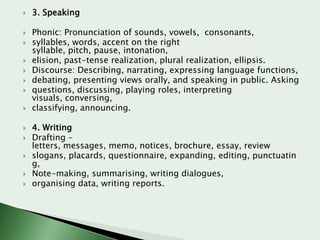
3. Speaking
Phonic: Pronunciation of sounds, vowels, consonants,
syllables, words, accent on the right
syllable, pitch, pause, intonation,
elision, past-tense realization, plural realization, ellipsis.
Discourse: Describing, narrating, expressing language functions,
debating, presenting views orally, and speaking in public. Asking
questions, discussing, playing roles, interpreting
visuals, conversing,
classifying, announcing.
4. Writing
Drafting –
letters, messages, memo, notices, brochure, essay, review
slogans, placards, questionnaire, expanding, editing, punctuatin
g,
Note-making, summarising, writing dialogues,
organising data, writing reports.
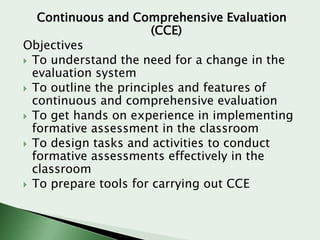
Continuous and Comprehensive Evaluation
(CCE)
Objectives
 To understand the need for a change in the
evaluation system
 To outline the principles and features of
continuous and comprehensive evaluation
 To get hands on experience in implementing
formative assessment in the classroom
 To design tasks and activities to conduct
formative assessments effectively in the
classroom
 To prepare tools for carrying out CCE
Extracts from NCF -2005








In the Indian education system, the term evaluation is
associated with examination, stress and anxiety
We are concerned about the ill effects that examinations have
on efforts to make learning and teaching meaningful and
joyous for children. Currently, the board examinations
negatively influence all testing and assessment throughout
the school years, beginning with pre-school.
At the same time, a good evaluation and examination system
can become an integral part of the learning process and
benefit both the learners themselves and the educational
system by giving credible feedback.
The purpose of assessment is necessarily to improve the teachinglearning process and materials , and to be able to review the
objectives that have been identified for different school stages by
gauging the extent to which the capabilities of learners have been
developed
Self-assessment and Feedback:






The role of assessment is to gauge the progress that both
learner and teacher have made towards achieving the aims
that have been set and appraising how this could be done
better. Opportunity for feedback, leading to revision and
improvement of performance, should constantly be available,
without exams and evaluations being used as a threat to
study.
Report cards need to present to children and parents a
comprehensive and holistic view of the child’s development in
many fields. Teachers must be able to say things about each
child/student that conveys to them a sense of individualised
attention, reaffirms a positive self-image, and communicates
personal goals for them to work towards.
Along with the teacher assessing each child, each student
could also assess himself or herself and include this selfassessment in the report card.


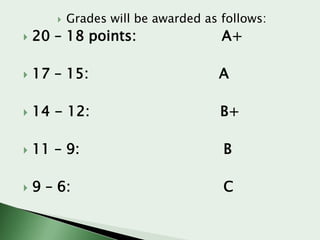
Grades will be awarded as follows:



20 – 18 points:

A+



17 – 15:

A



14 - 12:

B+



11 – 9:

B



9 – 6:

C
THANK

YOU
ONE AND
ALL.

English Class

  • 1.
  • 2.
     :    Teaching Englishfrom the pre-primary level. CONVENTIONAL METHOD of teaching grammar Rote learning NEW DIMENSION:  New dimension as activity oriented, self learning are already introduced in central schools.  New method is the essence of ancient gurukula system. 
  • 3.
    Teaching English asa language at the Secondary level – A perspective The National Curriculum Framework (NCF), 2005, recommends that children life at school must be linked to their life outside the school .This is the principle of a departure from the legacy of bookish learning which continues to shape our system and causes a gap between the school, home and community. The text books developed on the basis of NCF signify an attempt to implement this basic idea. They also attempt to discourage rote learning and the maintenance of sharp boundaries between different subject areas. NCF 2005 on Teaching English Objectives * To understand the principles of teaching a second language To read, comprehend and summarize the guidelines laid down in the Position Paper on Teaching English - NCF 2005 * To be able to share one’s ideas with the co-participants on the teaching of English.
  • 4.
    Constructivism • An approachto teach English as a Language Teaching for Construction of Knowledge. • In the constructivist perspective, learning is a process of the construction of knowledge. • Learners actively construct their own knowledge by connecting new ideas to existing ideas on the basis of materials/activities presented to them (experience) • Construction indicates that each learner individually and socially constructs meaning as he/she learns. •Constructing meaning is learning. The constructivist perspective provides strategies for promoting learning by all.
  • 5.
         A child constructsher/his knowledge while engaged in the process of learning. Active engagement involves enquiry, exploration, questioning, debates, application and reflection, leading to theory building and the creation of ideas. Schools must provide opportunities to question, enquire, debate, reflect, and arrive at concepts or create new ideas. The Value of Interactions in teaching learning process: Learning takes place more effectively through interactions with the environment around, nature, things and people, both through actions and through language. The physical activity of moving, exploring and doing things, on one’s own, with one’s peers or in the company of adults, and using language — to read, to express or ask, to listen and to interact — are the key processes through which learning occurs.
  • 6.
    SPIRAL APPROACH      Moving upward,keepreturning to the fundamentals. Basic facts learnt without worrying about details. Learning by stages. Learners are introduced to the details year by year. As we go up the ladder more complicates and difficult aspects are taken up for learning.
  • 7.
    INTEGRATED APPROACH  Knowledge Interrelate whole.  Learns discovered as a integrated whole. different subjects with language the language as a means of communication without being conscious of it.
  • 8.
     ROLE OF THEINSTRUCTER:  Role of facilitators.  Reciprocal questioning.  Peer discussion.  Debate at the school and class level .  Creating situations to understand the values.
  • 9.
    The 4 skillsinvolved in learning a language Listening  Listening is one of the important skills of language learning that we can help students to develop.  The listener has to employ different types of skills depending on the purpose of his/herlistening. The sub skills of listening are:  Sub-skill 1. Listening for detail 2. Listening for gist (Identifying main ideas) 3. Listening for specific information 4. Prediction 5. Going beyond the surface meaning of what is listened to
  • 10.
    SPEAKING    All languages arebasically spoken. Most of the transactions are done through the spoken version of the language – examples are, business deals, ads through TV and Radio, consultation with professionals like doctors, ministerial meetings discussion in legislative wings, teaching, argument in courts. The list is long. So, to come up in life one has to learn how to speak that language. We have already been familiar with language functions like greeting, introducing and persuading. Now let us see how best we can speak so that the listeners or the audience are able to understand, and as a result, respond or do, feel or think
  • 11.
    READING     Reading is areceptive skill, but it is the most and the widely practiced of all the skills, particularly in academics. Comprehension at different levels is done through silent reading. Skimming, scanning, sequencing, comprehending the main and subordinate points in a paragraph or in a write up are some of the sub-skills of reading. Reading wide varieties of texts enriches and supplements other skills like listening, speak in and writing.
  • 12.
    Techniques of Reading       1.Initially reading is done to associate the symbols (graphics) with things, actions and thoughts.Reading slowly and aloud is done at this stage. e.g. At the primary level. 2. Once the skill of reading reaches a fair level of automaticity, such techniques as skimming, Scanning, interpreting visuals and graphs etc are adapted for communication. 3. Skimming is reading a text at a fairly fast rate to note the main and subordinate points. E.g reading a story 4. Scanning is looking close at a selective part of the text to know the details. e.g Looking for the meaning of a word in a dictionary. 5. Inferring and interpreting visuals such as maps, graphs, cartoons etc are also important techniques. 6. Integrating the skills of reading with other skills like speaking and reading is the way to ensure effective communication.
  • 13.
    Factors influencing thereading process } Interest  } Urge } Necessity to read } Motivation } Concentration } Preparedness to read
  • 14.
    WRITING Writing is animportant skill. Writing is done with a purpose. The purpose determines the type of texts. Writing different types of texts such as letters, messages, notices, paragraphs, short stories,dialogues, biography/ profiles, diary entry, filling-in-forms, cheques, drawing flow charts etc. provides required input to acquire language and finally, develop the skills of writing
  • 15.
    Activity type  Objectives:  •             To understandthe different types of activities suggested in the textbook to develop language learning skills • To know how to transact these activities in the classroom • To understand the teacher’s and learner’s roles in the transaction of the new textbook Activity -Writing a Letter • Divide the participants into four groups. • Let them write down, individually, a few things that they know about .Ask them to discuss these points with their friends in the groups. • Let them write a short biography/profile of her/him in their groups. • Encourage them to present the biography to the whole class and seek some comments/suggestions from others. • Give feedback on the profiles they have written. • Collect more information from different sources such as newspapers/ magazines/websites/friends, rewrite the profile and hand over the next day. • The profile can be assessed by using the given rating scale. • Draw attention to the self-assessment sheet.
  • 16.
    A five-point ratingscale Points Descriptors 5 • All content points elaborated well • Meets text type requirements • Fully coherent text • Wide range of structures, few inaccuracies that do not hinder communication • Accurate and wide range of vocabulary 4.5 4 • All content points elaborated • Some inconsistencies in text type requirements • Coherent text • Good range of structures, occasional inaccuracies may not hinder communication • Good range of vocabulary, occasionally inaccurate vocabulary 3.5 3 • Most content points elaborated • Some inconsistencies in text type requirements • Good paragraph-level cohesion • Limited range of structures, frequent inaccuracies may hinder communication • Limited range of vocabulary, mostly inaccurate vocabulary 
  • 17.
    2.5 2 • Somecontent points elaborated • Many inconsistencies in text type requirements • Good sentence-level cohesion • Limited range of structures, frequent inaccuracies hinder communication • Limited range of vocabulary, frequently inaccurate vocabulary 1.5 1 • No content points elaborated • Does not meet text type requirements • Lack of sentence-level cohesion • No range of structures, mostly inaccurate • No range of vocabulary, mostly inaccurate vocabulary 0.5 0 Contains no response/merely copies the topic/is offtopic/is written in another language 
  • 18.
    Suggested activities fordeveloping the skills  1. Reading *flowchart, *tree diagram, *media transfer, *tables, *maps, *sector  graph, *completing tables, *summarising, *note-making,  *skimming, *scanning, *identifying main and subordinate ideas,  *sequencing, *categorising, *classifying, *doing crossword puzzles,  *anticipating /inferring /evaluating /discussing  2. Listening  Phonic Dimension *identifying the sounds, minimal pairs,  syllables, accent, intonation, pause, elision, falling and rising tone,  silent letters and short forms. Meaning Dimension  *comprehending, *identifying the theme, *repeating, *guessing  the intention of the speaker, *responding, *summarising
  • 19.
                 3. Speaking Phonic: Pronunciationof sounds, vowels, consonants, syllables, words, accent on the right syllable, pitch, pause, intonation, elision, past-tense realization, plural realization, ellipsis. Discourse: Describing, narrating, expressing language functions, debating, presenting views orally, and speaking in public. Asking questions, discussing, playing roles, interpreting visuals, conversing, classifying, announcing. 4. Writing Drafting – letters, messages, memo, notices, brochure, essay, review slogans, placards, questionnaire, expanding, editing, punctuatin g, Note-making, summarising, writing dialogues, organising data, writing reports.
  • 20.
    Continuous and ComprehensiveEvaluation (CCE) Objectives  To understand the need for a change in the evaluation system  To outline the principles and features of continuous and comprehensive evaluation  To get hands on experience in implementing formative assessment in the classroom  To design tasks and activities to conduct formative assessments effectively in the classroom  To prepare tools for carrying out CCE
  • 21.
    Extracts from NCF-2005     In the Indian education system, the term evaluation is associated with examination, stress and anxiety We are concerned about the ill effects that examinations have on efforts to make learning and teaching meaningful and joyous for children. Currently, the board examinations negatively influence all testing and assessment throughout the school years, beginning with pre-school. At the same time, a good evaluation and examination system can become an integral part of the learning process and benefit both the learners themselves and the educational system by giving credible feedback. The purpose of assessment is necessarily to improve the teachinglearning process and materials , and to be able to review the objectives that have been identified for different school stages by gauging the extent to which the capabilities of learners have been developed
  • 22.
    Self-assessment and Feedback:    Therole of assessment is to gauge the progress that both learner and teacher have made towards achieving the aims that have been set and appraising how this could be done better. Opportunity for feedback, leading to revision and improvement of performance, should constantly be available, without exams and evaluations being used as a threat to study. Report cards need to present to children and parents a comprehensive and holistic view of the child’s development in many fields. Teachers must be able to say things about each child/student that conveys to them a sense of individualised attention, reaffirms a positive self-image, and communicates personal goals for them to work towards. Along with the teacher assessing each child, each student could also assess himself or herself and include this selfassessment in the report card.
  • 23.
     Grades will beawarded as follows:  20 – 18 points: A+  17 – 15: A  14 - 12: B+  11 – 9: B  9 – 6: C
  • 24.