The Five Macro Skills in
Language
• When we learn a language, there are 5 skills that
we need to complete in communication. These
skills are listening, speaking, reading, writing
and viewing.
• These 5 skills of language (also known as the 5
skills of language learning) allow an individual to
comprehend and produce spoken language for
proper and effective interpersonal communication.
• The main skills are all basic and very important. They
are called the MACRO SKILLS.
• Macro skills refer to the primary, key, main, and
largest skill set relative to a particular context. It is
commonly referred to in English language.
• Listening and speaking are the brain input skills but
reading and writing are brain output skills.
Content
• LISTENING
• SPEAKING
• READING
• WRITING
• VIEWING
LISTENING
“Honor your relationships by developing listening skills.”
-Alan Lokos
• Listening is the most important skill in
communication.
• This is a communication technique that requires the
listener to understand, interpret and evaluate what he
or she hears.
• Listening effectively improves personal relationships
through the reduction of conflict and strengthens
cooperation through a collective understanding.
Listening is the ability to accurately receive and
interpret messages in the communication process.
Listening is key to all effective communication,
without the ability to listen effectively messages are
easily misunderstood communication breaks down and
the sender of the message can easily become
frustrated or irritated
.
Activities we should use to practice
listening skills
Activities for Grade 1 – 3
• Bring Me
• 5W’s and 1H
• Simple Retelling
Activities for Grade 4 - 6
• Watch films that model
conversation skills
• Reinforce active listening.
• Ask open-ended questions.
SPEAKING
“Everything becomes a little different as soon as it is spoken out loud.”
-Hermann Hesse
SPEAKING
• Language is a tool for communication. We Communicate with
others, to express our ideas, and to know others’ ideas as well.
• This assists the learners to begin to manipulate the language
by presenting them with a certain amount of choice, albeit
within a fairly controlled situation.
• In primary schools elocution and recitation are main sources to
master the sounds, rhythms, and intonation of the English
language through simple reproduction.
• The manifestations of the language in games and pair work
activities are encouraging source to learn to speak the
language.
Activities we should use to practice
speaking skills
Activities for Grade 1 - 3
• Oral with rewards
• Comparing a Picture
Describing
• Story telling
Activities for Grade 4 - 6
• Role Play
• Brainstorming
• Interviews
• Story Completion
• Reporting
READING
“Reading is a way for me to expand my mind, open my eyes, and fill up
my heart.”
-Oprah Winfrey
READING
• Reading is a fundamental skill for learners, not just for
learning but for life with reading being defined as the
ability to draw meaning from the printed page and
interpret this information appropriately.
• Reading is a learning skill. It helps you improve all
parts of the English language vocabulary, spelling,
grammar, and writing.
• It helps to develop language intuition in the corrected
form. Then the brain imitates them, producing similar
sentences to express the desired meaning.
• Imagine what your life would be like if you didn‘t
know how to read. Approximately only 80% of the
world‘s population is reported to be able to read.
• Using skimming or scanning technique to read quickly
is highly effective. While reading underlining of key
words is a must.
• Reading Skills help the students grasp the content and
draw conclusions.
• Reading skill development includes the ability to
comprehend and use both listening and speaking skills
because you need to:
Hear a word before you can say it
Say a word before you can read it
• Read a word before you can write it
• The students should also make it a point to familiarize
themselves with the jargons and new words by making reading
a habit be it reading newspapers, articles, books, magazines
etc.
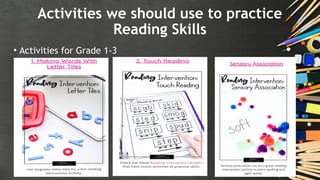
Activities we should use to practice
Reading Skills
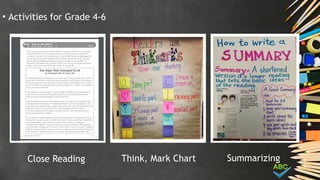
• Activities for Grade 1-3
• Activities for Grade 4-6
Close Reading Think, Mark Chart Summarizing
WRITING
“Writing is an exploration. You start from nothing and learn as you go.”
-E.L.Doctorow
Writing
Writing provides a learner with physical evidence of his
achievements and he can measure his improvement. It helps
to consolidate their grasp of vocabulary and structure, and
complements the other language skills. It helps to
understand the text and write compositions.
It can foster the learner’s ability to summarize and to use
the language freely. To write flawless language one should
excel in the Writing Skills. Importance should be given to
composition and creative writing.
These has four main goals for student
achievement:
1.To write clearly and creatively to convey a message
2. To communicate ideas, thoughts, feelings, and
experiences
3. To understand that writing is a reflective and
interactive process.
4. To understand the different purposes, audiences, and
forms for writing
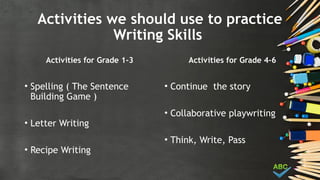
Activities we should use to practice
Writing Skills
Activities for Grade 1-3
• Spelling ( The Sentence
Building Game )
• Letter Writing
• Recipe Writing
Activities for Grade 4-6
• Continue the story
• Collaborative playwriting
• Think, Write, Pass
VIEWING
“Writing is an exploration. You start from nothing and learn as you go.”
-E.L.Doctorow
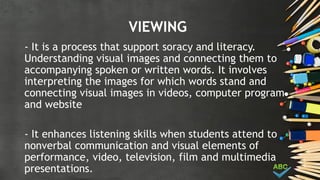
VIEWING
- It is a process that support soracy and literacy.
Understanding visual images and connecting them to
accompanying spoken or written words. It involves
interpreting the images for which words stand and
connecting visual images in videos, computer program
and website
- It enhances listening skills when students attend to
nonverbal communication and visual elements of
performance, video, television, film and multimedia
presentations.
Activities we should use to practice
Viewing Skills
Activities for Grade 1-3
• Flashcards
• Short Videos
• Photographs
Activities for Grade 4-6
• Movies Multimedia
• Webpages
• Observing Comics,
Newspapers and Charts
Thank you for Listening!

02-Macro-skills.pptx Education Students.

  • 1.
    The Five MacroSkills in Language
  • 2.
    • When welearn a language, there are 5 skills that we need to complete in communication. These skills are listening, speaking, reading, writing and viewing. • These 5 skills of language (also known as the 5 skills of language learning) allow an individual to comprehend and produce spoken language for proper and effective interpersonal communication.
  • 3.
    • The mainskills are all basic and very important. They are called the MACRO SKILLS. • Macro skills refer to the primary, key, main, and largest skill set relative to a particular context. It is commonly referred to in English language. • Listening and speaking are the brain input skills but reading and writing are brain output skills.
  • 4.
    Content • LISTENING • SPEAKING •READING • WRITING • VIEWING
  • 5.
    LISTENING “Honor your relationshipsby developing listening skills.” -Alan Lokos
  • 6.
    • Listening isthe most important skill in communication. • This is a communication technique that requires the listener to understand, interpret and evaluate what he or she hears. • Listening effectively improves personal relationships through the reduction of conflict and strengthens cooperation through a collective understanding.
  • 7.
    Listening is theability to accurately receive and interpret messages in the communication process. Listening is key to all effective communication, without the ability to listen effectively messages are easily misunderstood communication breaks down and the sender of the message can easily become frustrated or irritated .
  • 8.
    Activities we shoulduse to practice listening skills Activities for Grade 1 – 3 • Bring Me • 5W’s and 1H • Simple Retelling Activities for Grade 4 - 6 • Watch films that model conversation skills • Reinforce active listening. • Ask open-ended questions.
  • 9.
    SPEAKING “Everything becomes alittle different as soon as it is spoken out loud.” -Hermann Hesse
  • 10.
    SPEAKING • Language isa tool for communication. We Communicate with others, to express our ideas, and to know others’ ideas as well. • This assists the learners to begin to manipulate the language by presenting them with a certain amount of choice, albeit within a fairly controlled situation.
  • 11.
    • In primaryschools elocution and recitation are main sources to master the sounds, rhythms, and intonation of the English language through simple reproduction. • The manifestations of the language in games and pair work activities are encouraging source to learn to speak the language.
  • 12.
    Activities we shoulduse to practice speaking skills Activities for Grade 1 - 3 • Oral with rewards • Comparing a Picture Describing • Story telling Activities for Grade 4 - 6 • Role Play • Brainstorming • Interviews • Story Completion • Reporting
  • 13.
    READING “Reading is away for me to expand my mind, open my eyes, and fill up my heart.” -Oprah Winfrey
  • 14.
    READING • Reading isa fundamental skill for learners, not just for learning but for life with reading being defined as the ability to draw meaning from the printed page and interpret this information appropriately. • Reading is a learning skill. It helps you improve all parts of the English language vocabulary, spelling, grammar, and writing.
  • 15.
    • It helpsto develop language intuition in the corrected form. Then the brain imitates them, producing similar sentences to express the desired meaning. • Imagine what your life would be like if you didn‘t know how to read. Approximately only 80% of the world‘s population is reported to be able to read. • Using skimming or scanning technique to read quickly is highly effective. While reading underlining of key words is a must. • Reading Skills help the students grasp the content and
  • 16.
    • Reading Skillshelp the students grasp the content and draw conclusions. • Reading skill development includes the ability to comprehend and use both listening and speaking skills because you need to: Hear a word before you can say it Say a word before you can read it • Read a word before you can write it
  • 17.
    • The studentsshould also make it a point to familiarize themselves with the jargons and new words by making reading a habit be it reading newspapers, articles, books, magazines etc.
  • 18.
    Activities we shoulduse to practice Reading Skills • Activities for Grade 1-3
  • 19.
    • Activities forGrade 4-6 Close Reading Think, Mark Chart Summarizing
  • 20.
    WRITING “Writing is anexploration. You start from nothing and learn as you go.” -E.L.Doctorow
  • 21.
    Writing Writing provides alearner with physical evidence of his achievements and he can measure his improvement. It helps to consolidate their grasp of vocabulary and structure, and complements the other language skills. It helps to understand the text and write compositions. It can foster the learner’s ability to summarize and to use the language freely. To write flawless language one should excel in the Writing Skills. Importance should be given to composition and creative writing.
  • 22.
    These has fourmain goals for student achievement: 1.To write clearly and creatively to convey a message 2. To communicate ideas, thoughts, feelings, and experiences 3. To understand that writing is a reflective and interactive process. 4. To understand the different purposes, audiences, and forms for writing
  • 23.
    Activities we shoulduse to practice Writing Skills Activities for Grade 1-3 • Spelling ( The Sentence Building Game ) • Letter Writing • Recipe Writing Activities for Grade 4-6 • Continue the story • Collaborative playwriting • Think, Write, Pass
  • 24.
    VIEWING “Writing is anexploration. You start from nothing and learn as you go.” -E.L.Doctorow
  • 25.
    VIEWING - It isa process that support soracy and literacy. Understanding visual images and connecting them to accompanying spoken or written words. It involves interpreting the images for which words stand and connecting visual images in videos, computer program and website - It enhances listening skills when students attend to nonverbal communication and visual elements of performance, video, television, film and multimedia presentations.
  • 26.
    Activities we shoulduse to practice Viewing Skills Activities for Grade 1-3 • Flashcards • Short Videos • Photographs Activities for Grade 4-6 • Movies Multimedia • Webpages • Observing Comics, Newspapers and Charts
  • 27.
    Thank you forListening!