Communication Skills
For example:Imagine three  managers working in an office building .  The first is all alone but is nevertheless yelling for a subordinate to come help. No one appears,but he continues to yell. The second is talking on the telephone to a subordinate , but he static on the line causes misunderstanding to subordinate if he usually takes manager's order by telephone because of noice or miss interpreted words.
The third manager is talking in her office with a subordinate who clearly hears and understands what is being said.As we saw the three mangers are attempting to communicate but  with different results.Do you think any of our three managers communicate??
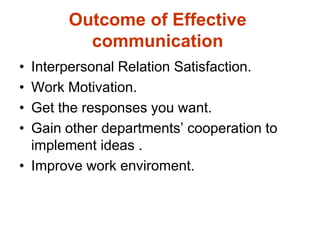
Outcome of Effective communicationInterpersonal Relation Satisfaction.Work Motivation.Get the responses you want. Gain other departments’ cooperation to implement ideas .Improve work enviroment.
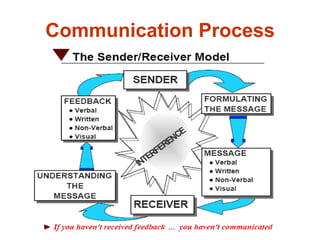
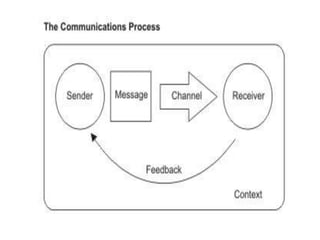
Communication Process
LISTENING SKILLSListening does not mean shutting your mouth and opening your ears!That is HEARING...!Good listener participates actively in the information exchange.
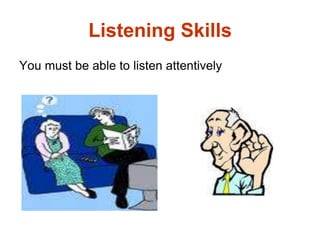
Listening SkillsYou must be able to listen attentively
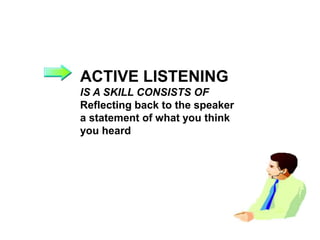
ACTIVE LISTENINGIS A SKILL CONSISTS OF Reflecting back to the speaker a statement of what you think you heard
How to be an active listener ??Start by Understanding Your Own Communication Style. Think before speaking.Pay attention to speakers .Use Nonverbal Communication .Give Feedback.Use Question Techniques.
Improving Your Listening SkillsAsk yourself "What new things can I learn from this person?"There is no such thing as an uninteresting subject.There are only uninterested people ..!Make sure you have paper and pencil.Move away from distraction. 
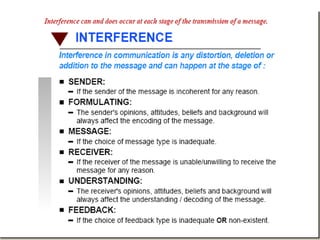
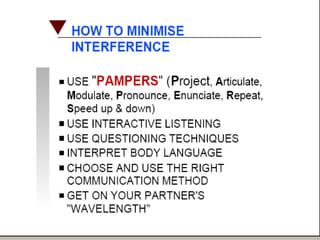
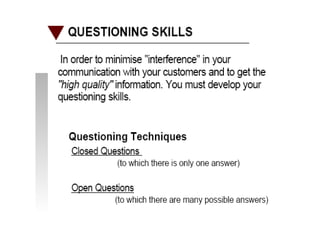
In order to minimize "interference" in yourcommunication with your customers and to get the"high quality" information. You must develop yourquestioning skills.
Communication BarriersIndividual barriersOrganizational barriers
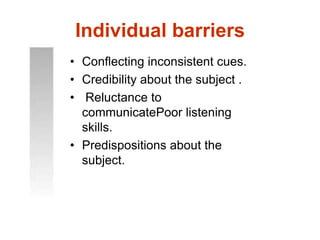
Individual barriersConflecting inconsistent cues.Credibility about the subject . Reluctance to communicatePoor listening skills.Predispositions about the subject.
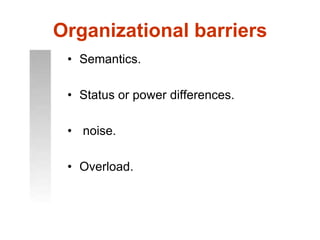
Organizational barriersSemantics.Status or power differences. noise.Overload.
How to Remove Barriers??
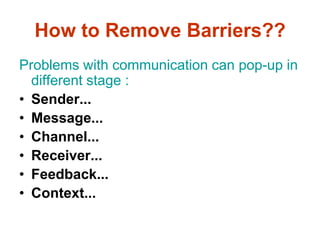
How to Remove Barriers??Problems with communication can pop-up in different stage :Sender...Message...Channel...Receiver...Feedback...Context...
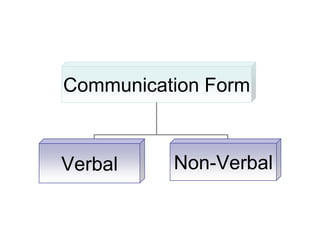
Forms of Communication
Verbal CommunicationVerbal Communication occurred by using words..Ensure Your Words Are Always Understood.
Non-Verbal CommunicationNon-Verbal Communication is a communication exchange that does not use words or may use words to carry more meaning than the strict definition of the words themselves .
Non-Verbal CommunicationEye Contact.Voice Control.Body Language.Posture.
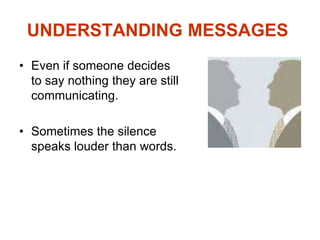
UNDERSTANDING MESSAGESEven if someone decides to say nothing they are still communicating. Sometimes the silence speaks louder than words.
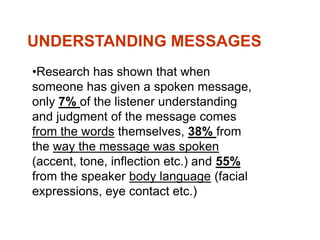
UNDERSTANDING MESSAGESResearch has shown that when someone has given a spoken message, only 7% of the listener understanding and judgment of the message comes from the words themselves, 38% from the way the message was spoken (accent, tone, inflection etc.) and 55% from the speaker body language (facial expressions, eye contact etc.)
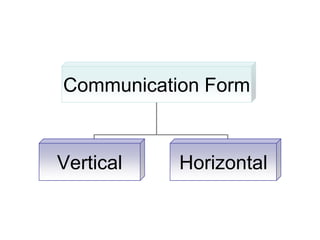
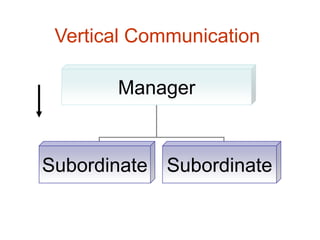
Vertical Communication
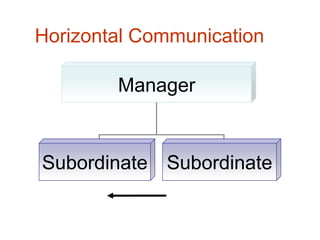
Horizontal Communication
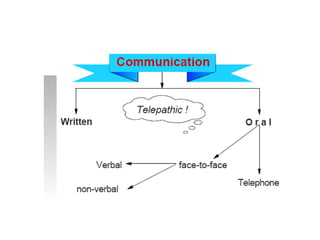
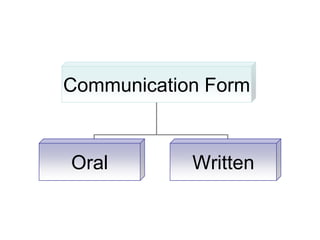
Oral CommunicationOral communication takes place in face-to-face conversation, group discussion , telephone call,…etc
Written CommunicationWritten communication can be achieved by different ways like business letter , memos , e.mail ,…..and convey resume.
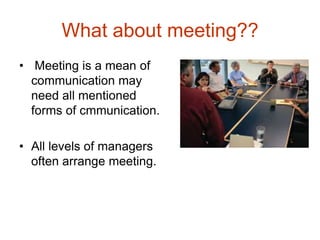
What about meeting?? Meeting is a mean of communication may need all mentioned forms of cmmunication.All levels of managers often arrange meeting.
How to run an effective meeting??Meetings are wonderful tools for generating ideas and managing group activity BY:Good Preparing.Managing a Meeting.Time Keeping.Issuing Minutes.
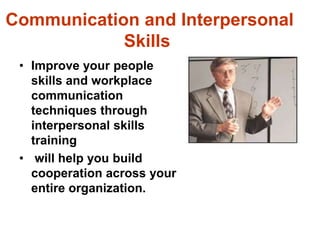
Communication and Interpersonal SkillsImprove your people skills and workplace communication techniques through interpersonal skills training  will help you build cooperation across your entire organization.
How to make a great impression??It takes just a quick glance, maybe three seconds, for someone to evaluate you when you meet for the first time. Be on TimeBe Yourself, Be at EasePresent Yourself AppropriatelyA Winning Smile Be Open and ConfidentBe PositiveBe Attentive
Electronic CommunicationE.mail  is one of the mostbenefiicial tool of cmmunication .Use Headlines.Make One Point per Email.Specify the Response You Want.Be a Good Correspondent.
Golden Tips of communicationDon't take another person's reaction or anger personally.Don't have to have all the answers.Respond (facts and feelings); don't react (feelings) .Understand that people want to feel heard more than they care about whether you agree or not.
Golden Tips of communication5-Remember that what someone says and what we hear can be amazingly different! 6-Acknowledge inconvenience or frustration and offer a timeline, particularly if you need someone else's cooperation.7-Look for common ground instead of focusing .8-Remember that change is stressful for most people .
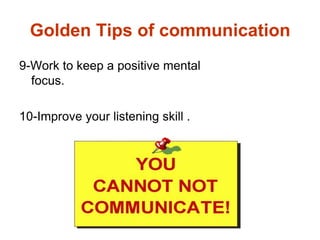
Golden Tips of communication9-Work to keep a positive mental focus.10-Improve your listening skill .
Communication skills

Communication skills

  • 1.
  • 5.
    For example:Imagine three managers working in an office building . The first is all alone but is nevertheless yelling for a subordinate to come help. No one appears,but he continues to yell. The second is talking on the telephone to a subordinate , but he static on the line causes misunderstanding to subordinate if he usually takes manager's order by telephone because of noice or miss interpreted words.
  • 6.
    The third manageris talking in her office with a subordinate who clearly hears and understands what is being said.As we saw the three mangers are attempting to communicate but with different results.Do you think any of our three managers communicate??
  • 7.
    Outcome of EffectivecommunicationInterpersonal Relation Satisfaction.Work Motivation.Get the responses you want. Gain other departments’ cooperation to implement ideas .Improve work enviroment.
  • 8.
  • 11.
    LISTENING SKILLSListening doesnot mean shutting your mouth and opening your ears!That is HEARING...!Good listener participates actively in the information exchange.
  • 12.
    Listening SkillsYou mustbe able to listen attentively
  • 13.
    ACTIVE LISTENINGIS ASKILL CONSISTS OF Reflecting back to the speaker a statement of what you think you heard
  • 14.
    How to bean active listener ??Start by Understanding Your Own Communication Style. Think before speaking.Pay attention to speakers .Use Nonverbal Communication .Give Feedback.Use Question Techniques.
  • 15.
    Improving Your ListeningSkillsAsk yourself "What new things can I learn from this person?"There is no such thing as an uninteresting subject.There are only uninterested people ..!Make sure you have paper and pencil.Move away from distraction. 
  • 17.
    In order tominimize "interference" in yourcommunication with your customers and to get the"high quality" information. You must develop yourquestioning skills.
  • 18.
  • 19.
    Individual barriersConflecting inconsistentcues.Credibility about the subject . Reluctance to communicatePoor listening skills.Predispositions about the subject.
  • 20.
    Organizational barriersSemantics.Status orpower differences. noise.Overload.
  • 21.
    How to RemoveBarriers??
  • 23.
    How to RemoveBarriers??Problems with communication can pop-up in different stage :Sender...Message...Channel...Receiver...Feedback...Context...
  • 24.
  • 26.
    Verbal CommunicationVerbal Communicationoccurred by using words..Ensure Your Words Are Always Understood.
  • 27.
    Non-Verbal CommunicationNon-Verbal Communicationis a communication exchange that does not use words or may use words to carry more meaning than the strict definition of the words themselves .
  • 28.
    Non-Verbal CommunicationEye Contact.VoiceControl.Body Language.Posture.
  • 29.
    UNDERSTANDING MESSAGESEven ifsomeone decides to say nothing they are still communicating. Sometimes the silence speaks louder than words.
  • 30.
    UNDERSTANDING MESSAGESResearch hasshown that when someone has given a spoken message, only 7% of the listener understanding and judgment of the message comes from the words themselves, 38% from the way the message was spoken (accent, tone, inflection etc.) and 55% from the speaker body language (facial expressions, eye contact etc.)
  • 31.
  • 32.
  • 35.
    Oral CommunicationOral communicationtakes place in face-to-face conversation, group discussion , telephone call,…etc
  • 36.
    Written CommunicationWritten communicationcan be achieved by different ways like business letter , memos , e.mail ,…..and convey resume.
  • 37.
    What about meeting??Meeting is a mean of communication may need all mentioned forms of cmmunication.All levels of managers often arrange meeting.
  • 38.
    How to runan effective meeting??Meetings are wonderful tools for generating ideas and managing group activity BY:Good Preparing.Managing a Meeting.Time Keeping.Issuing Minutes.
  • 39.
    Communication and InterpersonalSkillsImprove your people skills and workplace communication techniques through interpersonal skills training will help you build cooperation across your entire organization.
  • 40.
    How to makea great impression??It takes just a quick glance, maybe three seconds, for someone to evaluate you when you meet for the first time. Be on TimeBe Yourself, Be at EasePresent Yourself AppropriatelyA Winning Smile Be Open and ConfidentBe PositiveBe Attentive
  • 41.
    Electronic CommunicationE.mail is one of the mostbenefiicial tool of cmmunication .Use Headlines.Make One Point per Email.Specify the Response You Want.Be a Good Correspondent.
  • 42.
    Golden Tips ofcommunicationDon't take another person's reaction or anger personally.Don't have to have all the answers.Respond (facts and feelings); don't react (feelings) .Understand that people want to feel heard more than they care about whether you agree or not.
  • 43.
    Golden Tips ofcommunication5-Remember that what someone says and what we hear can be amazingly different! 6-Acknowledge inconvenience or frustration and offer a timeline, particularly if you need someone else's cooperation.7-Look for common ground instead of focusing .8-Remember that change is stressful for most people .
  • 44.
    Golden Tips ofcommunication9-Work to keep a positive mental focus.10-Improve your listening skill .