After completion ofthis course the learner will
understand:
Methods of communication
Communication skills
Questioning techniques
Techniques of discussion
How to lead discussion
How to solicit response
How to Identify problems organize information &
solving problems and
Communication barriers affecting workplace
discussion
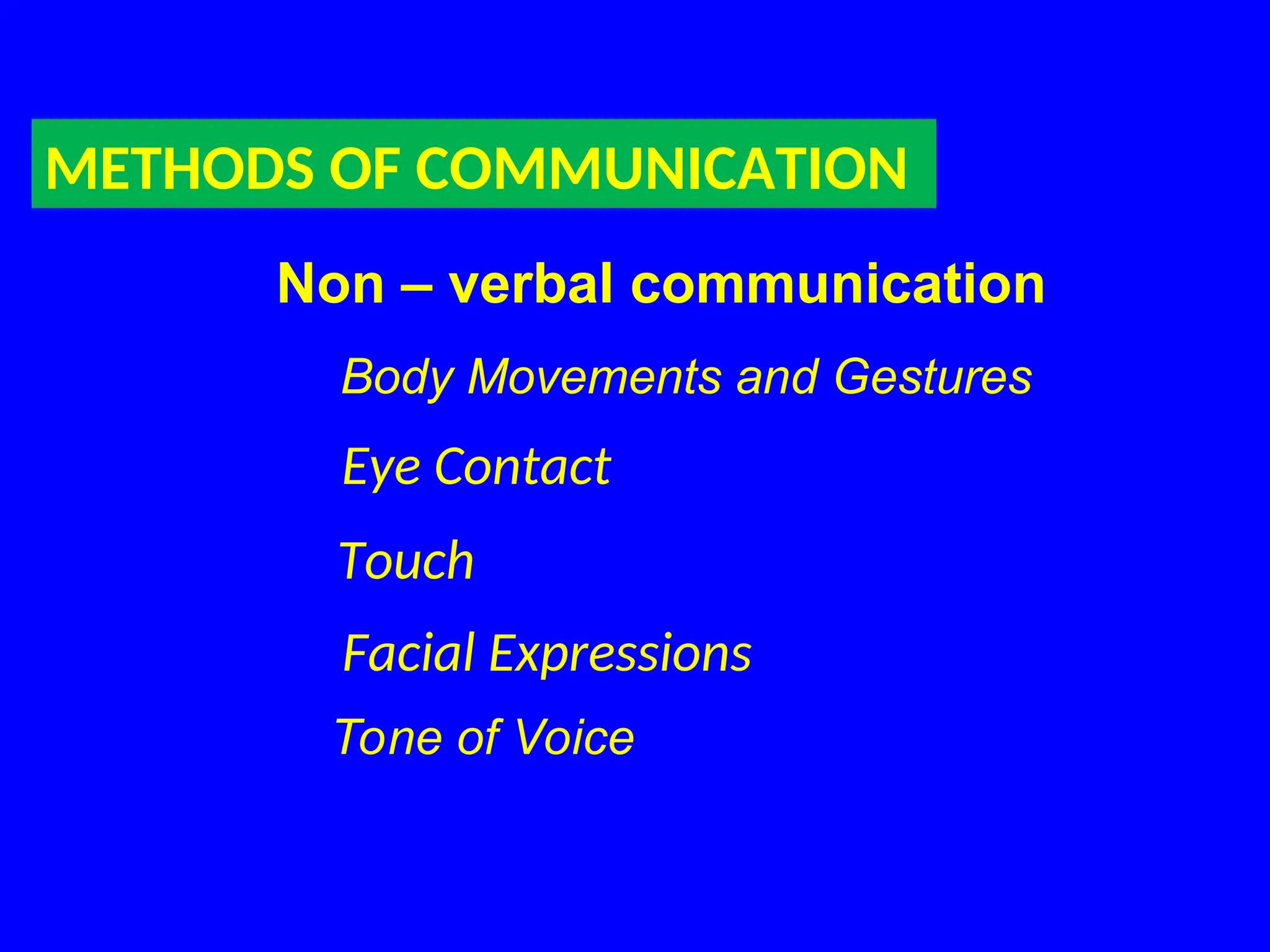
METHODS OF COMMUNICATION
Non– verbal communication
Body Movements and Gestures
Eye Contact
Touch
Facial Expressions
Tone of Voice
5.
FOM 3.5
Non-Verbal Communication
•Body language--gestures, facial
configurations, and other movements of the
body
• Verbal intonation--emphasis some gives to
words or phrases
• Approximately 65%-90% of message
transmitted face-to-face is interpreted
through body language
6.
METHODS OF COMMUNICATION
Verbalcommunication
A MEMO (Office Memorandum)
• Make sure that the heading indicates:
(1) The intended audience;
(2) The subject of the memo;
(3) The name of the sender; and
(4) The date that the memo was written.
• Revise to eliminate mistakes
• Add the names of people who need
7.
METHODS OF COMMUNICATION
Verbalcommunication
A LETTER
•Well presented
•Brief and to the point
•Accurate
•Easy to read and understand
METHODS OF COMMUNICATION
Verbalcommunication
A NEWSLETTER
Short
Monthly or quarterly publications
Important events,
Meetings, and Transitions
Provide inspirational stories
10.
METHODS OF COMMUNICATION
Verbalcommunication
ELECTRONIC COMMUNICATION
Can include:
Text,
Voice,
Graphics, or Video
THE INTERNET
11.
Face to facecommunication
Meetings
Staff meetings
Team meetings
12.
Face to facecommunication
Managing Meetings
Set up meeting facilities:
1.Prepare effective agenda.
The following steps may help:
•State the purpose of the meeting
•State definite start and stop time
•Structure content and process agenda.
(eg. Information only, discussion only,
decisions required)
•Establish priorities
•Determine the order of the agenda items
•Establish time limits on others
13.
2. Manage yourmeeting.
The following guideline may help:
• Mange your meetings before it begins.
Distribute handouts, prepare flipcharts,
or set up the first overhead.
• Start the meeting on time.
• Begin with a reminder of the time
allotted for the meeting and with an
assurance that the meeting will end on
Face to face communication
Managing Meetings
14.
• Review theagenda and amount of time
allotted to each item.
• Appoint a recorder for the meeting who will
take minutes and monitor the time.
• Express your concern to the group if the
meeting is straying from the agenda of if
specific items are taking longer to cover than
originally planned.
Face to face communication
Managing Meetings
15.
• At theend of the meeting, take a few
moments to “Process” the meeting. End the
meeting on time.
• Follow up by distributing copies of meeting
minutes and reminders about assignments
and deadlines to all persons who attended.
Face to face communication
Managing Meetings
FOM 3.18
The Grapevine
•Unofficial way that communications take
place in an organization
• Typically, it is neither authorized nor
supported by the organization
• It is questionable whether the information
transmitted through the grapevine is accurate
Does notlet others know directly his/her wants
Hopes that his or her needs will be met without
asking
Becomes resentful if others fail to understand
his/her needs or wants
PASSIVE COMMUNICATOR:
22.
AGGRESSIVE COMMUNICATOR:
Forceful approachto Communicate
with others
Expresses dominance and even anger
Ignores the needs and rights of others
Loudly proclaims what he or she wants
23.
A PASSIVE-AGGRESSIVE COMMUNICATOR:
Avoidsgiving direct responses to others'
requests or feedback
Tries to "get even" with others later for real
or imagined injustices
24.
ASSERTIVE COMMUNICATOR :
Standingup for their own rights in ways that
do not violate the other person’s rights
Are honest, open, and direct in making their
points
They show they understand other’s points view
They make brief statements and use ‘I’
statements
25.
ASSERTIVE COMMUNICATOR :
Theyclearly distinguish between fact and
opinion
They avoid ‘you should….’ ‘ you ought….’
They ask, not tell
They use open questions to discover
other’s thoughts
Know behaviour breeds behaviour and
aggression breeds aggression
26.
Presentation Skills
Prepare objectives
Organizethe presentation
Structure the presentation
Tailor the presentation
Establish your credibility
Speak in a responsive and conversational style
Use visual aids
Practice your presentation skills
Restate the key ideas
27.
Verbal communication skills
1.Get your points across when talking. To
ensure that your message gets
communicated:
Think through the main
idea you are trying to express.
State the idea in a clear, concise
statement.
Organize supporting
thoughts of facts in such a way that
they lead to your main point.
Ask the listeners for their
reactions
Speak Effectively:
28.
• Speak clearlyand concisely
• Speak with enthusiasm and
expressiveness
• Develop a more informal style of
speaking
• Improve your speaking through
practice
• Increase your awareness of nonverbal
communication
Speak Effectively:
29.
FOM 3.29
Barriers toEffective
Communication
• Filtering - the deliberate manipulation of
information to make it appear more favorable
to the receiver
• Selective Perception - what people see and
hear influenced by their attitudes,
background, and experience
(continued)
30.
FOM 3.30
Barriers toEffective
Communication (continued)
• Information Overload - information
available exceeds processing capacity
• Emotions - interpretation of a message
affected by the way the receiver feels
(continued)
31.
FOM 3.31
Barriers toEffective
Communication (continued)
• Language - meaning of words differs among people
with diverse backgrounds
– jargon - specialized terminology used by a group
• Gender - interpretation of a message affected
by a person’s gender
• National Culture - cultural values affect the way
people communicate
32.
FOM 3.32
Overcoming Communication
Barriers
•Use Feedback - ask a set of questions about a
message to determine whether it was
understood as intended
• Simplify Language - tailor the language to the
audience for whom the message is intended
• Listen Actively - listen for full meaning
(continued)
33.
FOM 3.33
Overcoming Communication
Barriers(continued)
• Constrain emotions - stop communicating
until composure has been restored
• Emphasize non-verbal cues - ensure that
actions align with words
34.
• Write clearlyand concisely
• Use correct grammar, spelling, and
punctuation
• Use technical terms appropriately
• Eliminate unnecessary detail
• Increase your vocabulary
• Write expressively
• Create effective visual aid
Building Basic Writing Skills:
35.
• Listen forthe total message
• Listen for main thoughts or ideas,
• Attempt to determine the speaker’s
frame of reference for what is said,
• View the thoughts and ideas from the
speaker’s perspective,
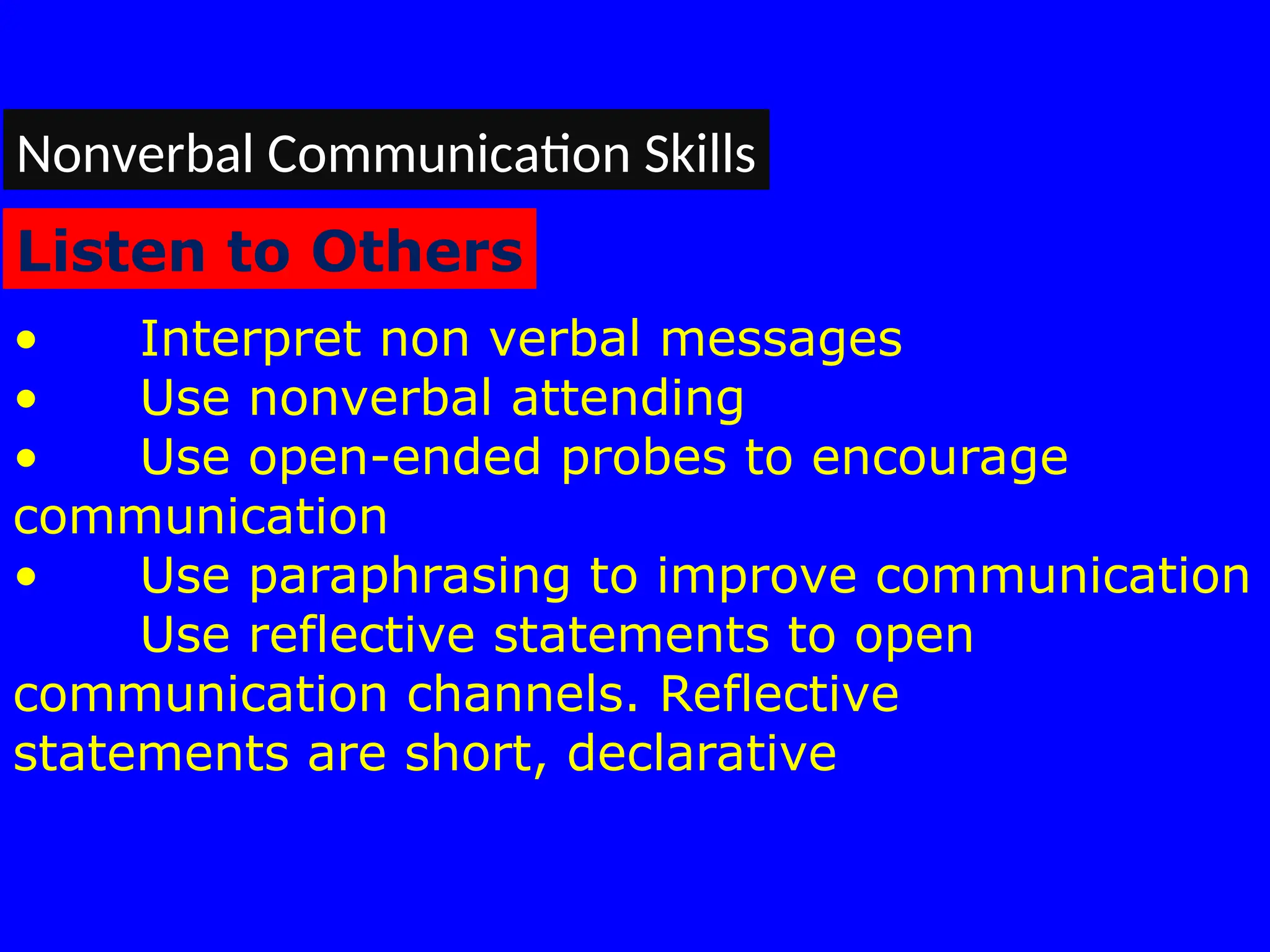
Nonverbal Communication Skills
Listen to Others
36.
• Interpret nonverbal messages
• Use nonverbal attending
• Use open-ended probes to encourage
communication
• Use paraphrasing to improve communication
Use reflective statements to open
communication channels. Reflective
statements are short, declarative
Nonverbal Communication Skills
Listen to Others
37.
• Use summarystatements to increase
understanding
• Listen to people without interrupting
• Listen willingly to others concern
Nonverbal Communication Skills
Listen to Others
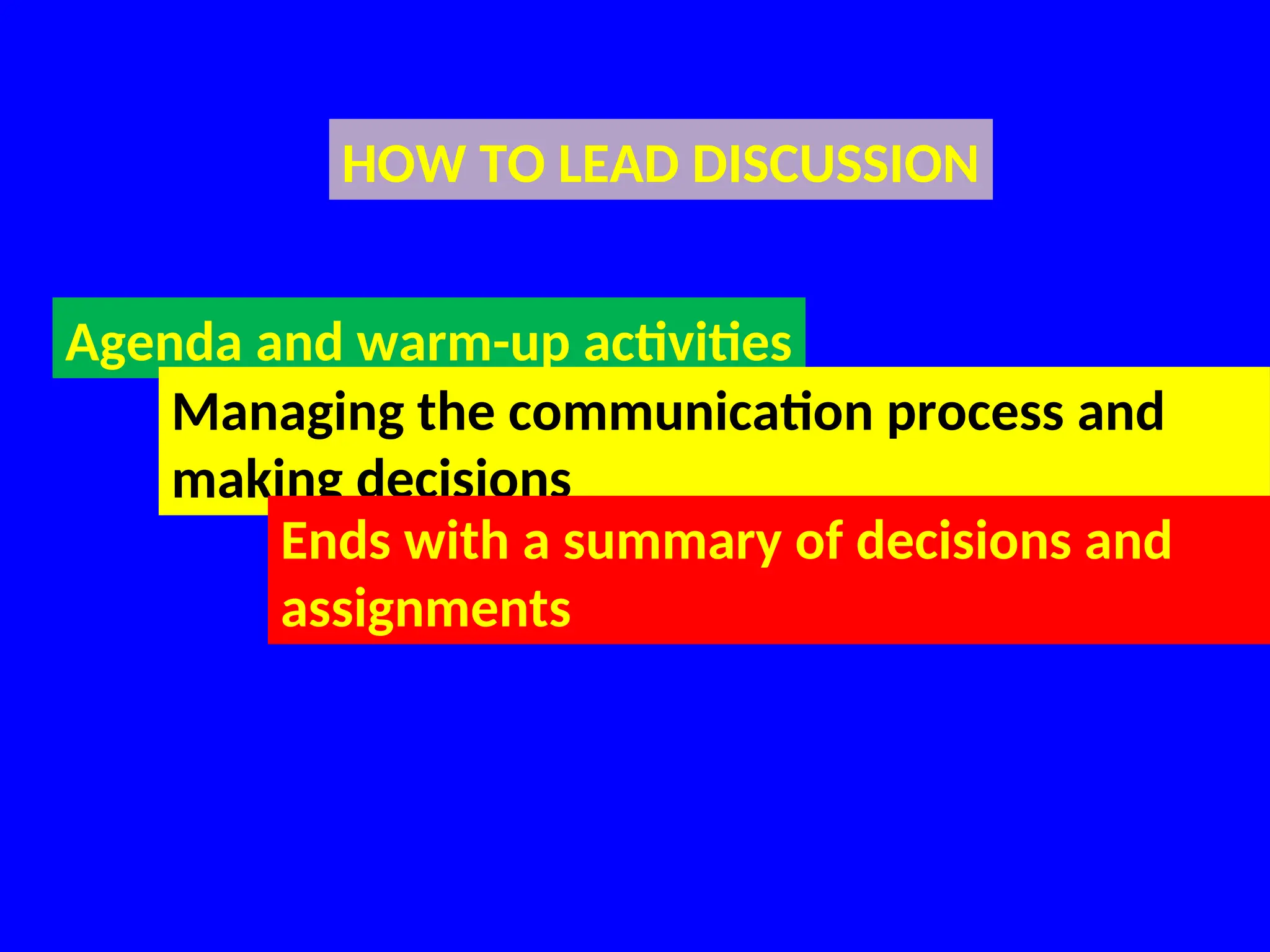
HOW TO LEADDISCUSSION
Agenda and warm-up activities
Managing the communication process and
making decisions
Ends with a summary of decisions and
assignments
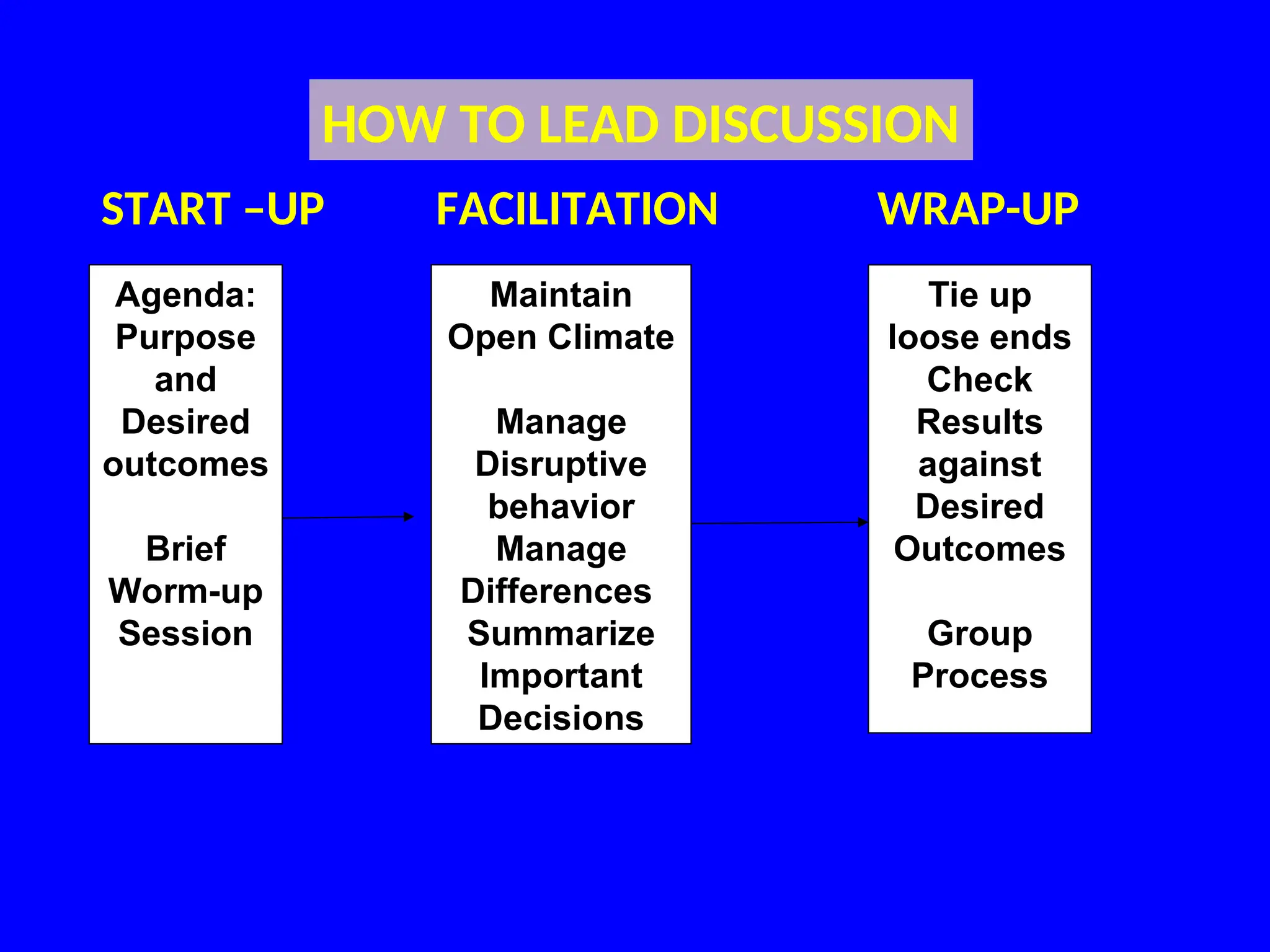
Maintain an openand collaborative climate.
HOW TO LEAD DISCUSSION
Manage disruptive behaviors
Manage differences
Summarize important decisions
Evaluate the group process
42.
HOW TO SOLICITRESPONSE
Leaders need to solicit input before making
decisions for a variety of reasons:
•To obtain critical input,
•To build commitment in others,
•To develop others,
•To show respect for others' opinions,
and to foster open communication and problem
sharing.
Factors that improvegroup problem solving:
view problems from a variety of viewpoints
consider a variety of options or alternatives
manages both the task and relational
aspects of problem solving.
discussion is focused on the problem
listens to minority opinions.
test alternative solutions
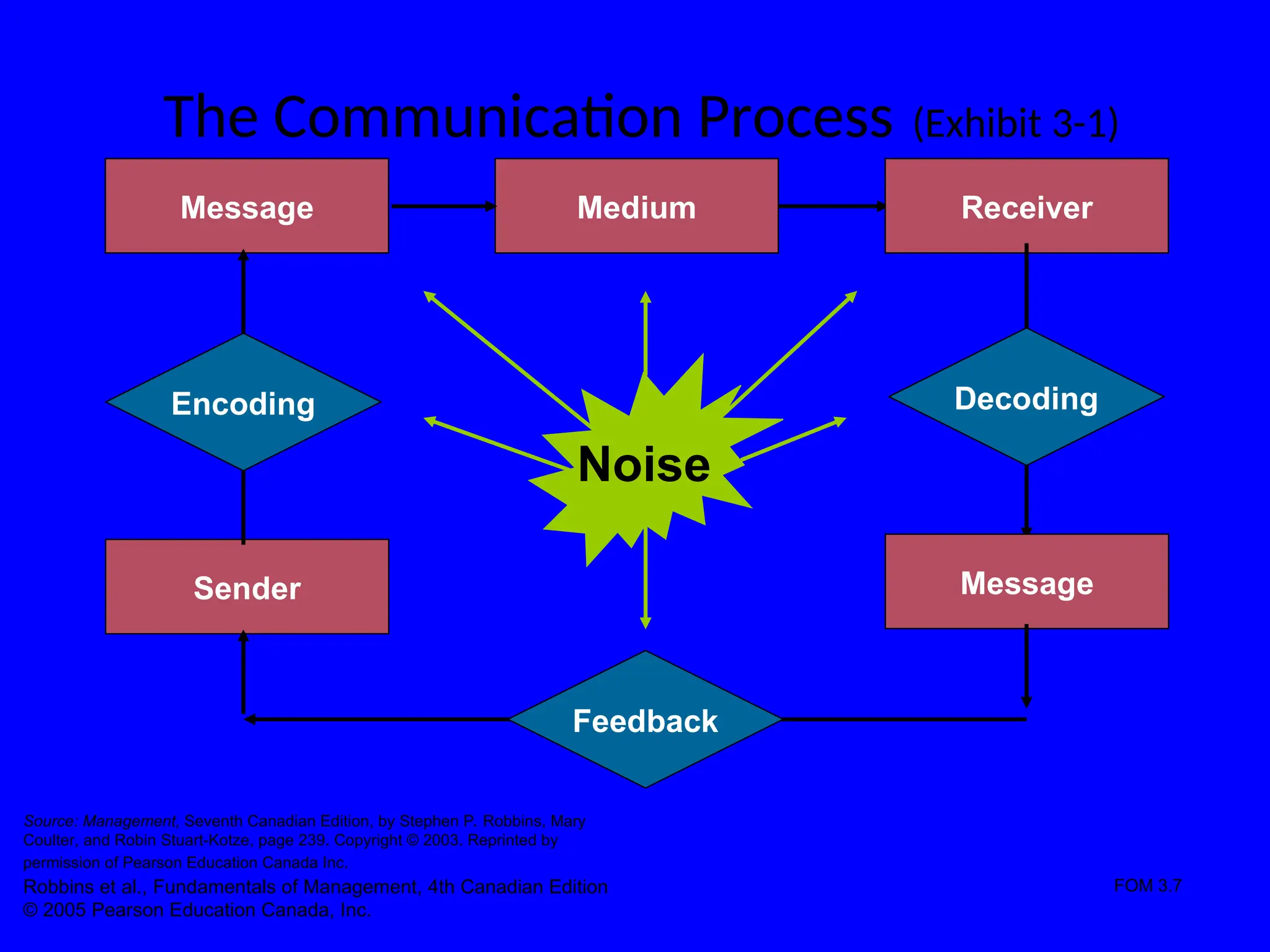
#3 Communication can be thought of as a flow and that problems occur when there are deviations or blockages in that flow.
Exhibit 3-1 depicts the model of communication. This model is composed of 7 parts:
The communication source (sender) from which the message comes; it is the actual physical product.
The source initiates a message by encoding the thought.
The message then travels through a channel--the medium. The medium is selected by the sender who must decide if the channel is formal or informal.
The message is received (receiver) and must be decoded or translated into a form that can be understood by the receiver.
The final link in the loop is feedback--which is a check on how successful you have been in transferring your message as originally intended.
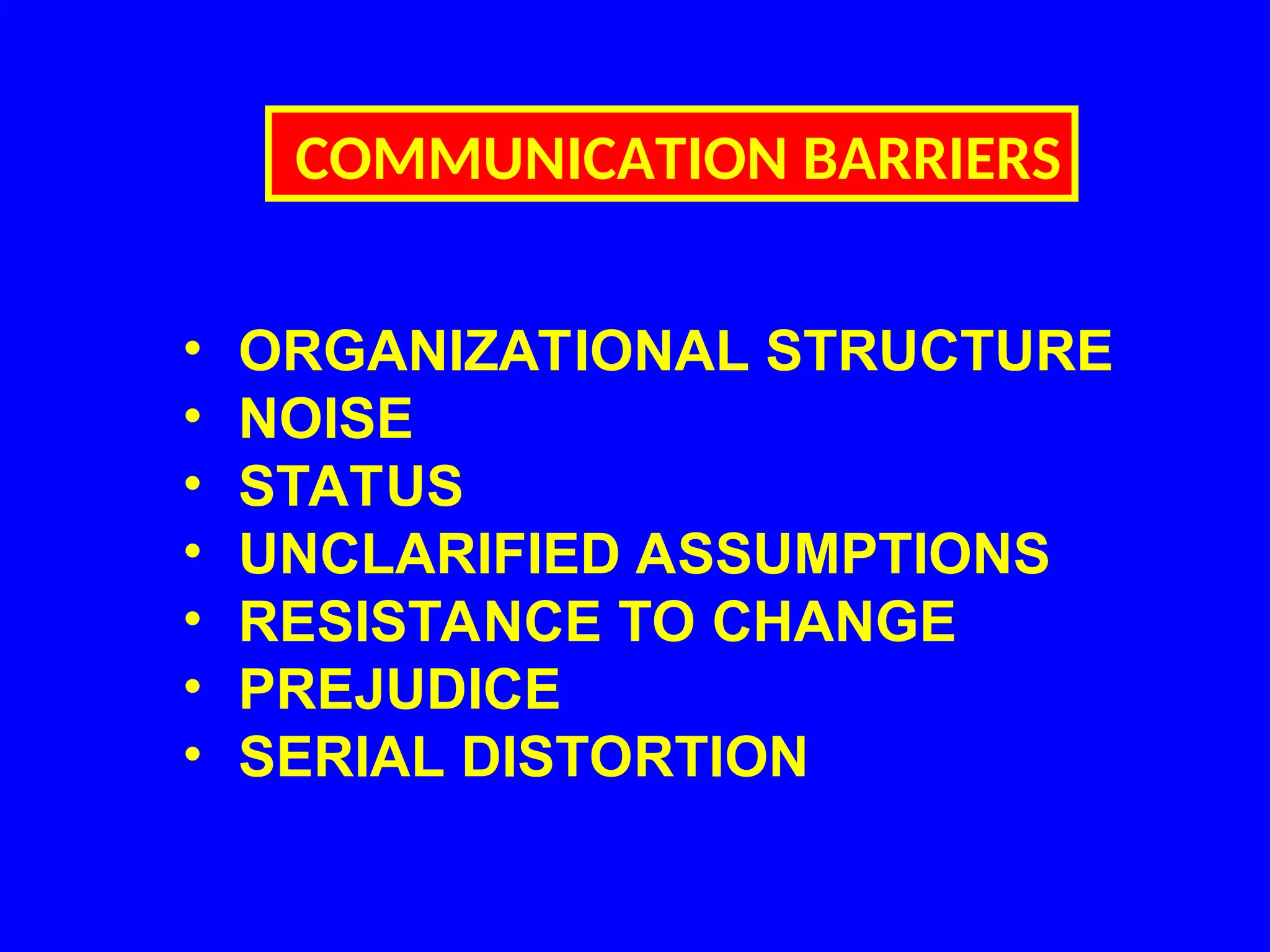
Throughout the process, noise can disturb the transmission, receipt, or feedback of a message. Examples of noise can include illegible print, phone static, inattention by the receiver, or background of machinery. It is important to remember that anything that interferes with understanding can be noise.
#5 Some of the most meaningful communications are neither spoken nor written. Non-verbal communications can be a loud siren or red light at an intersection or watching students who indicate to the instructor that they are bored by having a glassy eyes.
Hand motion, facial expressions, and other similar gestures can communicate emotions or temperaments such as aggression, fear, shyness, arrogance or joy. This is referred to as body language.
Another common non-verbal communication method is verbal intonation which refers to the emphasis someone gives to words or phrases. For example, if a student asks an instructor a question and the reply is “What do you mean by that” will get a different reaction from the student depending on the tone used by the instructor.
Research indicates that from 65%-90% of the message of every face-to-face conversation is interpreted through body language. Without complete agreement between the spoken words and the body language that accompanies it, receivers are more likely to react to the body language as the “true meaning.”
#18 The grapevine is an unofficial channel of communication in an organization. Information is usually spread by word-of-mouth. Recently, electronic means has also been used more and more frequently to share information.
The biggest question raised about grapevines, however, focuses on the accuracy of the rumours. Research on this has found mixed results. If an organization is characterized by openness, then the grapevine may be very accurate. However, if the culture of the organization is very authoritative, the information may be inaccurate.
#29 A number of interpersonal and intrapersonal barriers help to explain why the message decoded by a receiver is often different than that which the sender intended.
Filtering refers to the way that a sender manipulates information so that the receiver will see it more favourably. For example, when a manager tells his boss what he thinks the boss wants to hear, he is filtering information. This happens a great deal in organizations. Extent of filtering tends to be a function of the number of vertical levels in the organization and its culture. The more vertical levels, the more opportunities there are for filtering.
Selection perception occurs when the receivers in the communication process selectively see and hear based on their needs, motivation, experience, background, and other personal characteristics. For example, the employment interviewer who expects that a female job applicant will put her family ahead of her career is likely to see that tendency in all female applicants.
#30 Other barriers include information overload--which occurs when the information received exceeds our capacity to process. For instance, consider the international sales representative who is out of town and unable to check her e-mail and finds more than 600 e-mails waiting when she returns. When people get more information than the can sort out and use, they tend to select out, ignore, pass over, or forget information. What do you do when you have too many e-mails or phone calls?
Emotions will help determine how a message is interpreted. Often we might interpret something differently depending on whether we are happy or distressed. Extreme emotions are most likely to hinder effective communication.
#31 Words mean different things to different people. Age, education, and cultural background are three of the more obvious variables that influence the language a person uses. For example, singer Avril Lavigne probably uses language that is different than the students’ parents.
Language becomes more problematic when specialists develop their own language--or jargon. An example from the textbook is the letters MBO--which stand for “management by objectives.” Managers create their own jargon.
Whether any of us like it or not, mean and women do communicate differently which can lead to misunderstandings and misperceptions. Research has uncovered by men talk to emphasize status and independence whereas women talk to connect and develop relationships. To ensure gender differences don’t create communication difficulties, it is important that both men and women acknowledge that there are differences and adapt to each other.
Lastly, communication differences can arise from the different languages and different cultures. For example, Canadian managers rely heavily on memos and other formal forms of communications to state their positions on issues. Countries that are more collective, such as Japan, tend to have more informal personal contact and therefore will engage in extensive verbal consultation with employees first before drawing up a formal document.
#32 There are a number of things managers can do to overcome communication barriers. The suggestions includes:
Use feedback. Many communication problems can be directly attributed to misunderstandings and inaccuracies. These problems are less likely to occur if the manager uses feedback--either verbal or non-verbal.
Because language can be a barrier, managers should choose words and structure their messages in ways that will make those messages clear and understandable to the receiver. This means that the manager needs to consider the audience to whom the message is directed.
Active listening requires total concentration on the part of the receiver. This can be enhanced if the receiver is empathetic to the sender. An empathetic listener reserves judgment on the message’s content and carefully listens to what is being said.
#33 Additional suggestions to overcome barriers are
Constraining emotions. It would be naïve to assume that managers always communicate in a fully rational manner. A manager who is emotionally upset over an issue is likely to misconstrue incoming messages and fail to express his or her outgoing messages clearly and accurately. Because language can be a barrier, managers should choose words and structure their messages in ways that will make those messages clear and understandable to the receiver. This means that the manager needs to consider the audience to whom the message is directed.
Emphasize non-verbal cues. If actions speak louder than words, then it’s important to watch your actions to make sure that they align with and reinforce the words that go along with them. Remember that non-verbal messages carry a great deal of weight.