Role of Communication in Increasing Work Efficiency
Submitted By
Nikita Rai
Research Scholar
You can have great idea in the world but if you
can’t communicate them nobody can hear.
Kara Blackburn
Communication
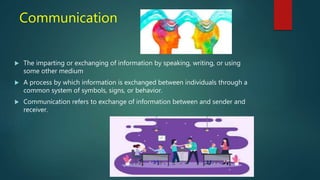
 The imparting or exchanging of information by speaking, writing, or using
some other medium
 A process by which information is exchanged between individuals through a
common system of symbols, signs, or behavior.
 Communication refers to exchange of information between and sender and
receiver.
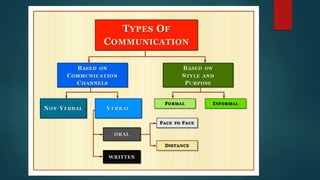
Types Of Communication
1. Non-verbal communication: It is used both intentionally and unintentionally.
 Facial expressions
 Posture
 Gestures and physical touch
 Eye contact
2. Verbal communication:
When we speak, we are communicating much more than just the content of our words.
 Pitch
 Tone
 Content
3. Written communication
 Structure
 Clarity
 Content
4. Visual communication
 Photographs
 Videos or Films
Communication at Work Place
 Workplace communication is the manner by which employees exchange information and
ideas within an organization.
 Communication is a crucial aspect to achieve organizational objectives and get any job done,
whether in-person or virtually.
 7 C’s Of Communication
1. Concrete
2. Coherent
3. Clarity
4. Commitment
5. Consistency
6. Completeness
7. Courteous
Formal vs. Informal Communication
Formal communication can have several forms.
• Meetings
• Conferences
• Telephone calls
• Company newsletters
• Performance reviews
Downward, Upward, or Horizontal Communication
• Downward communication flows from superiors to subordinates. This typically takes the form of
orders, instructions, and policy directives to people at lower levels in the company.
• Upward communication flows from subordinates to superiors. This is the opposite of downward
communication; it originates from people at lower levels and is directed to those who are above
them.
• Horizontal communication flows from people who are on the same level of the organization. This
type of directional communication enables people to interact with their peers without involving
people at other levels in the company.
Barriers in Communication
 Linguistic Barriers
 Psychological Barriers
 Emotional Barriers
 Physical Barriers
 Cultural Barriers
 Organizational Structure Barriers
 Attitude Barriers
 Perception Barriers
 Physiological Barriers
 Technological barriers
 Socio-religious barriers
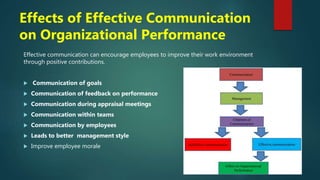
Effects of Effective Communication
on Organizational Performance
Effective communication can encourage employees to improve their work environment
through positive contributions.
 Communication of goals
 Communication of feedback on performance
 Communication during appraisal meetings
 Communication within teams
 Communication by employees
 Leads to better management style
 Improve employee morale
Communication Effects on Organization
 Communication increases innovation, safety, and operational
improvements in organizations
 Communication allows leaders to know what is happening at all levels of
the organization and to keep an eye on emerging issues
 Employees who have open minded leaders and know that their ideas are
valued will communicate and contribute to innovation
 Communication is necessary for organizational learning and growth,
particularly in complex and high-pressure environments
Communication and Attitude
The role of Attitude in Communication is very big. Two people communicating with each other
carry a certain attitude which affects the outcome and their long term relationship.
Positive Attitude – A person carrying positive attitude looks at the brighter side, concentrates on
solutions and avoid conflicts. They are happy workers and cooperative individuals who look for
overall growth not just personal growth
Negative Attitude leads to negative communication and the outcome is never fruitful.
Communicating negative about our friends or employers creates a hostile environment. It never
leads to solutions but drowns a person in more and more problems from where there is no
looking back.
Neutral Attitude – The person carrying neutral attitude will take the middle path and not take a
stand in communication. These type of people are better to deal with than negative ones. They
always remain diplomatic which work in their favor.9i
Communication and Team Building
 Effective communication within a team will build a common purpose among team
members that will allow them to reach their goals. Frequent friendly communication
can help team members develop a sense of belonging and strengthen relationships
 Communication & Team building holds cohesiveness, and ultimately build trust.
Team building can help break down barriers and get your employees to
communicate well and start trusting one another by putting them in situations that
encourage them to interact, problem solve, and share ideas in order to achieve a
specific goal.
 Communication affects teamwork in positive and negative ways. The quantity and
quality of communication within a team and from leadership affects teamwork.
Communication in increasing work Efficiency
Effective communication facilitates free flow of information among employees
and reduces misunderstandings and confusions and hence will increase the
work efficiency as employee will be happier
 More transparency and empowerment
 Less friction and misunderstanding
 Promotes a healthy company culture
 Increased accountability
 Clearer direction
The importance of communication in an
organization can be summarized as follows:
 Communication promotes motivation by informing and clarifying the employees about the
task to be done, the manner they are performing the task, and how to improve their
performance if it is not up to the mark.
 Communication is a source of information to the organizational members for decision-
making process as it helps identifying and assessing alternative course of actions.
 Communication also plays a crucial role in altering individual’s attitudes, i.e., a well
informed individual will have better attitude than a less-informed individual. Organizational
magazines, journals, meetings and various other forms of oral and written communication
help in molding employee’s attitudes.
 Communication also helps in socializing. In todays life the only presence of another
individual fosters communication. It is also said that one cannot survive without
communication.
 Communication also assists in controlling process. It helps controlling organizational
member’s behavior in various ways. There are various levels of hierarchy and certain principles
and guidelines that employees must follow in an organization
Feedback in communication
Feedback is the yardstick which measures the effectiveness of communication and is used for
evaluation review and to amend the message in the light of response.
1. Intention: Effective feedback is directed towards improving work performance and making the
worker a more valuable asset. It is not a personal attack. Feedback is directed towards aspect
of the job.
2. Specificity: Be specific rather than saying things like “you always” or “you never”. Vague
criticism causes resentment.
3. Description: Effective feedback can also be characterized as descriptive rather than evaluative.
It tells the receivers what he or she has done in objective terms, rather than presenting a value
judgment.
4. Usefulness: Effective feedback is information that the receiver can use to improve
performance. If it is not something the receiver can correct, it is not worth mentioning.
5. Validity: In order, for feedback, to be effective, it must be reliable and valid
Listening in Communication
Listening helps in the following ways:
 Building trust
 Establishing Credibility
 Gaining Support
 Getting things done
 Collecting Information
 Exchange
 Reflecting
 Demonstrate respect
Types of listening
1. Discriminative listening
2. Comprehension listening
3. Critical listening
4. Biased listening
5. Evaluative listening
6. Appreciative listening
7. Sympathetic listening
8. Empathetic listening
9. Therapeutic listening
10. Dialogic listening
Bad listening habits
There are many ways to listen badly, sometimes affected by the listener and
sometimes by the environment.
1. Lack of interest in the subject
2. Focus on the person, not on the content
3. Interrupting
4. Focus on the detail, missing the big picture
5. Force-fitting their ideas into your mental models
6. Body language that signals disinterest
7. Creating or allowing distractions
8. Ignoring what you do not understand
9. Letting emotions block the subject
10. Daydreaming
Effective Listening
• Makes eye contact
• Exhibits affirmative head nods and appropriate facial expressions Avoids
distracting actions or gestures that suggest boredom
• Asks questions
• Paraphrases using his or her own words
• Avoids interrupting the speaker
• Doesn’t over talk
• Makes smooth transitions between the role of speaker and that of listener
Conducting Effective Interviews
 Interviews are about presenting yourself in a positive and confident manner
and we have interview skills and tips to help you.
 The purpose of the interview is to check the requirement of job:
 Your personal qualities , How well you express yourself, Your motivation and
enthusiasm are checked though communication.
Things which are checked during interview keeping in consideration:
 Professionalism
 Good Communication
 Flexibility
 Interpersonal/Teamwork Abilities
 Ethics
 Avoid common bad body postures
 Mismatched Expressions, Shifty Eyes
 Excessive Nodding
Effective oral presentations
An oral presentation is more than just reading a paper or set of slides to an audience.
How you deliver your presentation is at least as important in effectively
communicating your message as what you say.
 Organize your thoughts.
 Have a strong opening
 Define terms early.
 Finish with a bang.
 Design PowerPoint slides to introduce important information
 Time yourself
 Create effective notes for yourself
 Practice, practice, practice
Things to remember while Oral
Communication
 Be excited
 Speak with confidence
 Make eye contact with the audience
 Avoid reading from the screen.
 Blank the screen when a slide is unnecessary
 Explain your equations and graphs
 Avoid filler words
 Give regards and acknowledgement
Thank you

Communication and Its effectiveness in work efficiency

  • 1.
    Role of Communicationin Increasing Work Efficiency Submitted By Nikita Rai Research Scholar
  • 2.
    You can havegreat idea in the world but if you can’t communicate them nobody can hear. Kara Blackburn
  • 3.
    Communication  The impartingor exchanging of information by speaking, writing, or using some other medium  A process by which information is exchanged between individuals through a common system of symbols, signs, or behavior.  Communication refers to exchange of information between and sender and receiver.
  • 5.
    Types Of Communication 1.Non-verbal communication: It is used both intentionally and unintentionally.  Facial expressions  Posture  Gestures and physical touch  Eye contact 2. Verbal communication: When we speak, we are communicating much more than just the content of our words.  Pitch  Tone  Content 3. Written communication  Structure  Clarity  Content 4. Visual communication  Photographs  Videos or Films
  • 6.
    Communication at WorkPlace  Workplace communication is the manner by which employees exchange information and ideas within an organization.  Communication is a crucial aspect to achieve organizational objectives and get any job done, whether in-person or virtually.  7 C’s Of Communication 1. Concrete 2. Coherent 3. Clarity 4. Commitment 5. Consistency 6. Completeness 7. Courteous
  • 7.
    Formal vs. InformalCommunication Formal communication can have several forms. • Meetings • Conferences • Telephone calls • Company newsletters • Performance reviews Downward, Upward, or Horizontal Communication • Downward communication flows from superiors to subordinates. This typically takes the form of orders, instructions, and policy directives to people at lower levels in the company. • Upward communication flows from subordinates to superiors. This is the opposite of downward communication; it originates from people at lower levels and is directed to those who are above them. • Horizontal communication flows from people who are on the same level of the organization. This type of directional communication enables people to interact with their peers without involving people at other levels in the company.
  • 8.
    Barriers in Communication Linguistic Barriers  Psychological Barriers  Emotional Barriers  Physical Barriers  Cultural Barriers  Organizational Structure Barriers  Attitude Barriers  Perception Barriers  Physiological Barriers  Technological barriers  Socio-religious barriers
  • 10.
    Effects of EffectiveCommunication on Organizational Performance Effective communication can encourage employees to improve their work environment through positive contributions.  Communication of goals  Communication of feedback on performance  Communication during appraisal meetings  Communication within teams  Communication by employees  Leads to better management style  Improve employee morale
  • 11.
    Communication Effects onOrganization  Communication increases innovation, safety, and operational improvements in organizations  Communication allows leaders to know what is happening at all levels of the organization and to keep an eye on emerging issues  Employees who have open minded leaders and know that their ideas are valued will communicate and contribute to innovation  Communication is necessary for organizational learning and growth, particularly in complex and high-pressure environments
  • 12.
    Communication and Attitude Therole of Attitude in Communication is very big. Two people communicating with each other carry a certain attitude which affects the outcome and their long term relationship. Positive Attitude – A person carrying positive attitude looks at the brighter side, concentrates on solutions and avoid conflicts. They are happy workers and cooperative individuals who look for overall growth not just personal growth Negative Attitude leads to negative communication and the outcome is never fruitful. Communicating negative about our friends or employers creates a hostile environment. It never leads to solutions but drowns a person in more and more problems from where there is no looking back. Neutral Attitude – The person carrying neutral attitude will take the middle path and not take a stand in communication. These type of people are better to deal with than negative ones. They always remain diplomatic which work in their favor.9i
  • 13.
    Communication and TeamBuilding  Effective communication within a team will build a common purpose among team members that will allow them to reach their goals. Frequent friendly communication can help team members develop a sense of belonging and strengthen relationships  Communication & Team building holds cohesiveness, and ultimately build trust. Team building can help break down barriers and get your employees to communicate well and start trusting one another by putting them in situations that encourage them to interact, problem solve, and share ideas in order to achieve a specific goal.  Communication affects teamwork in positive and negative ways. The quantity and quality of communication within a team and from leadership affects teamwork.
  • 14.
    Communication in increasingwork Efficiency Effective communication facilitates free flow of information among employees and reduces misunderstandings and confusions and hence will increase the work efficiency as employee will be happier  More transparency and empowerment  Less friction and misunderstanding  Promotes a healthy company culture  Increased accountability  Clearer direction
  • 15.
    The importance ofcommunication in an organization can be summarized as follows:  Communication promotes motivation by informing and clarifying the employees about the task to be done, the manner they are performing the task, and how to improve their performance if it is not up to the mark.  Communication is a source of information to the organizational members for decision- making process as it helps identifying and assessing alternative course of actions.  Communication also plays a crucial role in altering individual’s attitudes, i.e., a well informed individual will have better attitude than a less-informed individual. Organizational magazines, journals, meetings and various other forms of oral and written communication help in molding employee’s attitudes.  Communication also helps in socializing. In todays life the only presence of another individual fosters communication. It is also said that one cannot survive without communication.  Communication also assists in controlling process. It helps controlling organizational member’s behavior in various ways. There are various levels of hierarchy and certain principles and guidelines that employees must follow in an organization
  • 16.
    Feedback in communication Feedbackis the yardstick which measures the effectiveness of communication and is used for evaluation review and to amend the message in the light of response. 1. Intention: Effective feedback is directed towards improving work performance and making the worker a more valuable asset. It is not a personal attack. Feedback is directed towards aspect of the job. 2. Specificity: Be specific rather than saying things like “you always” or “you never”. Vague criticism causes resentment. 3. Description: Effective feedback can also be characterized as descriptive rather than evaluative. It tells the receivers what he or she has done in objective terms, rather than presenting a value judgment. 4. Usefulness: Effective feedback is information that the receiver can use to improve performance. If it is not something the receiver can correct, it is not worth mentioning. 5. Validity: In order, for feedback, to be effective, it must be reliable and valid
  • 17.
    Listening in Communication Listeninghelps in the following ways:  Building trust  Establishing Credibility  Gaining Support  Getting things done  Collecting Information  Exchange  Reflecting  Demonstrate respect
  • 18.
    Types of listening 1.Discriminative listening 2. Comprehension listening 3. Critical listening 4. Biased listening 5. Evaluative listening 6. Appreciative listening 7. Sympathetic listening 8. Empathetic listening 9. Therapeutic listening 10. Dialogic listening
  • 19.
    Bad listening habits Thereare many ways to listen badly, sometimes affected by the listener and sometimes by the environment. 1. Lack of interest in the subject 2. Focus on the person, not on the content 3. Interrupting 4. Focus on the detail, missing the big picture 5. Force-fitting their ideas into your mental models 6. Body language that signals disinterest 7. Creating or allowing distractions 8. Ignoring what you do not understand 9. Letting emotions block the subject 10. Daydreaming
  • 20.
    Effective Listening • Makeseye contact • Exhibits affirmative head nods and appropriate facial expressions Avoids distracting actions or gestures that suggest boredom • Asks questions • Paraphrases using his or her own words • Avoids interrupting the speaker • Doesn’t over talk • Makes smooth transitions between the role of speaker and that of listener
  • 21.
    Conducting Effective Interviews Interviews are about presenting yourself in a positive and confident manner and we have interview skills and tips to help you.  The purpose of the interview is to check the requirement of job:  Your personal qualities , How well you express yourself, Your motivation and enthusiasm are checked though communication. Things which are checked during interview keeping in consideration:  Professionalism  Good Communication  Flexibility  Interpersonal/Teamwork Abilities  Ethics  Avoid common bad body postures  Mismatched Expressions, Shifty Eyes  Excessive Nodding
  • 22.
    Effective oral presentations Anoral presentation is more than just reading a paper or set of slides to an audience. How you deliver your presentation is at least as important in effectively communicating your message as what you say.  Organize your thoughts.  Have a strong opening  Define terms early.  Finish with a bang.  Design PowerPoint slides to introduce important information  Time yourself  Create effective notes for yourself  Practice, practice, practice
  • 23.
    Things to rememberwhile Oral Communication  Be excited  Speak with confidence  Make eye contact with the audience  Avoid reading from the screen.  Blank the screen when a slide is unnecessary  Explain your equations and graphs  Avoid filler words  Give regards and acknowledgement
  • 24.