UNIT-I
COMMUNICATION SKILLS
Prepared By: Ms. Leena Ghag Sakpal.
Nursing Tutor
RN, P.B.B.Sc.Nursing
INTRODUCTON
• The word communication is derived from Latin word “Communicare", which means to
participate, to inform or impart.
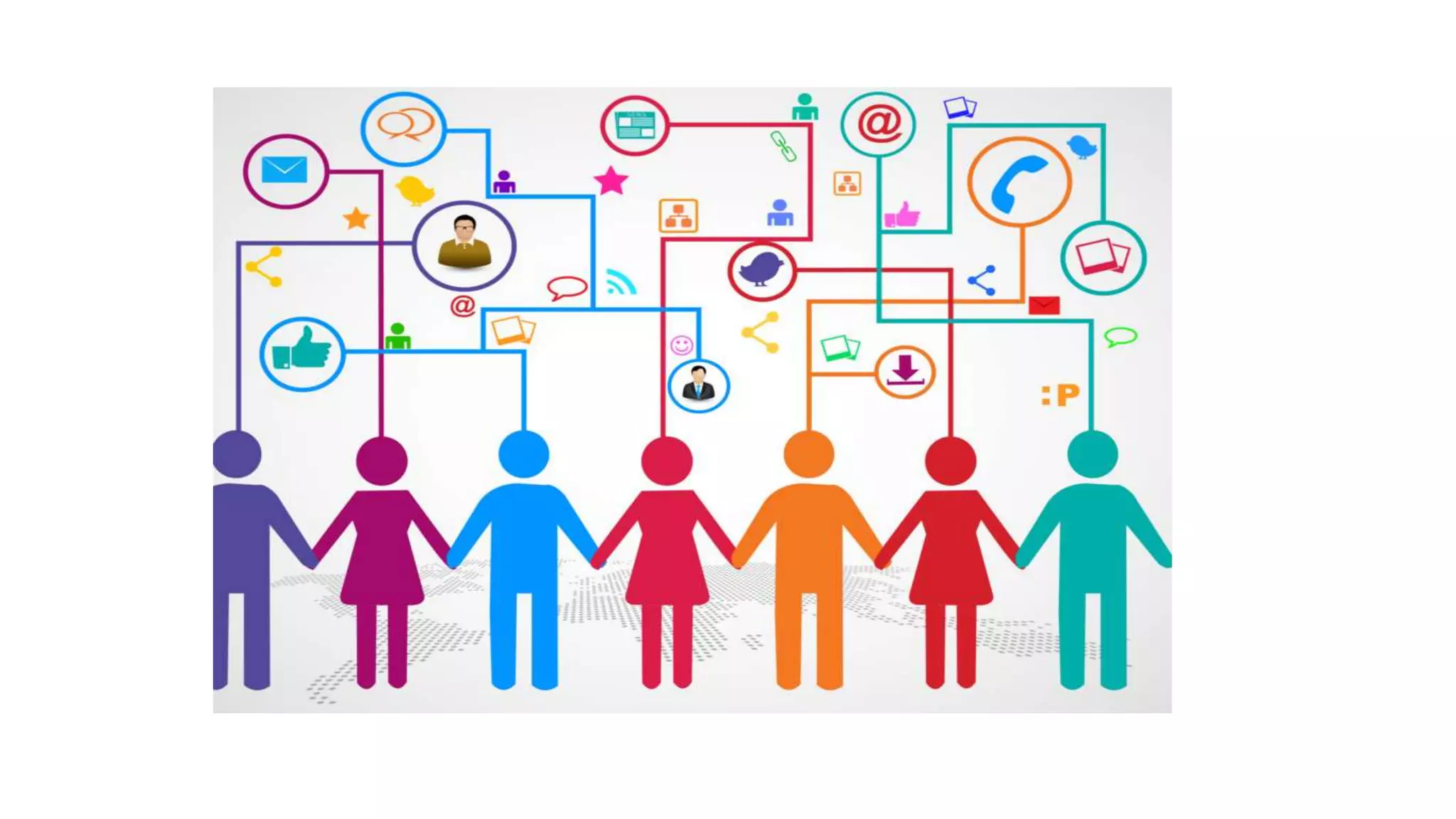
• Communication refers to the various ways of keeping humans in touch with one another.
• On this basis, communication is the participation and exchange of thinking, experiences,
views and opinions, information and facts between individuals and groups.
• The individuals and groups can be motivated towards health protection by using
communication skills in health education.
DEFINITION
PURPOSE
• Exchanging information regarding health.
• Encouraging co-operation, co-ordination, good personal relations and motivation among health
workers.
• Ensuring public participation in health programmes.
• Publicizing health policies, actions and activities and to remove rumours.
• Maintaining continuous public contact.
• Maintenance of health records and to receive correct reports. Obtaining feedback from community or
health workers.
• Making health education effective.
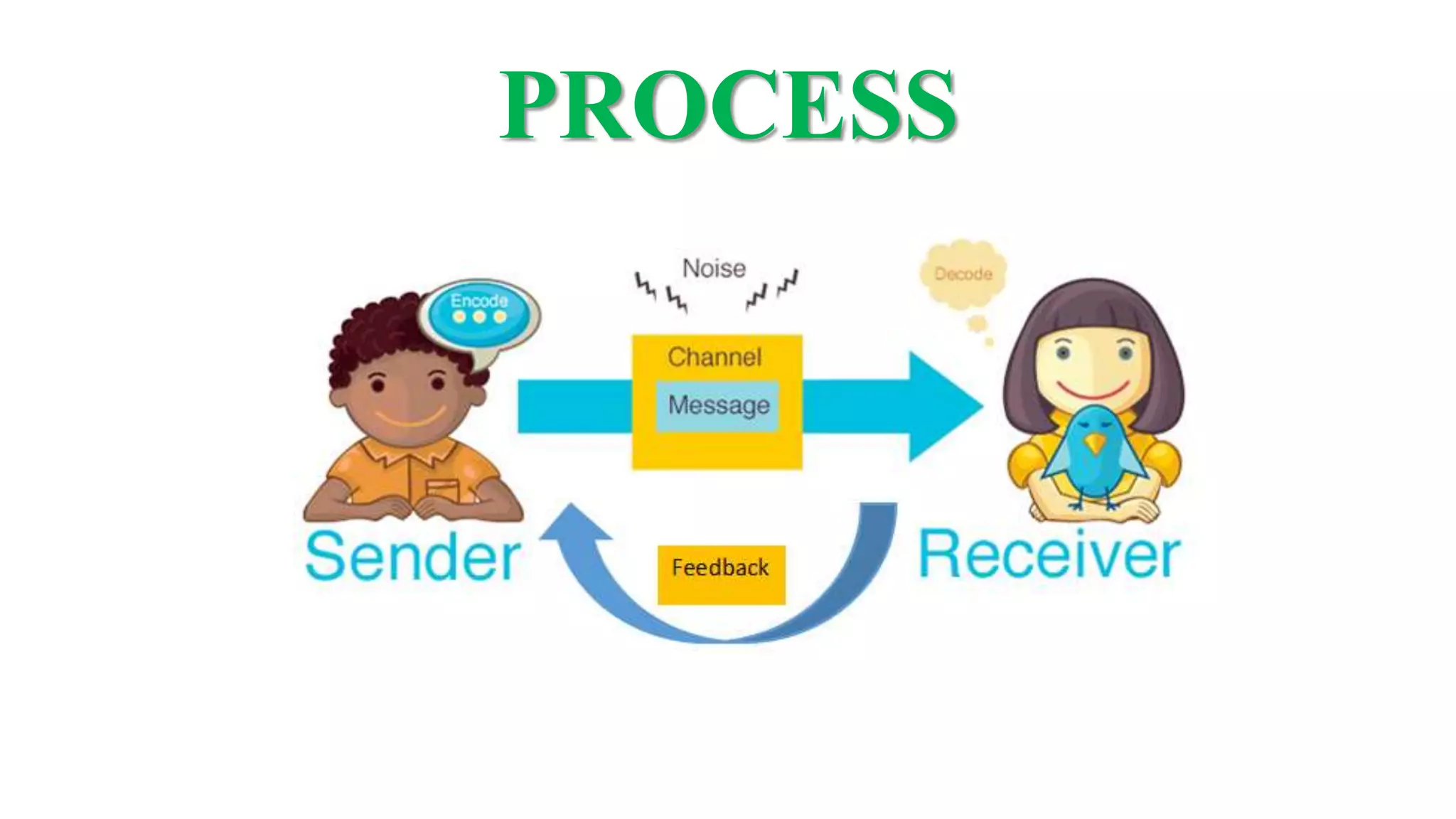
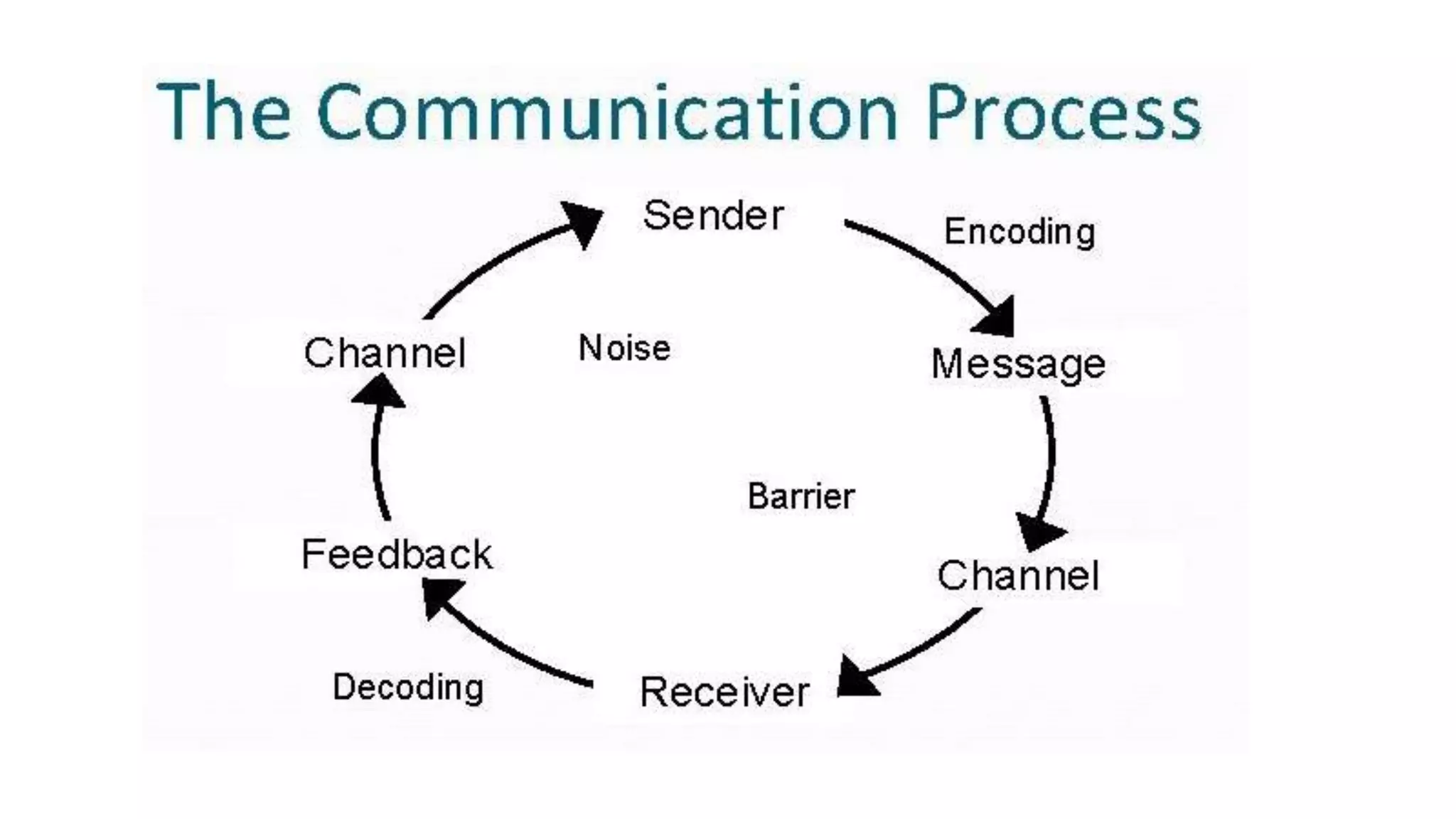
PROCESS
Communication process passes through the following
seven stages:
1. Source/sender: Individual or article which delivers information to others.
2. Ideas: This is the content (message, subject matter) of communication.
3. Encoding: To convert content into codes (words, actions, pictures etc.) is known as encoding.
4. Channel: Radio, telephone, speech, television, written message, gesture etc. can be the channels of
communication.
5. Receiver: It is the person for whom the message is sent.
6. Decoding: The opening of codes is called as decoding. It provides meaning to the received content.
7. Feedback: This is an answer from the receiver. Feedback is necessary to ensure whether the message has
reached in the desired form.
Communication process can also be taught through another model, that is,
S - M-C-R in which S = Source, M = Message, C = Channel and R = Receiver.
TYPES
1. FIRST CLASSIFICATION
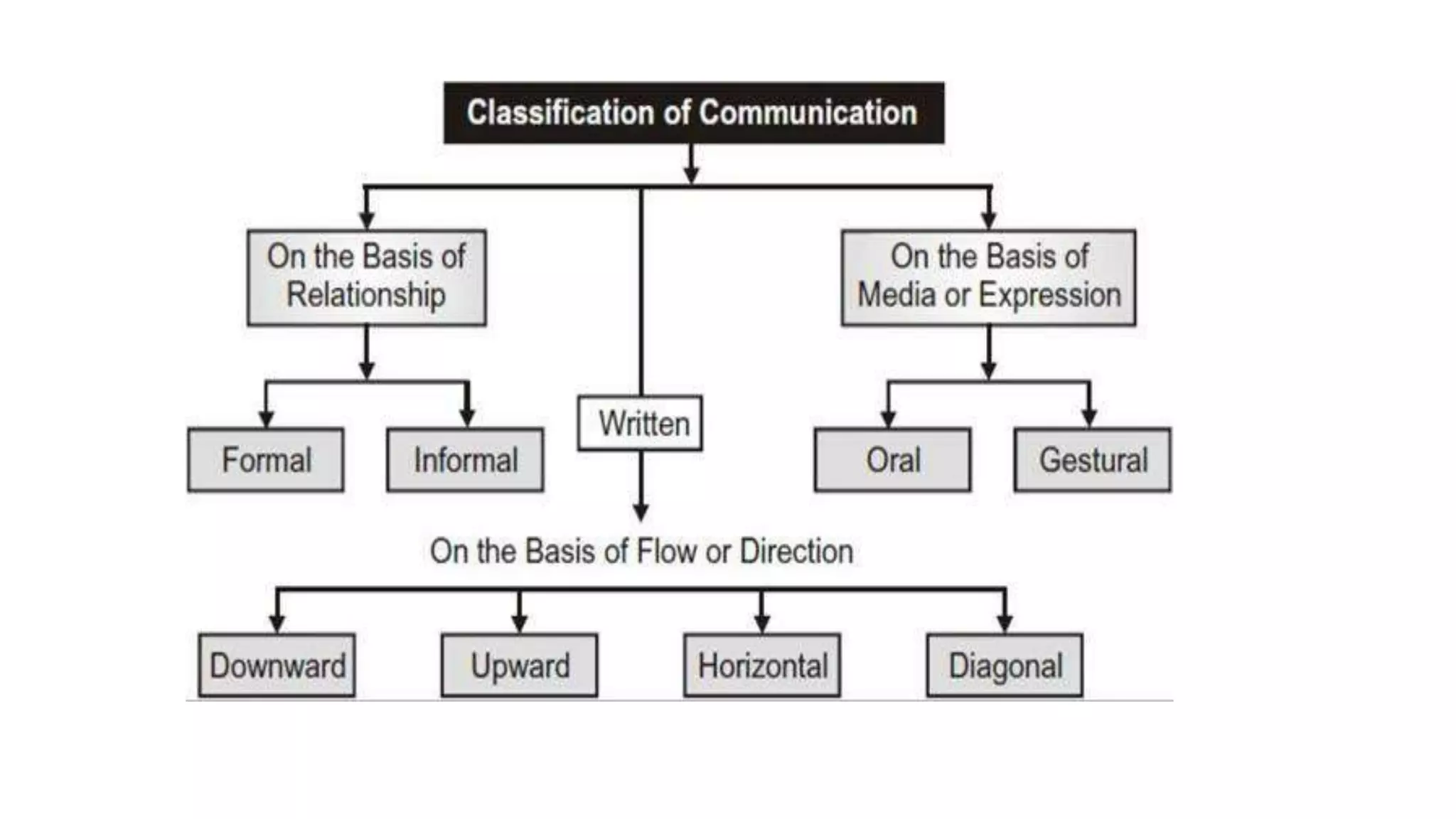
A. On the Basis of Relationship
• Formal: This is a communication given under the organisational structure.
• Informal: This is the process in which individuals carry out social but unscheduled activities within
the limits of an organisation. Informal communication is the synonym of rumour also.
B. On the Basis of Direction or Flow
• Downward communication: This communication flows from top to bottom and
the main objective is to convey orders, directives, instructions etc.
• Upward communication: This communication is from the subordinate staff to
the superior, which flows in the form of reports, complaints and suggestions.
Message runs from lower level to higher level.
• Horizontal communication: This is exchange of information between
individuals of the same status or designation.
C. On the Basis of Expression
• Non-verbal communication:
In this type of communication, facial expressions, expression through eyes, touch and bodily gestures
etc. are included.
Words are not used in this.
Mono-acting for imparting health education is an ideal example of this.
• Verbal communication:
In this type, written or spoken words are used for communication. Verbal communication is of two
types.
(a) Oral communication
(b) Written communication
 Oral communication: This is done through conversation, telephone, interview, lecture, conference
and other means but unclear words and absence of permanent record can lead to misunderstanding
and damage.
 Written communication: For health education, written communication is done by posters,
handbook, booklets, letters, newspapers, magazines, bulletins and noticeboard etc. but the readers
or viewers should be able to understand the language for effective communication.
2. SECOND CLASSIFICATION
A. One way communication or didactic method e.g. lecture method.
OR
Two way communication or Socratic method e.g. workshop, group discussion etc.
B. Verbal communication (oral and written communication)
OR
Non-verbal communication
C. Formal communication
OR
Informal communication
D. Auditory communication
OR
Visual communication
OR
Combined Communication (including telecommunication and internet)
ESTABLISHMENT OF
SUCCESSFUL
COMMUNICATON
• Clarity of thought with simple and understandable language.
• Use of two way communication.
• Usefulness of health message.
• Proper use of audio visual aids, gestures, words and pictures.
• Credibility and genuineness of communication.
• Topic for health education according to requirement, feelings, beliefs and experiences of people.
• Latest and reliable information.
• Correct medium or method for communication.
• Appropriate attention to verbal as well as non-verbal messages.
• Be careful in your non-verbal communication. In this position, gestures, touch, physical appearance,
facial expression, vocal cues (hesitation, flat tone, tense talking, tremulously speaking etc.), distance etc.
are included.
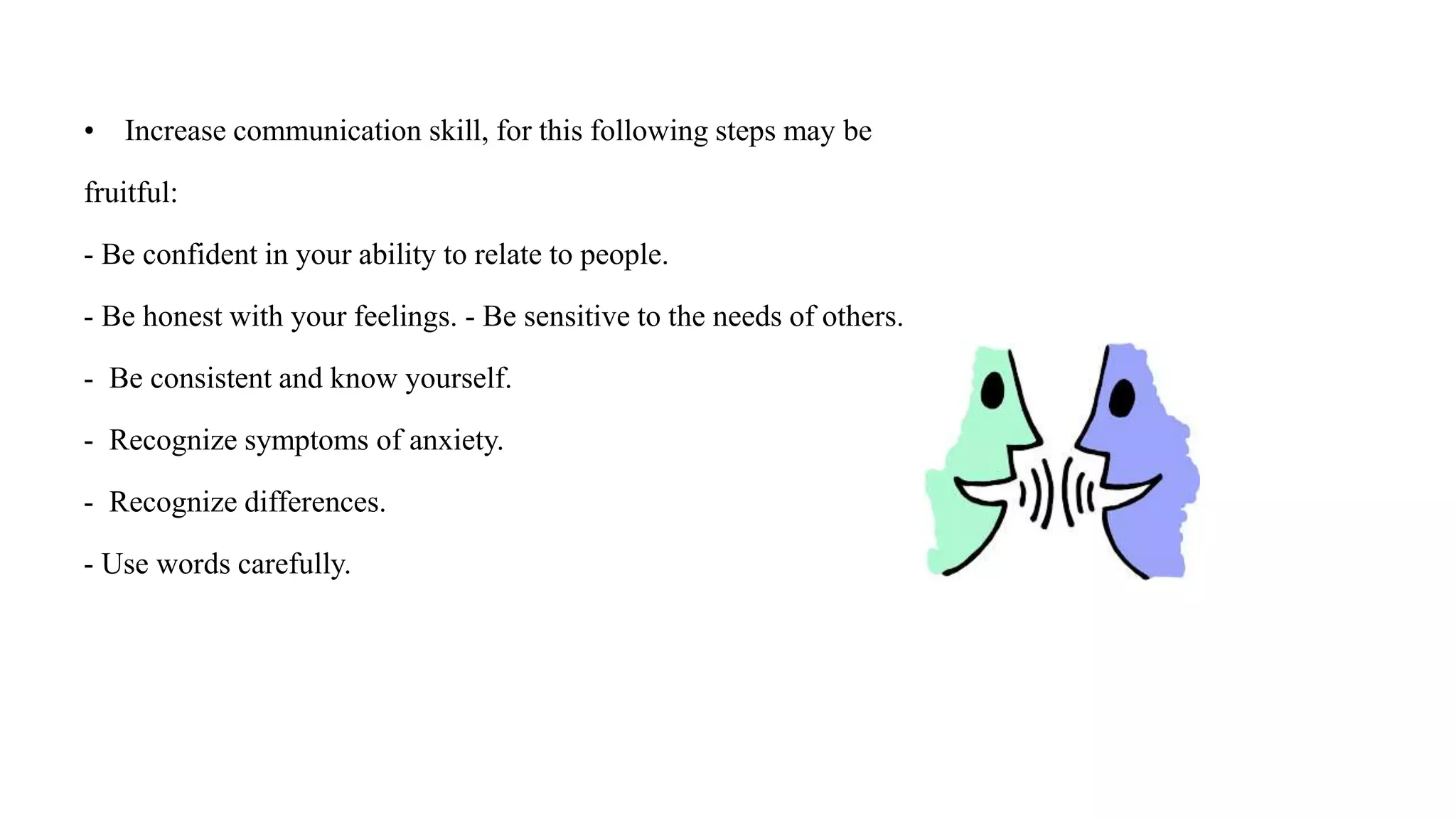
• Increase communication skill, for this following steps may be
fruitful:
- Be confident in your ability to relate to people.
- Be honest with your feelings. - Be sensitive to the needs of others.
- Be consistent and know yourself.
- Recognize symptoms of anxiety.
- Recognize differences.
- Use words carefully.
BARRIERS IN
COMMUNICATION
Effective communication is necessary for the achievement of objectives of health education. So many
times, objectives or faulty communication can lead to undesired , Hence, it is necessary to know the
barriers of communication.
These can be as follows:
1.LINGUISTIC BARRIER
These include incorrect message,
faulty translation, use of technical
language etc.
2. PHYSIOLOGICAL BARRIER
These include immaturity, has carelessness,
prejudices, jealousy, lack of interest, fail, of
communication, poor retention power, fear,
phobia, superstition, opposite thinking etc.
3. ORGANIZATIONAL BARRIER
These include lack of organizational structure, incorrect
policies and lack of means of communication.
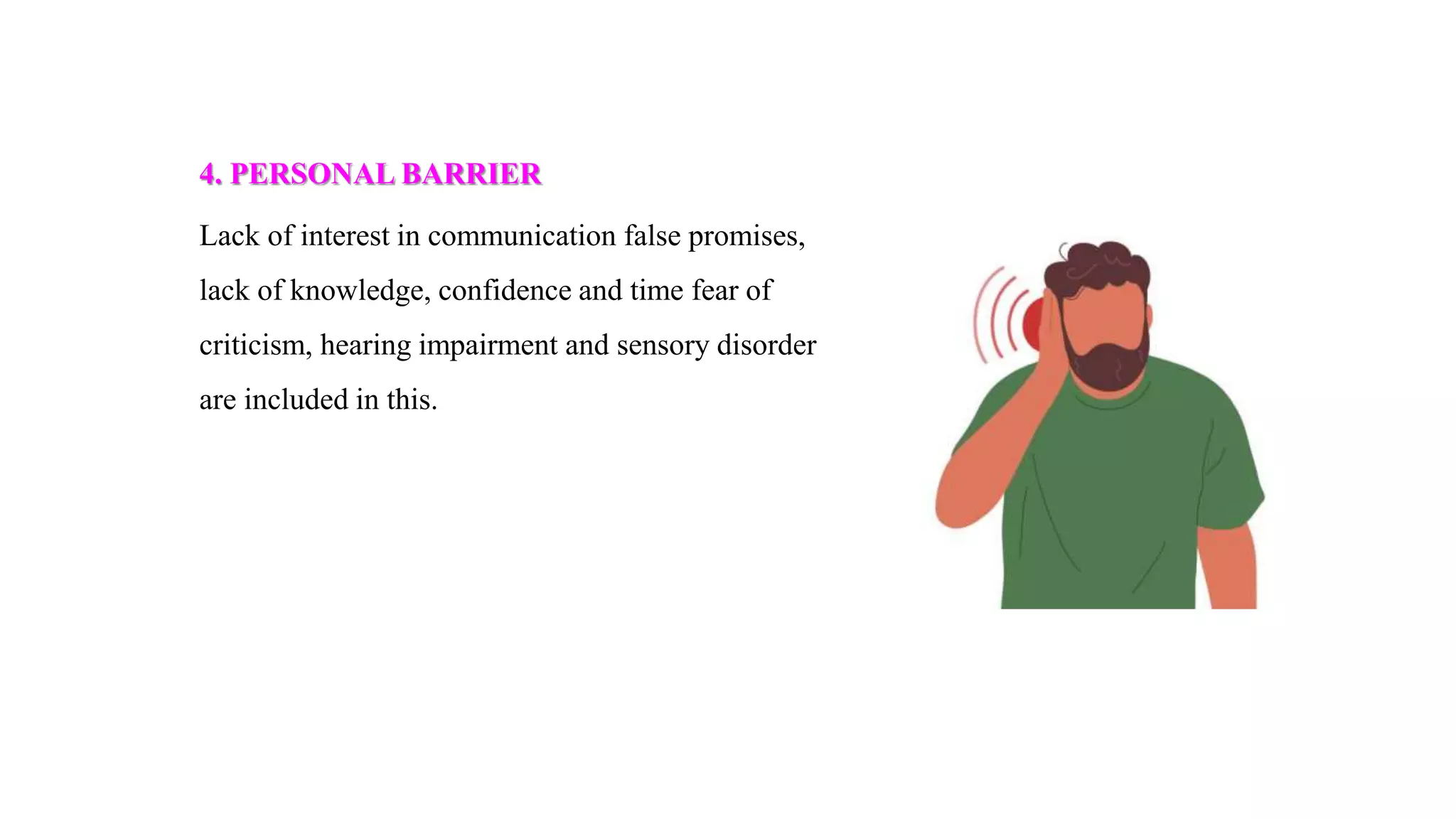
4. PERSONAL BARRIER
Lack of interest in communication false promises,
lack of knowledge, confidence and time fear of
criticism, hearing impairment and sensory disorder
are included in this.
5. ENVIRONMENTAL BARRIER
Geographical distance, mechanical and electrical
failure, sound pollution and physical obstacles can
block communication.
OBSERVING AND
LISTENING SKILLS
LISTENING SKILLS
• To be a good speaker is easy but to be a good listener is difficult.
• In communication, this fact should be kept in mind that apart from speaking, one should have the art of listening.
• The health problems should be well listened, understood, and evaluated, to make health education effective.
• Good art of listening enhances improvement in personality, saves time, decides the focus of the problems, fulfils
objectives and facilitates feedback.
The methods used in becoming a good listener, while communicating
or imparting health education can be described as LADDER pattern:
L - Look at others, keep good eye contact
A - Ask appropriate questions only
D - Do not interrupt
D - Do not change the subject
OBSERVATION
• According to Dictionary, "Observation means to see the events in right perspective and to record
them for knowing the mutual relationship between the cause and effect".
• Observation and inspection are qualities of a good manager and health educator.
• In health education, the observation must be goal oriented.
• The medium of observation should be selected according to the level (personal, group or
community), on which health education is being given.
For effective communication in health education, following
facts should be kept in mind during observation:
• The manner in which the health educator is being received or welcomed by the individual or the group.
• Whether the subject chosen is relevant to the individual, the group or the health problems of the community.
• The results of the efforts, made to solve problems.
• Determining the topic for future health education.
• Use of audio-visual aids by community health workers/
nurses/health educators.
• The advantages or gains to the individual or groups, by health education.
• Observation should be close to reality and should be focused on the immediate problems. For example,
persons suffering from anaemia, should be observed for skin, nails, colour of eyes and the dietary status.
Characteristics of Observation
• Use of special senses (in this, eyes, ears and speech can be used).
• Finding the primary facts and materials.
• Minuteness.
• Establishing relationship of cause and effect.
• Empirical study.
• Impartiality.
Limitations of Observation
• Reaction of the individual/group towards health education.
• Bias or favouritism of the observer.
• Limited area of study and inability to observe special events.
Kinds of Observation
• Participatory observation.
• Non-participatory observation.
• Semi participatory observation: In this, the observer takes
• part in some activities and remains neutral in the rest.
• Controlled observation.
• Uncontrolled observation.
Observation for Health Education
• Clarity towards observation: Observation should be limited only to the reference subject.
• Target bound: The objective of observation should be clear.
• The observer should be familiar with special technique and methods of observation.
• The observer should have previous experience and knowledge of health education.
• The observer should have interest and expertise in communication skill.
 Communication skills

Communication skills

  • 1.
    UNIT-I COMMUNICATION SKILLS Prepared By:Ms. Leena Ghag Sakpal. Nursing Tutor RN, P.B.B.Sc.Nursing
  • 3.
    INTRODUCTON • The wordcommunication is derived from Latin word “Communicare", which means to participate, to inform or impart. • Communication refers to the various ways of keeping humans in touch with one another. • On this basis, communication is the participation and exchange of thinking, experiences, views and opinions, information and facts between individuals and groups. • The individuals and groups can be motivated towards health protection by using communication skills in health education.
  • 4.
  • 5.
    PURPOSE • Exchanging informationregarding health. • Encouraging co-operation, co-ordination, good personal relations and motivation among health workers. • Ensuring public participation in health programmes. • Publicizing health policies, actions and activities and to remove rumours. • Maintaining continuous public contact. • Maintenance of health records and to receive correct reports. Obtaining feedback from community or health workers. • Making health education effective.
  • 6.
  • 8.
    Communication process passesthrough the following seven stages: 1. Source/sender: Individual or article which delivers information to others. 2. Ideas: This is the content (message, subject matter) of communication. 3. Encoding: To convert content into codes (words, actions, pictures etc.) is known as encoding. 4. Channel: Radio, telephone, speech, television, written message, gesture etc. can be the channels of communication. 5. Receiver: It is the person for whom the message is sent. 6. Decoding: The opening of codes is called as decoding. It provides meaning to the received content. 7. Feedback: This is an answer from the receiver. Feedback is necessary to ensure whether the message has reached in the desired form. Communication process can also be taught through another model, that is, S - M-C-R in which S = Source, M = Message, C = Channel and R = Receiver.
  • 9.
    TYPES 1. FIRST CLASSIFICATION A.On the Basis of Relationship • Formal: This is a communication given under the organisational structure. • Informal: This is the process in which individuals carry out social but unscheduled activities within the limits of an organisation. Informal communication is the synonym of rumour also.
  • 10.
    B. On theBasis of Direction or Flow • Downward communication: This communication flows from top to bottom and the main objective is to convey orders, directives, instructions etc. • Upward communication: This communication is from the subordinate staff to the superior, which flows in the form of reports, complaints and suggestions. Message runs from lower level to higher level. • Horizontal communication: This is exchange of information between individuals of the same status or designation.
  • 11.
    C. On theBasis of Expression • Non-verbal communication: In this type of communication, facial expressions, expression through eyes, touch and bodily gestures etc. are included. Words are not used in this. Mono-acting for imparting health education is an ideal example of this. • Verbal communication: In this type, written or spoken words are used for communication. Verbal communication is of two types. (a) Oral communication (b) Written communication
  • 12.
     Oral communication:This is done through conversation, telephone, interview, lecture, conference and other means but unclear words and absence of permanent record can lead to misunderstanding and damage.  Written communication: For health education, written communication is done by posters, handbook, booklets, letters, newspapers, magazines, bulletins and noticeboard etc. but the readers or viewers should be able to understand the language for effective communication.
  • 14.
    2. SECOND CLASSIFICATION A.One way communication or didactic method e.g. lecture method. OR Two way communication or Socratic method e.g. workshop, group discussion etc. B. Verbal communication (oral and written communication) OR Non-verbal communication C. Formal communication OR Informal communication D. Auditory communication OR Visual communication OR Combined Communication (including telecommunication and internet)
  • 15.
  • 16.
    • Clarity ofthought with simple and understandable language. • Use of two way communication. • Usefulness of health message. • Proper use of audio visual aids, gestures, words and pictures. • Credibility and genuineness of communication. • Topic for health education according to requirement, feelings, beliefs and experiences of people. • Latest and reliable information. • Correct medium or method for communication. • Appropriate attention to verbal as well as non-verbal messages. • Be careful in your non-verbal communication. In this position, gestures, touch, physical appearance, facial expression, vocal cues (hesitation, flat tone, tense talking, tremulously speaking etc.), distance etc. are included.
  • 17.
    • Increase communicationskill, for this following steps may be fruitful: - Be confident in your ability to relate to people. - Be honest with your feelings. - Be sensitive to the needs of others. - Be consistent and know yourself. - Recognize symptoms of anxiety. - Recognize differences. - Use words carefully.
  • 18.
  • 19.
    Effective communication isnecessary for the achievement of objectives of health education. So many times, objectives or faulty communication can lead to undesired , Hence, it is necessary to know the barriers of communication. These can be as follows: 1.LINGUISTIC BARRIER These include incorrect message, faulty translation, use of technical language etc.
  • 20.
    2. PHYSIOLOGICAL BARRIER Theseinclude immaturity, has carelessness, prejudices, jealousy, lack of interest, fail, of communication, poor retention power, fear, phobia, superstition, opposite thinking etc.
  • 21.
    3. ORGANIZATIONAL BARRIER Theseinclude lack of organizational structure, incorrect policies and lack of means of communication.
  • 22.
    4. PERSONAL BARRIER Lackof interest in communication false promises, lack of knowledge, confidence and time fear of criticism, hearing impairment and sensory disorder are included in this.
  • 23.
    5. ENVIRONMENTAL BARRIER Geographicaldistance, mechanical and electrical failure, sound pollution and physical obstacles can block communication.
  • 24.
  • 25.
    LISTENING SKILLS • Tobe a good speaker is easy but to be a good listener is difficult. • In communication, this fact should be kept in mind that apart from speaking, one should have the art of listening. • The health problems should be well listened, understood, and evaluated, to make health education effective. • Good art of listening enhances improvement in personality, saves time, decides the focus of the problems, fulfils objectives and facilitates feedback. The methods used in becoming a good listener, while communicating or imparting health education can be described as LADDER pattern: L - Look at others, keep good eye contact A - Ask appropriate questions only D - Do not interrupt D - Do not change the subject
  • 26.
    OBSERVATION • According toDictionary, "Observation means to see the events in right perspective and to record them for knowing the mutual relationship between the cause and effect". • Observation and inspection are qualities of a good manager and health educator. • In health education, the observation must be goal oriented. • The medium of observation should be selected according to the level (personal, group or community), on which health education is being given.
  • 27.
    For effective communicationin health education, following facts should be kept in mind during observation: • The manner in which the health educator is being received or welcomed by the individual or the group. • Whether the subject chosen is relevant to the individual, the group or the health problems of the community. • The results of the efforts, made to solve problems. • Determining the topic for future health education. • Use of audio-visual aids by community health workers/ nurses/health educators. • The advantages or gains to the individual or groups, by health education. • Observation should be close to reality and should be focused on the immediate problems. For example, persons suffering from anaemia, should be observed for skin, nails, colour of eyes and the dietary status.
  • 28.
    Characteristics of Observation •Use of special senses (in this, eyes, ears and speech can be used). • Finding the primary facts and materials. • Minuteness. • Establishing relationship of cause and effect. • Empirical study. • Impartiality. Limitations of Observation • Reaction of the individual/group towards health education. • Bias or favouritism of the observer. • Limited area of study and inability to observe special events.
  • 29.
    Kinds of Observation •Participatory observation. • Non-participatory observation. • Semi participatory observation: In this, the observer takes • part in some activities and remains neutral in the rest. • Controlled observation. • Uncontrolled observation. Observation for Health Education • Clarity towards observation: Observation should be limited only to the reference subject. • Target bound: The objective of observation should be clear. • The observer should be familiar with special technique and methods of observation. • The observer should have previous experience and knowledge of health education. • The observer should have interest and expertise in communication skill.