CULTURE
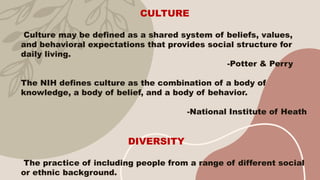
Culture may bedefined as a shared system of beliefs, values,
and behavioral expectations that provides social structure for
daily living.
-Potter & Perry
The NIH defines culture as the combination of a body of
knowledge, a body of belief, and a body of behavior.
-National Institute of Heath
DIVERSITY
The practice of including people from a range of different social
or ethnic background.
3.
CULTURAL DIVERSITY
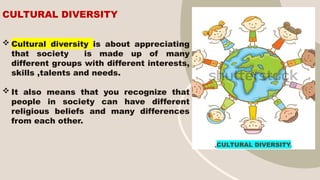
Culturaldiversity is about appreciating
that society is made up of many
different groups with different interests,
skills ,talents and needs.
It also means that you recognize that
people in society can have different
religious beliefs and many differences
from each other.
CULTURAL DIVERSITY
4.
CONCEPTS OF CULTURALDIVERSITY AND RESPECT
* Cultural diversity can be defined as the coexistence of different
ethnic, biological sex, racial, and socioeconomic groups within
one social unit.
* Culture has both visible and invisible component.
* Culture is an integral component of both health and illness
because of the cultural values and beliefs that we learn in our
families and communities.
* In any culture there is a dominant culture that exist along with
other sub-culture.
* Plan and provide nursing care in partnership with the patient to
ensure that it is safe , effective , and culturally sensitive.
5.
Nurses andother health care providers must be familiar with the
concepts of cultural diversity in order to understand
characteristics common to certain populations
Nurses must also be sensitive to cultural factors in order to
provide culturally respectful care to people from diverse
backgrounds.
The concept of cultural respect enables nurses to deliver
services that are respectful of and responsive to the health
beliefs, practices, and cultural and linguistic needs of diverse
patients.
Moreover, cultural respect is critical to reducing health
disparities and improving access to high quality health care.
6.
6
Characteristics of Culture:
Culture helps shape what is acceptable behavior for people in a
specific group.
It is shared by and provides an identity for members of the
same cultural group.
Culture is learned by each new generation through both formal
and informal life experiences.
Language is the primary means of transmitting culture.
The practices of a particular culture often arise because of the
group's social and physical environment.
7.
7
Cultural practicesand beliefs may evolve over time, but they
mainly remain constant as long as they satisfy a group's needs.
Culture influences the way people of a group view them-selves,
have expectations, and behave in response to certain situations.
Because a culture is made up of people, there are differences
both within cultures and among cultures
8.
8
SUB CULTURE
A Culturalgroup within a larger culture, often having beliefs or
interests at variance with those of the larger group.
They create a sense of belonging.
Example:-Various religious, age group, celebrity fans, nursing is a
subculture of the larger health care system culture Etc.
MULTICULTURAL
Multiculturalism defines as “the coexistence of multiple cultures
within a single society. It celebrates diversity and promote
collaboration.
Example:- India multilingual population speak over 23 official
language, multi religion, and various cultural tradition Etc.
9.
RACE (subspecies)
“A conceptused to describe a group of people who share physical
characteristics, such as skin colour and facial features. They may
share similar social or cultural identities and ancestral
backgrounds”.
Or
“Race is a socially defined category, based on real or perceived
biological differences between group of people”.
Examples Some people view race as:-
Skin colour
Religion (Jewish )
Nationality (British)
Entire human species (human race).
10.
10
Acculturation
.
Acculturation is theprocess of adapting to a new culture when
individuals or communities are exposed to it. It involves retaining
some element of one’s original culture while embracing and adopting
elements of the new culture
Or
Acculturation means the adoption of behavior pattern of the
surrounding culture.
Example :- Immigrating family
Acculturation is second culture learning.
WHILE
*(Enculturation is the term used for 1st
culture learning)
11.
11
ASSIMILATION
“ Assimilation isa type of cultural adaptation in which an individual
gives up his or her own cultural heritage and adopt the mainstream
culture identity”.
Or
“Assimilation is defined as the process by which minority group
adopts the pattern of the dominant culture”
Example :- children of immigrants sometimes give up their native
language to learn English in the US.
CHARACTERISTIC OF ASSIMILATION
May be Due to migration.
Involves reducing differences
Dominant culture is visible in assimilation
Assimilation can be forced or voluntary
12.
12
TRANSCULTURATION
Transculturation nursing isa comparative study of cultures to
understand similarities (culture universal) and differences (culture-
specific) across human group.
Leininger, 1991-the founder of transcultural nursing
Or
It is defined as the study of the lifeways and pattern of persons of
various cultures including their healthcare practices and nursing’s
role in that culture.
14
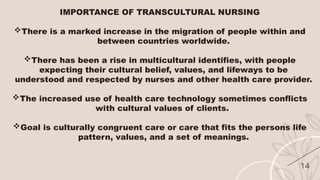
IMPORTANCE OF TRANSCULTURALNURSING
There is a marked increase in the migration of people within and
between countries worldwide.
There has been a rise in multicultural identifies, with people
expecting their cultural belief, values, and lifeways to be
understood and respected by nurses and other health care provider.
The increased use of health care technology sometimes conflicts
with cultural values of clients.
Goal is culturally congruent care or care that fits the persons life
pattern, values, and a set of meanings.
18
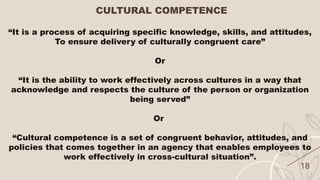
CULTURAL COMPETENCE
“It isa process of acquiring specific knowledge, skills, and attitudes,
To ensure delivery of culturally congruent care”
Or
“It is the ability to work effectively across cultures in a way that
acknowledge and respects the culture of the person or organization
being served”
Or
“Cultural competence is a set of congruent behavior, attitudes, and
policies that comes together in an agency that enables employees to
work effectively in cross-cultural situation”.
20
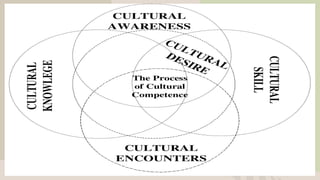
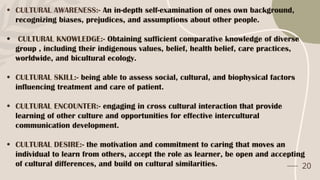
• CULTURAL AWARENESS:-An in-depth self-examination of ones own background,
recognizing biases, prejudices, and assumptions about other people.
• CULTURAL KNOWLEDGE:- Obtaining sufficient comparative knowledge of diverse
group , including their indigenous values, belief, health belief, care practices,
worldwide, and bicultural ecology.
• CULTURAL SKILL:- being able to assess social, cultural, and biophysical factors
influencing treatment and care of patient.
• CULTURAL ENCOUNTER:- engaging in cross cultural interaction that provide
learning of other culture and opportunities for effective intercultural
communication development.
• CULTURAL DESIRE:- the motivation and commitment to caring that moves an
individual to learn from others, accept the role as learner, be open and accepting
of cultural differences, and build on cultural similarities.
21.
21
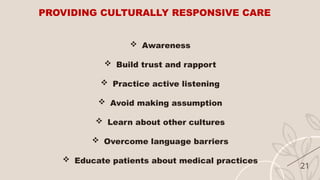
PROVIDING CULTURALLY RESPONSIVECARE
Awareness
Build trust and rapport
Practice active listening
Avoid making assumption
Learn about other cultures
Overcome language barriers
Educate patients about medical practices
22.
22
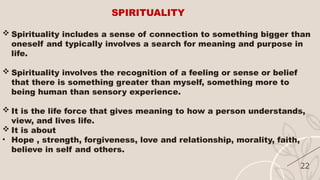
SPIRITUALITY
Spirituality includesa sense of connection to something bigger than
oneself and typically involves a search for meaning and purpose in
life.
Spirituality involves the recognition of a feeling or sense or belief
that there is something greater than myself, something more to
being human than sensory experience.
It is the life force that gives meaning to how a person understands,
view, and lives life.
It is about
• Hope , strength, forgiveness, love and relationship, morality, faith,
believe in self and others.
23.
23
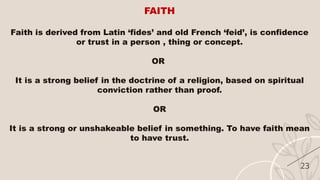
FAITH
Faith is derivedfrom Latin ‘fides’ and old French ‘feid’, is confidence
or trust in a person , thing or concept.
OR
It is a strong belief in the doctrine of a religion, based on spiritual
conviction rather than proof.
OR
It is a strong or unshakeable belief in something. To have faith mean
to have trust.
24.
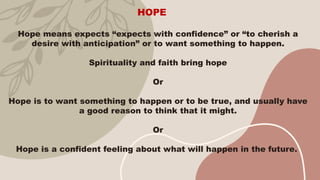
HOPE
Hope means expects“expects with confidence” or “to cherish a
desire with anticipation” or to want something to happen.
Spirituality and faith bring hope
Or
Hope is to want something to happen or to be true, and usually have
a good reason to think that it might.
Or
Hope is a confident feeling about what will happen in the future.
25.
RELIGION
Religion is thebelief in and worship of a superhuman controlling
power especially God, and the activities that are connected with this
belief.
Or
Religion is a unified system of belief , values, and practices that a
person holds sacred or considers to be spiritually significant.
Or
Religion can de defined as the belief in and worship of gods or any
such system of worship and belief.
26.
26
FACTORS AFFECTING SPIRITUALWELL BEING
The spiritual needs of patient vary depending on his spiritual belief,
faith, state of illness and adaptation to illness.
1. Cultural and religious background:- The culture and religion
influence spiritual needs and preferences. All religious beliefs and
practices are bound to the culture. The leaders have great
influences on the spiritual aspects.
2. Physiological background:- Many illness affects the sense of well
being and may predispose to a spiritual conflict .
When a life threatening diseases occur he/she may even doubts the
religion and its belief.
A person with severe pain also may not involve in spiritual
activities as usual.
27.
cont…
3. Psychosocial factors:-Social support system and social roles can
influence spiritual responses. The personality, outlook on life and
coping styles also influence spirituality.
4. Age:- children do not have spiritual crisis as adult. Children usually
follow the teaching of parents and teachers. But adolescents may
question the religious belief and teaching, whereas religion and
spirituality becomes more important as the person aged. Religion is
the key to life satisfaction for many older adults.
5. Crisis and change:- usually person becomes more spiritual during
crisis but in some cases like death of a desr one or life threatening
diseases of a loved one make them distressed and may weaken the
spiritual hope and faith.
 Most read
 Most read
 Most read