
Prepared By:
Prof. (Dr.) Rahul Sharma
Professor
Senior Coordinator
HOD Department of Mental Health Nursing
Ph.D. Coordinator
Seedling School of Nursing
Jaipur National University (NAAC-A+)
Application of Soft Skills
Unit XVI
Soft skills are personal attributes that enable you to
interact effectively with others and succeed in your
personal and professional life. They are often
referred to as "people skills" and include
communication, collaboration, and problem-solving.
The Concept of Soft Skills
Types of Soft Skills
Visual Skills
Visual skills involve
perceiving and interpreting
information through sight.
These skills are essential for
tasks like reading, interpreting
charts and graphs, and
identifying visual patterns.
Aural skills relate to the
ability to understand and
process auditory
information. They
encompass skills like
listening attentively,
comprehending spoken
language, and
distinguishing sounds.
Communication skills
involve effectively
conveying ideas, thoughts,
and information to others.
These skills encompass
both verbal and nonverbal
communication, including
writing, speaking,
listening, and body
language.
Aural Skills Communication Skills
The Ways of Communication
Verbal communication involves
using spoken words to
exchange information, ideas,
and thoughts. It encompasses
speaking clearly and concisely,
actively listening, and asking
relevant questions.
Verbal Communication
1 2. Nonverbal Communication
Nonverbal communication involves
conveying messages through facial
expressions, body language, gestures, and
tone of voice. It's essential for understanding
the emotional context of communication.
3. Written Communication
Written communication involves
exchanging information through
written text, such as emails, letters,
reports, and presentations. It requires
clarity, conciseness, and the ability to
organize thoughts effectively.
4. Visual Communication
Visual communication uses
images, graphics, and symbols
to convey information. It can be
powerful for conveying complex
ideas, enhancing understanding,
and engaging audiences.
Building Relationships with Clients
and Society
1.Understanding Needs
Active listening and empathy are crucial for understanding client
and community needs and expectations. This involves paying
attention, asking questions, and demonstrating genuine interest.
2.Building Trust
Trust is built through consistent reliability, open
communication, and ethical behavior. It's important to be
transparent, honest, and deliver on promises to build trust.
3.Engaging and Collaborating
Engaging with clients and communities involves actively
seeking their input, collaborating on solutions, and
responding to their concerns. This fosters a sense of
partnership.
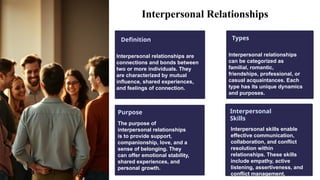
Interpersonal Relationships
Interpersonal relationships are
connections and bonds between
two or more individuals. They
are characterized by mutual
influence, shared experiences,
and feelings of connection.
Definition Types
Interpersonal relationships
can be categorized as
familial, romantic,
friendships, professional, or
casual acquaintances. Each
type has its unique dynamics
and purposes.
The purpose of
interpersonal relationships
is to provide support,
companionship, love, and a
sense of belonging. They
can offer emotional stability,
shared experiences, and
personal growth.
Purpose Interpersonal
Skills
Interpersonal skills enable
effective communication,
collaboration, and conflict
resolution within
relationships. These skills
include empathy, active
listening, assertiveness, and
conflict management.
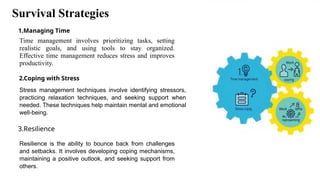
Survival Strategies
1.Managing Time
Time management involves prioritizing tasks, setting
realistic goals, and using tools to stay organized.
Effective time management reduces stress and improves
productivity.
2.Coping with Stress
Stress management techniques involve identifying stressors,
practicing relaxation techniques, and seeking support when
needed. These techniques help maintain mental and emotional
well-being.
Resilience is the ability to bounce back from challenges
and setbacks. It involves developing coping mechanisms,
maintaining a positive outlook, and seeking support from
others.
3.Resilience
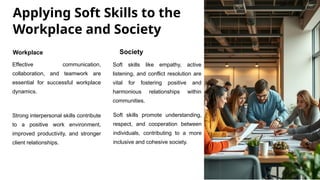
Applying Soft Skills to the
Workplace and Society
Workplace Society
Effective communication,
collaboration, and teamwork are
essential for successful workplace
dynamics.
Soft skills like empathy, active
listening, and conflict resolution are
vital for fostering positive and
harmonious relationships within
communities.
Strong interpersonal skills contribute
to a positive work environment,
improved productivity, and stronger
client relationships.
Soft skills promote understanding,
respect, and cooperation between
individuals, contributing to a more
inclusive and cohesive society.
Use of Soft Skills in Nursing
Effective
Communication
Nurses need to
communicate clearly
and empathetically
with patients, families,
and colleagues to
ensure safe and
compassionate care.
Empathy and
Compassion
Nurses must demonstrate
empathy and understanding
towards patients' needs and
concerns to provide
personalized and supportive
care.
Teamwork and
Collaboration
Nurses collaborate
effectively with doctors,
other healthcare
professionals, and support
staff to ensure coordinated
and comprehensive patient
care.
Problem-Solving Skills
Nurses use critical
thinking and problem-
solving skills to identify
and address patient
needs, ensuring timely
and appropriate
interventions.