INFECTION CONTROL
UNIT : 8
Infection is ainvasionof thehostbyapathogen.Once the
infectious agententersthehostit beginsto proliferate and
reactswiththedefensemechanismsof thebodyproducing
infection
It is characterizedby 5 signs
• Pain
• Swelling
• Redness
• Heat
• Impairedfunction of thebody part
The nature of infections
• Micro-organisms - bacteria, fungi,
viruses, protozoa and worms
• Most are harmless [non-pathogenic]
• Pathogenic organisms can cause
infection
• Infection exists when pathogenic
organisms enter the body, reproduce
and cause disease 3
NATURE OF INFECTION
Have5 stages
• Incubationperiod-silencestage(thepathogen has gained
entryinto the host and start replicating.
• Prodromalperiod- mild nonspecificsymptoms thatsignal
onset of somediseases.Itchy, runningnose, dry eyesetc.
• Illnessorclinicalphase-apersonexperiencestypicalsigns
andsymptomsof diseases.
• Decline- subsidenceof symptoms.
• Convalescence/recovery phase- symptomshave
disappeared, tissues heal and body regainsstrength
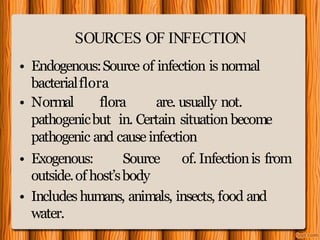
SOURCES OF INFECTION
• Endogenous:Source of infection is normal
bacterialflora
• Normal flora are. usually not.
pathogenicbut in. Certain situation become
pathogenic and cause infection
• Exogenous: Source of. Infectionis from
outside.of host’sbody
• Includes humans, animals, insects, food and
water.
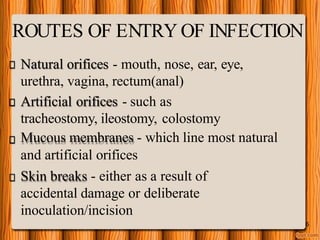
ROUTES OF ENTRY OF INFECTION
Natural orifices - mouth, nose, ear, eye,
urethra, vagina, rectum(anal)
Artificial orifices - such as
tracheostomy, ileostomy, colostomy
Mucous membranes - which line most natural
and artificial orifices
Skin breaks - either as a result of
accidental damage or deliberate
inoculation/incision
6
Chain of
infection
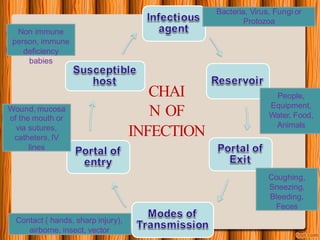
CHAI
N OF
INFECTION
Bacteria, Virus, Fungi or
Protozoa
People,
Equipment,
Water, Food,
Animals
Coughing,
Sneezing,
Bleeding,
Feces
Contact ( hands, sharp injury),
airborne, insect, vector
Wound, mucosa
of the mouth or
via sutures,
catheters, IV
lines
Non immune
person, immune
deficiency
babies
DEFENSES AGAINST INFECTION
• Defense protectshuman body frominfection and diseases.
• Non specific
• Specific (immune)defense
Nonspecific-
Skin
Mucous membrane –Protectsinternal organ
Oral cavity- Saliva preventsinfections by lysozymes
Specificdefense
a.Naturalor acquiredresistance to specificdisease
• Innateimmunity-inborn immunityinheritedfrom parents
• Acquiredimmunity- activeimmunity
 Naturalacquiredactiveimmunity-fromexposure to antigen
 Artificialacquiredactiveimmunity-
• Inoculationof toxoidsor liveattenuated orkilledvaccines
b. Passiveimmunity
• Naturalpassive immunity-from passageof IgG fromthe placenta to
the fetusandIgA through breast milk
TYPES OF INFECTION
• Primary infection: Initial infection with an organism to
host constitutes primary infection.
• Secondary infection: When in a host whose resistance is
lowered by pre-existing infection, a new organism may set
up anew infection.
• Local infection: Infection that is limited to a defined area
or single organwith symptoms that resemble inflammation
(redness, tenderness and swelling).
• Systemic infection: Infection that spreads to whole body
resulting inasepticaemia.
• Acute infection: It appears suddenly or lasts for a short
time. E.g. URI
• Chronic infection: May occur slowly over a long period
and may last months to years.
• Iatrogenic infection: Infection resulting due to therapeutic
and diagnostic procedures.
• Nosocomial infection: Also known as Hospital-acquired
infection (HAI) — is aninfection that is contracted from
the environment or staff of ahealthcare facility.
WHOIS AT RISK OF INFECTION?
• Staff: They are exposed to potentially infectious blood
and other body fluidson daily basis.
• Clients: they are at risk of post procedural infection e.g.
Improper hand washing, lack of aseptic techniques,
uncleanarticles
• Community: from inappropriate disposal of medical
waste.
HOSPITAL ACQUIREDINFECTIONOR
NOSOCOMIALINFECTION
Nosocomial infections are infections that are
acquired by patient during the delivery of healthcare services
or infection acquired by patient while under medical
supervision
IATROGENICINFECTIONS
• Typeof nosocomial infection resultingfromadiagnostic
or therapeutic procedure
• Exampleurinary tract infection that developsafter catheter
insertion
• May beexogenous or endogenous
SITES ANDCAUSES FOR NOSOCOMIAL
INFECTIONS
Urinary tract
• Insertion of urinary catheter,improper handwashing
technique
• Contaminated catheter,tube and bag
•Failureto useaseptic techniques
Respiratorytract
• ContaminatedET tubes,instruments, catheters
• Failureto useaseptic techniques
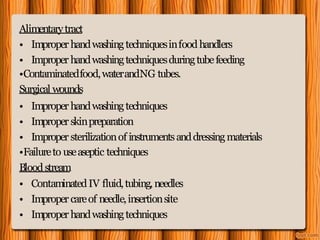
Alimentarytract
• Improper handwashingtechniquesinfood handlers
• Improper handwashingtechniquesduringtubefeeding
•Contaminatedfood,waterandNG tubes.
Surgical wounds
• Improper handwashingtechniques
• Improper skinpreparation
• Improper sterilizationof instrumentsanddressing materials
•Failureto useaseptic techniques
Bloodstream
• ContaminatedIV fluid,tubing, needles
• Improper careof needle,insertionsite
• Improper handwashingtechniques
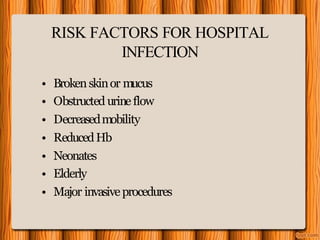
RISK FACTORS FOR HOSPITAL
INFECTION
• Brokenskinor mucus
• Obstructed urine flow
• Decreasedmobility
• ReducedHb
• Neonates
• Elderly
• Major invasiveprocedures
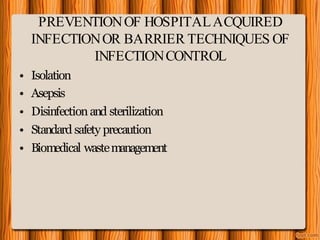
PREVENTIONOF HOSPITALACQUIRED
INFECTIONOR BARRIER TECHNIQUES OF
INFECTIONCONTROL
• Isolation
• Asepsis
• Disinfectionand sterilization
• Standard safety precaution
• Biomedical wastemanagement
ISOLATION
• Isolationrefersto theprecautions
that are taken in the hospital to
prevent the spread of infectious
agent from a infected or
colonized patient to susceptible
person
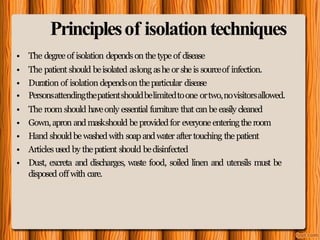
Principlesof isolationtechniques
• The degreeof isolation dependson the type of disease
• The patient should beisolated aslong ashe or sheis sourceof infection.
• Duration of isolation dependson theparticular disease
• Personsattendingthepatientshouldbelimitedtoone ortwo,novisitorsallowed.
• The room should haveonly essential furniture that can be easily cleaned
• Gown,apron andmaskshould be providedfor everyone enteringtheroom
• Hand should be washedwith soapandwater after touching the patient
• Articlesused by thepatient should bedisinfected
• Dust, excreta and discharges, waste food, soiled linen and utensils must be
disposed off with care.
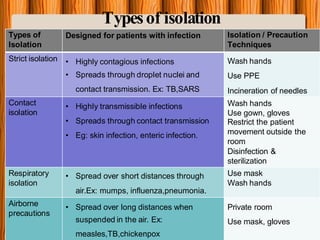
Typesof isolation
Types of
Isolation
Designed for patients with infection Isolation / Precaution
Techniques
Strict isolation • Highly contagious infections
• Spreads through droplet nuclei and
contact transmission. Ex: TB,SARS
Wash hands
Use PPE
Incineration of needles
Contact
isolation
• Highly transmissible infections
• Spreads through contact transmission
• Eg: skin infection, enteric infection.
Wash hands
Use gown, gloves
Restrict the patient
movement outside the
room
Disinfection &
sterilization
Respiratory
isolation
• Spread over short distances through
air.Ex: mumps, influenza,pneumonia.
Use mask
Wash hands
Airborne
precautions
• Spread over long distances when
suspended in the air. Ex:
measles,TB,chickenpox
Private room
Use mask, gloves
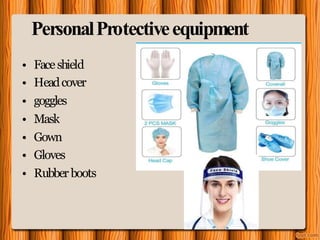
PersonalProtectiveequipment
• Faceshield
• Headcover
• goggles
• Mask
• Gown
• Gloves
• Rubber boots
ASEPSIS
• Asepsis is the state of being free from
• disease causing contaminants and preventing contact with
microorganisms
Purposes
• To prevent crossinfection
• To control infection
• To ensure patient’scomfort, safety
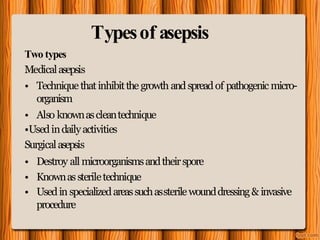
Typesof asepsis
Two types
Medicalasepsis
• Techniquethatinhibitthe growth andspreadof pathogenic micro-
organism
• Also knownascleantechnique
•Usedindailyactivities
Surgicalasepsis
• Destroy all microorganismsandtheirspore
• Knownassteriletechnique
• Usedin specializedareassuchassterilewounddressing& invasive
procedure
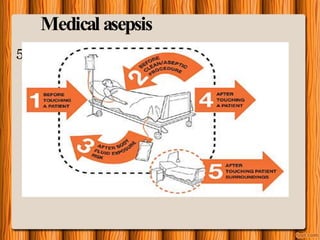
Medical asepsis
5 movementsof handwashing
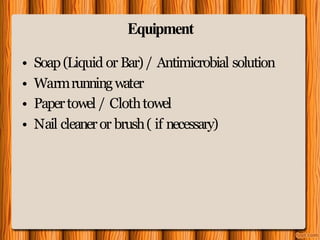
Equipment
• Soap(Liquid or Bar)/ Antimicrobial solution
• Warmrunningwater
• Papertowel / Clothtowel
• Nail cleaneror brush( if necessary)
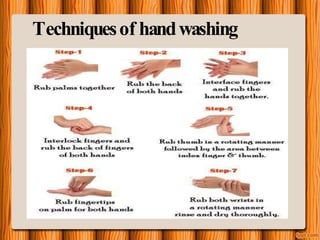
Techniquesof handwashing
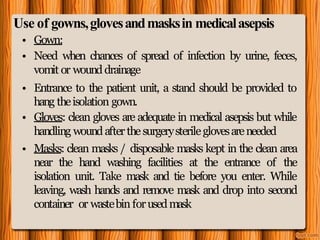
Use of gowns,glovesandmasksin medicalasepsis
• Gown:
• Need when chances of spread of infection by urine, feces,
vomit or wounddrainage
• Entrance to the patient unit, a stand should be provided to
hang theisolation gown.
• Gloves: clean gloves are adequate in medical asepsis but while
handling woundafterthe surgerysterileglovesareneeded
• Masks: clean masks / disposable masks kept in the clean area
near the hand washing facilities at the entrance of the
isolation unit. Take mask and tie before you enter. While
leaving, wash hands and remove mask and drop into second
container or wastebin forusedmask
Surgicalasepsis
Means keepingthe objects andareasterilethat is free from
all organisms.
Surgicalhandscrubbing
Purposes
• To remove debrisandtransient micro organismsfrom
thenails, hands and forearms.
• Reducemicrobial count to minimum and inhibit rapid
growthof microorganisms.
Equipment
• Soap / antimicrobial solution
• Running water
• Nail bush
• steriletowel
• Scrubber
Procedure
• Removethe nail polish
• Cut short thenails
• Removejewellery
• Roll up thesleeves
• Turnonwater supply and adjust theflow of water
• Wet handsandarms. Apply antimicrobial agent, lather the
hands for 5-6cmaboveelbow.
• Keep the elbow above the level of handsduring scrubbing
• Cleannailsofbothhandswithnailbrushunderrunning
water
• With antimicrobial agent scrub fingernails of one hand
with 15 strokes and hands with 10 strokes. Repeat the
processon other hand and arms
• Entire process should last for 5 -10 minutes. Keeping the
hands above elbow all thetimes
• Rinse hands and arms in one direction only from finger tip
to elbow
• Usesteriletowel to dry hands to elbow
• Use other towel to another hand or rotate the towel and
discardit
• Proceedwearing of sterilegownand gloves
Donning
Mask:
Hold mask by top strings and cover nose and mouth
Thetop strings at theback of thehead
The lower strings aroundthe neck
Thereshould beno gap betweenfaceand mask
Pinch upperportionof mask around thenose
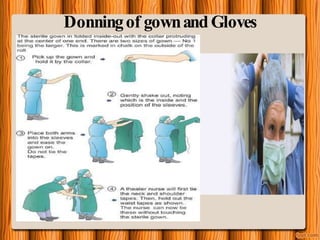
Gowning:
• The sterile gown is folded inside out
• with collar protruding at thecenterof one end
• Pick thegown andhold it fromcollar
• Hold it away from yourself and letitunfoldfreely without
touching surroundings
• Put each hand in thepositionsof sleeves.
• Expand the hands upward whileputting thegown.
• The OT assistantwill first tie theneckandshoulderandthenthewrist
tieswithouttouchingsterilegownshttps://youtu.be/e79YJ4ckwj0 -
STERILE GOWN
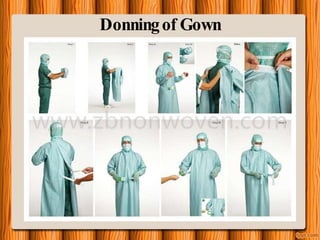
Donningof Gown
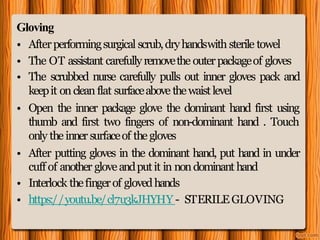
Gloving
• Afterperformingsurgical scrub,dryhandswith sterile towel
• The OT assistant carefullyremovethe outerpackageof gloves
• The scrubbed nurse carefully pulls out inner gloves pack and
keepit onclean flat surfaceabove thewaistlevel
• Open the inner package glove the dominant hand first using
thumb and first two fingers of non-dominant hand . Touch
only the inner surfaceof the gloves
• After putting gloves in the dominant hand, put hand in under
cuff of another gloveandputit in nondominant hand
• Interlock thefingerof glovedhands
• https://youtu.be/cl7u3kJHYHY - STERILE GLOVING
Donningof gownandGloves
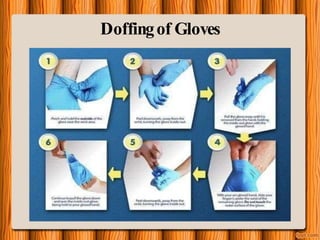
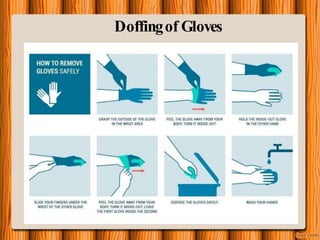
Doffingof Gloves
Doffingof Gloves
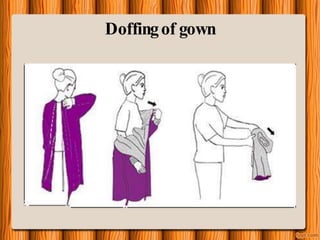
Doffingof gown
DISINFECTION AND STERILIZATION
Disinfection is the process of killing the pathogenic
microorganismbut not usually bacterial spores
• Disinfectant- Is agermicide, kills pathogenic
microorganism. Eg-phenol, lysol
• Deodorant - Supresses bad odors. Eg-lime, bleaching
powder
• Detergent- Surfacecleaning agent. Eg-soap
• Antiseptic- Preventsgrowth of microorganism. Eg-alchohol
Typesof disinfection
• Concurrent disinfection- disinfection of infectious
material ( stool, urine, contaminatedlinen)
• Terminal disinfection- disinfection undertaken at
the termination of an illness(after the recovery or
deathof thepatient)
• Prophylactic disinfection- boiling of water,
pasteurization of milk, washing hands with soap
andwater
Sterilization
Processthateliminatesorkillsallformsof life,
including transmissible agents such asbacteria, viruses,spore
forms
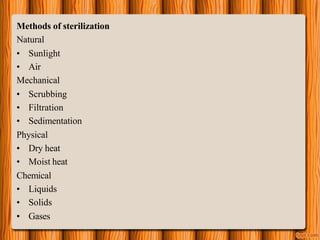
Methods of sterilization
Natural
• Sunlight
• Air
Mechanical
• Scrubbing
• Filtration
• Sedimentation
Physical
• Dry heat
• Moist heat
Chemical
• Liquids
• Solids
• Gases
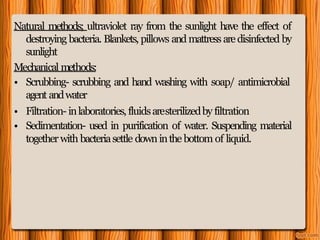
Natural methods; ultraviolet ray from the sunlight have the effect of
destroying bacteria. Blankets, pillows and mattress aredisinfected by
sunlight
Mechanical methods:
• Scrubbing- scrubbing and hand washing with soap/ antimicrobial
agent andwater
• Filtration- inlaboratories, fluidsaresterilizedby filtration
• Sedimentation- used in purification of water. Suspending material
togetherwith bacteriasettle down inthe bottom of liquid.
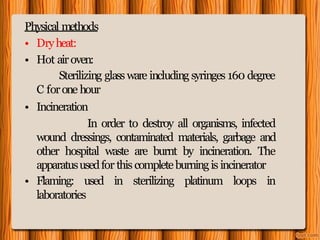
Physical methods
• Dryheat:
• Hot airoven:
Sterilizing glassware including syringes 160 degree
C forone hour
• Incineration
In order to destroy all organisms, infected
wound dressings, contaminated materials, garbage and
other hospital waste are burnt by incineration. The
apparatususedfor this completeburningis incinerator
• Flaming: used in sterilizing platinum loops in
laboratories
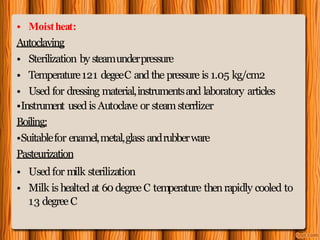
• Moistheat:
Autoclaving
• Sterilization by steamunderpressure
• Temperature121 degeeC and the pressure is 1.05 kg/cm2
• Used for dressing material,instrumentsand laboratory articles
•Instrument used is Autoclave or steamsterrlizer
Boiling:
•Suitablefor enamel,metal,glass andrubberware
Pasteurization
• Usedfor milk sterilization
• Milk is healted at 60 degree C temperature thenrapidly cooled to
13 degree C
Chemical method
Common chemical substances usedare
• Dettol for sterilization of thermometer, instruments. It is
non poisonous non irritant to the skin, also used for
dressingand wound irrigation
• Savlon 1:30 savlon solution is used to kill the vegetative
bacteria
• Chloride of lime ( bleaching powder) used for
disinfection of drinking water,bed pan , floor.
• Tincture of iodine used for cleaning skin and treating
injuries to theskin
• Hydrogen peroxide used in cleaning wounds
and to removepusfrominfectedareas.
• Potassium permanganate used
toclean the mouth and to irrigate the
wounds
• Gaseslike formaldehyde and
glutaraldehyde.are usedin disinfection of
rooms andinstruments.
STANDARD SAFETY PRECAUTION
• Used to prevent exposure to infectious agent during all
patient careactivity.
• Follow hand washing techniques , wear clean gloves when
touching blood, body fluids, secretions and contaminated
items and non intact skin. Change the gloves between the
taskif necessaryand removegloves promptly after use.
• Wear personal protective equipment's such as mask, eye
protectionface shield,gownsduring procedures.
• Avoid recapping needles
• Equipments used for patient care that is soiled with
blood or bodyfluids shouldbehandledcarefully.
• Use adequate environmental controls, to ensure
routine care, cleaning anddisinfection procedure are
followed.
• Place patients who may spread the infection in
isolationroom.
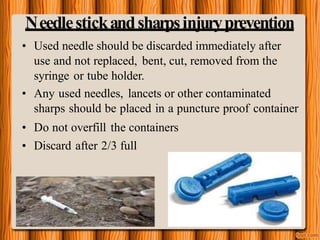
Needlestickandsharpsinjuryprevention
• Used needle should be discarded immediately after
use and not replaced, bent, cut, removed from the
syringe or tube holder.
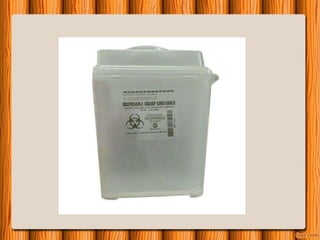
• Any used needles, lancets or other contaminated
sharps should be placed in a puncture proof container
• Do not overfill the containers
• Discard after 2/3 full
Managinginjuriesandexposurein
healthcarepersonal:
In health care settings, injuries form needle or
other sharp instruments are of the cause of the
occupational exposure to blood born
infections.
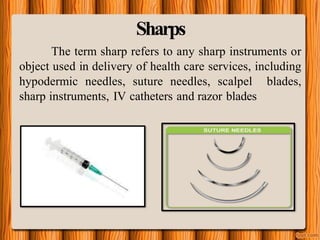
Sharps
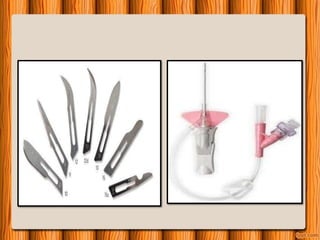
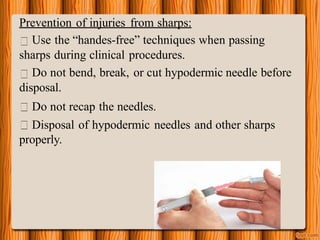
The term sharp refers to any sharp instruments or
object used in delivery of health care services, including
hypodermic needles, suture needles, scalpel blades,
sharp instruments, IV catheters and razor blades
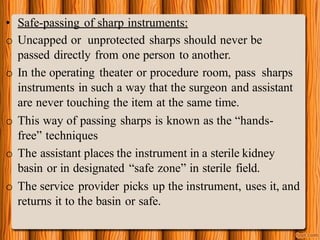
Prevention of injuries from sharps:
Use the “handes-free” techniques when passing
sharps during clinical procedures.
Do not bend, break, or cut hypodermic needle before
disposal.
Do not recap the needles.
Disposal of hypodermic needles and other sharps
properly.
• Safe-passing of sharp instruments:
o Uncapped or unprotected sharps should never be
passed directly from one person to another.
o In the operating theater or procedure room, pass sharps
instruments in such a way that the surgeon and assistant
are never touching the item at the same time.
o This way of passing sharps is known as the “hands-
free” techniques
o The assistant places the instrument in a sterile kidney
basin or in designated “safe zone” in sterile field.
o The service provider picks up the instrument, uses it, and
returns it to the basin or safe.
• Managing injuries and exposure:
If you are accidently exposed to blood or other
body fluids, either by needle stick, an injury
from another sharp object, and or a splash of
fluid
Wash the needle stick injury site with soap
and running water.
Flush the splashes to the nose, mouth or skin
with water.
Irrigate splashes to the eyes with water or
saline.
Immediately After Needle stick
injury
• Wash the needle stick injury site with soap and
running water.
• Do not squeeze
• Inform to ward incharge, floor supervisor, NS.
• Give your blood samples for investigation
• Post exposure prophylaxis:
Post exposure prophylaxis with drugs or other
therapy can reduce the risk of transmission of
some blood borne pathogens.
For hepatitis B: hepatitis B immune globulin and
hepatitis B vaccine can reduce the risk of infection after
exposure to blood or other body fluids containing the hepatitis B
virus.
For hepatitis C: there is no post exposure prophylaxis
available for hepatitis C. Neither immune globulin nor
antiviral drugs shown to reduce the risk of hepatitis C
transmission
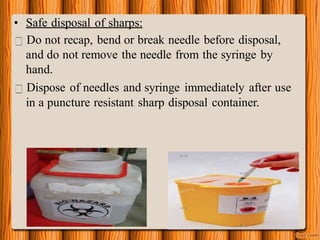
• Safe disposal of sharps:
Do not recap, bend or break needle before disposal,
and do not remove the needle from the syringe by
hand.
Dispose of needles and syringe immediately after use
in a puncture resistant sharp disposal container.
BIOMEDICAL WASTE
MANAGEMENT
Bio-medicalwasteisdefinedas“wastethatisgeneratedduring
thediagnosis,treatm
e
nt or im
m
unizationof hum
anbeingsand
arecontam
inatedwithpatient’s bodyfluids”
Typesof hospitalwaste
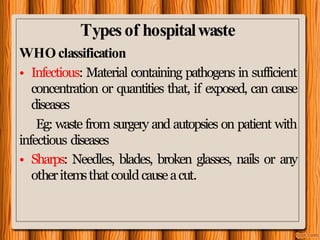
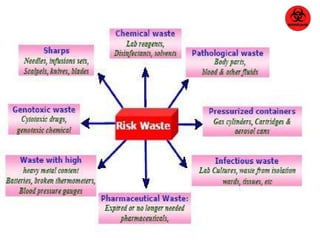
WHO classification
• Infectious: Material containing pathogens in sufficient
concentration or quantities that, if exposed, can cause
diseases
Eg: waste from surgery and autopsies on patient with
infectious diseases
• Sharps: Needles, blades, broken glasses, nails or any
otheritemsthatcouldcauseacut.
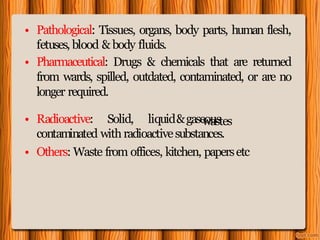
• Pathological: Tissues, organs, body parts, human flesh,
fetuses, blood & body fluids.
• Pharmaceutical: Drugs & chemicals that are returned
from wards, spilled, outdated, contaminated, or are no
longer required.
wastes
• Radioactive: Solid, liquid&gaseous
contaminated with radioactivesubstances.
• Others: Waste from offices, kitchen, papersetc
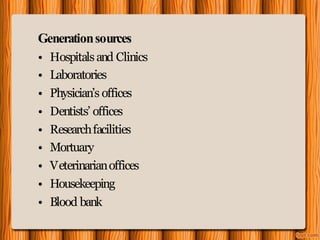
Generationsources
• Hospitalsand Clinics
• Laboratories
• Physician’s offices
• Dentists’ offices
• Researchfacilities
• Mortuary
• Veterinarianoffices
• Housekeeping
• Blood bank
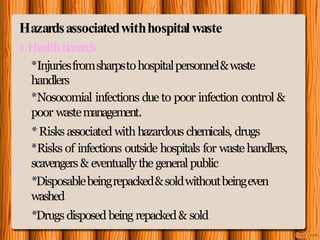
Hazardsassociatedwithhospitalwaste
1.Health hazards
*Injuriesfromsharpstohospitalpersonnel&waste
handlers
*Nosocomial infections due to poor infection control &
poor wastemanagement.
*Risks associated with hazardous chemicals, drugs
*Risks of infections outside hospitals for waste handlers,
scavengers& eventuallythe general public
*Disposablebeingrepacked&soldwithoutbeingeven
washed
*Drugs disposed being repacked& sold
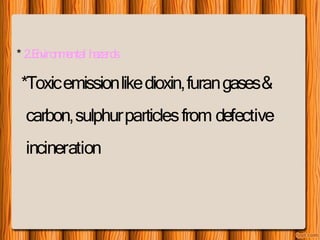
* 2.E
n
v
ironm
ental h
a
za
rd
s
*Toxicemissionlikedioxin,furangases&
carbon,sulphurparticlesfrom defective
incineration
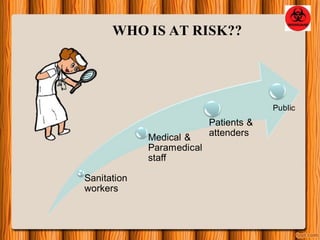
WHO IS AT RISK??
Sanitation
workers
Medical &
Paramedical
staff
Patients &
attenders
Public
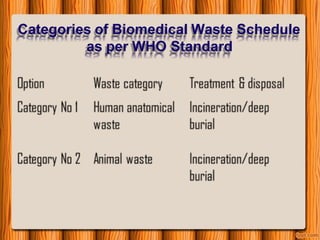
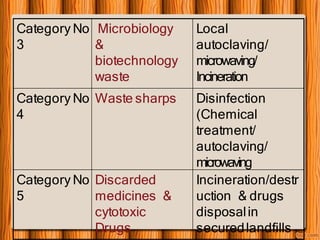
Categories of Biomedical Waste Schedule
as per WHO Standard
CategoryNo
3
Microbiology
&
biotechnology
waste
Local
autoclaving/
microwaving/
Incineration
CategoryNo
4
Waste sharps Disinfection
(Chemical
treatment/
autoclaving/
microwaving
CategoryNo
5
Discarded
medicines &
cytotoxic
Drugs
Incineration/destr
uction & drugs
disposalin
securedlandfills
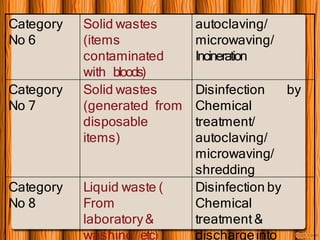
Category
No 6
Solid wastes
(items
contaminated
with bloods)
autoclaving/
microwaving/
Incineration
Category
No 7
Solid wastes
(generated from
disposable
items)
Disinfection by
Chemical
treatment/
autoclaving/
microwaving/
shredding
Category
No 8
Liquid waste (
From
laboratory&
washing etc)
Disinfection by
Chemical
treatment &
dischargeinto
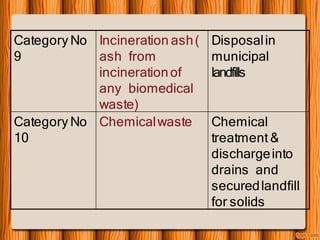
CategoryNo
9
Incineration ash(
ash from
incinerationof
any biomedical
waste)
Disposalin
municipal
landfills
Category No
10
Chemicalwaste Chemical
treatment &
dischargeinto
drains and
securedlandfill
for solids
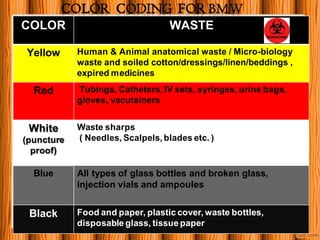
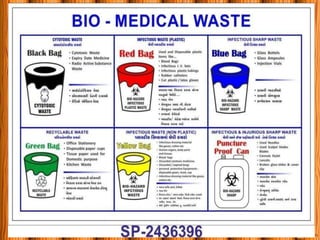
COLOR WASTE
Yellow Human & Animal anatomical waste / Micro-biology
waste and soiled cotton/dressings/linen/beddings ,
expired medicines
Red Tubings, Catheters, IV sets, syringes, urine bags,
gloves, vacutainers
White
(puncture
proof)
Waste sharps
( Needles, Scalpels,blades etc. )
Blue All types of glass bottles and broken glass,
injection vials and ampoules
Black Food and paper, plastic cover, waste bottles,
disposable glass, tissue paper
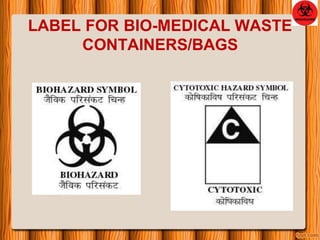
LABEL FOR BIO-MEDICAL WASTE
CONTAINERS/BAGS
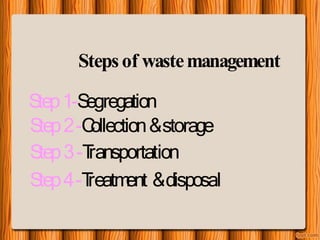
Steps of wastemanagement
S
tep1-S
egregation
S
tep2-C
ollection&storage
S
tep3-T
ransportation
S
tep4-T
reatm
ent &disposal
Segregation
“Storing of waste
in separate
container ”
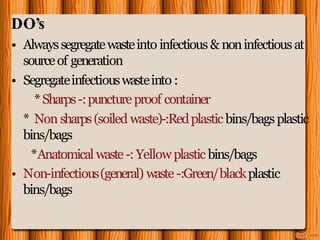
DO’s
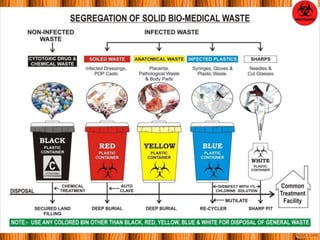
• Alwayssegregatewasteinto infectious& noninfectiousat
sourceof generation
• Segregateinfectiouswasteinto :
*Sharps-:punctureproof container
* Non sharps(soiled waste)-:Redplastic bins/bagsplastic
bins/bags
*Anatomical waste -:Yellowplastic bins/bags
• Non-infectious(general) waste-:Green/blackplastic
bins/bags
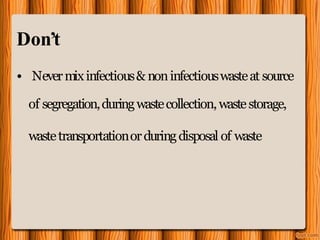
Don’t
• Nevermixinfectious& noninfectiouswasteat source
of segregation,duringwastecollection,wastestorage,
wastetransportationorduringdisposal of waste
Collection&Storage
DO’s
• Alwayscollect thewasteincoveredbins.
• Fill thebinsup to 3/4th level.
• Cleanregularlywithsoap& water.
Don’ts
• Neveroverfill thebins.
• Nevermixinfectious & noninfectious wasteinthe
sam
ebin
• Neverstorewastebeyond48hours.
Transportation
Do’s
• Always carrythe waste in closed containers from source of
generationto final disposal.
• Use dedicatedwaste collection bins for transporting waste .
Don’ts
• Nevertransport thewasteinopencontainers or bags, it
may spill & causespreadof infection.
• Nevertransport withsterileequipment
Treatment&disposal
Do’s
1. Always rememberto disinfect& mutilatethewaste
beforeitsfinaldisposal.
2. Rememberthefollowingwhiletreatingthewaste
streams.
*Anatomicalwasteto bedeepburied.
*Syringestobecut&chemicallydisinfectedat
sourceof generation, thendisposeinsharpspit.
*Infected plastic to be chemically disinfected or
autoclaved, shredded & recycled & sent for disposal into
municipal dumps
*General waste to be sent to municipal dumps for final
disposal
Don’ts
* Never throw infectious waste into general waste
without anypre-treatment& mutilation.