




Communication
   2013
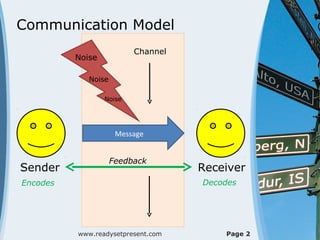
Communication Model
                          Channel
          Noise

             Noise

                  Noise


                      Message


                     Feedback
Sender                              Receiver
Encodes                             Decodes


          www.readysetpresent.com       Page 2
Program Objectives               (1 of 3)

    Identify steps in taking
     responsibility for your own
     communication.
    Explore the use of words, tone
     of voice, and body language in
     communication.
    Identify ways to establish
     rapport in communication.
    Compare “telling” and “asking”
     questions styles in solving
     problems.

           www.readysetpresent.com          Page 3
Program Objectives               (2 of 3)

    Recognize and understand the
     power of communication.
    Understand how problems
     develop due to poor listening
     skills.
    Identify specific communication
     problems, and apply treatments.

    Learn techniques to manage and
     ensure proper communication.


           www.readysetpresent.com          Page 4
Program Objectives                (3 of 3)

    Enhance your knowledge of
     nonverbal communication.
    Apply what you learn to the
     written word.
    Know how to use the last resort.
    Practice, role-play, discuss, and
     problem-solve.


            www.readysetpresent.com          Page 5
Definition of Communication
(1 of 2)

    The exchange of thoughts,
     messages, or the like, as by
     speech, signals or writing
    To express oneself in such a way
     that one is readily and clearly
     understood


           www.readysetpresent.com      Page 6
Definition of Communication
(2 of 2)

    Shared feelings/shared
     understanding.
    If you can honestly achieve that
     goal, you are communicating
     effectively.


           www.readysetpresent.com      Page 7
Feedback    (2 of 5)

  1. Evaluative: Making a judgment about
     the value of what the other person
     has said


  2. Interpretive: Attempting to discover
     the meaning of what the other
     person has said, often through
     paraphrasing


  3. Supportive: Helping or encouraging
     the other person in the conversation


          www.readysetpresent.com           Page 8
Communication Technology                   (4 of 4)

  – Communication technology can be
    very helpful, yet it is important to
    make sure that it is being used
    effectively.


  – If you use communication technology,
    be aware that your message may be
    misinterpreted.


  – Do not substitute communication
    technology for conversations that are
    delicate and must be dealt with face-
    to-face.


          www.readysetpresent.com            Page 9
Ten Barriers and Gateways


 www.readysetpresent.com    Page 10
Ten Barriers and Gateways
 2. Varying Perceptions Due to the
    Past
    Recognize that disagreements may
     result from different perceptions.
    Recognize that when someone
     disagrees with you, they are not
     inept.
    Discover the cause for the differing
     viewpoints.
    Understand the other person’s
     “frame of reference.”

           www.readysetpresent.com      Page 11
Communication and Culture                        (2 of 12)

    High Context Vs. Low Context
     Cultures:


     – High context cultures focus on group
       norms, values, decisions, and
       responsibilities. High context cultures
       are conformist.


     – Low context cultures focus on
       individuality, personal goals, personal
       achievements, and self-expression.
       Low context cultures are individualist.


             www.readysetpresent.com             Page 12
Business Communication              (3 of 7)


Consideration
   Focus on “I” and “We” for verbal
    communication.
   Focus on “You” for written
    communication.
   Show the reader the benefit they
    can receive, or at least show
    them sincerity.
   Emphasize the positive and
    pleasant facts.
   Apply integrity and ethics.
          www.readysetpresent.com        Page 13
Enhance
Relationships


 www.readysetpresent.com   Page 14
Accurate Verbal Following            (2 of 3)

    Utilize responses that relate
     directly to what the employee is
     speaking about.
    Do not jump to new topics or
     interrupt the employee. Instead,
     follow what he or she is saying.
    Take cues of what to say from
     the employee’s verbal and
     nonverbal communication.


           www.readysetpresent.com      Page 15
Interruptions
Are Positive


                www.readysetpresent.com   Page 16
What is
                      your next
                        step?


www.readysetpresent.com       Page 17
Download “Communication”
              PowerPoint presentation
             at ReadySetPresent.com

  171 slides include: 4 slides on a communication model and
definitions, 9 points on noise, 5 slides on feedback, points on the
         advantages of effective communication, 6 types of
 communication, 4 slides on communication technology, 5 slides
     on organizational communication, 6 slides on workplace
 communication, 3 communication formations, 3 slides on verbal
    communication vs. nonverbal communication, 12 slides on
  communication and culture, 10 keys to effective listening, 10
  barriers and gateways to communication, 7 slides on business
   communication, 9 points on effective listening, 10 points on
   criticism, 8 techniques for listening, 6 slides on attending, 7
 points on eye contact, 7 points on posture, 3 slides on accurate
verbal following, 6 points on improving listening skills, 4 slides on
               action steps, how to's and much more.
       Royalty Free - Use Them Over and Over Again.
            Updated & Expanded 2013
     Now: more content, graphics, and diagrams


                   www.readysetpresent.com                   Page 18

Communication PowerPoint PPT Content Modern Sample

  • 1.
  • 2.
    Communication Model Channel Noise Noise Noise Message Feedback Sender Receiver Encodes Decodes www.readysetpresent.com Page 2
  • 3.
    Program Objectives (1 of 3)  Identify steps in taking responsibility for your own communication.  Explore the use of words, tone of voice, and body language in communication.  Identify ways to establish rapport in communication.  Compare “telling” and “asking” questions styles in solving problems. www.readysetpresent.com Page 3
  • 4.
    Program Objectives (2 of 3)  Recognize and understand the power of communication.  Understand how problems develop due to poor listening skills.  Identify specific communication problems, and apply treatments.  Learn techniques to manage and ensure proper communication. www.readysetpresent.com Page 4
  • 5.
    Program Objectives (3 of 3)  Enhance your knowledge of nonverbal communication.  Apply what you learn to the written word.  Know how to use the last resort.  Practice, role-play, discuss, and problem-solve. www.readysetpresent.com Page 5
  • 6.
    Definition of Communication (1of 2)  The exchange of thoughts, messages, or the like, as by speech, signals or writing  To express oneself in such a way that one is readily and clearly understood www.readysetpresent.com Page 6
  • 7.
    Definition of Communication (2of 2)  Shared feelings/shared understanding.  If you can honestly achieve that goal, you are communicating effectively. www.readysetpresent.com Page 7
  • 8.
    Feedback (2 of 5) 1. Evaluative: Making a judgment about the value of what the other person has said 2. Interpretive: Attempting to discover the meaning of what the other person has said, often through paraphrasing 3. Supportive: Helping or encouraging the other person in the conversation www.readysetpresent.com Page 8
  • 9.
    Communication Technology (4 of 4) – Communication technology can be very helpful, yet it is important to make sure that it is being used effectively. – If you use communication technology, be aware that your message may be misinterpreted. – Do not substitute communication technology for conversations that are delicate and must be dealt with face- to-face. www.readysetpresent.com Page 9
  • 10.
    Ten Barriers andGateways www.readysetpresent.com Page 10
  • 11.
    Ten Barriers andGateways 2. Varying Perceptions Due to the Past  Recognize that disagreements may result from different perceptions.  Recognize that when someone disagrees with you, they are not inept.  Discover the cause for the differing viewpoints.  Understand the other person’s “frame of reference.” www.readysetpresent.com Page 11
  • 12.
    Communication and Culture (2 of 12)  High Context Vs. Low Context Cultures: – High context cultures focus on group norms, values, decisions, and responsibilities. High context cultures are conformist. – Low context cultures focus on individuality, personal goals, personal achievements, and self-expression. Low context cultures are individualist. www.readysetpresent.com Page 12
  • 13.
    Business Communication (3 of 7) Consideration  Focus on “I” and “We” for verbal communication.  Focus on “You” for written communication.  Show the reader the benefit they can receive, or at least show them sincerity.  Emphasize the positive and pleasant facts.  Apply integrity and ethics. www.readysetpresent.com Page 13
  • 14.
  • 15.
    Accurate Verbal Following (2 of 3)  Utilize responses that relate directly to what the employee is speaking about.  Do not jump to new topics or interrupt the employee. Instead, follow what he or she is saying.  Take cues of what to say from the employee’s verbal and nonverbal communication. www.readysetpresent.com Page 15
  • 16.
    Interruptions Are Positive www.readysetpresent.com Page 16
  • 17.
    What is your next step? www.readysetpresent.com Page 17
  • 18.
    Download “Communication” PowerPoint presentation at ReadySetPresent.com 171 slides include: 4 slides on a communication model and definitions, 9 points on noise, 5 slides on feedback, points on the advantages of effective communication, 6 types of communication, 4 slides on communication technology, 5 slides on organizational communication, 6 slides on workplace communication, 3 communication formations, 3 slides on verbal communication vs. nonverbal communication, 12 slides on communication and culture, 10 keys to effective listening, 10 barriers and gateways to communication, 7 slides on business communication, 9 points on effective listening, 10 points on criticism, 8 techniques for listening, 6 slides on attending, 7 points on eye contact, 7 points on posture, 3 slides on accurate verbal following, 6 points on improving listening skills, 4 slides on action steps, how to's and much more. Royalty Free - Use Them Over and Over Again. Updated & Expanded 2013 Now: more content, graphics, and diagrams www.readysetpresent.com Page 18