Communication
(Sample)
Definition of Communication
(1 of 2)
 The exchange of thoughts,
messages, or the like, as by
speech, signals or writing
 To express oneself in such a way
that one is readily and clearly
understood
www.readysetpresent.com Page 2
Communication Model
www.readysetpresent.com Page 3
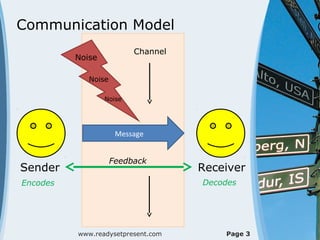
Sender Receiver
Message
Encodes Decodes
Noise
Noise
Noise
Feedback
Channel
Feedback (2 of 5)
1. Evaluative: Making a judgment about
the value of what the other person
has said
2. Interpretive: Attempting to discover
the meaning of what the other
person has said, often through
paraphrasing
3. Supportive: Helping or encouraging
the other person in the conversation
www.readysetpresent.com Page 4
Communication Technology (4 of 4)
– Communication technology can be
very helpful, yet it is important to
make sure that it is being used
effectively.
– If you use communication technology,
be aware that your message may be
misinterpreted.
– Do not substitute communication
technology for conversations that are
delicate and must be dealt with face-
to-face.
www.readysetpresent.com Page 5
Ten Barriers and Gateways
2. Varying Perceptions Due to the
Past
 Recognize that disagreements may
result from different perceptions.
 Recognize that when someone
disagrees with you, they are not
inept.
 Discover the cause for the differing
viewpoints.
 Understand the other person’s
“frame of reference.”
www.readysetpresent.com Page 6
Communication and Culture (2 of 12)
 High Context Vs. Low Context
Cultures:
– High context cultures focus on group
norms, values, decisions, and
responsibilities. High context cultures
are conformist.
– Low context cultures focus on
individuality, personal goals, personal
achievements, and self-expression.
Low context cultures are individualist.
www.readysetpresent.com Page 7
Business Communication (3 of 7)
Consideration
 Focus on “I” and “We” for verbal
communication.
 Focus on “You” for written
communication.
 Show the reader the benefit they
can receive, or at least show
them sincerity.
 Emphasize the positive and
pleasant facts.
 Apply integrity and ethics.
www.readysetpresent.com Page 8
Accurate Verbal Following (2 of 3)
 Utilize responses that relate
directly to what the employee is
speaking about.
 Do not jump to new topics or
interrupt the employee. Instead,
follow what he or she is saying.
 Take cues of what to say from
the employee’s verbal and
nonverbal communication.
www.readysetpresent.com Page 9
Download “Communication”
PowerPoint presentation
at ReadySetPresent.com
Slides include: 4 slides on a communication model and
definitions, 9 points on noise, 5 slides on feedback, points
on the advantages of effective communication, 6 types of
communication, 4 slides on communication technology, 5
slides on organizational communication, 6 slides on
workplace communication, 3 communication formations, 3
slides on verbal communication vs. nonverbal
communication, 12 slides on communication and culture,
10 keys to effective listening, 10 barriers and gateways to
communication, 7 slides on business communication, 9
points on effective listening, 10 points on criticism, 8
techniques for listening, 6 slides on attending, 7 points on
eye contact, 7 points on posture, 3 slides on accurate
verbal following, 6 points on improving listening skills, 4
slides on action steps, how to's and much more.
Royalty Free - Use Them Over and Over Again.
Now: more content, graphics, and diagrams
www.readysetpresent.com Page 10

Communication

  • 1.
  • 2.
    Definition of Communication (1of 2)  The exchange of thoughts, messages, or the like, as by speech, signals or writing  To express oneself in such a way that one is readily and clearly understood www.readysetpresent.com Page 2
  • 3.
    Communication Model www.readysetpresent.com Page3 Sender Receiver Message Encodes Decodes Noise Noise Noise Feedback Channel
  • 4.
    Feedback (2 of5) 1. Evaluative: Making a judgment about the value of what the other person has said 2. Interpretive: Attempting to discover the meaning of what the other person has said, often through paraphrasing 3. Supportive: Helping or encouraging the other person in the conversation www.readysetpresent.com Page 4
  • 5.
    Communication Technology (4of 4) – Communication technology can be very helpful, yet it is important to make sure that it is being used effectively. – If you use communication technology, be aware that your message may be misinterpreted. – Do not substitute communication technology for conversations that are delicate and must be dealt with face- to-face. www.readysetpresent.com Page 5
  • 6.
    Ten Barriers andGateways 2. Varying Perceptions Due to the Past  Recognize that disagreements may result from different perceptions.  Recognize that when someone disagrees with you, they are not inept.  Discover the cause for the differing viewpoints.  Understand the other person’s “frame of reference.” www.readysetpresent.com Page 6
  • 7.
    Communication and Culture(2 of 12)  High Context Vs. Low Context Cultures: – High context cultures focus on group norms, values, decisions, and responsibilities. High context cultures are conformist. – Low context cultures focus on individuality, personal goals, personal achievements, and self-expression. Low context cultures are individualist. www.readysetpresent.com Page 7
  • 8.
    Business Communication (3of 7) Consideration  Focus on “I” and “We” for verbal communication.  Focus on “You” for written communication.  Show the reader the benefit they can receive, or at least show them sincerity.  Emphasize the positive and pleasant facts.  Apply integrity and ethics. www.readysetpresent.com Page 8
  • 9.
    Accurate Verbal Following(2 of 3)  Utilize responses that relate directly to what the employee is speaking about.  Do not jump to new topics or interrupt the employee. Instead, follow what he or she is saying.  Take cues of what to say from the employee’s verbal and nonverbal communication. www.readysetpresent.com Page 9
  • 10.
    Download “Communication” PowerPoint presentation atReadySetPresent.com Slides include: 4 slides on a communication model and definitions, 9 points on noise, 5 slides on feedback, points on the advantages of effective communication, 6 types of communication, 4 slides on communication technology, 5 slides on organizational communication, 6 slides on workplace communication, 3 communication formations, 3 slides on verbal communication vs. nonverbal communication, 12 slides on communication and culture, 10 keys to effective listening, 10 barriers and gateways to communication, 7 slides on business communication, 9 points on effective listening, 10 points on criticism, 8 techniques for listening, 6 slides on attending, 7 points on eye contact, 7 points on posture, 3 slides on accurate verbal following, 6 points on improving listening skills, 4 slides on action steps, how to's and much more. Royalty Free - Use Them Over and Over Again. Now: more content, graphics, and diagrams www.readysetpresent.com Page 10