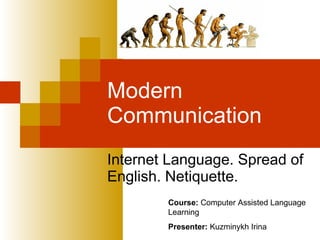
Modern Communication Internet Language. Spread of English. Netiquette.  Course:  Computer Assisted Language Learning Presenter:  Kuzminykh Irina
 
Today’s Agenda: History of Communication Non-Verbal Communication Modern communication with the help of computer Internet Language Netiquette
Non-Verbal Communication Try to define “ Communication ” in one sentence. the process of giving information or of making emotions or ideas known to someone the process of speaking or writing to someone to exchange information or ideas
History of Communication: Timeline
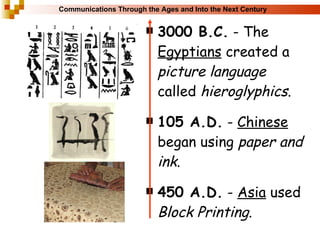
3000 B.C.  - The  Egyptians  created a  picture language  called  hieroglyphics . 105 A.D.  -  Chinese  began using  paper and ink . 450 A.D.  -  Asia  used  Block Printing . Communications Through the Ages and Into the Next Century
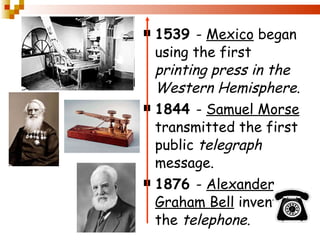
1539  -  Mexico  began using the first  printing press in the Western Hemisphere . 1844  -  Samuel Morse  transmitted the first public  telegraph  message. 1876  -  Alexander Graham Bell  invented the  telephone .
1936  -  First television  broadcast made in  London, England . 1941  -  Z3 computer  developed by  German  engineer  Konrad Zuse . 1954  -  Color television broadcast standards  are set in  the U.S.
1957  -  Satellite  first sent information back to earth. 1999  - Intel introduces the  Pentium III processor , taking personal computing to new heights.
Modern Communication Computers are a key part of modern communication.  When you use a computer, English is very useful.    why?  One reason is because English is an international language.
In 1994 only 35% of schools had internet access. Today more than 90% of schools have internet access. Past vs. Present
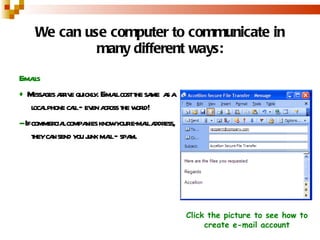
We can use computer to communicate in many different ways: E-mails +  Messages arrive quickly. E-mail cost the same  as a local phone call – even across the world! --  If commercial companies know your e-mail address, they can send you junk mail – spam. Click the picture to see how to create e-mail account
Chat Rooms +  Immediate communication: it’s like writing a phone call! There are hundreds of “special interest” discussion groups. --  You have to type quickly! Do not give your personal information! !  You will have to register and create a special codename to log in – don’t forget it!
 
Blog  +  This is a nice way to record your thoughts every day. It is a kind of interactive diary. You can read other people’s ideas, and comment on them. --  When you create a blog, you have to update it every few days. Lots of work!
E - commerce +  You can buy things without going out. Your purchase are delivered to your house: no need to carry heavy bags! --  You can’t see real things before you buy it! You can’t try clothes on!
Online communication How is  written  language different from  oral  speech? The language of online communication is called  “Internet language” . It is a slang that Internet users have created with the purpose of saving keystrokes.
Cases of Internet Slang Abbreviations and Acronyms (the most used kind of Internet slang) Emoticons = “Smileys” Format tagging
Abbreviations and Acronyms Abbreviation  – is a shortened form of a word or phrase used chiefly in writing to represent the complete form, such as  Dr. = Doctor; Mass. = Massachusetts . Acronym  – is a word formed from the initial letters of a name, such as  USA , or by combining initial letters of a series of words:  RADAR = RAdio Detecting And Ranging
List of frequent acronyms: ASAP BBL BTW  FAQs  IMHO  LOL  CUL  F2F  OMG  TTYL =  as soon as possible = be back later =  by the way = frequently asked questions = in my humble opinion = laugh out loud = see you later = face to face =  oh my god! = talk to you later
Cn i B Yr VLNT9?   =   Can I be your Valentine? OMG  =  Oh My God, Oh My Gosh, etc. w00t!, woot!   =   "All right!", "Okay!" or similar How would it sound if everyone talked using internet slang? (click the picture to see)
Emoticons = “Smileys” a sequence of characters which resembles human ace and conveys an emotion Western Style Can be easily recognized by tilting one’s head left: :-)  :-(  :-D  B-) East Asian Style Do not require the view to tilt one’s head (*_*)  <(^_^)>
The smiley has become an essential of Internet culture. A smiley face adorns the north side of the water tower in Hammond, Illinois.
Format tagging A variation of tagging meant to resemble XML or HTML code is used to give emphasis on posts, blogs, forums and message boards. Ex.:   <b>  and  </b>  are placed around the text, a web browser will display it in  boldface.
Greetings   People in the  West  usually  shake hands  when they first meet. Middle Eastern  cultures  kiss  each other 3 times on the cheeks. The  Japanese  bring their hands together in front of their face.  Bowing  in Japan, Thailand and India is also a part of normal greeting. The  online community , too, has its own culture and customs. Good internet behaviour is called  Netiquette .
Netiquette  Netiquette includes more than good spelling and grammar. Typing in all upper case is bad as it is the same as SHOUTING. Not starting your sentences with capital sentences is bad. It is also bad netiquette to send people spam!
How well do you remember this lesson?
Our Class Blog Post lessons Post tasks Connect with you
Video: how to create own blog  http://www.youtube.com/watch?v=BnploFsS_tY
The End

Modern communication

  • 1.
    Modern Communication InternetLanguage. Spread of English. Netiquette. Course: Computer Assisted Language Learning Presenter: Kuzminykh Irina
  • 2.
  • 3.
    Today’s Agenda: Historyof Communication Non-Verbal Communication Modern communication with the help of computer Internet Language Netiquette
  • 4.
    Non-Verbal Communication Tryto define “ Communication ” in one sentence. the process of giving information or of making emotions or ideas known to someone the process of speaking or writing to someone to exchange information or ideas
  • 5.
  • 6.
    3000 B.C. - The Egyptians created a picture language called hieroglyphics . 105 A.D. - Chinese began using paper and ink . 450 A.D. - Asia used Block Printing . Communications Through the Ages and Into the Next Century
  • 7.
    1539 - Mexico began using the first printing press in the Western Hemisphere . 1844 - Samuel Morse transmitted the first public telegraph message. 1876 - Alexander Graham Bell invented the telephone .
  • 8.
    1936 - First television broadcast made in London, England . 1941 - Z3 computer developed by German engineer Konrad Zuse . 1954 - Color television broadcast standards are set in the U.S.
  • 9.
    1957 - Satellite first sent information back to earth. 1999 - Intel introduces the Pentium III processor , taking personal computing to new heights.
  • 10.
    Modern Communication Computersare a key part of modern communication. When you use a computer, English is very useful.  why? One reason is because English is an international language.
  • 11.
    In 1994 only35% of schools had internet access. Today more than 90% of schools have internet access. Past vs. Present
  • 12.
    We can usecomputer to communicate in many different ways: E-mails + Messages arrive quickly. E-mail cost the same as a local phone call – even across the world! -- If commercial companies know your e-mail address, they can send you junk mail – spam. Click the picture to see how to create e-mail account
  • 13.
    Chat Rooms + Immediate communication: it’s like writing a phone call! There are hundreds of “special interest” discussion groups. -- You have to type quickly! Do not give your personal information! ! You will have to register and create a special codename to log in – don’t forget it!
  • 14.
  • 15.
    Blog + This is a nice way to record your thoughts every day. It is a kind of interactive diary. You can read other people’s ideas, and comment on them. -- When you create a blog, you have to update it every few days. Lots of work!
  • 16.
    E - commerce+ You can buy things without going out. Your purchase are delivered to your house: no need to carry heavy bags! -- You can’t see real things before you buy it! You can’t try clothes on!
  • 17.
    Online communication Howis written language different from oral speech? The language of online communication is called “Internet language” . It is a slang that Internet users have created with the purpose of saving keystrokes.
  • 18.
    Cases of InternetSlang Abbreviations and Acronyms (the most used kind of Internet slang) Emoticons = “Smileys” Format tagging
  • 19.
    Abbreviations and AcronymsAbbreviation – is a shortened form of a word or phrase used chiefly in writing to represent the complete form, such as Dr. = Doctor; Mass. = Massachusetts . Acronym – is a word formed from the initial letters of a name, such as USA , or by combining initial letters of a series of words: RADAR = RAdio Detecting And Ranging
  • 20.
    List of frequentacronyms: ASAP BBL BTW FAQs IMHO LOL CUL F2F OMG TTYL = as soon as possible = be back later = by the way = frequently asked questions = in my humble opinion = laugh out loud = see you later = face to face = oh my god! = talk to you later
  • 21.
    Cn i BYr VLNT9? = Can I be your Valentine? OMG = Oh My God, Oh My Gosh, etc. w00t!, woot! = &quot;All right!&quot;, &quot;Okay!&quot; or similar How would it sound if everyone talked using internet slang? (click the picture to see)
  • 22.
    Emoticons = “Smileys”a sequence of characters which resembles human ace and conveys an emotion Western Style Can be easily recognized by tilting one’s head left: :-) :-( :-D B-) East Asian Style Do not require the view to tilt one’s head (*_*) <(^_^)>
  • 23.
    The smiley hasbecome an essential of Internet culture. A smiley face adorns the north side of the water tower in Hammond, Illinois.
  • 24.
    Format tagging Avariation of tagging meant to resemble XML or HTML code is used to give emphasis on posts, blogs, forums and message boards. Ex.: <b> and </b> are placed around the text, a web browser will display it in boldface.
  • 25.
    Greetings People in the West usually shake hands when they first meet. Middle Eastern cultures kiss each other 3 times on the cheeks. The Japanese bring their hands together in front of their face. Bowing in Japan, Thailand and India is also a part of normal greeting. The online community , too, has its own culture and customs. Good internet behaviour is called Netiquette .
  • 26.
    Netiquette Netiquetteincludes more than good spelling and grammar. Typing in all upper case is bad as it is the same as SHOUTING. Not starting your sentences with capital sentences is bad. It is also bad netiquette to send people spam!
  • 27.
    How well doyou remember this lesson?
  • 28.
    Our Class BlogPost lessons Post tasks Connect with you
  • 29.
    Video: how tocreate own blog http://www.youtube.com/watch?v=BnploFsS_tY
  • 30.

Editor's Notes

  • #5 Eyes, face, body and appearance can send non-verbal messages * possible activity – game with 5 squares (Educational Leadership class in Albany)