Digital Communication Basics

                  Prof. Anish Goel
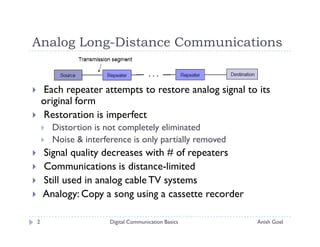
Analog Long-Distance Communications


    Each repeater attempts to restore analog signal to its
    original form
    Restoration is imperfect
      Distortion is not completely eliminated
      Noise & interference is only partially removed
    Signal quality decreases with # of repeaters
    Communications is distance-limited
    Still used in analog cable TV systems
    Analogy: Copy a song using a cassette recorder

2                    Digital Communication Basics      Anish Goel
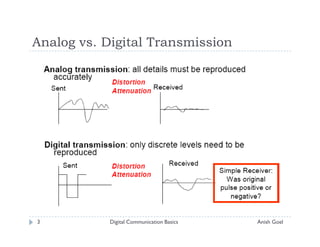
Analog vs. Digital Transmission


3           Digital Communication Basics   Anish Goel
Digital Long-Distance Communications


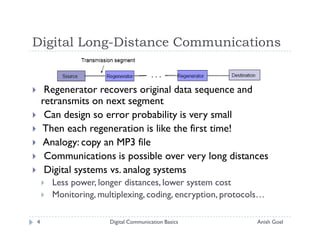
     Regenerator recovers original data sequence and
    retransmits on next segment
     Can design so error probability is very small
    Then each regeneration is like the first time!
    Analogy: copy an MP3 file
     Communications is possible over very long distances
     Digital systems vs. analog systems
      Less power, longer distances, lower system cost
      Monitoring, multiplexing, coding, encryption, protocols…

4                    Digital Communication Basics           Anish Goel
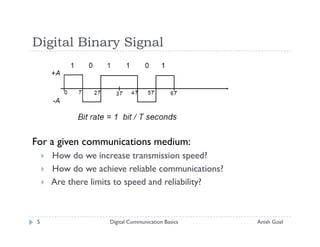
Digital Binary Signal


For a given communications medium:
     How do we increase transmission speed?
     How do we achieve reliable communications?
     Are there limits to speed and reliability?


 5                 Digital Communication Basics   Anish Goel
Pulse Transmission Rate
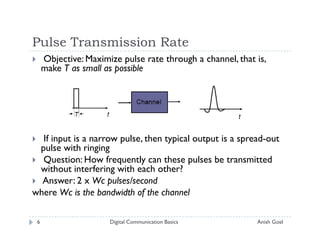
     Objective: Maximize pulse rate through a channel, that is,
     make T as small as possible


  If input is a narrow pulse, then typical output is a spread-out
 pulse with ringing
  Question: How frequently can these pulses be transmitted
 without interfering with each other?
  Answer: 2 x Wc pulses/second
where Wc is the bandwidth of the channel

 6                    Digital Communication Basics          Anish Goel
Bandwidth of a Channel


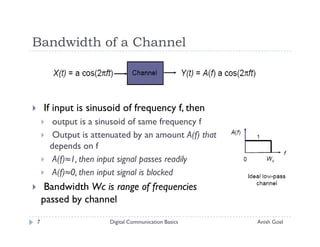
    If input is sinusoid of frequency f, then
       output is a sinusoid of same frequency f
       Output is attenuated by an amount A(f) that
      depends on f
       A(f)≈1, then input signal passes readily
       A(f)≈0, then input signal is blocked
     Bandwidth Wc is range of frequencies
    passed by channel

7                    Digital Communication Basics    Anish Goel
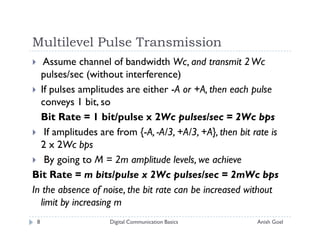
Multilevel Pulse Transmission
   Assume channel of bandwidth Wc, and transmit 2 Wc
  pulses/sec (without interference)
  If pulses amplitudes are either -A or +A, then each pulse
  conveys 1 bit, so
  Bit Rate = 1 bit/pulse x 2Wc pulses/sec = 2Wc bps
   If amplitudes are from {-A, -A/3, +A/3, +A}, then bit rate is
  2 x 2Wc bps
   By going to M = 2m amplitude levels, we achieve
Bit Rate = m bits/pulse x 2Wc pulses/sec = 2mWc bps
In the absence of noise, the bit rate can be increased without
  limit by increasing m
 8                  Digital Communication Basics          Anish Goel
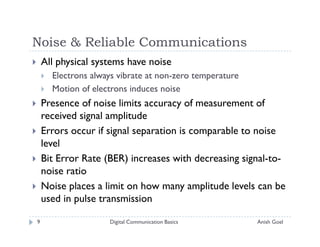
Noise & Reliable Communications
    All physical systems have noise
      Electrons always vibrate at non-zero temperature
      Motion of electrons induces noise
    Presence of noise limits accuracy of measurement of
    received signal amplitude
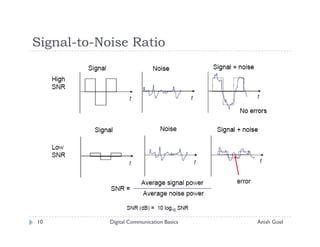
    Errors occur if signal separation is comparable to noise
    level
    Bit Error Rate (BER) increases with decreasing signal-to-
    noise ratio
    Noise places a limit on how many amplitude levels can be
    used in pulse transmission

9                   Digital Communication Basics         Anish Goel
Signal-to-Noise Ratio


10          Digital Communication Basics   Anish Goel
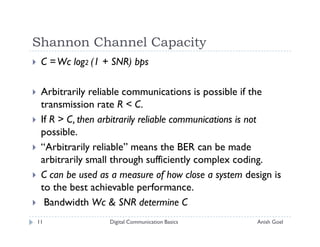
Shannon Channel Capacity
 C = Wc log2 (1 + SNR) bps

 Arbitrarily reliable communications is possible if the
 transmission rate R < C.
 If R > C, then arbitrarily reliable communications is not
 possible.
 “Arbitrarily reliable” means the BER can be made
 arbitrarily small through sufficiently complex coding.
 C can be used as a measure of how close a system design is
 to the best achievable performance.
  Bandwidth Wc & SNR determine C
11               Digital Communication Basics        Anish Goel
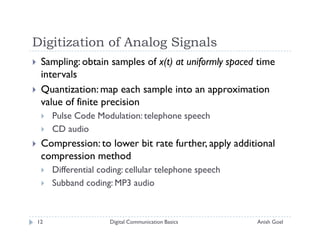
Digitization of Analog Signals
 Sampling: obtain samples of x(t) at uniformly spaced time
 intervals
 Quantization: map each sample into an approximation
 value of finite precision
     Pulse Code Modulation: telephone speech
     CD audio
 Compression: to lower bit rate further, apply additional
 compression method
     Differential coding: cellular telephone speech
     Subband coding: MP3 audio


12                  Digital Communication Basics      Anish Goel
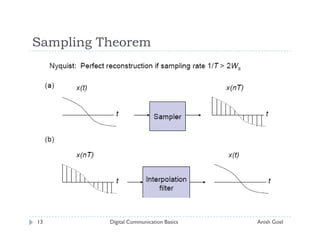
Sampling Theorem


13        Digital Communication Basics   Anish Goel
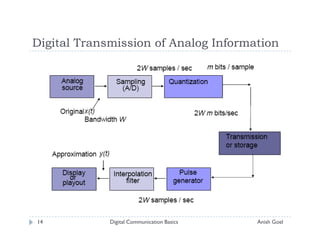
Digital Transmission of Analog Information


14           Digital Communication Basics   Anish Goel
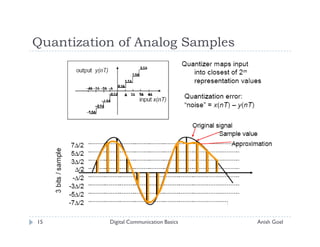
Quantization of Analog Samples


15         Digital Communication Basics   Anish Goel
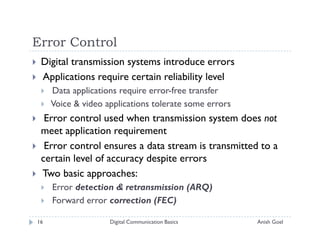
Error Control
 Digital transmission systems introduce errors
 Applications require certain reliability level
     Data applications require error-free transfer
     Voice & video applications tolerate some errors
  Error control used when transmission system does not
 meet application requirement
  Error control ensures a data stream is transmitted to a
 certain level of accuracy despite errors
 Two basic approaches:
     Error detection & retransmission (ARQ)
     Forward error correction (FEC)

16                  Digital Communication Basics       Anish Goel
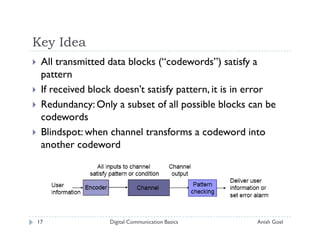
Key Idea
 All transmitted data blocks (“codewords”) satisfy a
 pattern
 If received block doesn’t satisfy pattern, it is in error
 Redundancy: Only a subset of all possible blocks can be
 codewords
 Blindspot: when channel transforms a codeword into
 another codeword


17               Digital Communication Basics        Anish Goel
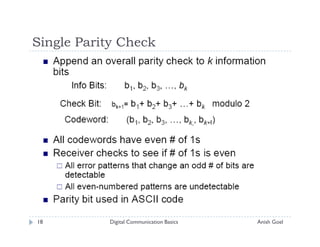
Single Parity Check


18         Digital Communication Basics   Anish Goel
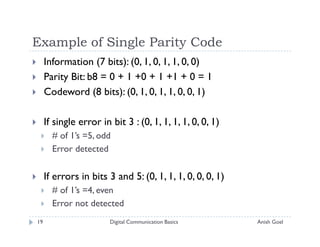
Example of Single Parity Code
     Information (7 bits): (0, 1, 0, 1, 1, 0, 0)
     Parity Bit: b8 = 0 + 1 +0 + 1 +1 + 0 = 1
     Codeword (8 bits): (0, 1, 0, 1, 1, 0, 0, 1)

     If single error in bit 3 : (0, 1, 1, 1, 1, 0, 0, 1)
       # of 1’s =5, odd
       Error detected

     If errors in bits 3 and 5: (0, 1, 1, 1, 0, 0, 0, 1)
       # of 1’s =4, even
       Error not detected
19                      Digital Communication Basics       Anish Goel

Communication Networks II

  • 1.
  • 2.
    Analog Long-Distance Communications Each repeater attempts to restore analog signal to its original form Restoration is imperfect Distortion is not completely eliminated Noise & interference is only partially removed Signal quality decreases with # of repeaters Communications is distance-limited Still used in analog cable TV systems Analogy: Copy a song using a cassette recorder 2 Digital Communication Basics Anish Goel
  • 3.
    Analog vs. DigitalTransmission 3 Digital Communication Basics Anish Goel
  • 4.
    Digital Long-Distance Communications Regenerator recovers original data sequence and retransmits on next segment Can design so error probability is very small Then each regeneration is like the first time! Analogy: copy an MP3 file Communications is possible over very long distances Digital systems vs. analog systems Less power, longer distances, lower system cost Monitoring, multiplexing, coding, encryption, protocols… 4 Digital Communication Basics Anish Goel
  • 5.
    Digital Binary Signal Fora given communications medium: How do we increase transmission speed? How do we achieve reliable communications? Are there limits to speed and reliability? 5 Digital Communication Basics Anish Goel
  • 6.
    Pulse Transmission Rate Objective: Maximize pulse rate through a channel, that is, make T as small as possible If input is a narrow pulse, then typical output is a spread-out pulse with ringing Question: How frequently can these pulses be transmitted without interfering with each other? Answer: 2 x Wc pulses/second where Wc is the bandwidth of the channel 6 Digital Communication Basics Anish Goel
  • 7.
    Bandwidth of aChannel If input is sinusoid of frequency f, then output is a sinusoid of same frequency f Output is attenuated by an amount A(f) that depends on f A(f)≈1, then input signal passes readily A(f)≈0, then input signal is blocked Bandwidth Wc is range of frequencies passed by channel 7 Digital Communication Basics Anish Goel
  • 8.
    Multilevel Pulse Transmission Assume channel of bandwidth Wc, and transmit 2 Wc pulses/sec (without interference) If pulses amplitudes are either -A or +A, then each pulse conveys 1 bit, so Bit Rate = 1 bit/pulse x 2Wc pulses/sec = 2Wc bps If amplitudes are from {-A, -A/3, +A/3, +A}, then bit rate is 2 x 2Wc bps By going to M = 2m amplitude levels, we achieve Bit Rate = m bits/pulse x 2Wc pulses/sec = 2mWc bps In the absence of noise, the bit rate can be increased without limit by increasing m 8 Digital Communication Basics Anish Goel
  • 9.
    Noise & ReliableCommunications All physical systems have noise Electrons always vibrate at non-zero temperature Motion of electrons induces noise Presence of noise limits accuracy of measurement of received signal amplitude Errors occur if signal separation is comparable to noise level Bit Error Rate (BER) increases with decreasing signal-to- noise ratio Noise places a limit on how many amplitude levels can be used in pulse transmission 9 Digital Communication Basics Anish Goel
  • 10.
    Signal-to-Noise Ratio 10 Digital Communication Basics Anish Goel
  • 11.
    Shannon Channel Capacity C = Wc log2 (1 + SNR) bps Arbitrarily reliable communications is possible if the transmission rate R < C. If R > C, then arbitrarily reliable communications is not possible. “Arbitrarily reliable” means the BER can be made arbitrarily small through sufficiently complex coding. C can be used as a measure of how close a system design is to the best achievable performance. Bandwidth Wc & SNR determine C 11 Digital Communication Basics Anish Goel
  • 12.
    Digitization of AnalogSignals Sampling: obtain samples of x(t) at uniformly spaced time intervals Quantization: map each sample into an approximation value of finite precision Pulse Code Modulation: telephone speech CD audio Compression: to lower bit rate further, apply additional compression method Differential coding: cellular telephone speech Subband coding: MP3 audio 12 Digital Communication Basics Anish Goel
  • 13.
    Sampling Theorem 13 Digital Communication Basics Anish Goel
  • 14.
    Digital Transmission ofAnalog Information 14 Digital Communication Basics Anish Goel
  • 15.
    Quantization of AnalogSamples 15 Digital Communication Basics Anish Goel
  • 16.
    Error Control Digitaltransmission systems introduce errors Applications require certain reliability level Data applications require error-free transfer Voice & video applications tolerate some errors Error control used when transmission system does not meet application requirement Error control ensures a data stream is transmitted to a certain level of accuracy despite errors Two basic approaches: Error detection & retransmission (ARQ) Forward error correction (FEC) 16 Digital Communication Basics Anish Goel
  • 17.
    Key Idea Alltransmitted data blocks (“codewords”) satisfy a pattern If received block doesn’t satisfy pattern, it is in error Redundancy: Only a subset of all possible blocks can be codewords Blindspot: when channel transforms a codeword into another codeword 17 Digital Communication Basics Anish Goel
  • 18.
    Single Parity Check 18 Digital Communication Basics Anish Goel
  • 19.
    Example of SingleParity Code Information (7 bits): (0, 1, 0, 1, 1, 0, 0) Parity Bit: b8 = 0 + 1 +0 + 1 +1 + 0 = 1 Codeword (8 bits): (0, 1, 0, 1, 1, 0, 0, 1) If single error in bit 3 : (0, 1, 1, 1, 1, 0, 0, 1) # of 1’s =5, odd Error detected If errors in bits 3 and 5: (0, 1, 1, 1, 0, 0, 0, 1) # of 1’s =4, even Error not detected 19 Digital Communication Basics Anish Goel