TRANSMISSION
OF
DIGITAL SIGNALS
Pranshu Pathak
Sachin Artani
IT-B
DIGITAL SIGNALS
2
A digital signal refers to an electrical signal that
is converted into a pattern of bits. Unlike an
analog signal, which is a continuous signal that
contains time-varying quantities, a digital
signal has a discrete value at each sampling
point.
CLASSIFICATION OF DIGITAL SIGNALS
TRANSMISSION
3
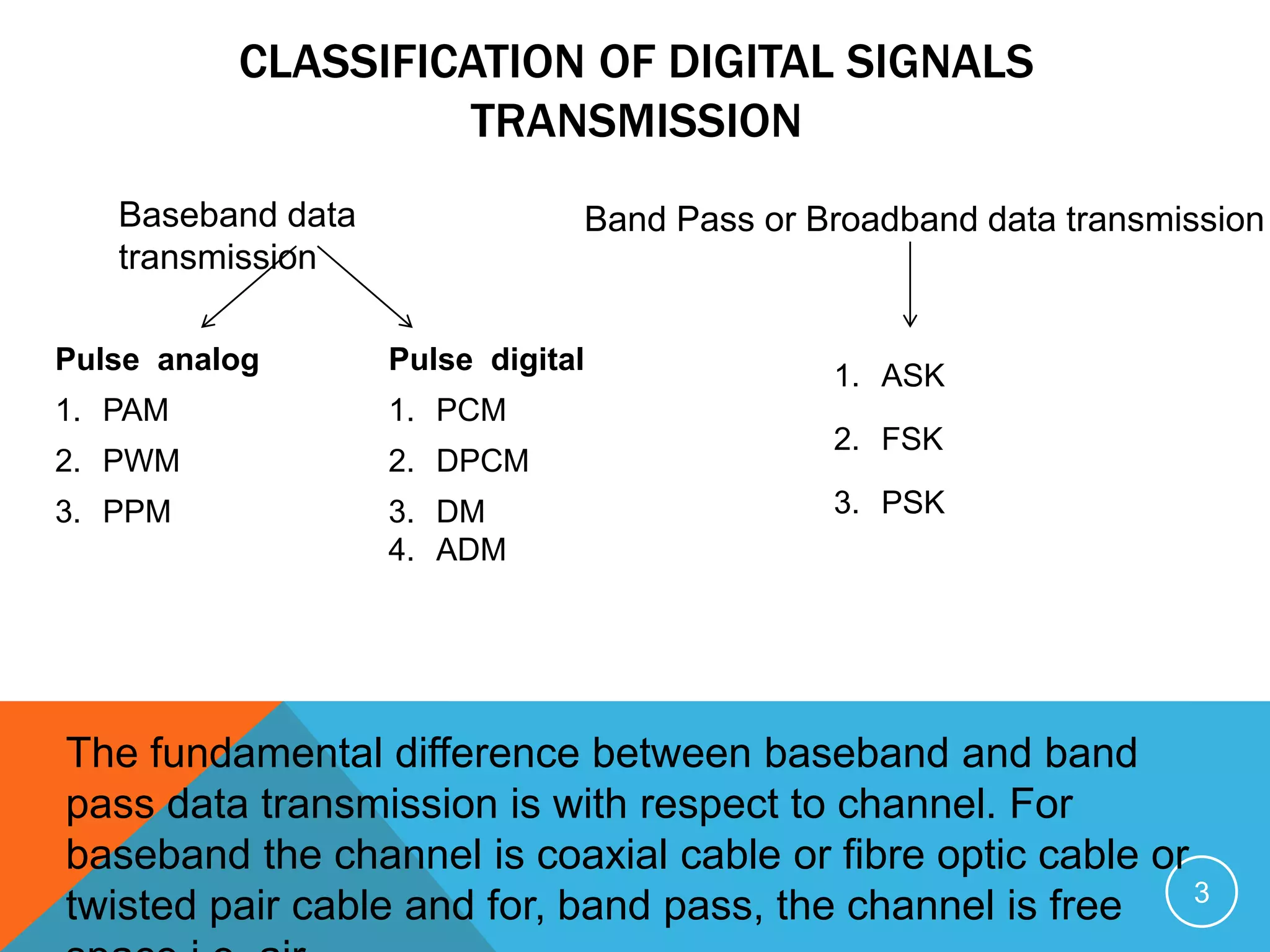
Baseband data
transmission
Pulse analog Pulse digital
1. PAM 1. PCM
2. PWM 2. DPCM
3. PPM 3. DM
4. ADM
Band Pass or Broadband data transmission
1. ASK
2. FSK
3. PSK
The fundamental difference between baseband and band
pass data transmission is with respect to channel. For
baseband the channel is coaxial cable or fibre optic cable or
twisted pair cable and for, band pass, the channel is free
BASEBAND DATA TRANSMISSION
4
m(t)
c(t)
PAM
Pulse Amplitude
Modulation
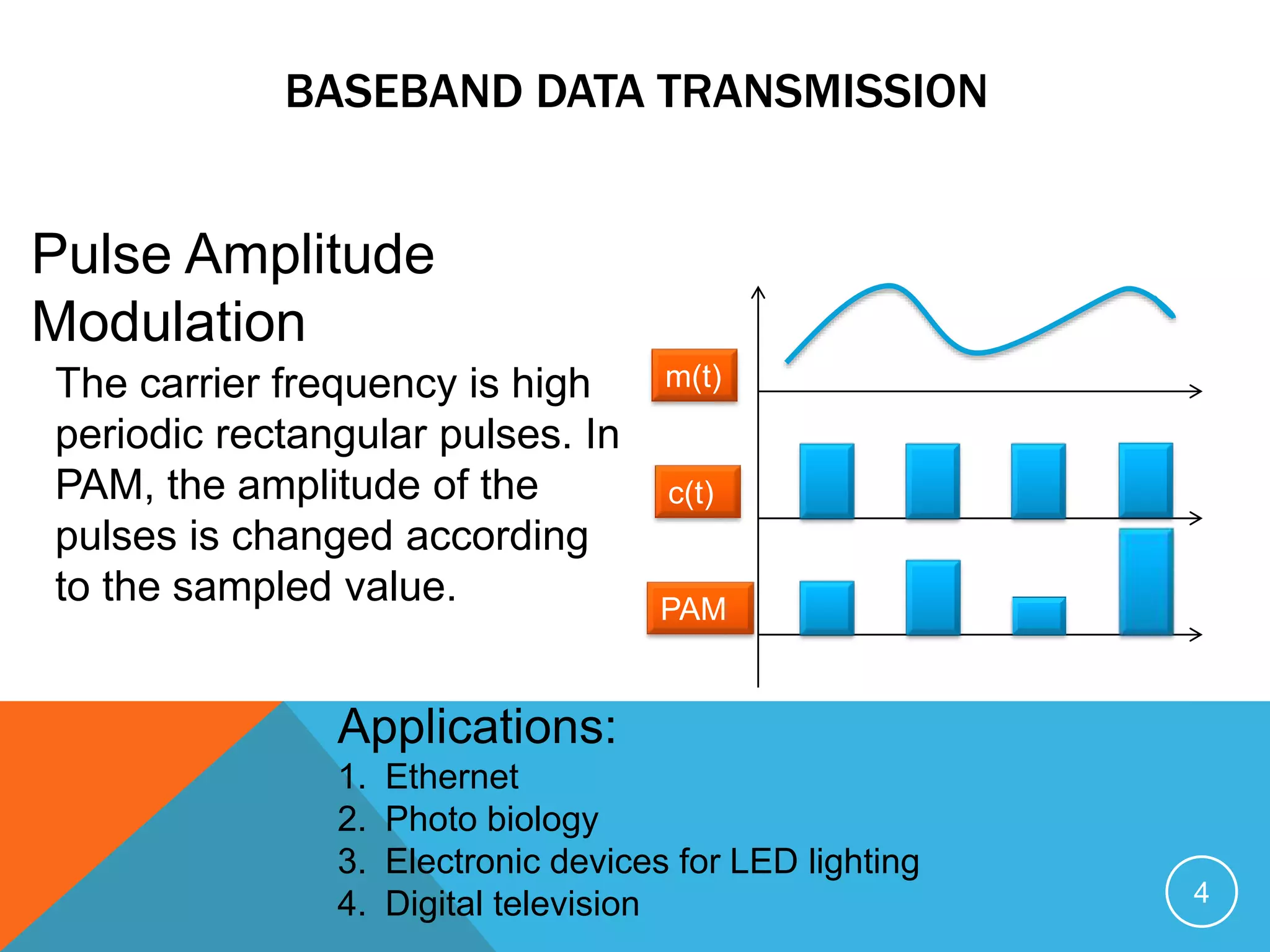
The carrier frequency is high
periodic rectangular pulses. In
PAM, the amplitude of the
pulses is changed according
to the sampled value.
Applications:
1. Ethernet
2. Photo biology
3. Electronic devices for LED lighting
4. Digital television
GENERATION OF PAM SIGNAL
5
Multiplierm(t) PAM
Signal
c(t)
When a continuous message signal and a high frequency
carrier signal are passed through the multiplier, PAM
signal is generated.
PULSE WIDTH MODULATION
6
m(t)
c(t)
PWM
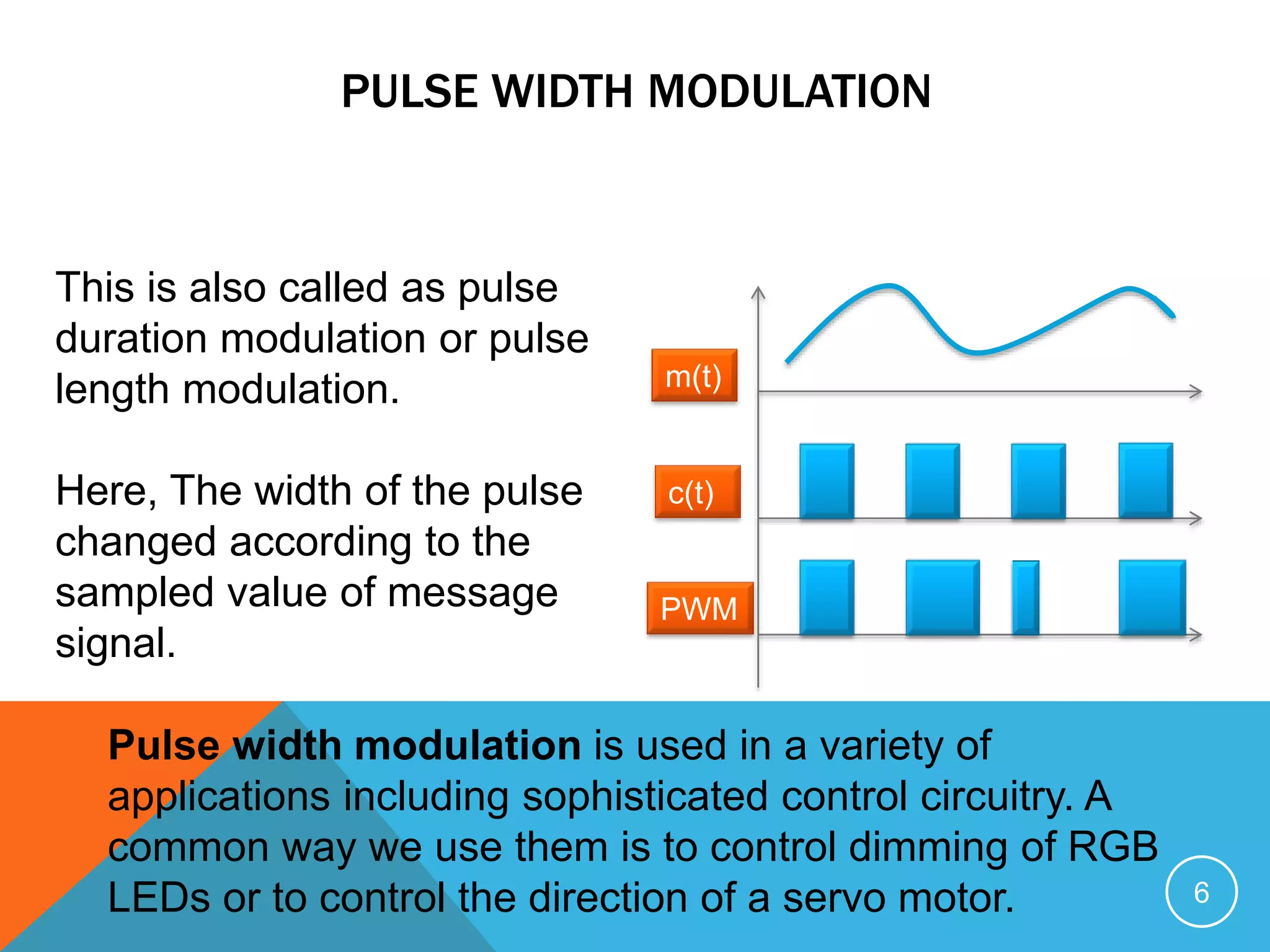
This is also called as pulse
duration modulation or pulse
length modulation.
Here, The width of the pulse
changed according to the
sampled value of message
signal.
Pulse width modulation is used in a variety of
applications including sophisticated control circuitry. A
common way we use them is to control dimming of RGB
LEDs or to control the direction of a servo motor.
GENERATION OF PWM SIGNAL
7
m(t) PAM
Signal
c(t)
Multiplier Slicer
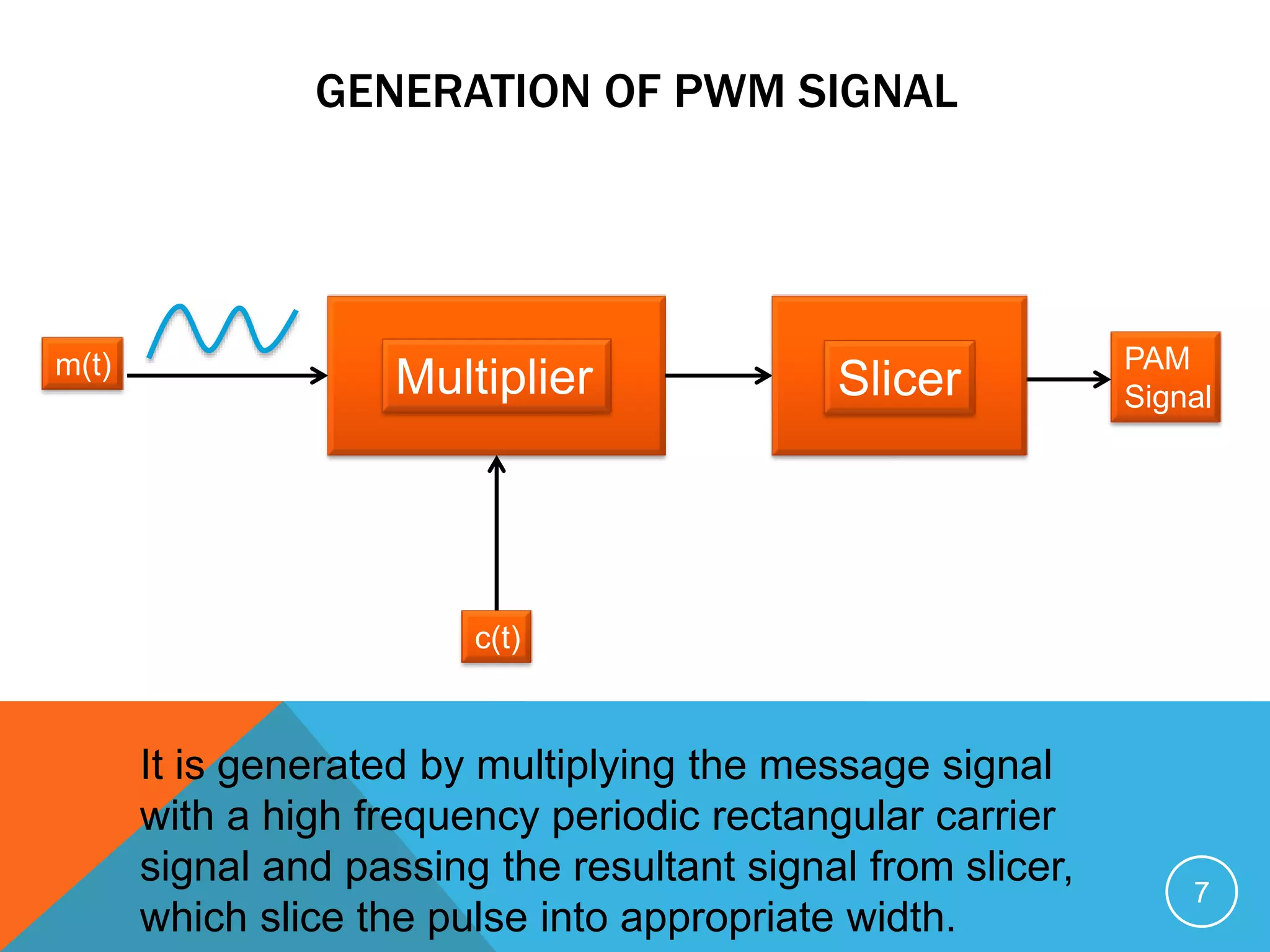
It is generated by multiplying the message signal
with a high frequency periodic rectangular carrier
signal and passing the resultant signal from slicer,
which slice the pulse into appropriate width.
PULSE POSITION MODULATION
8
This is also called
Pulse time modulation.
Here the position of the
pulse is changed
depending on the
sampled value of
message signal.
All three modulation technics, PAM, PWM and PPM are used in
telemetry applications. Telemetry is an automated communications
process by which measurements and other data are collected at
remote locations for recording and analysis.
PPM is also used in satellite communication.
m(t)
c(t)
PW
M
PPM
PULSE CODE MODULATION
9
• In PCM, a message signal is represented by a sequence of
coded pulses, which is accomplished by representing the
signal in discrete form in both time and amplitude.
• The LPF is included to prevent aliasing of the message
signal.
• The basic operations performed in the transmitter of a PCM
signal are sampling, quantizing and encoding.
• The quantizing and encoding operations are usually
performed in the same circuit, which is called an analog-to-
digital converter.
Sampler converts a continuous varying time signal into
discrete time signal. While Quantizer converts a
continuously varying amplitude signal to a discrete
amplitude signals with limited levels.
BLOCK DIAGRAM OF PCM SIGNAL
10
Source of
continuous
time signal
LPF QuantizerSampler
Decode
r
Encoder
Reconstruction
filter
Destination
PCM
Signal
PCM
Signal
Transmitter
Receiver
DIFFERENTIAL PULSE CODE MODULATION
11
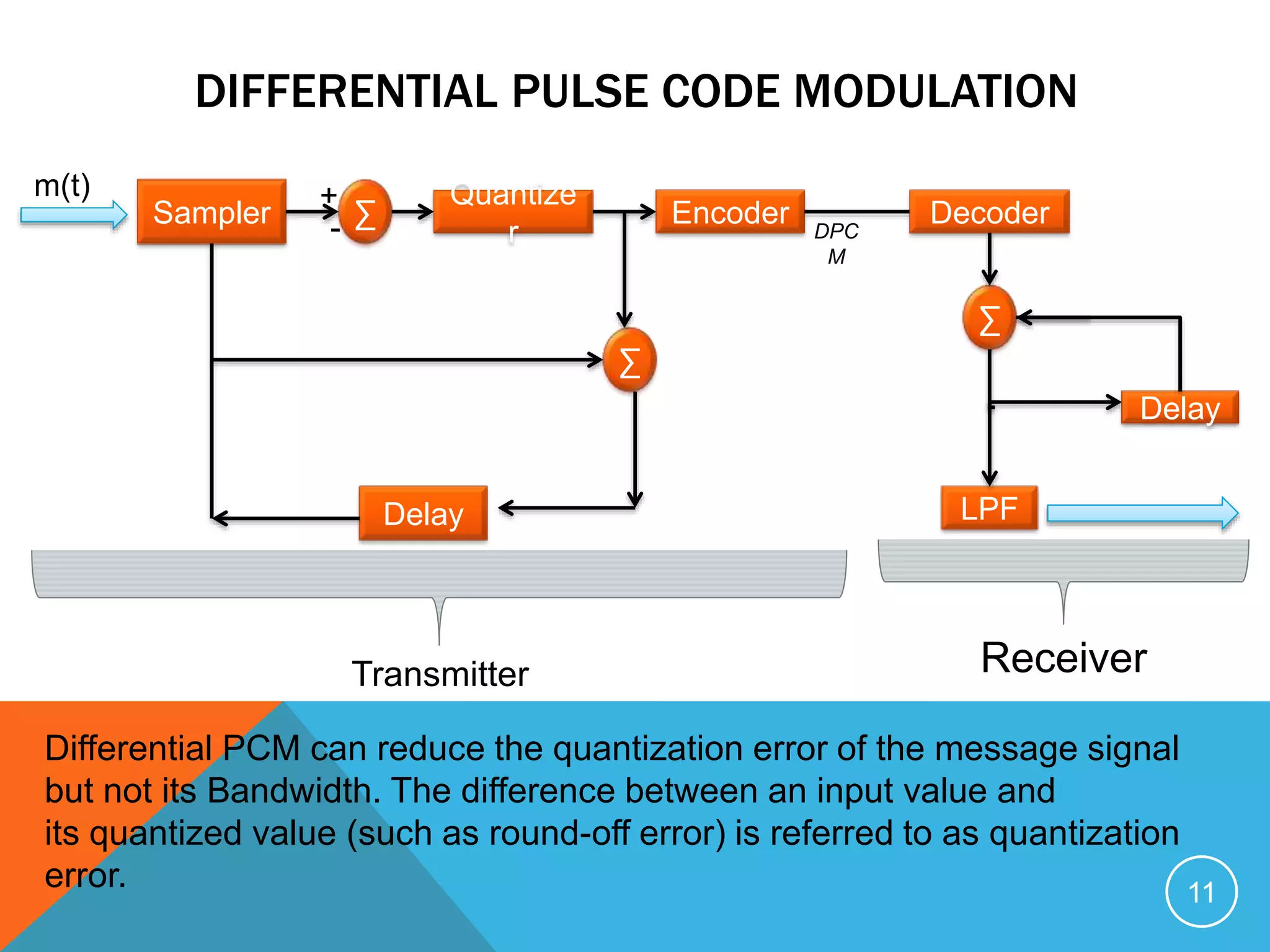
Differential PCM can reduce the quantization error of the message signal
but not its Bandwidth. The difference between an input value and
its quantized value (such as round-off error) is referred to as quantization
error.
Transmitter Receiver
Delay
Sampler
Quantize
r
Encoder∑
∑
∑
m(t) +
- DPC
M
Decoder
LPF
Delay
DELTA MODULATION
12
It is used to decrease the bandwidth of transmitted signal. The
block schematic is similar to DPCM but the encode is 1 bit
encoder.
Transmitter Receiver
Delay
Sampler
Quantize
r
Encoder∑
∑
∑
m(t) +
- 0
Decoder
LPF
Delay
1
QUANTIZATION ERROR IN DELTA MODULATION
13
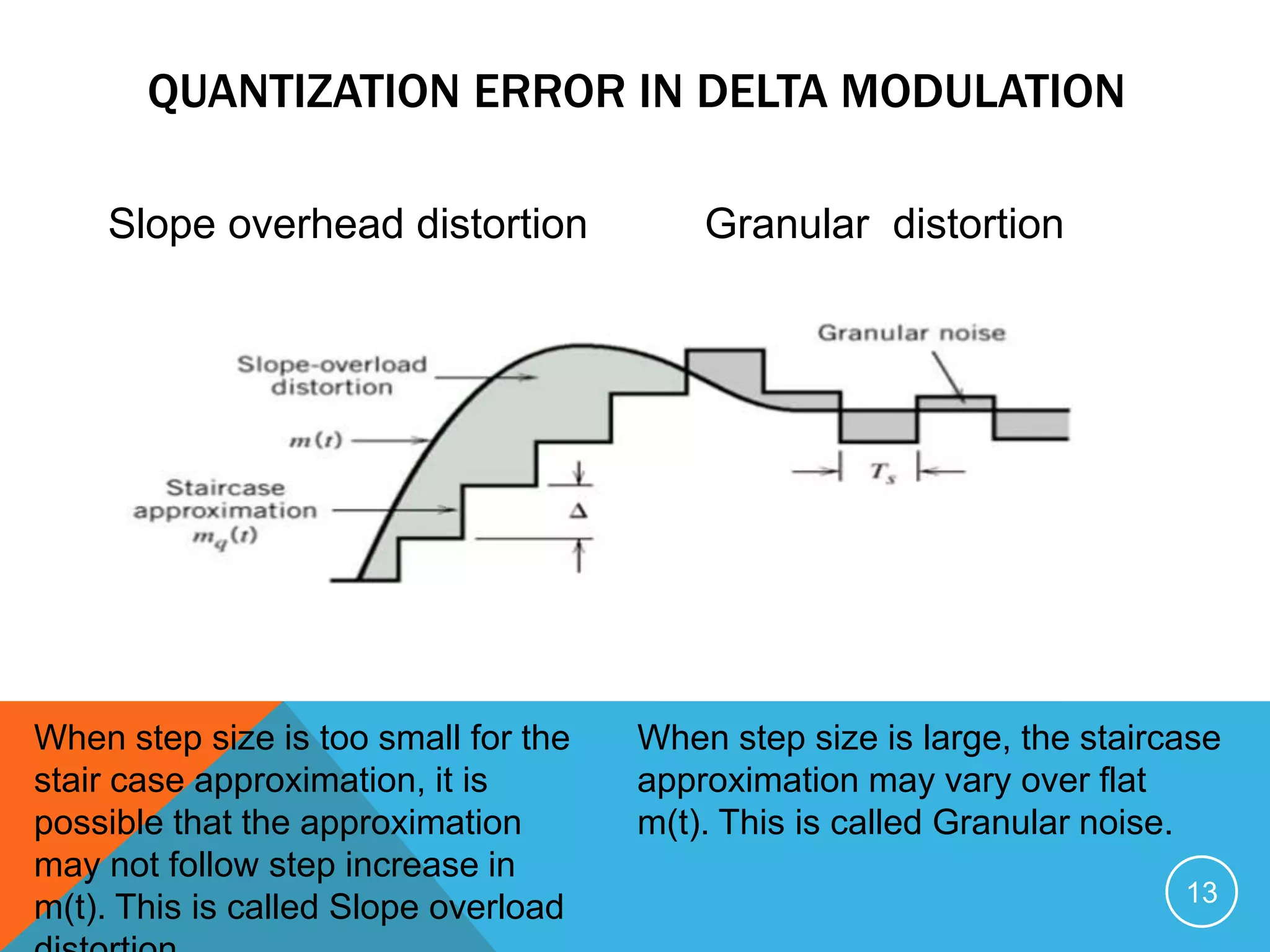
When step size is large, the staircase
approximation may vary over flat
m(t). This is called Granular noise.
When step size is too small for the
stair case approximation, it is
possible that the approximation
may not follow step increase in
m(t). This is called Slope overload
Slope overhead distortion Granular distortion
ADAPTIVE DELTA MODULATION
14
In ADM additional hardware is designed to provide
variable step size, thereby reducing slope-overload
effects without increasing the granular noise.
BAND PASS DATA TRANSMISSION
15
In Band pass or broadband data transmission
there are three technics:
1. Amplitude Shift Keying (ASK)
2. Frequency Shift Keying (FSK)
3. Phase Shift Keying (PSK)
LINE CODES : (ELECTRICAL REPRESENTATION
OF 1’S AND 0’S)
16
1. Unipolar/on-off signaling: 1 is
represented by a pulse and 0
is not represented.
2. Polar/NRZ signaling: 1 and 0’s
are represented by +ve and –
ve pulses.
3. RZ signaling: Pulse of half
symbol wide is sent for 1,
nothing for 0.
4. Bipolar signaling: +ve and –ve
pulses are used for 1. nothing
for 0.
5. Manchester code (Split-
phase): For ‘1’, +ve to –ve
and for a ‘0’, -ve to +ve
1 1 0 1 0 1
1
AMPLITUDE SHIFT KEYING
17
In ASK, the amplitude of the carrier is modulated
according to the message signal.
When an on-off signaling binary message signal is
multiplied with a high frequency sinusoidal carrier
signal, then ASK signal is formed.
BLOCK DIAGRAM OF ASK
18
PHASE SHIFT KEYING
19
• Phase-shift keying (PSK) is
a digital modulation scheme
that conveys data by
changing (modulating)
the phase of a
reference signal (the carrier
wave).
• It is widely used for wireless
LANs and Bluetooth communi
cation.
• Types of PSK modulation
include BPSK, QPSK and
8PSK. BPSK stands for
Binary Phase Shift Keying.
QPSK stands for Quadrature
Phase Shift Keying.
FREQUENCY SHIFT KEYING
20
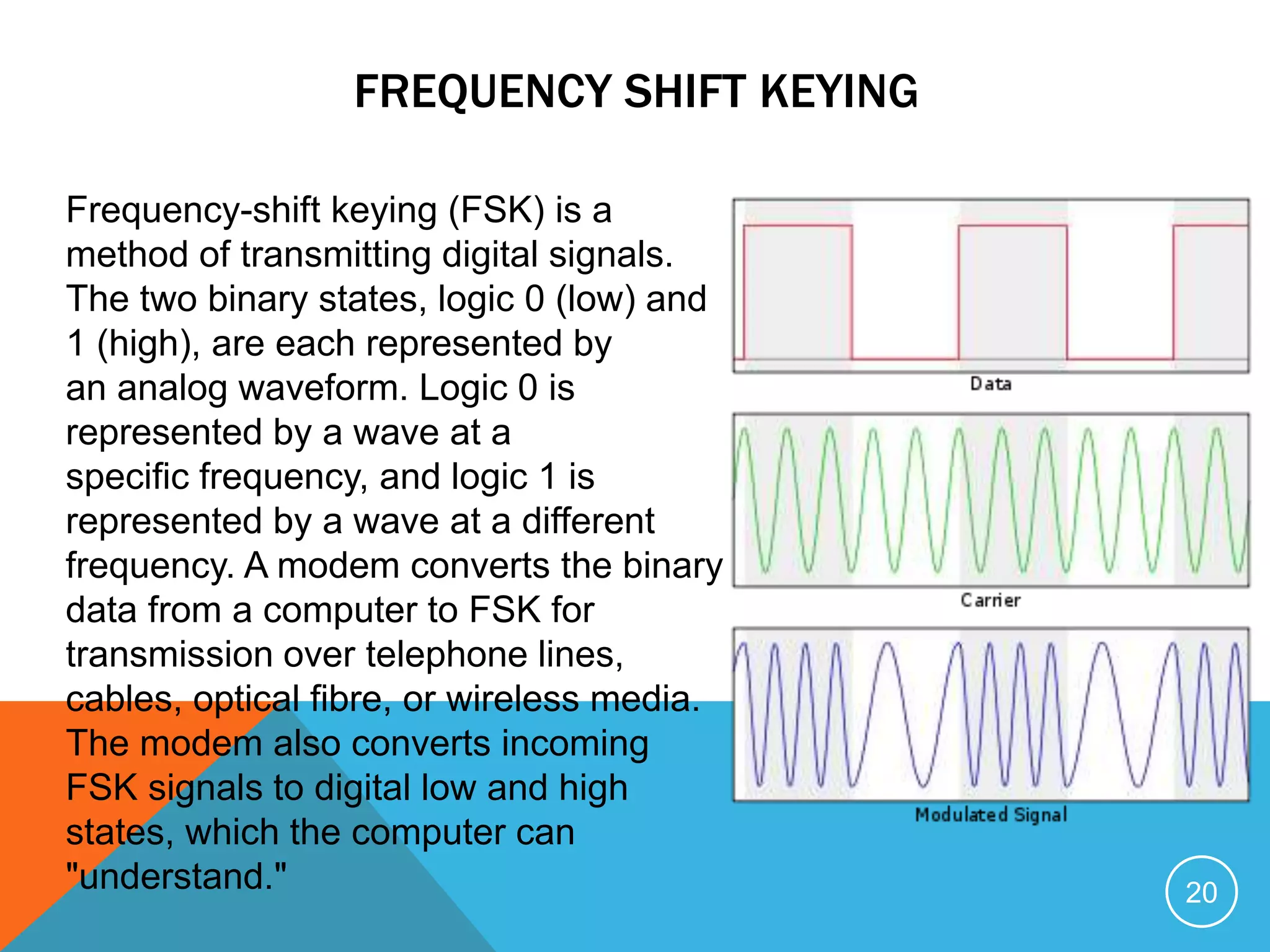
Frequency-shift keying (FSK) is a
method of transmitting digital signals.
The two binary states, logic 0 (low) and
1 (high), are each represented by
an analog waveform. Logic 0 is
represented by a wave at a
specific frequency, and logic 1 is
represented by a wave at a different
frequency. A modem converts the binary
data from a computer to FSK for
transmission over telephone lines,
cables, optical fibre, or wireless media.
The modem also converts incoming
FSK signals to digital low and high
states, which the computer can
"understand."
21

Transmission of digital signals

  • 1.
  • 2.
    DIGITAL SIGNALS 2 A digitalsignal refers to an electrical signal that is converted into a pattern of bits. Unlike an analog signal, which is a continuous signal that contains time-varying quantities, a digital signal has a discrete value at each sampling point.
  • 3.
    CLASSIFICATION OF DIGITALSIGNALS TRANSMISSION 3 Baseband data transmission Pulse analog Pulse digital 1. PAM 1. PCM 2. PWM 2. DPCM 3. PPM 3. DM 4. ADM Band Pass or Broadband data transmission 1. ASK 2. FSK 3. PSK The fundamental difference between baseband and band pass data transmission is with respect to channel. For baseband the channel is coaxial cable or fibre optic cable or twisted pair cable and for, band pass, the channel is free
  • 4.
    BASEBAND DATA TRANSMISSION 4 m(t) c(t) PAM PulseAmplitude Modulation The carrier frequency is high periodic rectangular pulses. In PAM, the amplitude of the pulses is changed according to the sampled value. Applications: 1. Ethernet 2. Photo biology 3. Electronic devices for LED lighting 4. Digital television
  • 5.
    GENERATION OF PAMSIGNAL 5 Multiplierm(t) PAM Signal c(t) When a continuous message signal and a high frequency carrier signal are passed through the multiplier, PAM signal is generated.
  • 6.
    PULSE WIDTH MODULATION 6 m(t) c(t) PWM Thisis also called as pulse duration modulation or pulse length modulation. Here, The width of the pulse changed according to the sampled value of message signal. Pulse width modulation is used in a variety of applications including sophisticated control circuitry. A common way we use them is to control dimming of RGB LEDs or to control the direction of a servo motor.
  • 7.
    GENERATION OF PWMSIGNAL 7 m(t) PAM Signal c(t) Multiplier Slicer It is generated by multiplying the message signal with a high frequency periodic rectangular carrier signal and passing the resultant signal from slicer, which slice the pulse into appropriate width.
  • 8.
    PULSE POSITION MODULATION 8 Thisis also called Pulse time modulation. Here the position of the pulse is changed depending on the sampled value of message signal. All three modulation technics, PAM, PWM and PPM are used in telemetry applications. Telemetry is an automated communications process by which measurements and other data are collected at remote locations for recording and analysis. PPM is also used in satellite communication. m(t) c(t) PW M PPM
  • 9.
    PULSE CODE MODULATION 9 •In PCM, a message signal is represented by a sequence of coded pulses, which is accomplished by representing the signal in discrete form in both time and amplitude. • The LPF is included to prevent aliasing of the message signal. • The basic operations performed in the transmitter of a PCM signal are sampling, quantizing and encoding. • The quantizing and encoding operations are usually performed in the same circuit, which is called an analog-to- digital converter. Sampler converts a continuous varying time signal into discrete time signal. While Quantizer converts a continuously varying amplitude signal to a discrete amplitude signals with limited levels.
  • 10.
    BLOCK DIAGRAM OFPCM SIGNAL 10 Source of continuous time signal LPF QuantizerSampler Decode r Encoder Reconstruction filter Destination PCM Signal PCM Signal Transmitter Receiver
  • 11.
    DIFFERENTIAL PULSE CODEMODULATION 11 Differential PCM can reduce the quantization error of the message signal but not its Bandwidth. The difference between an input value and its quantized value (such as round-off error) is referred to as quantization error. Transmitter Receiver Delay Sampler Quantize r Encoder∑ ∑ ∑ m(t) + - DPC M Decoder LPF Delay
  • 12.
    DELTA MODULATION 12 It isused to decrease the bandwidth of transmitted signal. The block schematic is similar to DPCM but the encode is 1 bit encoder. Transmitter Receiver Delay Sampler Quantize r Encoder∑ ∑ ∑ m(t) + - 0 Decoder LPF Delay 1
  • 13.
    QUANTIZATION ERROR INDELTA MODULATION 13 When step size is large, the staircase approximation may vary over flat m(t). This is called Granular noise. When step size is too small for the stair case approximation, it is possible that the approximation may not follow step increase in m(t). This is called Slope overload Slope overhead distortion Granular distortion
  • 14.
    ADAPTIVE DELTA MODULATION 14 InADM additional hardware is designed to provide variable step size, thereby reducing slope-overload effects without increasing the granular noise.
  • 15.
    BAND PASS DATATRANSMISSION 15 In Band pass or broadband data transmission there are three technics: 1. Amplitude Shift Keying (ASK) 2. Frequency Shift Keying (FSK) 3. Phase Shift Keying (PSK)
  • 16.
    LINE CODES :(ELECTRICAL REPRESENTATION OF 1’S AND 0’S) 16 1. Unipolar/on-off signaling: 1 is represented by a pulse and 0 is not represented. 2. Polar/NRZ signaling: 1 and 0’s are represented by +ve and – ve pulses. 3. RZ signaling: Pulse of half symbol wide is sent for 1, nothing for 0. 4. Bipolar signaling: +ve and –ve pulses are used for 1. nothing for 0. 5. Manchester code (Split- phase): For ‘1’, +ve to –ve and for a ‘0’, -ve to +ve 1 1 0 1 0 1 1
  • 17.
    AMPLITUDE SHIFT KEYING 17 InASK, the amplitude of the carrier is modulated according to the message signal. When an on-off signaling binary message signal is multiplied with a high frequency sinusoidal carrier signal, then ASK signal is formed.
  • 18.
  • 19.
    PHASE SHIFT KEYING 19 •Phase-shift keying (PSK) is a digital modulation scheme that conveys data by changing (modulating) the phase of a reference signal (the carrier wave). • It is widely used for wireless LANs and Bluetooth communi cation. • Types of PSK modulation include BPSK, QPSK and 8PSK. BPSK stands for Binary Phase Shift Keying. QPSK stands for Quadrature Phase Shift Keying.
  • 20.
    FREQUENCY SHIFT KEYING 20 Frequency-shiftkeying (FSK) is a method of transmitting digital signals. The two binary states, logic 0 (low) and 1 (high), are each represented by an analog waveform. Logic 0 is represented by a wave at a specific frequency, and logic 1 is represented by a wave at a different frequency. A modem converts the binary data from a computer to FSK for transmission over telephone lines, cables, optical fibre, or wireless media. The modem also converts incoming FSK signals to digital low and high states, which the computer can "understand."
  • 21.