*
Clyde A. Lettsome, Ph.D., P.E.
* Digital Communication Overview
* Digital Modulation Techniques
* Frequency Shift Keying
* Binary Phase Shift Keying

* Code Error Detection and Correction Methods
* Parity
* Cyclical Redundancy Check
* Block Error Detection and Correction
* Hamming Code
* Reed Solomon

* Channel Access Methods
* Time Division Multiple Access (TDMA)
* Code Division Multiple Access (CDMA)

*
*
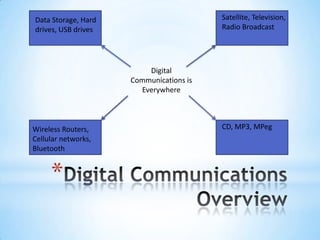
Satellite, Television,
Radio Broadcast

Data Storage, Hard
drives, USB drives

Digital
Communications is
Everywhere

Wireless Routers,
Cellular networks,
Bluetooth

*

CD, MP3, MPeg
* Reduced bandwidth if modulated on an analog
carrier

* Noise Immunity
* Errors may be detected
* Errors may be corrected

* Easily manipulate to improve transmission
* Time Division Multiple Access (TDMA)
* Code Division Multiple Access (CDMA)

*
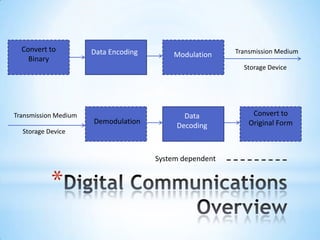
Convert to
Binary

Data Encoding

Modulation

Transmission Medium
Storage Device

Transmission Medium
Storage Device

Demodulation

Data
Decoding

System dependent

*

Convert to
Original Form
*
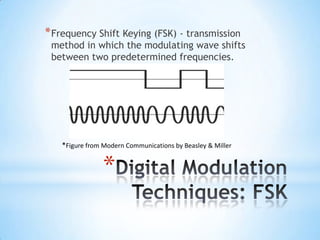
* Frequency Shift Keying (FSK) - transmission

method in which the modulating wave shifts
between two predetermined frequencies.

*Figure from Modern Communications by Beasley & Miller

*
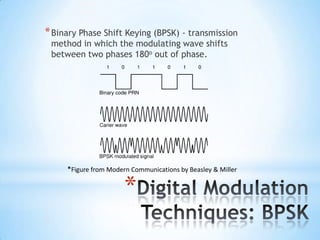
* Binary Phase Shift Keying (BPSK) - transmission
method in which the modulating wave shifts
between two phases 180o out of phase.

*Figure from Modern Communications by Beasley & Miller

*
* What if a bit(s) is(are) messed up during
transmission or storage?

* Examples: atmospheric noise, intrinsic noise,
scratches on CDs, single-event upsets, etc.

* Digital coding has many advantages over analog
coding

* Immunity to noise
* Errors can be detected and corrected

*
*
* Error detection –Retransmit the block
* Parity
* Cyclic Redundancy Check
* Block Codes

* Error correction – Fix errors at the receiver via
FEC – Forward Error Correction

(Adding more coding
bits increases the correction capability but reduces throughput.)

*

* Block Codes
* Hamming Code
* Reed Solomon
* Arguably the most common method of error
detection.

* A single bit called parity bit is added to each
transmitted code.

* Parity bit makes the code either be even or odd
* Even parity makes the total number of ones even
* Odd parity makes the total number of ones odd

* Example: Code [1001]
* Even parity transmitted code: [1001|0]
* Odd parity transmitted code: [1001|1]

*
*Will detect error only if an unexpected
parity is received

* Odd parity transmitted code: [1001|1]

* Received code indicates error [1101|1]
* Received code does not indicate error [1111|1]
*Good for random errors (single bit errors
but not for burst errors (multiple
consecutive errors)
*Used with ASCII

*
* Effectively detect 99.95 % errors.
* Block of data (D) is combined with a frame

check sequence (F) to compose a frame to be
transmitted (T).

* The Frame check sequence is developed by

mathematically dividing the block of data by a
predetermined divisor (P).

* On the receiver side the transmitted frame (T)

is divided by the divisor (P). If the remainder is
zero then no error is detected.

*
Example: Develop a (7,4) cyclic code from a transmitter
where the data to be transmitted(D) = [1100] and divisor
(P) =[1011].
1100/1011 = 1110 <-[D]/[P]
1011
1110

1011
1010
1011
010 <-Remainder (Block Check Code)

Transmitted(T) = [D R] = [1100010]

*
Decoding in the receiver
1100010 /1011 = 1110 <-[T]/[P]
1011
1110
1011
1011
1011
00 <-Remainder

*
* The Hamming distance is the number of bits
that are different between allowed
transmitted code words

* d(code block, received block)
* d(00000,00100) = 1
* d(00111,00100) = 2

* The greater the Hamming distance the more
errors need to be corrected.

*
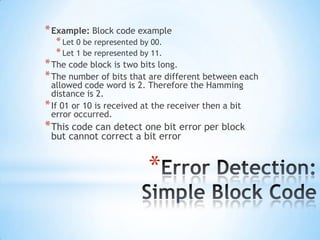
* Example: Block code example
* Let 0 be represented by 00.
* Let 1 be represented by 11.

* The code block is two bits long.
* The number of bits that are different between each
allowed code word is 2. Therefore the Hamming
distance is 2.
* If 01 or 10 is received at the receiver then a bit
error occurred.

* This code can detect one bit error per block
but cannot correct a bit error

*
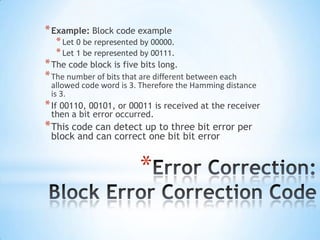
* Example: Block code example

* Let 0 be represented by 00000.
* Let 1 be represented by 00111.

* The code block is five bits long.
* The number of bits that are different between each

allowed code word is 3. Therefore the Hamming distance
is 3.
* If 00110, 00101, or 00011 is received at the receiver
then a bit error occurred.

* This code can detect up to three bit error per
block and can correct one bit bit error

*
* Hamming code correct single bit errors
* Example: Consider D=[1001] the minimum number
of parity bits is 3.

(2n ≥ m+n+1 where m is the length of D and n is the
smallest of parity bits that makes the relationship
true)

* Let P1 = (2,4,5), P2 = (4,5,6), P3 = (5,6,2) and use
odd parity.

P1 1 P2 0 0 1 P3
1 2 34 567
0 1 0 0 0 1 1  Transmitted

*
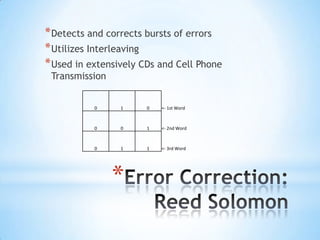
* Detects and corrects bursts of errors
* Utilizes Interleaving
* Used in extensively CDs and Cell Phone
Transmission

0

1

0

<- 1st Word

0

0

1

<- 2nd Word

0

1

1

<- 3rd Word

*
*
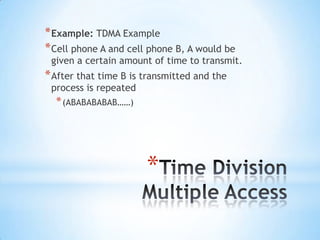
* Example: TDMA Example
* Cell phone A and cell phone B, A would be

given a certain amount of time to transmit.

* After that time B is transmitted and the
process is repeated

* (ABABABABAB……)

*
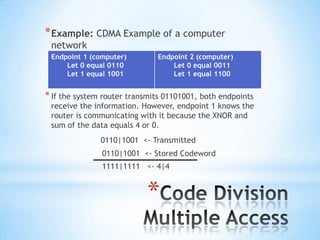
* Example: CDMA Example of a computer
network

Endpoint 1 (computer)
Let 0 equal 0110
Let 1 equal 1001

Endpoint 2 (computer)
Let 0 equal 0011
Let 1 equal 1100

* If the system router transmits 01101001, both endpoints

receive the information. However, endpoint 1 knows the
router is communicating with it because the XNOR and
sum of the data equals 4 or 0.

0110|1001 <- Transmitted
0110|1001 <- Stored Codeword
1111|1111 <- 4|4

*

Wireless digital communication and coding techniques new

  • 1.
  • 2.
    * Digital CommunicationOverview * Digital Modulation Techniques * Frequency Shift Keying * Binary Phase Shift Keying * Code Error Detection and Correction Methods * Parity * Cyclical Redundancy Check * Block Error Detection and Correction * Hamming Code * Reed Solomon * Channel Access Methods * Time Division Multiple Access (TDMA) * Code Division Multiple Access (CDMA) *
  • 3.
  • 4.
    Satellite, Television, Radio Broadcast DataStorage, Hard drives, USB drives Digital Communications is Everywhere Wireless Routers, Cellular networks, Bluetooth * CD, MP3, MPeg
  • 5.
    * Reduced bandwidthif modulated on an analog carrier * Noise Immunity * Errors may be detected * Errors may be corrected * Easily manipulate to improve transmission * Time Division Multiple Access (TDMA) * Code Division Multiple Access (CDMA) *
  • 6.
    Convert to Binary Data Encoding Modulation TransmissionMedium Storage Device Transmission Medium Storage Device Demodulation Data Decoding System dependent * Convert to Original Form
  • 7.
  • 8.
    * Frequency ShiftKeying (FSK) - transmission method in which the modulating wave shifts between two predetermined frequencies. *Figure from Modern Communications by Beasley & Miller *
  • 9.
    * Binary PhaseShift Keying (BPSK) - transmission method in which the modulating wave shifts between two phases 180o out of phase. *Figure from Modern Communications by Beasley & Miller *
  • 10.
    * What ifa bit(s) is(are) messed up during transmission or storage? * Examples: atmospheric noise, intrinsic noise, scratches on CDs, single-event upsets, etc. * Digital coding has many advantages over analog coding * Immunity to noise * Errors can be detected and corrected *
  • 11.
  • 12.
    * Error detection–Retransmit the block * Parity * Cyclic Redundancy Check * Block Codes * Error correction – Fix errors at the receiver via FEC – Forward Error Correction (Adding more coding bits increases the correction capability but reduces throughput.) * * Block Codes * Hamming Code * Reed Solomon
  • 13.
    * Arguably themost common method of error detection. * A single bit called parity bit is added to each transmitted code. * Parity bit makes the code either be even or odd * Even parity makes the total number of ones even * Odd parity makes the total number of ones odd * Example: Code [1001] * Even parity transmitted code: [1001|0] * Odd parity transmitted code: [1001|1] *
  • 14.
    *Will detect erroronly if an unexpected parity is received * Odd parity transmitted code: [1001|1] * Received code indicates error [1101|1] * Received code does not indicate error [1111|1] *Good for random errors (single bit errors but not for burst errors (multiple consecutive errors) *Used with ASCII *
  • 15.
    * Effectively detect99.95 % errors. * Block of data (D) is combined with a frame check sequence (F) to compose a frame to be transmitted (T). * The Frame check sequence is developed by mathematically dividing the block of data by a predetermined divisor (P). * On the receiver side the transmitted frame (T) is divided by the divisor (P). If the remainder is zero then no error is detected. *
  • 16.
    Example: Develop a(7,4) cyclic code from a transmitter where the data to be transmitted(D) = [1100] and divisor (P) =[1011]. 1100/1011 = 1110 <-[D]/[P] 1011 1110 1011 1010 1011 010 <-Remainder (Block Check Code) Transmitted(T) = [D R] = [1100010] *
  • 17.
    Decoding in thereceiver 1100010 /1011 = 1110 <-[T]/[P] 1011 1110 1011 1011 1011 00 <-Remainder *
  • 18.
    * The Hammingdistance is the number of bits that are different between allowed transmitted code words * d(code block, received block) * d(00000,00100) = 1 * d(00111,00100) = 2 * The greater the Hamming distance the more errors need to be corrected. *
  • 19.
    * Example: Blockcode example * Let 0 be represented by 00. * Let 1 be represented by 11. * The code block is two bits long. * The number of bits that are different between each allowed code word is 2. Therefore the Hamming distance is 2. * If 01 or 10 is received at the receiver then a bit error occurred. * This code can detect one bit error per block but cannot correct a bit error *
  • 20.
    * Example: Blockcode example * Let 0 be represented by 00000. * Let 1 be represented by 00111. * The code block is five bits long. * The number of bits that are different between each allowed code word is 3. Therefore the Hamming distance is 3. * If 00110, 00101, or 00011 is received at the receiver then a bit error occurred. * This code can detect up to three bit error per block and can correct one bit bit error *
  • 21.
    * Hamming codecorrect single bit errors * Example: Consider D=[1001] the minimum number of parity bits is 3. (2n ≥ m+n+1 where m is the length of D and n is the smallest of parity bits that makes the relationship true) * Let P1 = (2,4,5), P2 = (4,5,6), P3 = (5,6,2) and use odd parity. P1 1 P2 0 0 1 P3 1 2 34 567 0 1 0 0 0 1 1  Transmitted *
  • 22.
    * Detects andcorrects bursts of errors * Utilizes Interleaving * Used in extensively CDs and Cell Phone Transmission 0 1 0 <- 1st Word 0 0 1 <- 2nd Word 0 1 1 <- 3rd Word *
  • 23.
  • 24.
    * Example: TDMAExample * Cell phone A and cell phone B, A would be given a certain amount of time to transmit. * After that time B is transmitted and the process is repeated * (ABABABABAB……) *
  • 25.
    * Example: CDMAExample of a computer network Endpoint 1 (computer) Let 0 equal 0110 Let 1 equal 1001 Endpoint 2 (computer) Let 0 equal 0011 Let 1 equal 1100 * If the system router transmits 01101001, both endpoints receive the information. However, endpoint 1 knows the router is communicating with it because the XNOR and sum of the data equals 4 or 0. 0110|1001 <- Transmitted 0110|1001 <- Stored Codeword 1111|1111 <- 4|4 *