Data Communication
and Computer Networks
[EEE 314]
Mubashir Husain RehmaniMubashir Husain Rehmani
Assistant Professor
Department of Electrical Engineering
COMSATS Institute of Information Technology,
Wah Cantt, Pakistan
Digital
Transmission
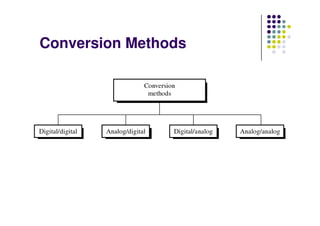
Conversion Methods
Digital
to
DigitalDigital
Encoding
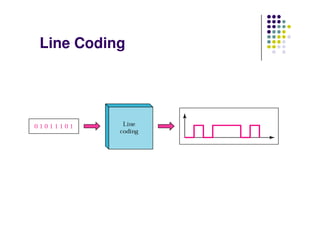
LineLine coding is the process ofcoding is the process of
converting digital data to digitalconverting digital data to digital
signalssignalssignalssignals
Line Coding
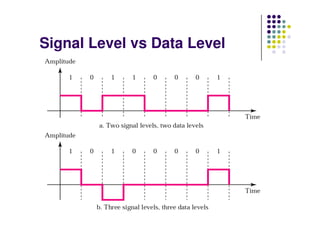
Signal Level vs Data Level
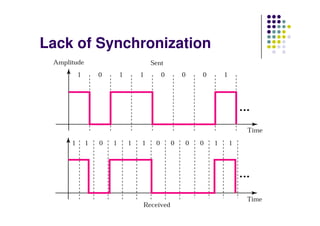
Lack of Synchronization
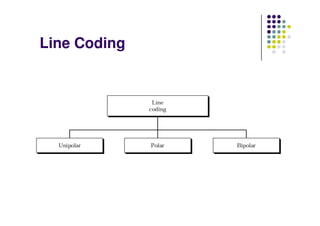
Line Coding
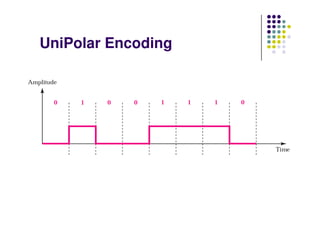
Unipolar encoding uses only one
voltage level.
In a unipolar scheme, all the
signal levels are on one side of
the time axis, either above
or below.
UniPolar Encoding
Polar encoding uses two voltagePolar encoding uses two voltage
levels (positive and negative).levels (positive and negative).
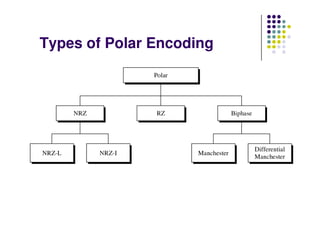
Types of Polar Encoding
NRZ Non Return to Zero
NRZ-L Non Return to Zero - Level
NRZ-I Non Return to Zero – Inverted
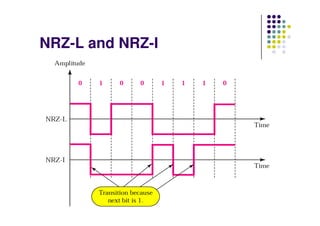
In NRZIn NRZ--L the level of the signal isL the level of the signal is
dependent upon the state of thedependent upon the state of the
bit.bit.bit.bit.
In NRZIn NRZ--I the signal is inverted if aI the signal is inverted if a
1 is encountered.1 is encountered.
NRZ-L and NRZ-I
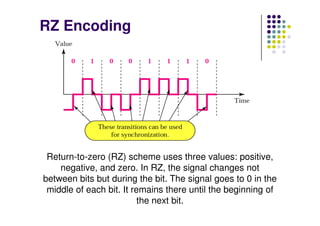
RZ Encoding
Return-to-zero (RZ) scheme uses three values: positive,
negative, and zero. In RZ, the signal changes not
between bits but during the bit. The signal goes to 0 in the
middle of each bit. It remains there until the beginning of
the next bit.
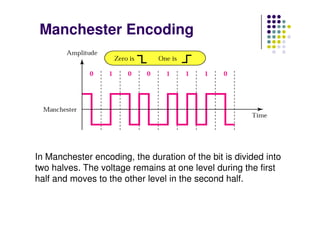
Manchester Encoding
In Manchester encoding, the duration of the bit is divided into
two halves. The voltage remains at one level during the first
half and moves to the other level in the second half.
In Manchester encoding, theIn Manchester encoding, the
transition at the middle of the bittransition at the middle of the bit
is used for both synchronizationis used for both synchronizationis used for both synchronizationis used for both synchronization
and bit representation.and bit representation.
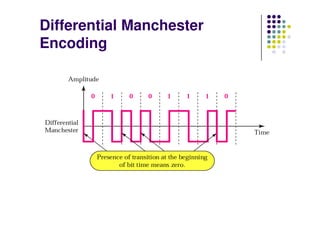
Differential Manchester
Encoding
In differential ManchesterIn differential Manchester
encoding, the transition at theencoding, the transition at the
middle of the bit is used only formiddle of the bit is used only for
synchronization.synchronization.synchronization.synchronization.
The bit representation is definedThe bit representation is defined
by the inversion orby the inversion or noninversionnoninversion
at the beginning of the bit.at the beginning of the bit.
In bipolar encoding, we use threeIn bipolar encoding, we use three
levels: positive, zero,levels: positive, zero,
and negative.and negative.and negative.and negative.
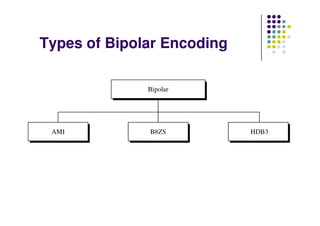
Types of Bipolar Encoding
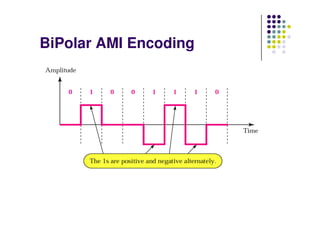
BiPolar AMI Encoding
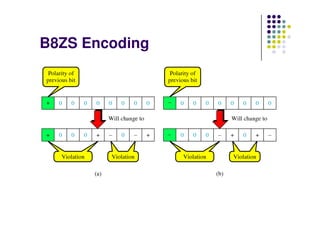
B8ZS Encoding
Analog
to
DigitalDigital
Encoding
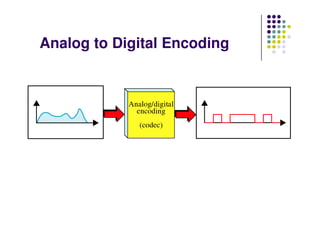
Analog to Digital Encoding
Pulse Code Modulation (PCM)
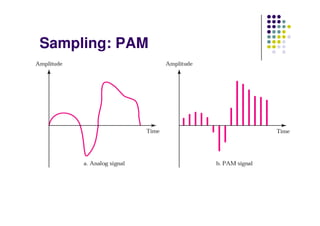
The Analog signal is Sampled
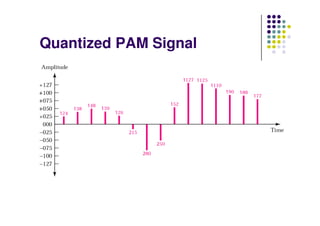
The Sampled signal is Quantized
The Quantized values are encoded as stream
of bitsof bits
Sampling: PAM
Quantized PAM Signal
Digital
to
AnalogAnalog
Encoding
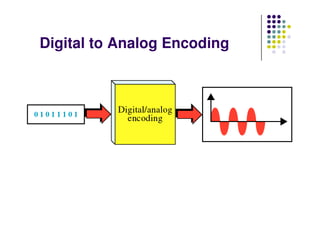
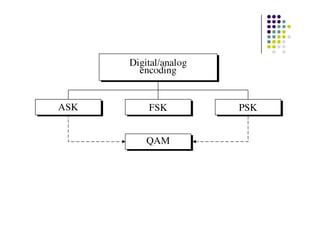
Digital to Analog Encoding
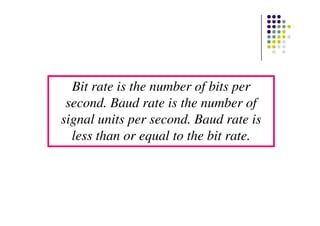
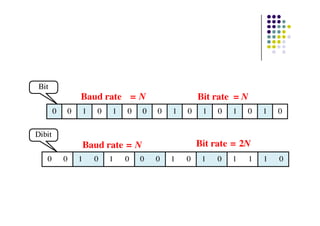
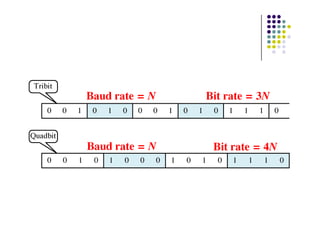
Bit rate is the number of bits per
second. Baud rate is the number of
signal units per second. Baud rate issignal units per second. Baud rate is
less than or equal to the bit rate.
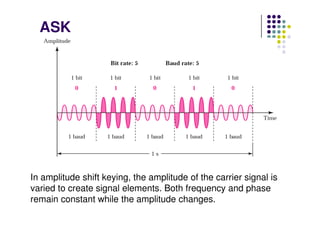
ASK
In amplitude shift keying, the amplitude of the carrier signal is
varied to create signal elements. Both frequency and phase
remain constant while the amplitude changes.
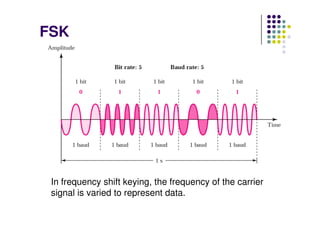
FSK
In frequency shift keying, the frequency of the carrier
signal is varied to represent data.
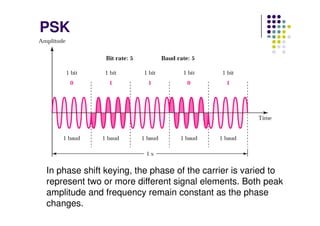
PSK
In phase shift keying, the phase of the carrier is varied to
represent two or more different signal elements. Both peak
amplitude and frequency remain constant as the phase
changes.
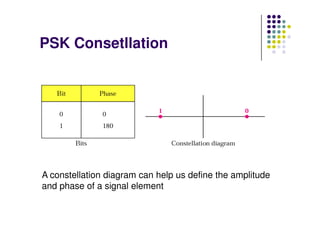
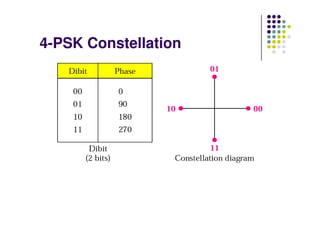
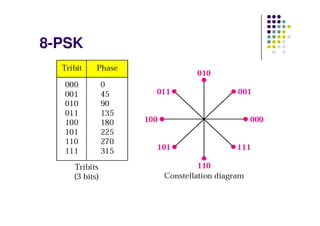
PSK Consetllation
A constellation diagram can help us define the amplitude
and phase of a signal element
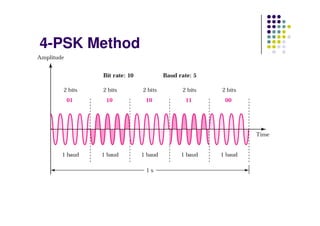
4-PSK Method
4-PSK Constellation
8-PSK
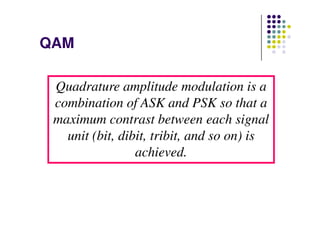
QAM
Quadrature amplitude modulation is a
combination of ASK and PSK so that a
maximum contrast between each signalmaximum contrast between each signal
unit (bit, dibit, tribit, and so on) is
achieved.
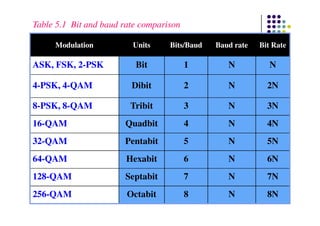
Table 5.1 Bit and baud rate comparison
ModulationModulation UnitsUnits Bits/BaudBits/Baud Baud rateBaud rate Bit Rate
ASK, FSK, 2ASK, FSK, 2--PSKPSK Bit 1 N N
44--PSK, 4PSK, 4--QAMQAM Dibit 2 N 2N
88--PSK, 8PSK, 8--QAMQAM Tribit 3 N 3N
1616--QAMQAM Quadbit 4 N 4N
3232--QAMQAM Pentabit 5 N 5N
6464--QAMQAM Hexabit 6 N 6N
128128--QAMQAM Septabit 7 N 7N
256256--QAMQAM Octabit 8 N 8N
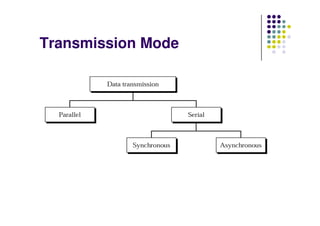
Transmission Mode
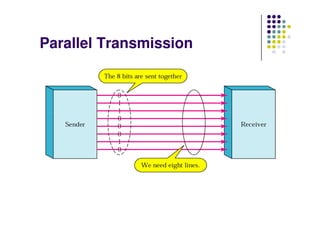
Parallel Transmission
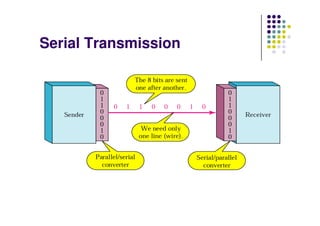
Serial Transmission
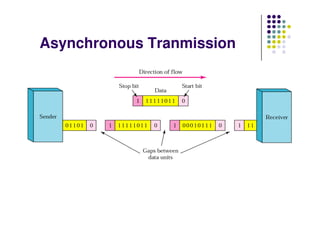
In asynchronous transmission,In asynchronous transmission,
we send 1 start bit (0) at thewe send 1 start bit (0) at the
beginning and 1 or more stopbeginning and 1 or more stopbeginning and 1 or more stopbeginning and 1 or more stop
bits (1s) at the end of each byte.bits (1s) at the end of each byte.
There may be a gap betweenThere may be a gap between
each byte.each byte.
Asynchronous here meansAsynchronous here means
“asynchronous at the byte level,”“asynchronous at the byte level,”
but the bits are stillbut the bits are stillbut the bits are stillbut the bits are still
synchronized; their durations aresynchronized; their durations are
the same.the same.
Asynchronous Tranmission
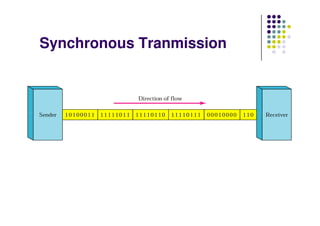
In synchronous transmission,In synchronous transmission,
we send bits one after anotherwe send bits one after another
without start/stop bits or gaps.without start/stop bits or gaps.without start/stop bits or gaps.without start/stop bits or gaps.
It is the responsibility of theIt is the responsibility of the
receiver to group the bits.receiver to group the bits.
Synchronous Tranmission
Modulation of Analog Signals
Amplitude Modulation (AM)
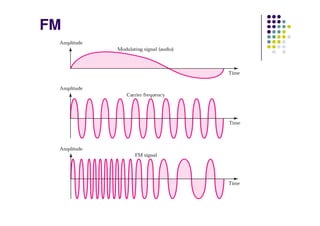
Frequency Modulation (FM)
Phase Modulation (PM)
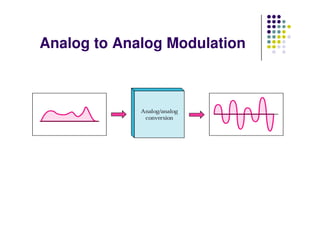
Analog to Analog Modulation
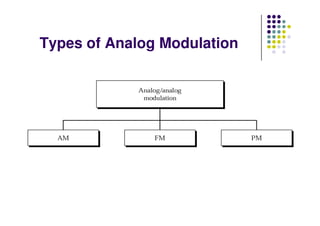
Types of Analog Modulation
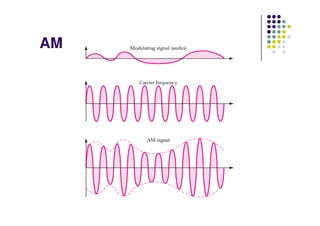
AM
FM

Dccn - Digital Transmission

  • 1.
    Data Communication and ComputerNetworks [EEE 314] Mubashir Husain RehmaniMubashir Husain Rehmani Assistant Professor Department of Electrical Engineering COMSATS Institute of Information Technology, Wah Cantt, Pakistan
  • 2.
  • 3.
  • 4.
  • 5.
    LineLine coding isthe process ofcoding is the process of converting digital data to digitalconverting digital data to digital signalssignalssignalssignals
  • 6.
  • 7.
    Signal Level vsData Level
  • 8.
  • 9.
  • 10.
    Unipolar encoding usesonly one voltage level. In a unipolar scheme, all the signal levels are on one side of the time axis, either above or below.
  • 11.
  • 12.
    Polar encoding usestwo voltagePolar encoding uses two voltage levels (positive and negative).levels (positive and negative).
  • 13.
  • 14.
    NRZ Non Returnto Zero NRZ-L Non Return to Zero - Level NRZ-I Non Return to Zero – Inverted
  • 15.
    In NRZIn NRZ--Lthe level of the signal isL the level of the signal is dependent upon the state of thedependent upon the state of the bit.bit.bit.bit.
  • 16.
    In NRZIn NRZ--Ithe signal is inverted if aI the signal is inverted if a 1 is encountered.1 is encountered.
  • 17.
  • 18.
    RZ Encoding Return-to-zero (RZ)scheme uses three values: positive, negative, and zero. In RZ, the signal changes not between bits but during the bit. The signal goes to 0 in the middle of each bit. It remains there until the beginning of the next bit.
  • 19.
    Manchester Encoding In Manchesterencoding, the duration of the bit is divided into two halves. The voltage remains at one level during the first half and moves to the other level in the second half.
  • 20.
    In Manchester encoding,theIn Manchester encoding, the transition at the middle of the bittransition at the middle of the bit is used for both synchronizationis used for both synchronizationis used for both synchronizationis used for both synchronization and bit representation.and bit representation.
  • 21.
  • 22.
    In differential ManchesterIndifferential Manchester encoding, the transition at theencoding, the transition at the middle of the bit is used only formiddle of the bit is used only for synchronization.synchronization.synchronization.synchronization. The bit representation is definedThe bit representation is defined by the inversion orby the inversion or noninversionnoninversion at the beginning of the bit.at the beginning of the bit.
  • 23.
    In bipolar encoding,we use threeIn bipolar encoding, we use three levels: positive, zero,levels: positive, zero, and negative.and negative.and negative.and negative.
  • 24.
  • 25.
  • 26.
  • 27.
  • 28.
  • 29.
    Pulse Code Modulation(PCM) The Analog signal is Sampled The Sampled signal is Quantized The Quantized values are encoded as stream of bitsof bits
  • 30.
  • 31.
  • 32.
  • 33.
  • 35.
    Bit rate isthe number of bits per second. Baud rate is the number of signal units per second. Baud rate issignal units per second. Baud rate is less than or equal to the bit rate.
  • 38.
    ASK In amplitude shiftkeying, the amplitude of the carrier signal is varied to create signal elements. Both frequency and phase remain constant while the amplitude changes.
  • 39.
    FSK In frequency shiftkeying, the frequency of the carrier signal is varied to represent data.
  • 40.
    PSK In phase shiftkeying, the phase of the carrier is varied to represent two or more different signal elements. Both peak amplitude and frequency remain constant as the phase changes.
  • 41.
    PSK Consetllation A constellationdiagram can help us define the amplitude and phase of a signal element
  • 42.
  • 43.
  • 44.
  • 45.
    QAM Quadrature amplitude modulationis a combination of ASK and PSK so that a maximum contrast between each signalmaximum contrast between each signal unit (bit, dibit, tribit, and so on) is achieved.
  • 46.
    Table 5.1 Bitand baud rate comparison ModulationModulation UnitsUnits Bits/BaudBits/Baud Baud rateBaud rate Bit Rate ASK, FSK, 2ASK, FSK, 2--PSKPSK Bit 1 N N 44--PSK, 4PSK, 4--QAMQAM Dibit 2 N 2N 88--PSK, 8PSK, 8--QAMQAM Tribit 3 N 3N 1616--QAMQAM Quadbit 4 N 4N 3232--QAMQAM Pentabit 5 N 5N 6464--QAMQAM Hexabit 6 N 6N 128128--QAMQAM Septabit 7 N 7N 256256--QAMQAM Octabit 8 N 8N
  • 47.
  • 48.
  • 49.
  • 50.
    In asynchronous transmission,Inasynchronous transmission, we send 1 start bit (0) at thewe send 1 start bit (0) at the beginning and 1 or more stopbeginning and 1 or more stopbeginning and 1 or more stopbeginning and 1 or more stop bits (1s) at the end of each byte.bits (1s) at the end of each byte. There may be a gap betweenThere may be a gap between each byte.each byte.
  • 51.
    Asynchronous here meansAsynchronoushere means “asynchronous at the byte level,”“asynchronous at the byte level,” but the bits are stillbut the bits are stillbut the bits are stillbut the bits are still synchronized; their durations aresynchronized; their durations are the same.the same.
  • 52.
  • 53.
    In synchronous transmission,Insynchronous transmission, we send bits one after anotherwe send bits one after another without start/stop bits or gaps.without start/stop bits or gaps.without start/stop bits or gaps.without start/stop bits or gaps. It is the responsibility of theIt is the responsibility of the receiver to group the bits.receiver to group the bits.
  • 54.
  • 55.
    Modulation of AnalogSignals Amplitude Modulation (AM) Frequency Modulation (FM) Phase Modulation (PM)
  • 56.
    Analog to AnalogModulation
  • 57.
    Types of AnalogModulation
  • 58.
  • 59.