Introduction
A general overview of signal encoding
You will learn why to use digital encoding, how signal
is transmitted and received and how analog signals
are converted to digital
Some digital encoding methods
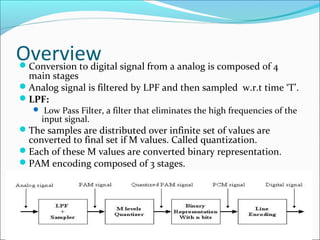
OverviewConversion to digital signal from a analog is composed of 4
main stages
Analog signal is filtered by LPF and then sampled w.r.t time ‘T’.
LPF:
 Low Pass Filter, a filter that eliminates the high frequencies of the
input signal.
The samples are distributed over infinite set of values are
converted to final set if M values. Called quantization.
Each of these M values are converted binary representation.
PAM encoding composed of 3 stages.
Why PCM method?
A digital representation of an analog signal where the
magnitude of the signal is sampled regularly at
uniform intervals, then quantized to a series of
symbols in a numeric (usually binary) code.
Answer is the advantages over digitizing.
Part of them is also available in analog systems , but
cost is higher and performance is usually worse.
PCM
Error correction
Retransmit the damaged data again (as in TCP)
Encryption
Encrypted easily advantage in business/military purpose
Compression
Compress data take less memory
Storage
Retrieval of data using cheaper peripherals devices
Transmission
Repeater for long distance to reduce noise and regeneration
Line encoding
PCM signal is not ready to be transmitted requires line encoding
Some formal technique are used to represent data, and narrow
B/W
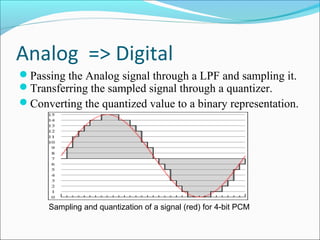
Analog => Digital
Passing the Analog signal through a LPF and sampling it.
Transferring the sampled signal through a quantizer.
Converting the quantized value to a binary representation.
Sampling and quantization of a signal (red) for 4-bit PCM
LPF and Sampling
Nyquest theorem, an Analog signal can be reconstructed from
a sequence of samples if the sampling rate is, at least, twice as
the highest frequency of the signal.
The LPF must come before the sampling. Filtering the
frequencies higher then the sampling rate, removing the
phenomenon called Aliasing.
Sampling rate help in calculating the time period of each
sample Ts= 1/fs.
Which defines the samples over an infinite set of values,
which is a big problem when it comes to transmission.
What to do then >>>????
We need to Quantize the data
Quantization
Confine the infinite set to finite set of values, defined
by letter M which is an exponential function
M = 2n
It can be easily derived from
the above table that this
quantizer has 8 levels (M=8).
The quantizer used here
is a linear quantizer.
Speech contain lower frequencies then higher
therefore we use more quantization levels then higher
X, the input voltage
[Volt]
Output voltage [Volt]
X >= 6 7
6 > X >= 4 5
4 > X >= 2 3
2 > X >= 0 1
0 > X >= -2 -1
-2 > X >= -4 -3
-4 > X >= -6 -5
-6 > X -7
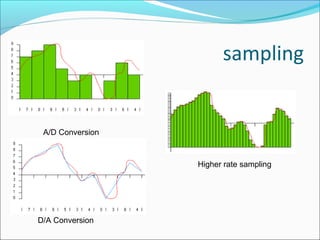
sampling
When you sample the wave with an analog-to-digital
converter, you have control over two variables:
The sampling rate - Controls how many samples are
taken per second
The sampling precision - Controls how many
different gradations (quantization levels) are possible
when taking the sample
sampling
A/D Conversion
D/A Conversion
Higher rate sampling
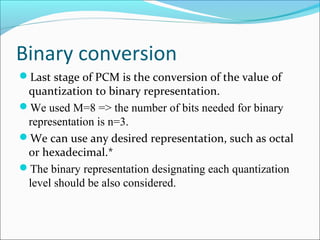
Binary conversion
Last stage of PCM is the conversion of the value of
quantization to binary representation.
We used M=8 => the number of bits needed for binary
representation is n=3.
We can use any desired representation, such as octal
or hexadecimal.*
The binary representation designating each quantization
level should be also considered.
Gray codes
Gray code can be very useful here.
In Gray code, every two neighboring words are different
in only one bit.
Thus a error caused due to additive noise will cause only
a minor shift to neighboring frequencies
Decreasing the impact of the
error occurred significantly.
Quantizer output voltage
[Volt]
PCM output [binary
representation]
7 110
5 111
3 101
1 100
-1 000
-3 001
-5 011
-7 010
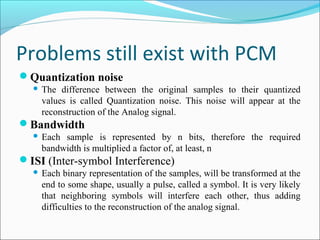
Problems still exist with PCM
Quantization noise
 The difference between the original samples to their quantized
values is called Quantization noise. This noise will appear at the
reconstruction of the Analog signal.
Bandwidth
 Each sample is represented by n bits, therefore the required
bandwidth is multiplied a factor of, at least, n
ISI (Inter-symbol Interference)
 Each binary representation of the samples, will be transformed at the
end to some shape, usually a pulse, called a symbol. It is very likely
that neighboring symbols will interfere each other, thus adding
difficulties to the reconstruction of the analog signal.
Encodings
Digital data, digital signals
How to represent bits (codes)
Analog data, digital signals
How to represent voltages (sampling)
Digital/Digital Encoding
Issue in comparing various techniques:
Signal spectrum
 High freq-big b/w, no dc – Better isolation
Signal synchronization capability
Signal error detecting capability
Signal interference and noise immunity
Cost and complexity
More A – D modulation
Pulse Amplitude Modulation (PAM)
Delta Modulation (DM)
Quantizing noise
Slope-overload noise
Differential Pulse code Modulation (DPAM)
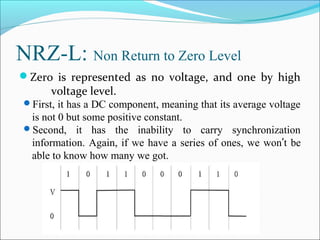
NRZ-L: Non Return to Zero Level
Zero is represented as no voltage, and one by high
voltage level.
First, it has a DC component, meaning that its average voltage
is not 0 but some positive constant.
Second, it has the inability to carry synchronization
information. Again, if we have a series of ones, we won’t be
able to know how many we got.
Polar NRZ-L: Polar Non Return to Zero Level
Zero is represented as negative voltage level, and one
by positive voltage level.
This code is similar to the previous one. It handles the
DC component issue, meaning the average voltage level
is 0. It still has the synchronization problem.
NRZ-I: Non Return to Zero Inverted
Transition on one only.
Like Polar NRZ no change in voltage in the case of
zeroes sequence and no carry of synchronization
information.
This code doesn’t handle the DC component (average
is not 0).
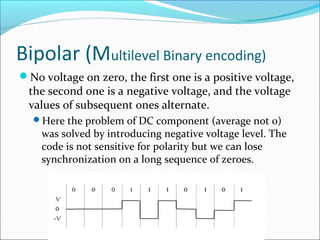
Bipolar (Multilevel Binary encoding)
No voltage on zero, the first one is a positive voltage,
the second one is a negative voltage, and the voltage
values of subsequent ones alternate.
Here the problem of DC component (average not 0)
was solved by introducing negative voltage level. The
code is not sensitive for polarity but we can lose
synchronization on a long sequence of zeroes.
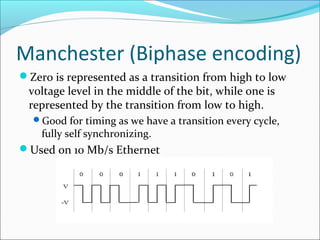
Manchester (Biphase encoding)
Zero is represented as a transition from high to low
voltage level in the middle of the bit, while one is
represented by the transition from low to high.
Good for timing as we have a transition every cycle,
fully self synchronizing.
Used on 10 Mb/s Ethernet
Differential Manchester (Biphase)
Always a transition in the middle of a bit, transition at the
beginning only for zero.
As in the regular Manchester code, fully self synchronizing
Another advantage here, polarity is not significant.
The drawback of this line code is the same as for the
previous one, double bandwidth.
Scrambling Techniques
For long distance applications, the encoding schemes
that are normally used are known as scrambling tech.
Applied in case of bipolar AMI (Alternate mark
inversion)
Solve problem of long strings of ‘0’
 B8ZS- bipolar 8 zero substitution
HDB3- high density Bipolar 3 zeros
4B/5B
Insert extra bits to break up runs
4 bit vales sent as 5 bit codeword
Codeword have <2 leading 0 and <3 trailing 0; 16 of 32
used (other for ctrl)
Transmittied using NRZI
80% efficiency
Used by FDDI and 100 Mb/s ethernet
Complete communication system
A basic block diagram of a complete communication
system for analog signals.
Receiver
Modulation taking the input bits (called Baseband)
and, loading it on the transmission carrier (RF
carrier).
Detection mainly, receiving only a pre defined
frequency range.
Matched filter a filter that is match to the
transmitted signal, thus enables the best possible
reception.
Decision for every digital value received we should
decide what was the original value that was
transmitted.
D/A Digital to Analog signal convertor.

1 PCM & Encoding

  • 2.
    Introduction A general overviewof signal encoding You will learn why to use digital encoding, how signal is transmitted and received and how analog signals are converted to digital Some digital encoding methods
  • 3.
    OverviewConversion to digitalsignal from a analog is composed of 4 main stages Analog signal is filtered by LPF and then sampled w.r.t time ‘T’. LPF:  Low Pass Filter, a filter that eliminates the high frequencies of the input signal. The samples are distributed over infinite set of values are converted to final set if M values. Called quantization. Each of these M values are converted binary representation. PAM encoding composed of 3 stages.
  • 4.
    Why PCM method? Adigital representation of an analog signal where the magnitude of the signal is sampled regularly at uniform intervals, then quantized to a series of symbols in a numeric (usually binary) code. Answer is the advantages over digitizing. Part of them is also available in analog systems , but cost is higher and performance is usually worse.
  • 5.
    PCM Error correction Retransmit thedamaged data again (as in TCP) Encryption Encrypted easily advantage in business/military purpose Compression Compress data take less memory Storage Retrieval of data using cheaper peripherals devices Transmission Repeater for long distance to reduce noise and regeneration Line encoding PCM signal is not ready to be transmitted requires line encoding Some formal technique are used to represent data, and narrow B/W
  • 6.
    Analog => Digital Passingthe Analog signal through a LPF and sampling it. Transferring the sampled signal through a quantizer. Converting the quantized value to a binary representation. Sampling and quantization of a signal (red) for 4-bit PCM
  • 7.
    LPF and Sampling Nyquesttheorem, an Analog signal can be reconstructed from a sequence of samples if the sampling rate is, at least, twice as the highest frequency of the signal. The LPF must come before the sampling. Filtering the frequencies higher then the sampling rate, removing the phenomenon called Aliasing. Sampling rate help in calculating the time period of each sample Ts= 1/fs. Which defines the samples over an infinite set of values, which is a big problem when it comes to transmission. What to do then >>>???? We need to Quantize the data
  • 8.
    Quantization Confine the infiniteset to finite set of values, defined by letter M which is an exponential function M = 2n It can be easily derived from the above table that this quantizer has 8 levels (M=8). The quantizer used here is a linear quantizer. Speech contain lower frequencies then higher therefore we use more quantization levels then higher X, the input voltage [Volt] Output voltage [Volt] X >= 6 7 6 > X >= 4 5 4 > X >= 2 3 2 > X >= 0 1 0 > X >= -2 -1 -2 > X >= -4 -3 -4 > X >= -6 -5 -6 > X -7
  • 9.
    sampling When you samplethe wave with an analog-to-digital converter, you have control over two variables: The sampling rate - Controls how many samples are taken per second The sampling precision - Controls how many different gradations (quantization levels) are possible when taking the sample
  • 10.
  • 12.
    Binary conversion Last stageof PCM is the conversion of the value of quantization to binary representation. We used M=8 => the number of bits needed for binary representation is n=3. We can use any desired representation, such as octal or hexadecimal.* The binary representation designating each quantization level should be also considered.
  • 13.
    Gray codes Gray codecan be very useful here. In Gray code, every two neighboring words are different in only one bit. Thus a error caused due to additive noise will cause only a minor shift to neighboring frequencies Decreasing the impact of the error occurred significantly. Quantizer output voltage [Volt] PCM output [binary representation] 7 110 5 111 3 101 1 100 -1 000 -3 001 -5 011 -7 010
  • 14.
    Problems still existwith PCM Quantization noise  The difference between the original samples to their quantized values is called Quantization noise. This noise will appear at the reconstruction of the Analog signal. Bandwidth  Each sample is represented by n bits, therefore the required bandwidth is multiplied a factor of, at least, n ISI (Inter-symbol Interference)  Each binary representation of the samples, will be transformed at the end to some shape, usually a pulse, called a symbol. It is very likely that neighboring symbols will interfere each other, thus adding difficulties to the reconstruction of the analog signal.
  • 15.
    Encodings Digital data, digitalsignals How to represent bits (codes) Analog data, digital signals How to represent voltages (sampling)
  • 16.
    Digital/Digital Encoding Issue incomparing various techniques: Signal spectrum  High freq-big b/w, no dc – Better isolation Signal synchronization capability Signal error detecting capability Signal interference and noise immunity Cost and complexity
  • 17.
    More A –D modulation Pulse Amplitude Modulation (PAM) Delta Modulation (DM) Quantizing noise Slope-overload noise Differential Pulse code Modulation (DPAM)
  • 18.
    NRZ-L: Non Returnto Zero Level Zero is represented as no voltage, and one by high voltage level. First, it has a DC component, meaning that its average voltage is not 0 but some positive constant. Second, it has the inability to carry synchronization information. Again, if we have a series of ones, we won’t be able to know how many we got.
  • 19.
    Polar NRZ-L: PolarNon Return to Zero Level Zero is represented as negative voltage level, and one by positive voltage level. This code is similar to the previous one. It handles the DC component issue, meaning the average voltage level is 0. It still has the synchronization problem.
  • 20.
    NRZ-I: Non Returnto Zero Inverted Transition on one only. Like Polar NRZ no change in voltage in the case of zeroes sequence and no carry of synchronization information. This code doesn’t handle the DC component (average is not 0).
  • 21.
    Bipolar (Multilevel Binaryencoding) No voltage on zero, the first one is a positive voltage, the second one is a negative voltage, and the voltage values of subsequent ones alternate. Here the problem of DC component (average not 0) was solved by introducing negative voltage level. The code is not sensitive for polarity but we can lose synchronization on a long sequence of zeroes.
  • 22.
    Manchester (Biphase encoding) Zerois represented as a transition from high to low voltage level in the middle of the bit, while one is represented by the transition from low to high. Good for timing as we have a transition every cycle, fully self synchronizing. Used on 10 Mb/s Ethernet
  • 23.
    Differential Manchester (Biphase) Alwaysa transition in the middle of a bit, transition at the beginning only for zero. As in the regular Manchester code, fully self synchronizing Another advantage here, polarity is not significant. The drawback of this line code is the same as for the previous one, double bandwidth.
  • 24.
    Scrambling Techniques For longdistance applications, the encoding schemes that are normally used are known as scrambling tech. Applied in case of bipolar AMI (Alternate mark inversion) Solve problem of long strings of ‘0’  B8ZS- bipolar 8 zero substitution HDB3- high density Bipolar 3 zeros
  • 25.
    4B/5B Insert extra bitsto break up runs 4 bit vales sent as 5 bit codeword Codeword have <2 leading 0 and <3 trailing 0; 16 of 32 used (other for ctrl) Transmittied using NRZI 80% efficiency Used by FDDI and 100 Mb/s ethernet
  • 26.
    Complete communication system Abasic block diagram of a complete communication system for analog signals.
  • 27.
    Receiver Modulation taking theinput bits (called Baseband) and, loading it on the transmission carrier (RF carrier). Detection mainly, receiving only a pre defined frequency range. Matched filter a filter that is match to the transmitted signal, thus enables the best possible reception. Decision for every digital value received we should decide what was the original value that was transmitted. D/A Digital to Analog signal convertor.