
COMMUNICATING WITH MORE CONFIDENCE By Dr.Sherif Elarabi
Purpose of learning communication People are forgetting how to talk How to listen How to express themselve what words to use and not to use  They lack the confidence to meet other  people  Or tackle difficult situations face-to-face
Improving your communication skills can Help you to win more contracts and sales Gain promotion  manage your organisation or your team more effectively
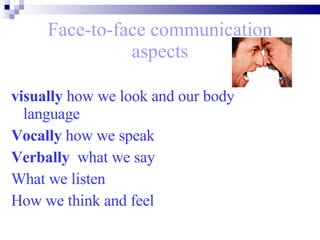
Face-to-face communication aspects visually  how we look and our body language  Vocally  how we speak  Verbally  what we say  What we listen  How we think and feel
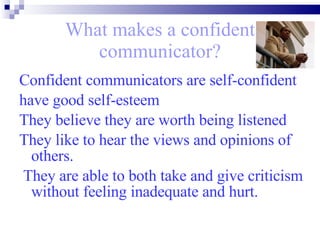
What makes a confident communicator? Confident communicators are self-confident  have good self-esteem They believe they are worth being listened  They like to hear the views and opinions of others. They are able to both take and give criticism without feeling inadequate and hurt.
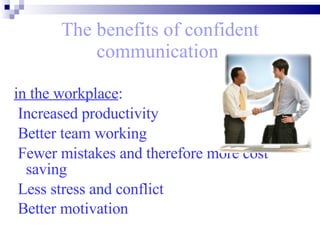
The benefits of confident communication   in the workplace : Increased productivity  Better team working Fewer mistakes and therefore more cost saving  Less stress and conflict Better motivation
in your personal life can mean: fewer misunderstandings greater cooperation  more friends  improved relationships
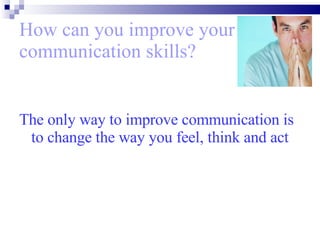
How can you improve your communication skills? The only way to improve communication is to change the way you feel, think and act
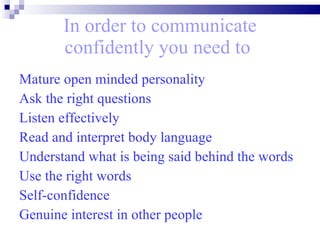
In order to communicate confidently you need to   Mature open minded personality Ask the right questions Listen effectively Read and interpret body language Understand what is being said behind the words Use the right words Self-confidence  Genuine interest in other people
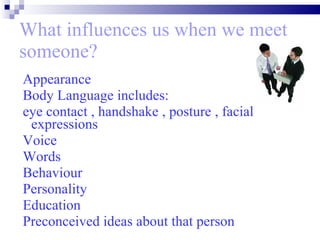
What influences us when we meet someone? Appearance Body Language includes: eye contact , handshake , posture , facial  expressions Voice Words  Behaviour  Personality  Education Preconceived ideas about that person
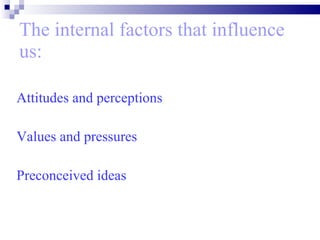
The internal factors that influence us: Attitudes and perceptions Values and pressures  Preconceived ideas
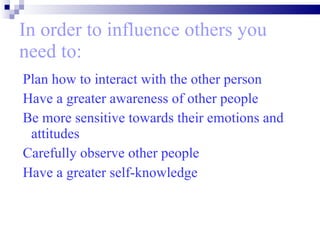
In order to influence others you need to: Plan how to interact with the other person Have a greater awareness of other people  Be more sensitive towards their emotions and attitudes  Carefully observe other people Have a greater self-knowledge
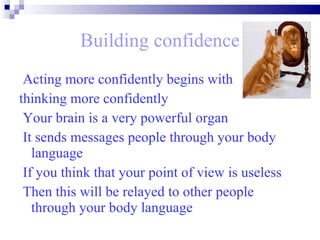
Building confidence Acting more confidently begins with  thinking more confidently Your brain is a very powerful organ  It sends messages people through your body language  If you think that your point of view is useless  Then this will be relayed to other people through your body language
SELF- ESTEEM Self esteem  is the picture we have of  ourselves and the value we place upon ourselves  It is dependent on what others tell us about ourselves
How to improve self-esteem   Think positive Feel good about yourself  also learn to feel good about others You can gain a great deal of personal satisfaction and strength through helping others.
Your inner voice Don,t listen to negative inner voice Stop comparing yourself to others Get a more positive dialogue
Listening Listening is the heart of effective communication Listening involves both: the ability to  understand what is being said   the ability to  organize and analyze  the messages
There are two types of listening: 1- Causal listening : is what we tend to do most of the time We are only half listening  we discard other parts of conversation  2-Critical listening : requires concentration and stamina .
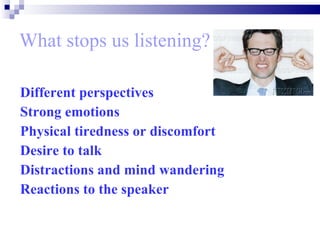
What stops us listening? Different perspectives  Strong emotions   Physical tiredness or discomfort   Desire to talk   Distractions and mind wandering   Reactions to the speaker
So how can we improve our listening skills? Start listening with the first word Turn off all negative thoughts you have about the speaker  Think at the speed they’re talking, don’t jump ahead  Do not interrupt  Find an area of interest  Resist distractions if you possibly can Suspend your judgement and keep an open mind
Getting on someone’s wavelength How can we get on someone’s wavelength, even those whom we find it difficult to relate to?  Well of course they don’t and they’re not like us  We are all different  Recognising this can help us to adapt our approach
Personality Types Type A – dominance Have dominance and superiority in their make up Impatient individuals  Confident decision makers Time conscious and find it hard to relax Have a high degree of energy, and like getting things done  They are good at ideas, and at problem solving  Being natural risk takers Quickly get bored with the detail  Highly independent
Their influencing style   Tough battler, pressing for results, giving orders,  issuing challenges  They are enterprising and forceful
Managing a Type A personality you should give them short-term goals  that give them a high degree of recognition and status ensure they have the opportunity to develop new skills and interest  try and speed up the way you talk  be direct, get straight to the point  Use time efficiently
How to recognize the Type A They will use dominant body language Their speech will be direct  Get right to the point  They will make flat assertions They will also use a lot of ‘I’ statements  Give you the benefit of their wisdom and provide advice
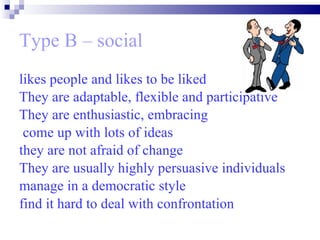
Type B – social likes people and likes to be liked  They are adaptable, flexible and participative  They are enthusiastic, embracing come up with lots of ideas  they are not afraid of change  They are usually highly persuasive individuals manage in a democratic style find it hard to deal with confrontation
Their influencing style Friendly helper Showing concern Expressing friendliness and warmth  Try to influence by appealing to others’ emotions
Managing a Type B give them short to medium-term goals  consistent management approach
Recognising a Type B Less dominant body language  They will not be so direct Quickly participate in any meeting Friendly, talkative and smile at you  They enjoy team working Their hobbies will often be people and team related
Type C – measured Measured and far more logical and analytical Steady, often security minded Don’t like a lot of change Suspicious and sceptical of new ideas They are consistent, caring and patient They don’t like taking risks They are generally warm hearted When aggressive can be very stubborn
Their influencing style Based on logic and facts  Fairness is paramount to a Type C personality
Managing a Type C Set long-term goals with careful and periodic reviews  The Type C needs to be told what you want  Prefer to rely on more assertive people to take the lead When introducing change it is best to do it in stages  Doesn’t like interruptions and distractions They need to feel they have your support and encouragement
Recognising a Type C personality   They are not motivated Pessimistic and cautious No dominant body language  Their hobbies will be those that require more detail and patience
Type D – compliant comply with the rules and regulations  very systematic, precise, hyperefficient and bureaucratic  love facts and detail will use rules, authority and logical argument
Their influencing style   based on logic and facts often quoting authorities and rules and regulations  They have a tendency to correct errors and inaccuracies
Managing a Type D They like long-term goals fully negotiated They like harmony  They need a detailed brief and explanation Do not like taking risks  Concerned with quality  You will also need to delegate very specifically
Recognising a Type D No dominant body language likely to be submissive  speak quietly and can be vague  enjoy complex hobbies requiring patience and detail
Final Check list Accept full responsibility for communication Accept you cannot change another person  Be aware of the values, attitudes, pressures Keep an open mind and try and see where the other person is coming from Get a positive inner voice Adopt and practise giving out confident body  language  Fine tune your listening skills using critical listening  Understand that not everyone is like you
 

Communicate With Confidence

  • 1.
    COMMUNICATING WITH MORECONFIDENCE By Dr.Sherif Elarabi
  • 2.
    Purpose of learningcommunication People are forgetting how to talk How to listen How to express themselve what words to use and not to use They lack the confidence to meet other people Or tackle difficult situations face-to-face
  • 3.
    Improving your communicationskills can Help you to win more contracts and sales Gain promotion manage your organisation or your team more effectively
  • 4.
    Face-to-face communication aspectsvisually how we look and our body language Vocally how we speak Verbally what we say What we listen How we think and feel
  • 5.
    What makes aconfident communicator? Confident communicators are self-confident have good self-esteem They believe they are worth being listened They like to hear the views and opinions of others. They are able to both take and give criticism without feeling inadequate and hurt.
  • 6.
    The benefits ofconfident communication in the workplace : Increased productivity Better team working Fewer mistakes and therefore more cost saving Less stress and conflict Better motivation
  • 7.
    in your personallife can mean: fewer misunderstandings greater cooperation more friends improved relationships
  • 8.
    How can youimprove your communication skills? The only way to improve communication is to change the way you feel, think and act
  • 9.
    In order tocommunicate confidently you need to Mature open minded personality Ask the right questions Listen effectively Read and interpret body language Understand what is being said behind the words Use the right words Self-confidence Genuine interest in other people
  • 10.
    What influences uswhen we meet someone? Appearance Body Language includes: eye contact , handshake , posture , facial expressions Voice Words Behaviour Personality Education Preconceived ideas about that person
  • 11.
    The internal factorsthat influence us: Attitudes and perceptions Values and pressures Preconceived ideas
  • 12.
    In order toinfluence others you need to: Plan how to interact with the other person Have a greater awareness of other people Be more sensitive towards their emotions and attitudes Carefully observe other people Have a greater self-knowledge
  • 13.
    Building confidence Actingmore confidently begins with thinking more confidently Your brain is a very powerful organ It sends messages people through your body language If you think that your point of view is useless Then this will be relayed to other people through your body language
  • 14.
    SELF- ESTEEM Selfesteem is the picture we have of ourselves and the value we place upon ourselves It is dependent on what others tell us about ourselves
  • 15.
    How to improveself-esteem Think positive Feel good about yourself also learn to feel good about others You can gain a great deal of personal satisfaction and strength through helping others.
  • 16.
    Your inner voiceDon,t listen to negative inner voice Stop comparing yourself to others Get a more positive dialogue
  • 17.
    Listening Listening isthe heart of effective communication Listening involves both: the ability to understand what is being said the ability to organize and analyze the messages
  • 18.
    There are twotypes of listening: 1- Causal listening : is what we tend to do most of the time We are only half listening we discard other parts of conversation 2-Critical listening : requires concentration and stamina .
  • 19.
    What stops uslistening? Different perspectives Strong emotions Physical tiredness or discomfort Desire to talk Distractions and mind wandering Reactions to the speaker
  • 20.
    So how canwe improve our listening skills? Start listening with the first word Turn off all negative thoughts you have about the speaker Think at the speed they’re talking, don’t jump ahead Do not interrupt Find an area of interest Resist distractions if you possibly can Suspend your judgement and keep an open mind
  • 21.
    Getting on someone’swavelength How can we get on someone’s wavelength, even those whom we find it difficult to relate to? Well of course they don’t and they’re not like us We are all different Recognising this can help us to adapt our approach
  • 22.
    Personality Types TypeA – dominance Have dominance and superiority in their make up Impatient individuals Confident decision makers Time conscious and find it hard to relax Have a high degree of energy, and like getting things done They are good at ideas, and at problem solving Being natural risk takers Quickly get bored with the detail Highly independent
  • 23.
    Their influencing style Tough battler, pressing for results, giving orders, issuing challenges They are enterprising and forceful
  • 24.
    Managing a TypeA personality you should give them short-term goals that give them a high degree of recognition and status ensure they have the opportunity to develop new skills and interest try and speed up the way you talk be direct, get straight to the point Use time efficiently
  • 25.
    How to recognizethe Type A They will use dominant body language Their speech will be direct Get right to the point They will make flat assertions They will also use a lot of ‘I’ statements Give you the benefit of their wisdom and provide advice
  • 26.
    Type B –social likes people and likes to be liked They are adaptable, flexible and participative They are enthusiastic, embracing come up with lots of ideas they are not afraid of change They are usually highly persuasive individuals manage in a democratic style find it hard to deal with confrontation
  • 27.
    Their influencing styleFriendly helper Showing concern Expressing friendliness and warmth Try to influence by appealing to others’ emotions
  • 28.
    Managing a TypeB give them short to medium-term goals consistent management approach
  • 29.
    Recognising a TypeB Less dominant body language They will not be so direct Quickly participate in any meeting Friendly, talkative and smile at you They enjoy team working Their hobbies will often be people and team related
  • 30.
    Type C –measured Measured and far more logical and analytical Steady, often security minded Don’t like a lot of change Suspicious and sceptical of new ideas They are consistent, caring and patient They don’t like taking risks They are generally warm hearted When aggressive can be very stubborn
  • 31.
    Their influencing styleBased on logic and facts Fairness is paramount to a Type C personality
  • 32.
    Managing a TypeC Set long-term goals with careful and periodic reviews The Type C needs to be told what you want Prefer to rely on more assertive people to take the lead When introducing change it is best to do it in stages Doesn’t like interruptions and distractions They need to feel they have your support and encouragement
  • 33.
    Recognising a TypeC personality They are not motivated Pessimistic and cautious No dominant body language Their hobbies will be those that require more detail and patience
  • 34.
    Type D –compliant comply with the rules and regulations very systematic, precise, hyperefficient and bureaucratic love facts and detail will use rules, authority and logical argument
  • 35.
    Their influencing style based on logic and facts often quoting authorities and rules and regulations They have a tendency to correct errors and inaccuracies
  • 36.
    Managing a TypeD They like long-term goals fully negotiated They like harmony They need a detailed brief and explanation Do not like taking risks Concerned with quality You will also need to delegate very specifically
  • 37.
    Recognising a TypeD No dominant body language likely to be submissive speak quietly and can be vague enjoy complex hobbies requiring patience and detail
  • 38.
    Final Check listAccept full responsibility for communication Accept you cannot change another person Be aware of the values, attitudes, pressures Keep an open mind and try and see where the other person is coming from Get a positive inner voice Adopt and practise giving out confident body language Fine tune your listening skills using critical listening Understand that not everyone is like you
  • 39.