Antibiotics are drugs derived wholly or partially from certain microorganisms and are used to treat bacterial or fungal infections. Antibiotics either kill microorganisms ( bactericidal ) or stop them from reproducing ( bacteriostatic ). Antibiotics are among the  most frequently prescribed  medications in modern medicine. Today,  over 100  different antibiotics are available to doctors to cure minor discomforts as well as life-threatening infections.
Up to 80% of antibiotics are prescribed in the outpatient setting: URTI's UTI's  50% of office visits colds and upper RTI’s  80% of visits for acute bronchitis … are treated with antibiotics.
B-LACTAMS. Aminoglycosides. Quinolones. Sulphonamides. Macrolides.
1.Inhibit synthesis of bacterial cell wall. 2.Act directly on the cell membrane of the bacteria, causing it to break open. 3.Inhibit bacterial protein synthesis. (nucleic acid synthesis , interferes with ribosomal functions) 4.Affect bacterial metabolism and growth.
Their biological source: Plant, mold, soil microorganisms Their spectrum of action or coverage: Broad/wide spectrum  - effective against a wide range of bacteria  Narrow spectrum  - effective mainly against specific categories of bacteria  e.g. Gram-positive or Gram-negative bacteria but not both Limited spectrum  - effective against a single organism or disease Their mode of action: How they fight bacteria
Specific agents Penicillin G (IV), Penicillin V (oral) Antistaphylococcal  nafcillin, oxacillin, dicloxacillin Extended spectrum  ampicillin, amoxicillin ticarcillin, piperacillin Clinical uses Streptococcal phayngitis (PCN) MSSA (nafcillin) E.coli, Proteus (ampicilin) Pseudomonas (piperacillin)
Mechanism of action Inhibits bacterial cell wall synthesis Bind to Penicillin binding proteins Bactericidal Mechanisms of resistance Altered penicillin binding proteins (PBPs) mecA/MRSA, Strep. Pneumo resistance Production of Beta-lactamases (penicillinases) Decreased penetration/increased efflux (pseudomonas)
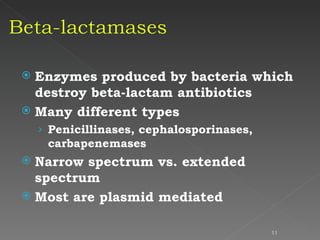
Enzymes produced by bacteria which destroy beta-lactam antibiotics Many different types Penicillinases, cephalosporinases, carbapenemases Narrow spectrum vs. extended spectrum Most are plasmid mediated
Clavulanate With amoxicillin (Augmentin) With ticarcillin (Timentin) Sulbactam With ampicillin (Unasyn) Tazobactam With piperacillin (Zosyn)
Adverse effects Allergy (Anaphylaxis, rash, fever, interstitial nephritis) Diarrhea –amoxicillin/clavulanate (augmentin) Rash - ampicillin Sodium overload- ticarcillin Seizure especially with high doses and renal dysfunction
1 st  generation – cefazolin 2 nd  generation - cefuroxime 3 rd  generation - ceftriaxone 4 th  generation - cefepime 5 th  generation - ceftobiprole Differ in spectrum, resistance to beta lactamases, penetration into CNS IV, IM: oral forms for 1 st , 2 nd ,3 rd  gen.
Clinical uses Cellulitis – (cephalexin) Prophylactic prior to surgery (cefotetan) Meningitis – (ceftriaxone) Mechanism of action Inhibition of cell wall synthesis Bactericidal
Resistance mechanisms Destruction by beta-lactamases (cephalosporinases) Alteration in the affinity of penicillin binding proteins (PBPs) for cephalosporins Efflux of cephalosporins from microbe
Adverse Effects Allergic reactions – 10% cross reactivity with penicillins GIT disturbances. Pain & inflammation at site of injection. Bleeding disorders and disulfiram-like effect.
Specific agents Imipenem  With cilastin (Primaxin) Meropenem (Merrem) Ertapenem (Invanz) Doripenem (Doribax) IV only Broad spectrum Gram positives Gram negatives Pseudomonas (except ertapenem
Clinical uses Intraabdominal infections Polymicrobial infections Pseudomonas aeruginosa Neutropenic fever Mechanism of action Inhibit bacterial cell wall synthesis Bactericidal Adverse effects Nausea/vomiting Allergy – Significant cross reaction with pencillin allergy Seizure
Aztreonam (Azactam) IV only Antimicrobial spectrum Gram negative aerobic bacteria only Including Pseudomonas Inhibits cell wall synthesis Bactericidal Adverse effects Allergy (<1% cross-reactive with penicillin)
Specific agents Gentamicin Tobramycin Amikacin IV/IM/inhaled Spectrum of action Aerobic Gram negative bacteria Pseudomonas spp .,  E.coli , others
Mechanism of action Inhibit bacterial protein synthesis Bactericidal Mechanisms of resistance Bacterial production of enzyme that inactivates aminoglycosides Alteration of drug target site Altered drug transport
Adverse effects Nephrotoxicity Ototoxicity Vestibular toxicity Neuromuscular (myasthenia gravis)
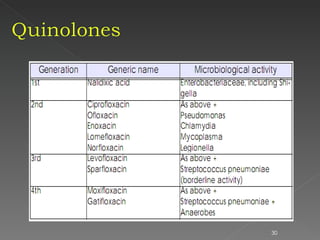
Specific agents Norfloxacin Ciprofloxacin Levofloxacin (Levaquin) Gatifloxacin (Tequin) Moxifloxacin (Avelox) Nalidixic acid
Spectrum of action Broad spectrum (varies by agent) Inhibit DNA synthesis Bactericidal Mechanisms of resistance Change in target enzyme Change in permeability of organism
Adverse Effects Nausea/vomiting CNS – headache, confusion (in elderly), panic attack, anxiety, nightmares Tendonitis or tendon rupture Kidney stones due to loss of Oxalobacter formigenes. Drug-Drug interactions with NSAID, Theophylline.
Spectrum of activity Gram positives and some gram negatives Beta-hemolytic streptococci, staphylococci and enterococci Some pneumococcal Mycoplasma and legionella Chlamydia Specific agents Erythromycin Azithromycin (Unizithrin) Clarithromycin (Klacid)
Mechanism of action Inhibit bacterial protein synthesis Bacteriostatic in small concentration & Bactericidal in high concentration Mechanism of resistance Decreased permeability of drug into the microbe Modification of target sites Hydrolysis of macrolide by bacterial enzymes Adverse effects Gastrointestinal Arrhythmias Liver toxicity
Antimicrobial spectrum Anaerobes Some gram positives Inhibits bacterial protein synthesis Bacteriostatic Adverse effects Nausea, diarrhea Clostridium difficile
Clinical use Broad spectrum Also  Mycoplasma pneumonia , Chlamydia, Rickettsia, Lyme disease Specific agents Tetracycline Doxycycline (Vibramycin) Minocycline (Minocin)
Inhibit bacterial protein synthesis Bacteriostatic Adverse effects Food drug interaction (food and dairy interfere with absorption) Also occurs with some antacids GI irritation Hepatic toxicity Renal toxicity Photosensitivity Discoloration of teeth  Vertigo (Minocycline)
Specific agents Sulfisoxazole Sulfamethoxazole/trimethoprim (Bactrim) Trimethoprim Clinical uses Broad spectrum (gram + and gram -) Oral – UTIs Topical – burn wounds, opthalmic preps Pneumocystis, Nocardia
Mechanism of action Inhibit folic acid synthesis Bacteriostatic Mechanism of resistance Alternate mechanisms for folate synthesis Sulfa not usually used alone due to resistance Adverse Effects Hypersensitivity Hematologic toxicity Renal toxicity CNS Photosensitivity Hematopoetic  Drug interactions
Mechanism of action Inhibits bacterial cell wall synthesis Bactericidal?  Spectrum Gram positive bacteria Methicillin resistant Staphylococcus aureus  Clostridium difficile (oral)
Mechanisms of resistance Production of a new cell wall component that vancomycin doesn’t inhibit Adverse Effects Red Man’s syndrome Rash Renal toxicity Ototoxicity Leukopenia
Linezolid (Zyvox) Mechanism of action Inhibit bacterial protein synthesis Bacteriostatic or bactericidal IV/oral
Antimicrobial spectrum Anaerobes ( Clostridium difficile , Bacteroides) Protozoa (Trichomonas, Entamoeba histolytica)
Mechanism of action Not completely understood Metronidazole is a prodrug Metabolism of the drug produces toxic metabolites Bactericidal Adverse effects Metallic taste Peripheral neuropathy Disulfuram effect – interaction with ethanol
Microbiological activity. Concentration at site of infection. How long it will remain at the site of action. MIC.
Using AB only when absolutely needed and indicated: AB often abused for viral infections (diarrhea, flu-symptoms, etc.) –  Starting with narrow-spectrum drugs –  Limiting use of newer drugs –  Identifying the infecting organism –  Defining the drug sensitivity of the infecting organism –  Considering all host factors: site of infection, inability of drug of choice to penetrate the site of infection, etc. –  Using AB combinations only when indicated: Severe or mixed infections, prevention of resistance (tuberculosis) Worldwide more than 500 metric tons antibiotics are used anually !!!

Anti Biotics

  • 1.
  • 2.
    Antibiotics are drugsderived wholly or partially from certain microorganisms and are used to treat bacterial or fungal infections. Antibiotics either kill microorganisms ( bactericidal ) or stop them from reproducing ( bacteriostatic ). Antibiotics are among the most frequently prescribed medications in modern medicine. Today, over 100 different antibiotics are available to doctors to cure minor discomforts as well as life-threatening infections.
  • 3.
    Up to 80%of antibiotics are prescribed in the outpatient setting: URTI's UTI's 50% of office visits colds and upper RTI’s 80% of visits for acute bronchitis … are treated with antibiotics.
  • 4.
    B-LACTAMS. Aminoglycosides. Quinolones.Sulphonamides. Macrolides.
  • 5.
    1.Inhibit synthesis ofbacterial cell wall. 2.Act directly on the cell membrane of the bacteria, causing it to break open. 3.Inhibit bacterial protein synthesis. (nucleic acid synthesis , interferes with ribosomal functions) 4.Affect bacterial metabolism and growth.
  • 7.
    Their biological source:Plant, mold, soil microorganisms Their spectrum of action or coverage: Broad/wide spectrum - effective against a wide range of bacteria Narrow spectrum - effective mainly against specific categories of bacteria e.g. Gram-positive or Gram-negative bacteria but not both Limited spectrum - effective against a single organism or disease Their mode of action: How they fight bacteria
  • 9.
    Specific agents PenicillinG (IV), Penicillin V (oral) Antistaphylococcal nafcillin, oxacillin, dicloxacillin Extended spectrum ampicillin, amoxicillin ticarcillin, piperacillin Clinical uses Streptococcal phayngitis (PCN) MSSA (nafcillin) E.coli, Proteus (ampicilin) Pseudomonas (piperacillin)
  • 10.
    Mechanism of actionInhibits bacterial cell wall synthesis Bind to Penicillin binding proteins Bactericidal Mechanisms of resistance Altered penicillin binding proteins (PBPs) mecA/MRSA, Strep. Pneumo resistance Production of Beta-lactamases (penicillinases) Decreased penetration/increased efflux (pseudomonas)
  • 11.
    Enzymes produced bybacteria which destroy beta-lactam antibiotics Many different types Penicillinases, cephalosporinases, carbapenemases Narrow spectrum vs. extended spectrum Most are plasmid mediated
  • 12.
    Clavulanate With amoxicillin(Augmentin) With ticarcillin (Timentin) Sulbactam With ampicillin (Unasyn) Tazobactam With piperacillin (Zosyn)
  • 13.
    Adverse effects Allergy(Anaphylaxis, rash, fever, interstitial nephritis) Diarrhea –amoxicillin/clavulanate (augmentin) Rash - ampicillin Sodium overload- ticarcillin Seizure especially with high doses and renal dysfunction
  • 15.
    1 st generation – cefazolin 2 nd generation - cefuroxime 3 rd generation - ceftriaxone 4 th generation - cefepime 5 th generation - ceftobiprole Differ in spectrum, resistance to beta lactamases, penetration into CNS IV, IM: oral forms for 1 st , 2 nd ,3 rd gen.
  • 16.
    Clinical uses Cellulitis– (cephalexin) Prophylactic prior to surgery (cefotetan) Meningitis – (ceftriaxone) Mechanism of action Inhibition of cell wall synthesis Bactericidal
  • 17.
    Resistance mechanisms Destructionby beta-lactamases (cephalosporinases) Alteration in the affinity of penicillin binding proteins (PBPs) for cephalosporins Efflux of cephalosporins from microbe
  • 18.
    Adverse Effects Allergicreactions – 10% cross reactivity with penicillins GIT disturbances. Pain & inflammation at site of injection. Bleeding disorders and disulfiram-like effect.
  • 20.
    Specific agents Imipenem With cilastin (Primaxin) Meropenem (Merrem) Ertapenem (Invanz) Doripenem (Doribax) IV only Broad spectrum Gram positives Gram negatives Pseudomonas (except ertapenem
  • 21.
    Clinical uses Intraabdominalinfections Polymicrobial infections Pseudomonas aeruginosa Neutropenic fever Mechanism of action Inhibit bacterial cell wall synthesis Bactericidal Adverse effects Nausea/vomiting Allergy – Significant cross reaction with pencillin allergy Seizure
  • 22.
    Aztreonam (Azactam) IVonly Antimicrobial spectrum Gram negative aerobic bacteria only Including Pseudomonas Inhibits cell wall synthesis Bactericidal Adverse effects Allergy (<1% cross-reactive with penicillin)
  • 23.
    Specific agents GentamicinTobramycin Amikacin IV/IM/inhaled Spectrum of action Aerobic Gram negative bacteria Pseudomonas spp ., E.coli , others
  • 24.
    Mechanism of actionInhibit bacterial protein synthesis Bactericidal Mechanisms of resistance Bacterial production of enzyme that inactivates aminoglycosides Alteration of drug target site Altered drug transport
  • 25.
    Adverse effects NephrotoxicityOtotoxicity Vestibular toxicity Neuromuscular (myasthenia gravis)
  • 28.
    Specific agents NorfloxacinCiprofloxacin Levofloxacin (Levaquin) Gatifloxacin (Tequin) Moxifloxacin (Avelox) Nalidixic acid
  • 29.
    Spectrum of actionBroad spectrum (varies by agent) Inhibit DNA synthesis Bactericidal Mechanisms of resistance Change in target enzyme Change in permeability of organism
  • 31.
    Adverse Effects Nausea/vomitingCNS – headache, confusion (in elderly), panic attack, anxiety, nightmares Tendonitis or tendon rupture Kidney stones due to loss of Oxalobacter formigenes. Drug-Drug interactions with NSAID, Theophylline.
  • 32.
    Spectrum of activityGram positives and some gram negatives Beta-hemolytic streptococci, staphylococci and enterococci Some pneumococcal Mycoplasma and legionella Chlamydia Specific agents Erythromycin Azithromycin (Unizithrin) Clarithromycin (Klacid)
  • 33.
    Mechanism of actionInhibit bacterial protein synthesis Bacteriostatic in small concentration & Bactericidal in high concentration Mechanism of resistance Decreased permeability of drug into the microbe Modification of target sites Hydrolysis of macrolide by bacterial enzymes Adverse effects Gastrointestinal Arrhythmias Liver toxicity
  • 34.
    Antimicrobial spectrum AnaerobesSome gram positives Inhibits bacterial protein synthesis Bacteriostatic Adverse effects Nausea, diarrhea Clostridium difficile
  • 35.
    Clinical use Broadspectrum Also Mycoplasma pneumonia , Chlamydia, Rickettsia, Lyme disease Specific agents Tetracycline Doxycycline (Vibramycin) Minocycline (Minocin)
  • 36.
    Inhibit bacterial proteinsynthesis Bacteriostatic Adverse effects Food drug interaction (food and dairy interfere with absorption) Also occurs with some antacids GI irritation Hepatic toxicity Renal toxicity Photosensitivity Discoloration of teeth Vertigo (Minocycline)
  • 37.
    Specific agents SulfisoxazoleSulfamethoxazole/trimethoprim (Bactrim) Trimethoprim Clinical uses Broad spectrum (gram + and gram -) Oral – UTIs Topical – burn wounds, opthalmic preps Pneumocystis, Nocardia
  • 38.
    Mechanism of actionInhibit folic acid synthesis Bacteriostatic Mechanism of resistance Alternate mechanisms for folate synthesis Sulfa not usually used alone due to resistance Adverse Effects Hypersensitivity Hematologic toxicity Renal toxicity CNS Photosensitivity Hematopoetic Drug interactions
  • 39.
    Mechanism of actionInhibits bacterial cell wall synthesis Bactericidal? Spectrum Gram positive bacteria Methicillin resistant Staphylococcus aureus Clostridium difficile (oral)
  • 40.
    Mechanisms of resistanceProduction of a new cell wall component that vancomycin doesn’t inhibit Adverse Effects Red Man’s syndrome Rash Renal toxicity Ototoxicity Leukopenia
  • 41.
    Linezolid (Zyvox) Mechanismof action Inhibit bacterial protein synthesis Bacteriostatic or bactericidal IV/oral
  • 42.
    Antimicrobial spectrum Anaerobes( Clostridium difficile , Bacteroides) Protozoa (Trichomonas, Entamoeba histolytica)
  • 43.
    Mechanism of actionNot completely understood Metronidazole is a prodrug Metabolism of the drug produces toxic metabolites Bactericidal Adverse effects Metallic taste Peripheral neuropathy Disulfuram effect – interaction with ethanol
  • 45.
    Microbiological activity. Concentrationat site of infection. How long it will remain at the site of action. MIC.
  • 48.
    Using AB onlywhen absolutely needed and indicated: AB often abused for viral infections (diarrhea, flu-symptoms, etc.) – Starting with narrow-spectrum drugs – Limiting use of newer drugs – Identifying the infecting organism – Defining the drug sensitivity of the infecting organism – Considering all host factors: site of infection, inability of drug of choice to penetrate the site of infection, etc. – Using AB combinations only when indicated: Severe or mixed infections, prevention of resistance (tuberculosis) Worldwide more than 500 metric tons antibiotics are used anually !!!

Editor's Notes

  • #8 Antibiotics can be classified in a few different ways, including by their biological source , which refers to the plant, mold, soil microorganisms, or even other microorganisms from which it was derived. Or by their spectrum of action , meaning the kind of bacteria they’re effective against . Broad spectrum antibiotics are effective against a wide range of bacteria and are often given to patients as empiric treatment before the infecting organism is determined. Narrow coverage means they’re effective against specific category of bacteria, for example its effective against gram-negative or gram-positive bacteria, but not both. and if an antibiotic only works against a single type of organism or infection, it has limited coverage. They can also be classified by their mode of action , or in other words, how they fight the bacteria and we’ll go into that a bit later.
  • #10 Used to treat Group A streptococcus – strep phayngitis, pneumococcus
  • #11 PBPs wotj decreased affinity for penicillins e.g. mec A encodes PBP2a a high molecular weight novel penicillin binding protein. PBP2a binds beta-lactams with low affinity.