People Management and
Communication Skills
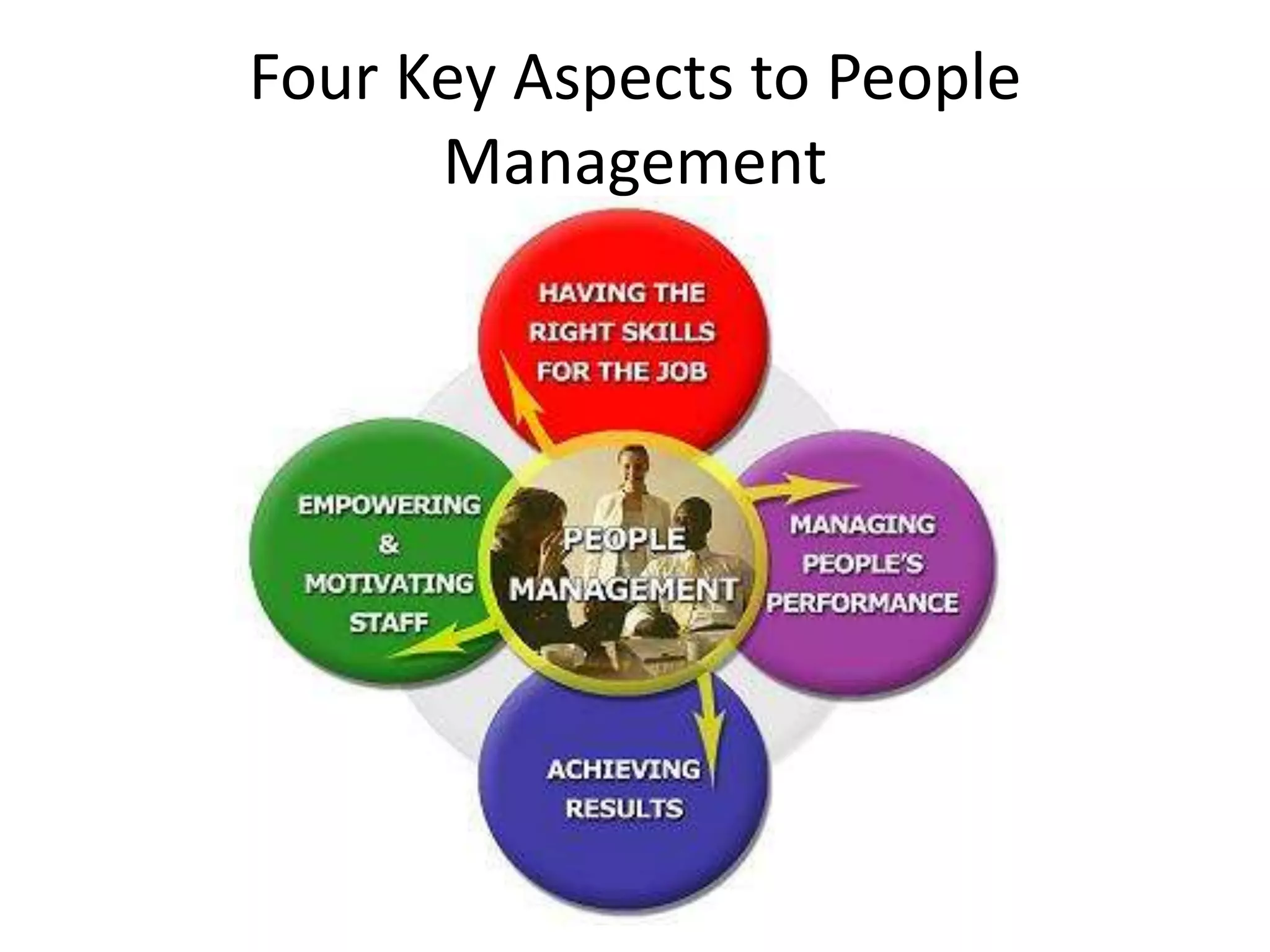
Four Key Aspects to People
Management
People Skills
Understanding how people communicate
Expressing your thoughts and feelings clearly
Speaking up when your needs are not being met
Asking for feedback and giving quality feedback in return
Influencing how others think and act
Bringing conflicts to the surface and getting them resolved
Collaborating with others
Shifting gears when relationships are unproductive
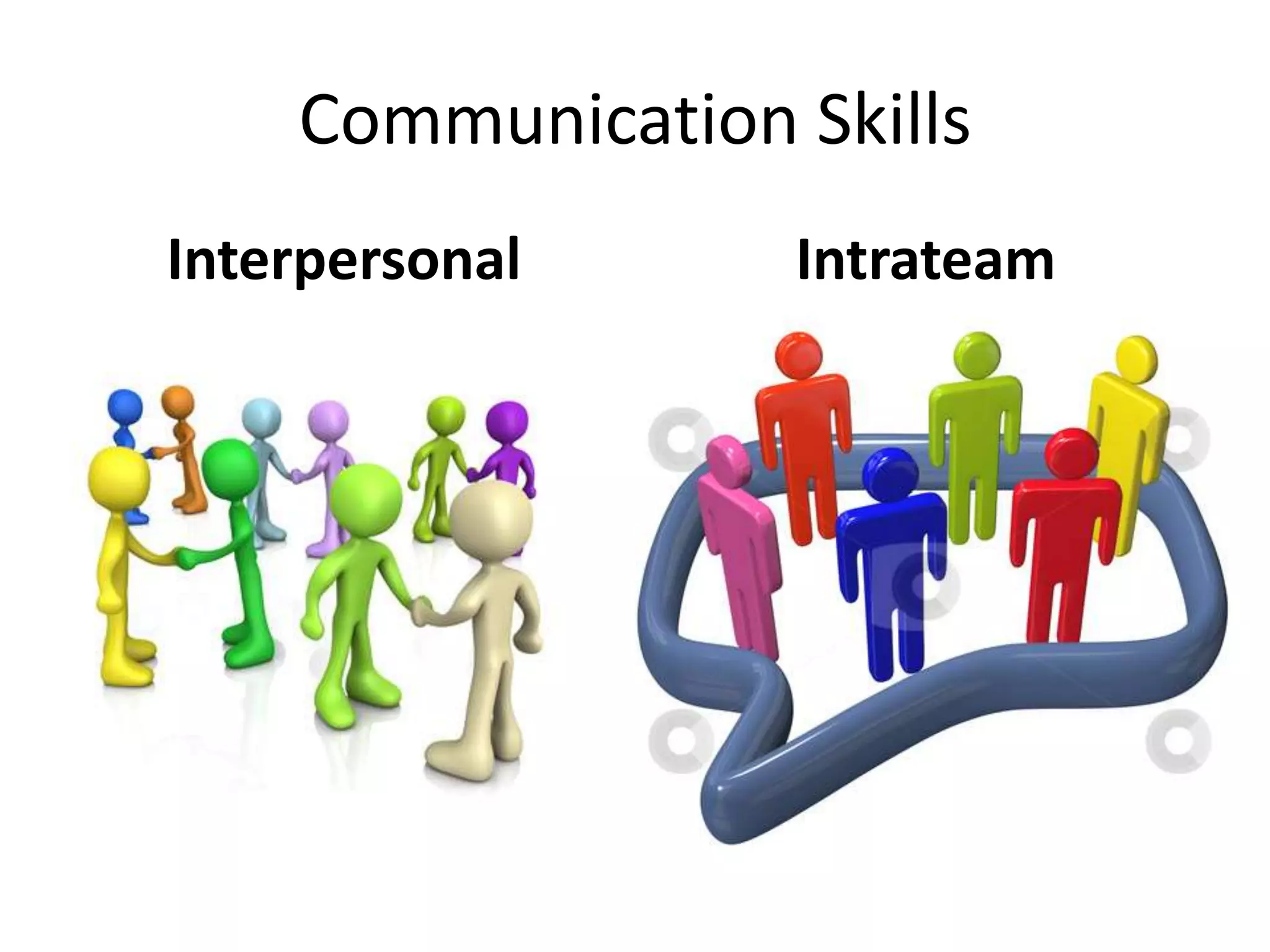
Communication Skills
Interpersonal Intrateam
Effective Communication: Discuss
1. What is interpersonal communication?
2. What is intrateam communication?
3. Why learn about interpersonal and intrateam
communication?
4. How might I understand effective
communication?
5. Verbal vs. non verbal communication
6. Reasons for communication breakdown
7. Overcoming communication barriers
8. How can I improve my communication skills?
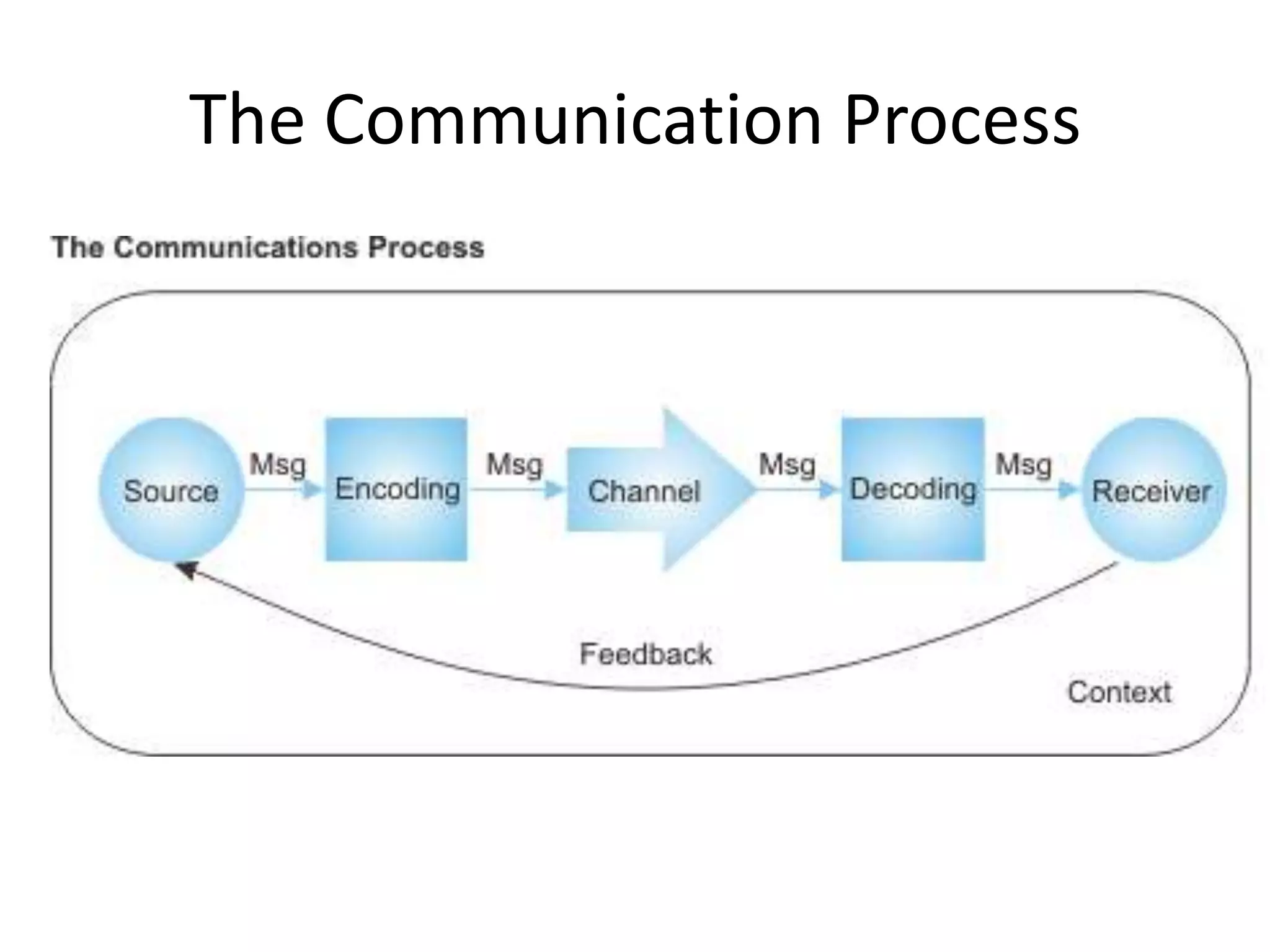
The Communication Process
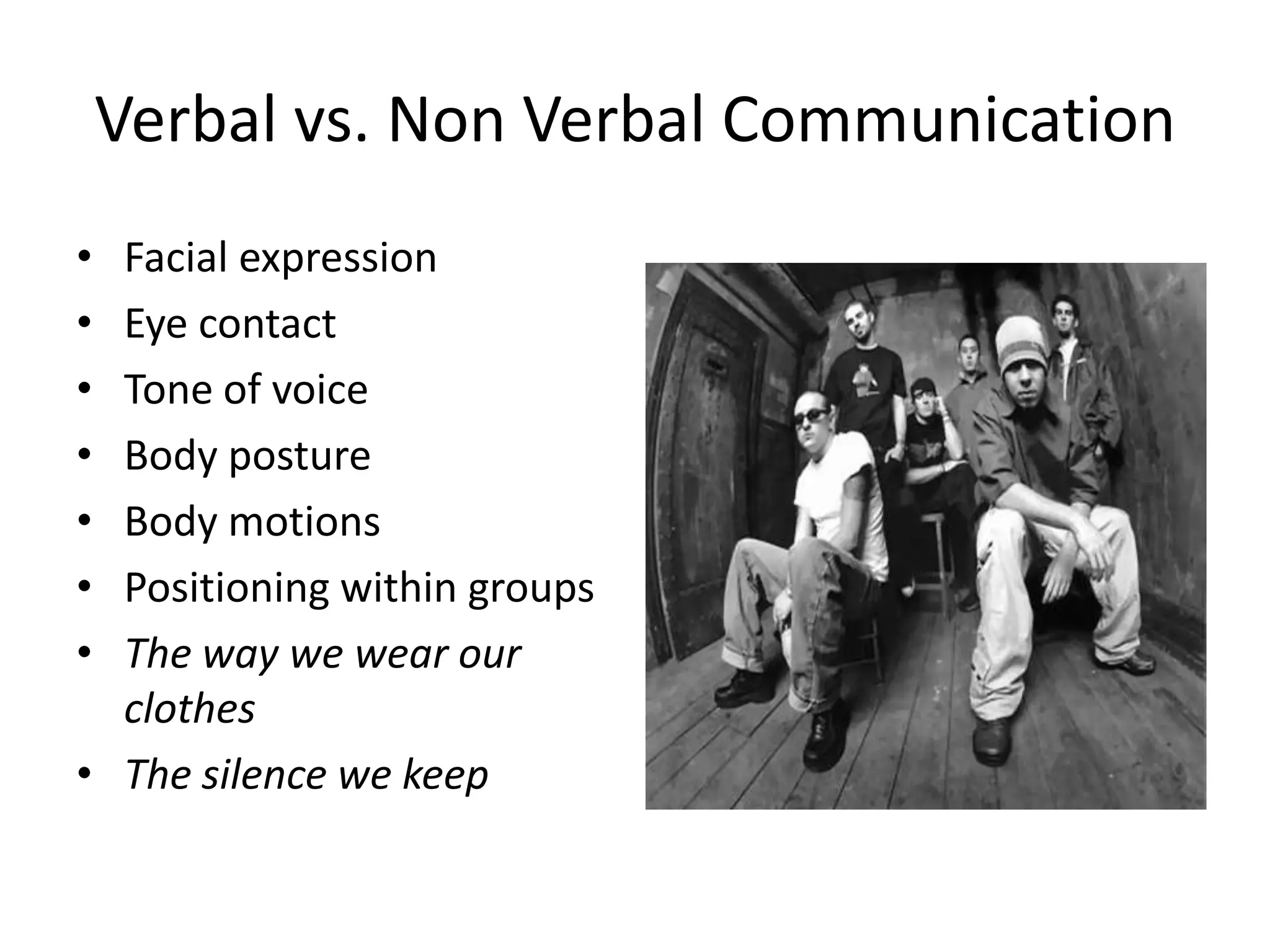
Verbal vs. Non Verbal Communication
• Facial expression
• Eye contact
• Tone of voice
• Body posture
• Body motions
• Positioning within groups
• The way we wear our
clothes
• The silence we keep
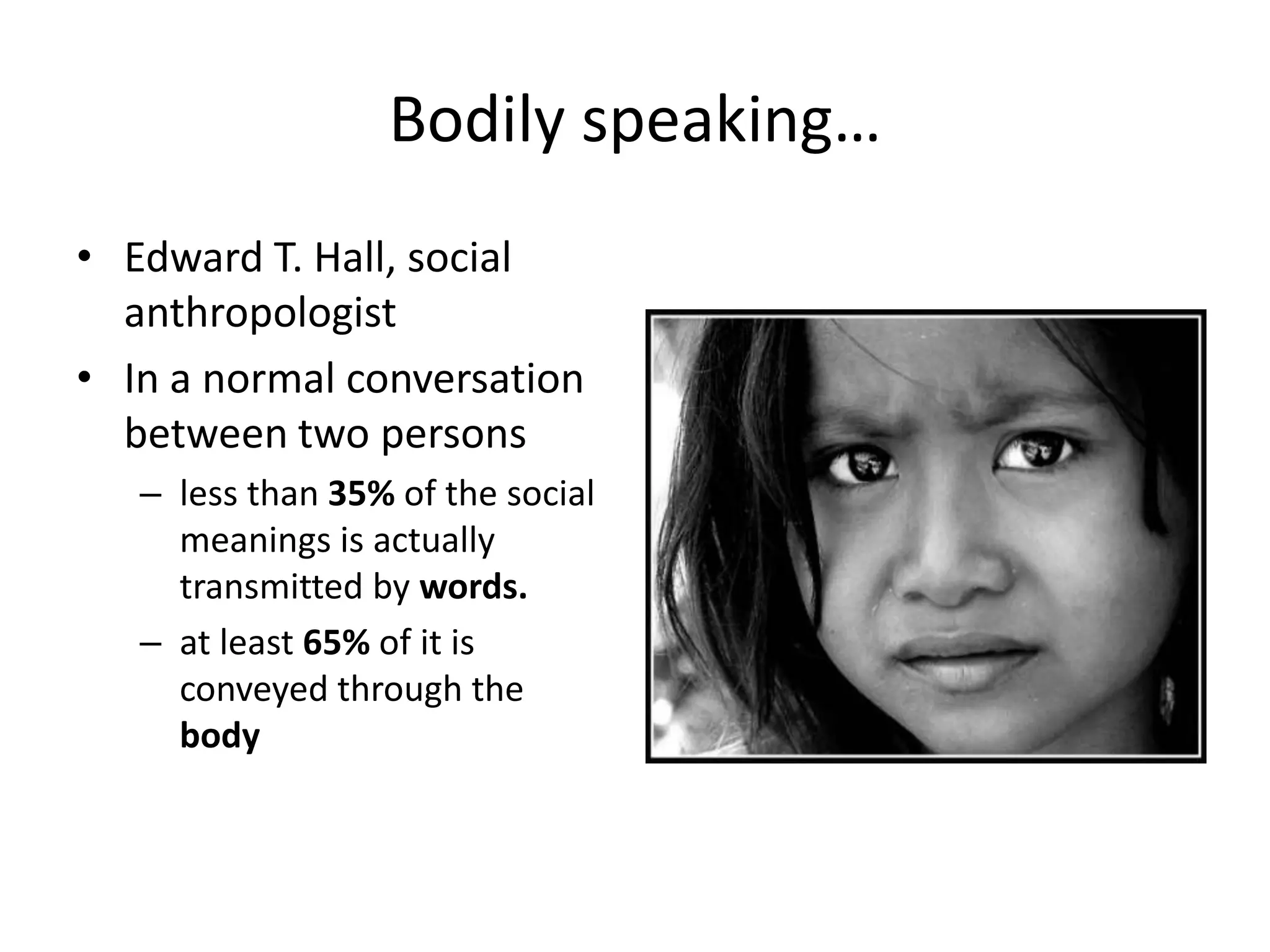
Bodily speaking…
• Edward T. Hall, social
anthropologist
• In a normal conversation
between two persons
– less than 35% of the social
meanings is actually
transmitted by words.
– at least 65% of it is
conveyed through the
body
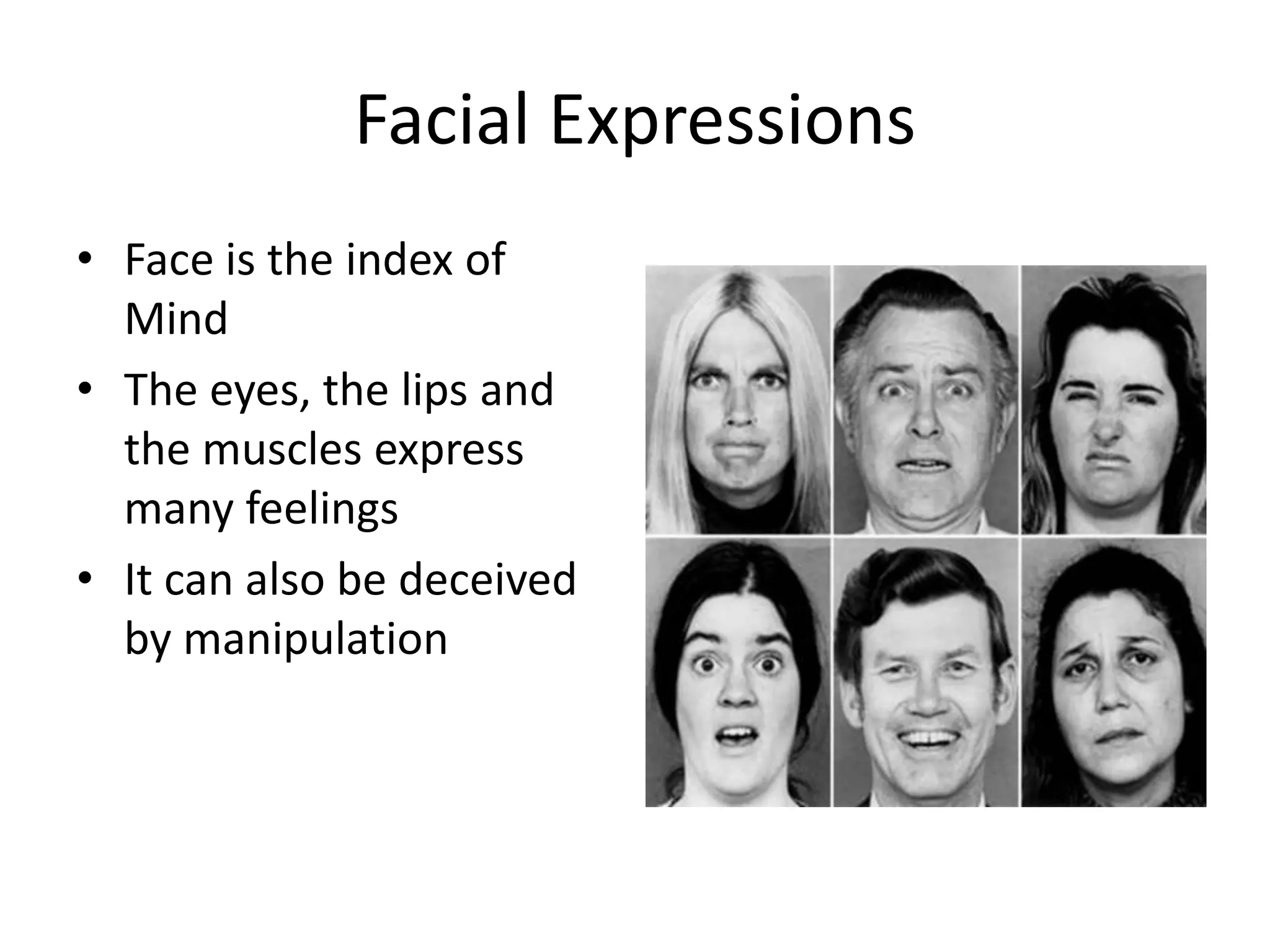
Facial Expressions
• Face is the index of
Mind
• The eyes, the lips and
the muscles express
many feelings
• It can also be deceived
by manipulation
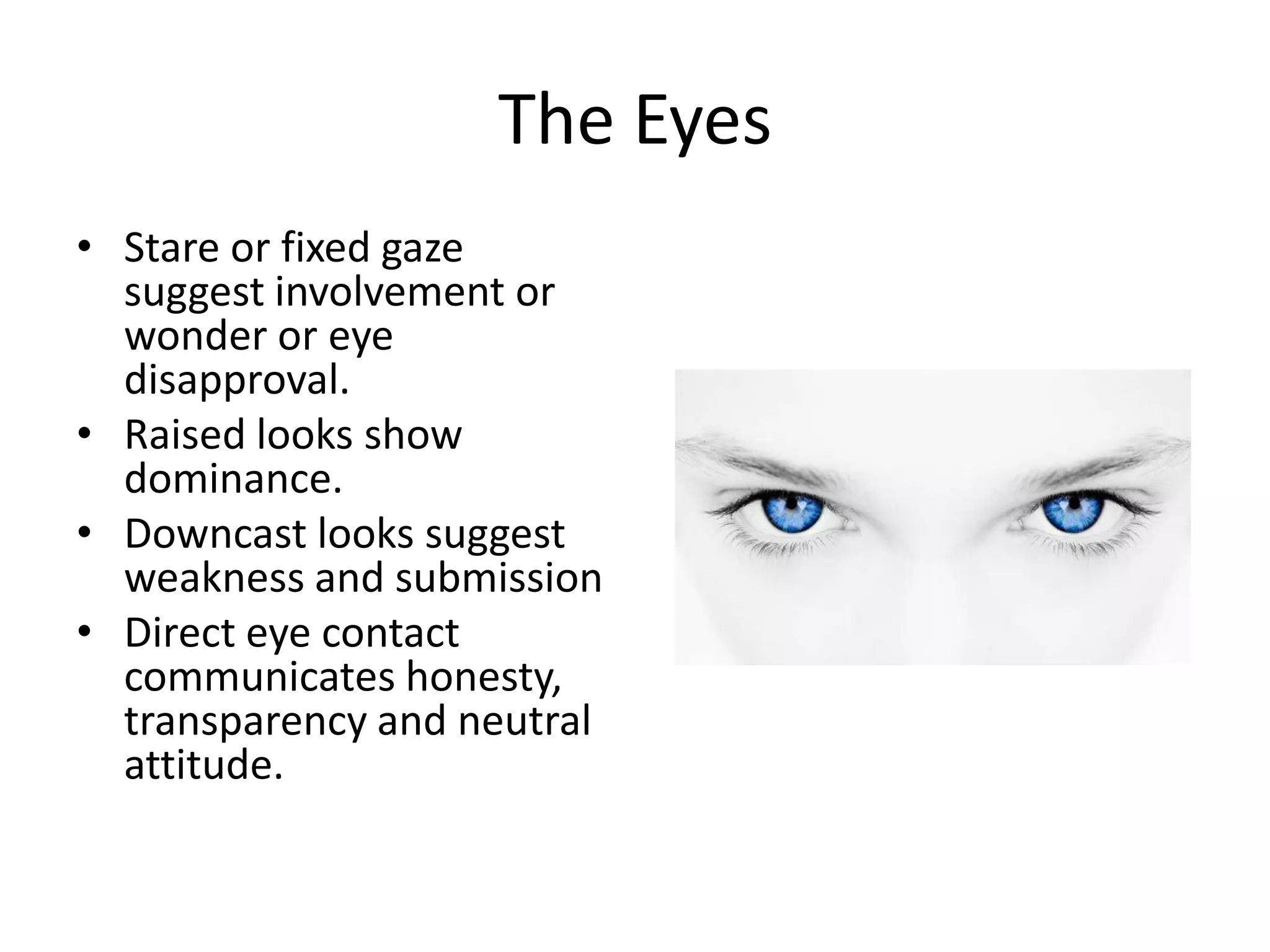
The Eyes
• Stare or fixed gaze
suggest involvement or
wonder or eye
disapproval.
• Raised looks show
dominance.
• Downcast looks suggest
weakness and submission
• Direct eye contact
communicates honesty,
transparency and neutral
attitude.
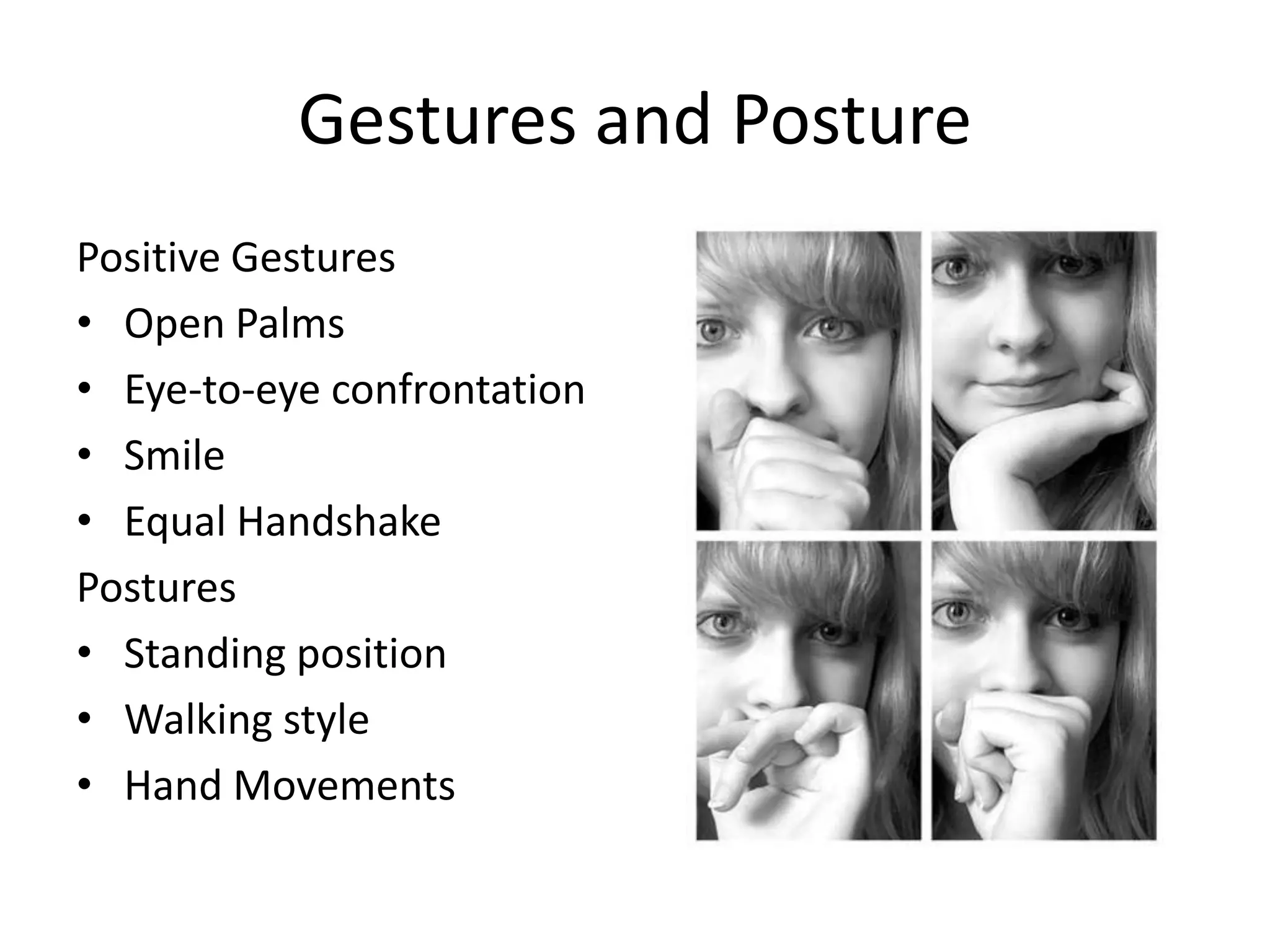
Gestures and Posture
Positive Gestures
• Open Palms
• Eye-to-eye confrontation
• Smile
• Equal Handshake
Postures
• Standing position
• Walking style
• Hand Movements
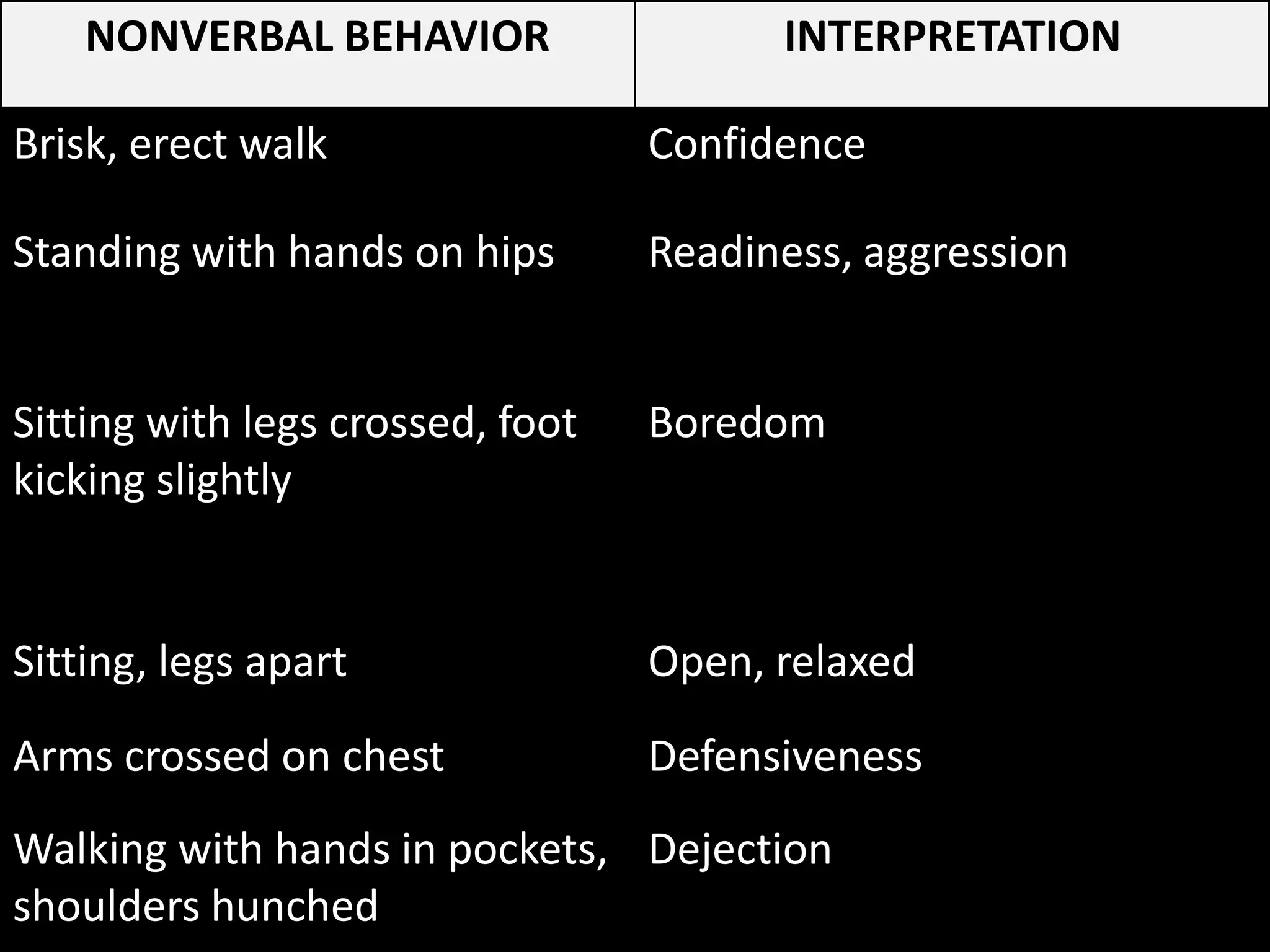
NONVERBAL BEHAVIOR INTERPRETATION
Brisk, erect walk Confidence
Standing with hands on hips Readiness, aggression
Sitting with legs crossed, foot
kicking slightly
Boredom
Sitting, legs apart Open, relaxed
Arms crossed on chest Defensiveness
Walking with hands in pockets,
shoulders hunched
Dejection
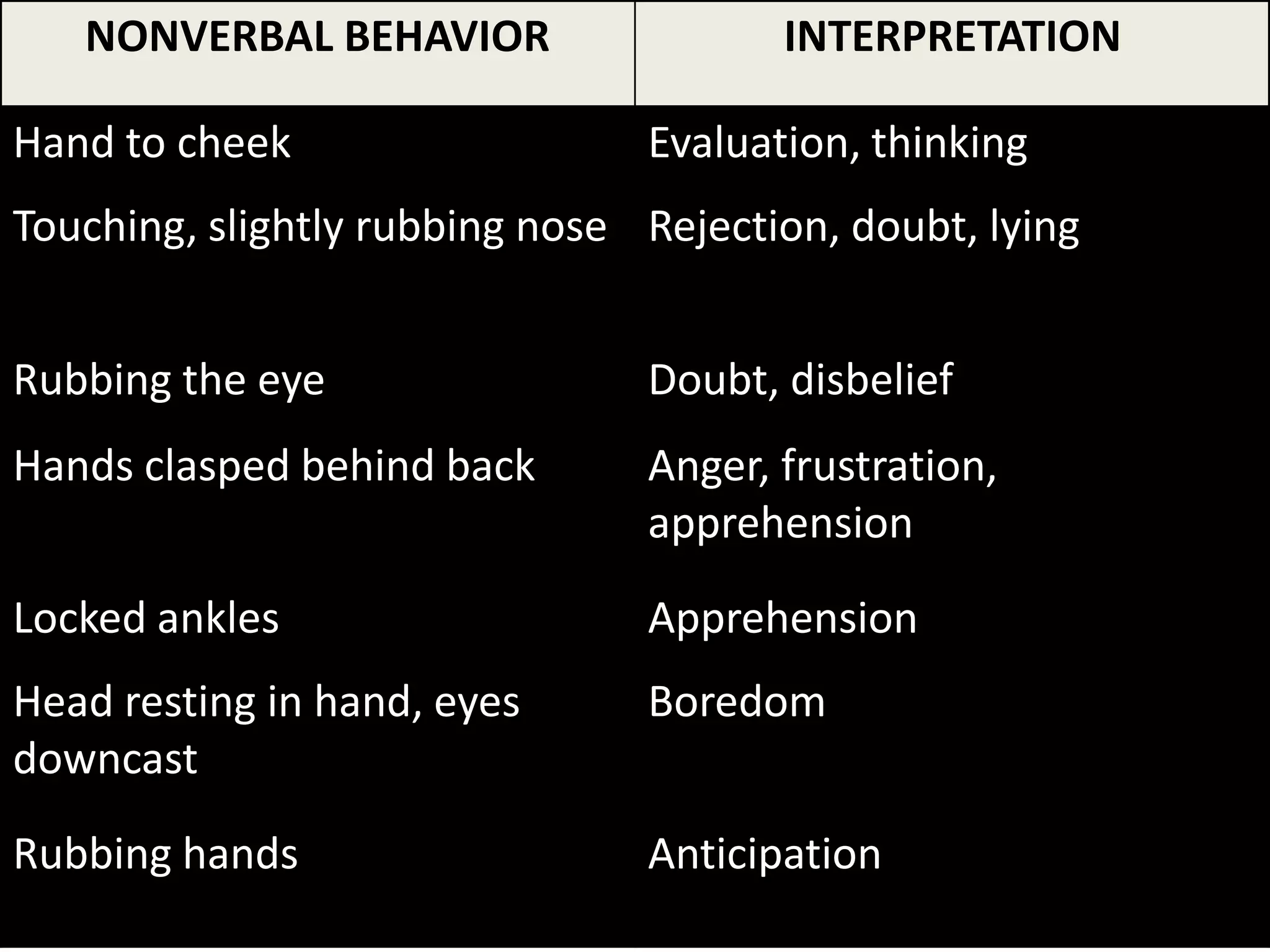
NONVERBAL BEHAVIOR INTERPRETATION
Hand to cheek Evaluation, thinking
Touching, slightly rubbing nose Rejection, doubt, lying
Rubbing the eye Doubt, disbelief
Hands clasped behind back Anger, frustration,
apprehension
Locked ankles Apprehension
Head resting in hand, eyes
downcast
Boredom
Rubbing hands Anticipation
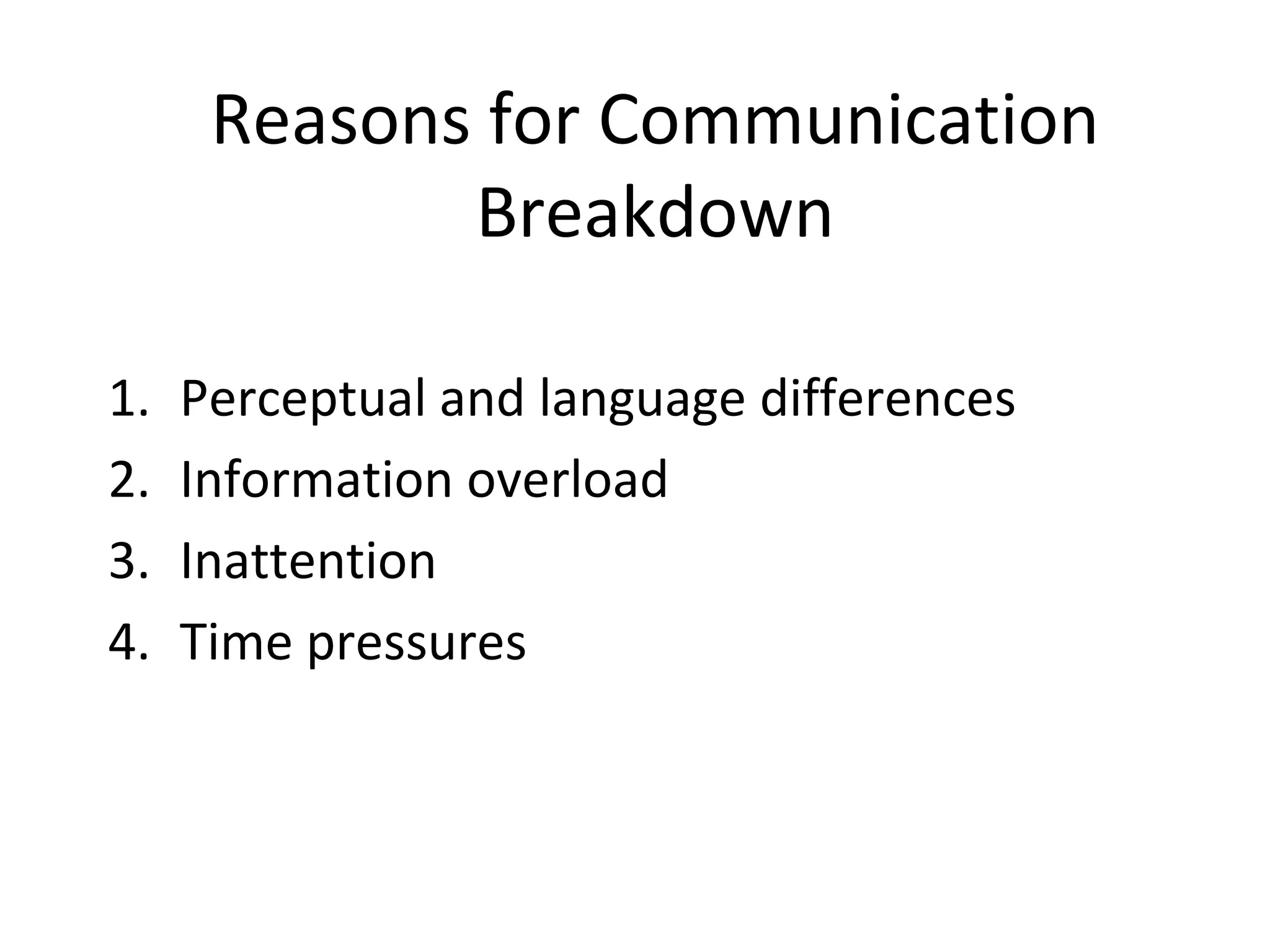
Reasons for Communication
Breakdown
1. Perceptual and language differences
2. Information overload
3. Inattention
4. Time pressures
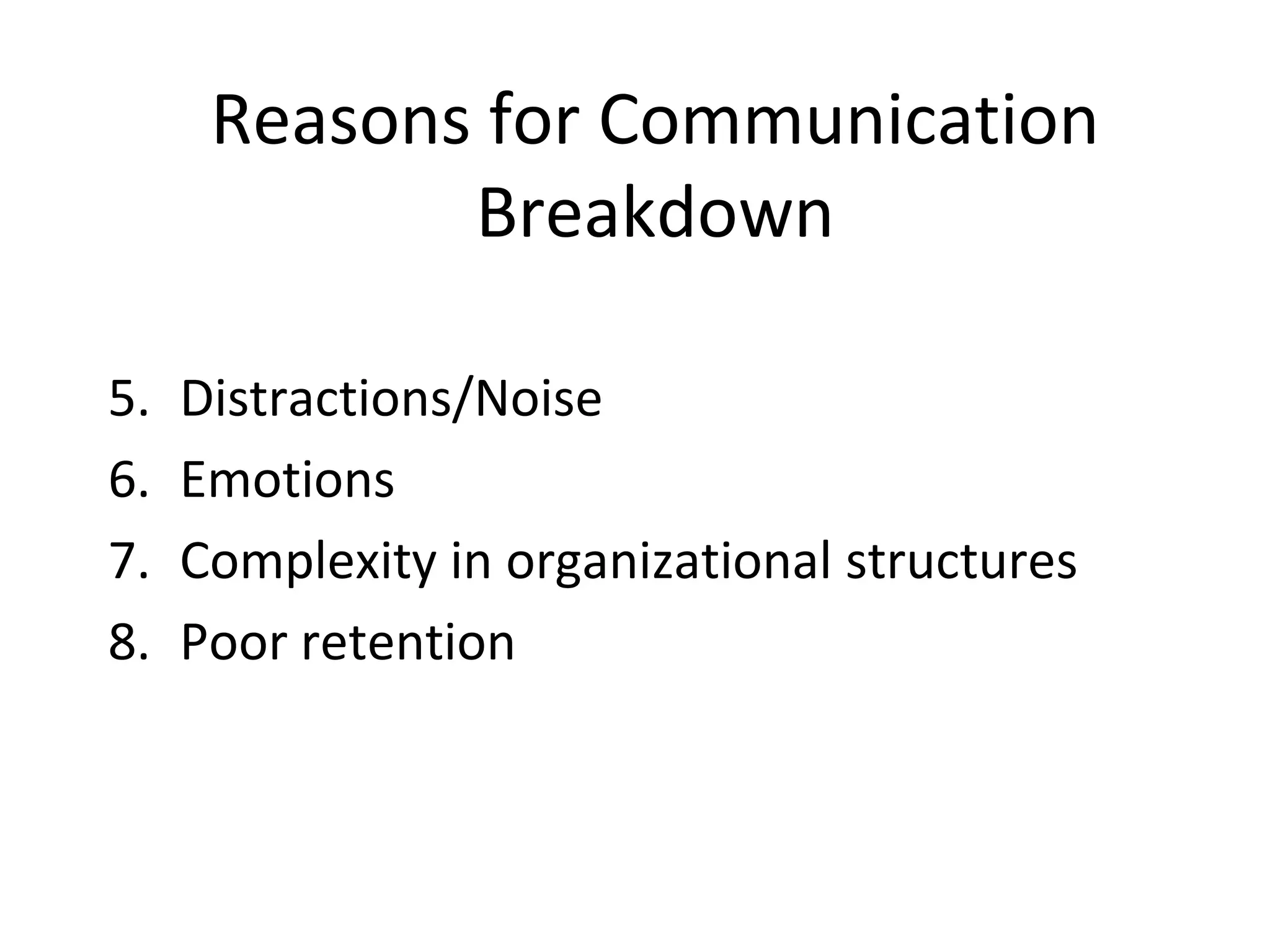
Reasons for Communication
Breakdown
5. Distractions/Noise
6. Emotions
7. Complexity in organizational structures
8. Poor retention
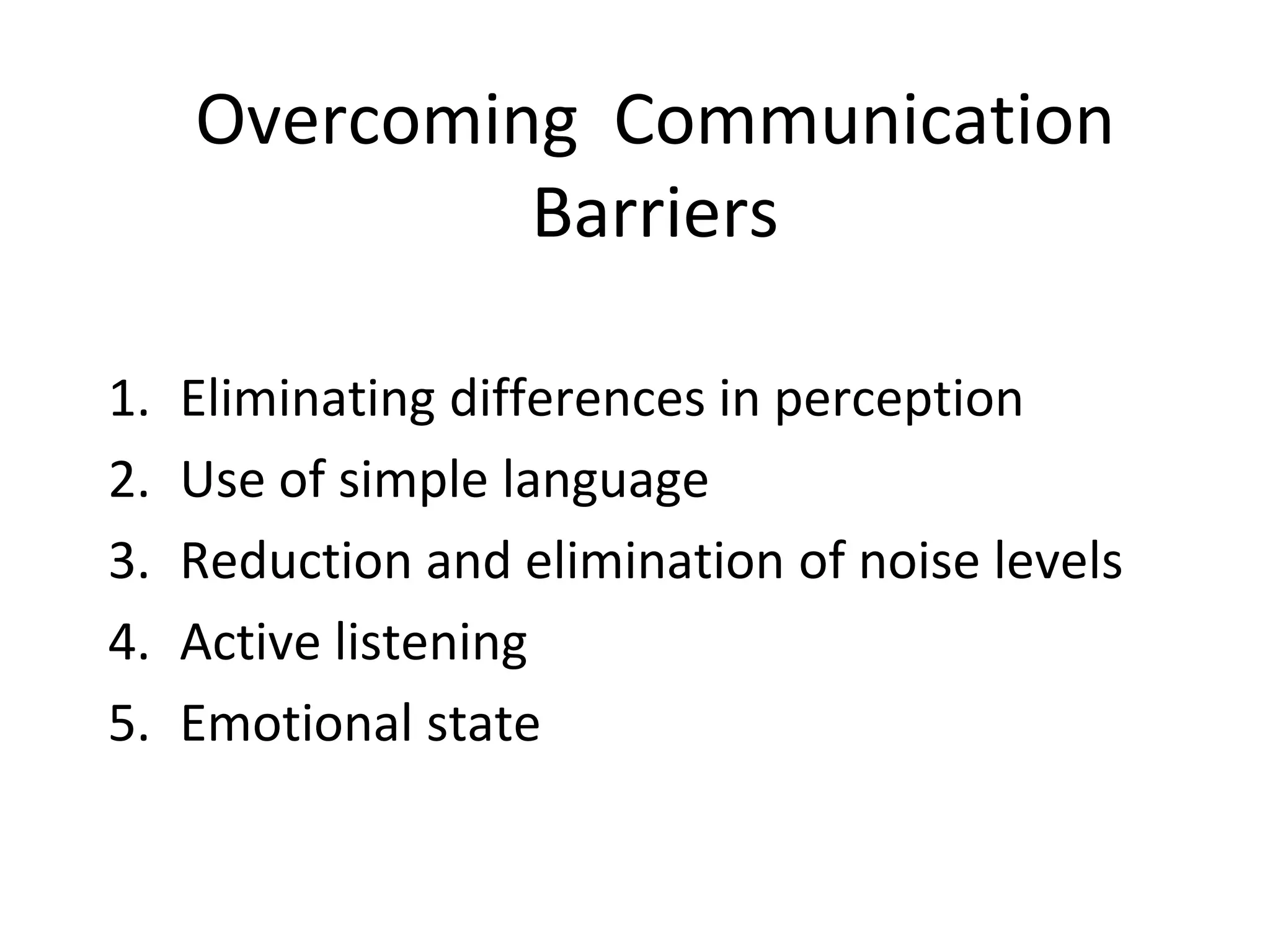
Overcoming Communication
Barriers
1. Eliminating differences in perception
2. Use of simple language
3. Reduction and elimination of noise levels
4. Active listening
5. Emotional state
Overcoming Communication
Barriers
6. Simple organizational structure
7. Avoid information overload
8. Give constructive feedback
9. Proper media selection
10.Flexibility in meeting the targets
How can I improve my
communication skills?
1. Become an active listener
2. Become a good conversationalist
3. Become an effective presenter
4. Become a good writer
5. Learn how to deliver bad news
6. Give constructive feedback and criticism
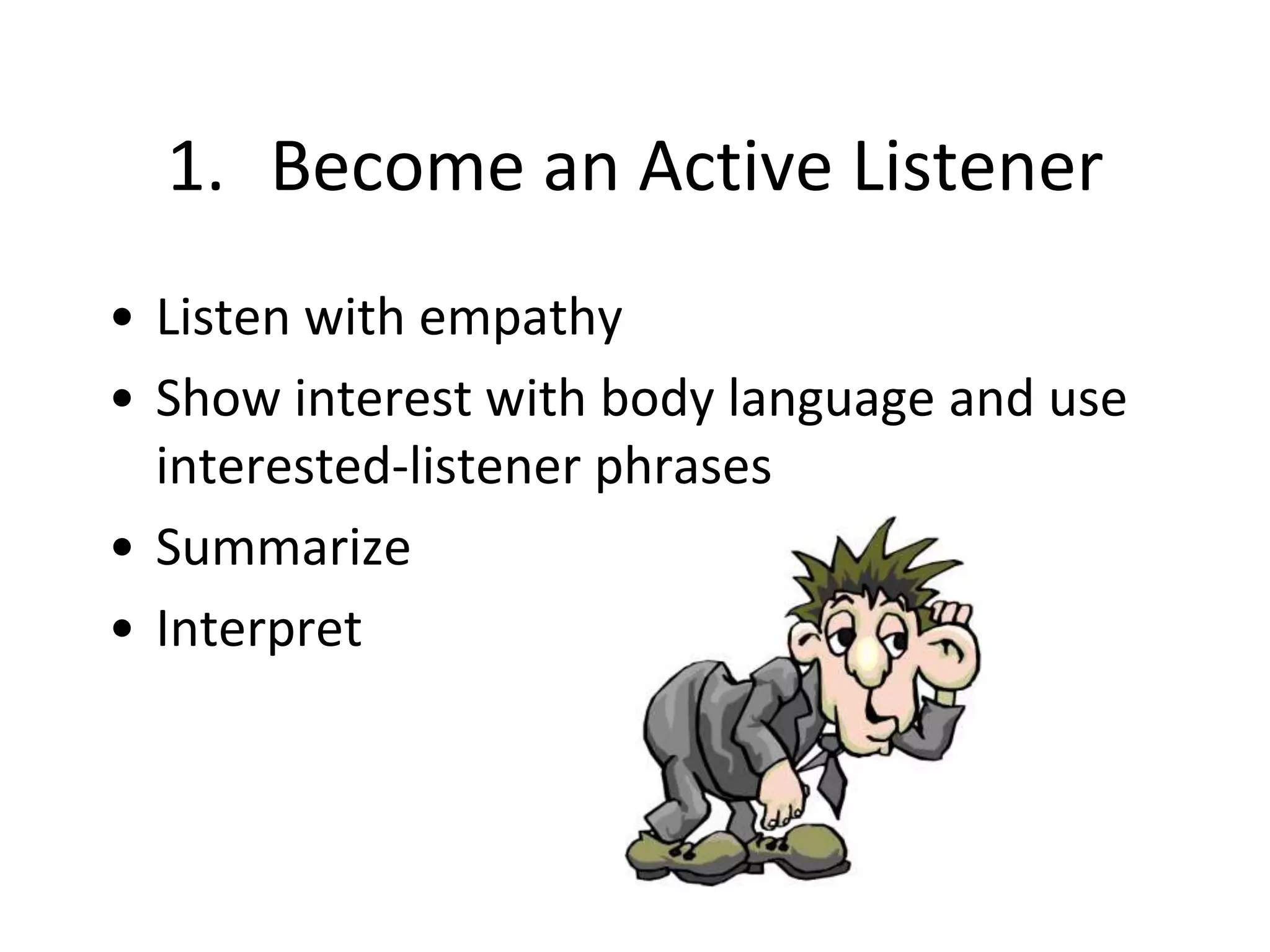
1. Become an Active Listener
• Listen with empathy
• Show interest with body language and use
interested-listener phrases
• Summarize
• Interpret
1. Become an Active Listener
• Fight off competing thoughts
– Change your physical position
– Ask a clarifying question
• Don’t forget their names!
– When you’re introduced to someone, shut out all thoughts and
listen for the name.
– Next, make a point of repeating it out loud immediately. You’ll
hear, “I’m Joseph,” and as you shake hands, say, “Nice to meet
you, Joseph.”
– Finally, take a second to concentrate fully on the person’s face,
and think, “Joseph.”
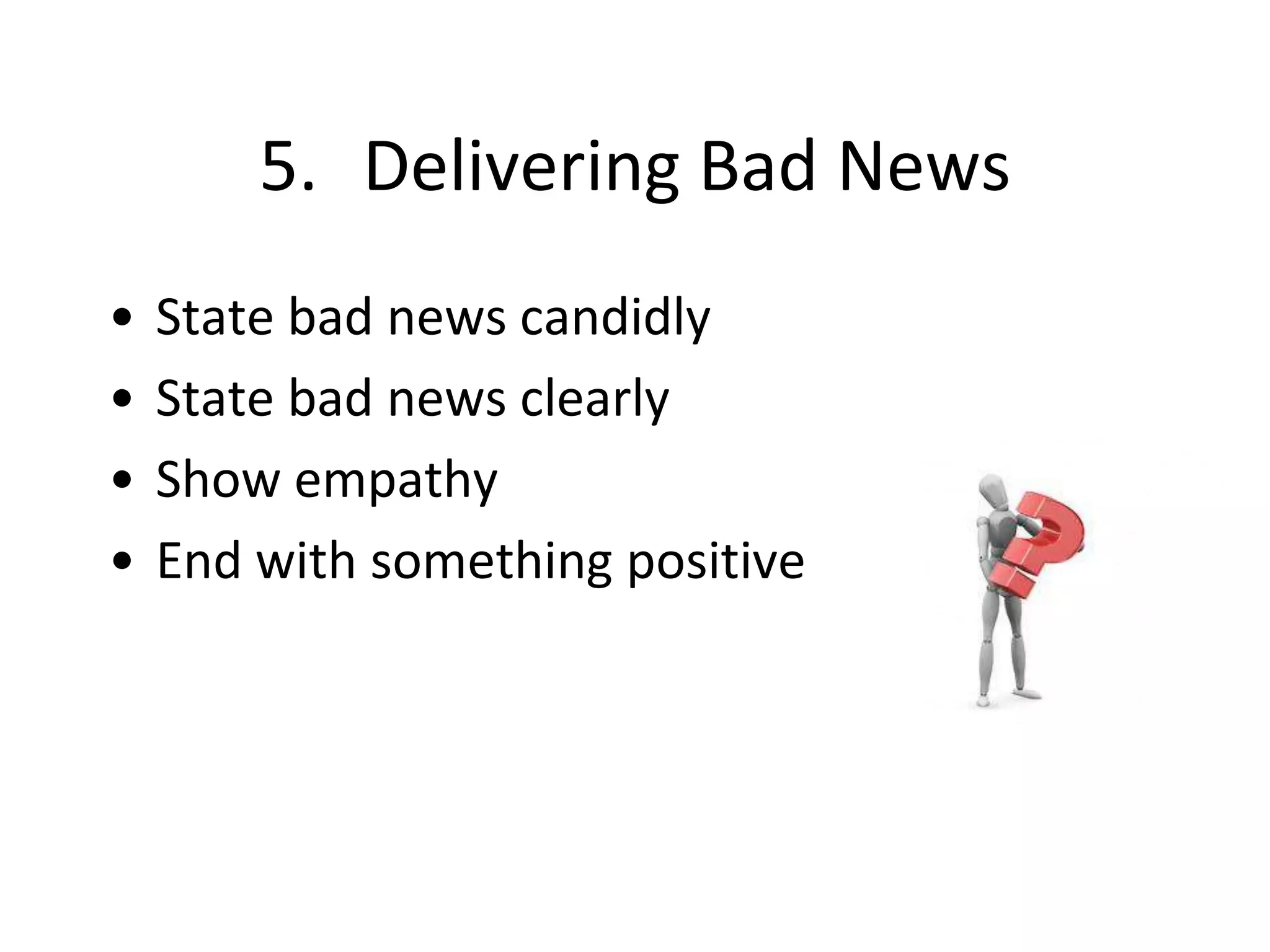
5. Delivering Bad News
• State bad news candidly
• State bad news clearly
• Show empathy
• End with something positive
6. Constructive Feedback and Criticism
• Constructive Feedback
– Returning output of information based on
input received by another
• Constructive Criticism
– The act of making judgments or evaluations
Receiving Feedback
 Evaluate if you are taking the constructive
criticism personally
 Get yourself in a continuous improvement
mood
 Find something that you can agree with
and express that agreement
 Do not assume that you know what the
other person thinks or feels
Giving Feedback
Start with something supportive
 State your opinion using “I” statements
 Monitor your tone of voice and body
language

People management and communication skills

  • 1.
  • 2.
    Four Key Aspectsto People Management
  • 3.
    People Skills Understanding howpeople communicate Expressing your thoughts and feelings clearly Speaking up when your needs are not being met Asking for feedback and giving quality feedback in return Influencing how others think and act Bringing conflicts to the surface and getting them resolved Collaborating with others Shifting gears when relationships are unproductive
  • 4.
  • 5.
    Effective Communication: Discuss 1.What is interpersonal communication? 2. What is intrateam communication? 3. Why learn about interpersonal and intrateam communication? 4. How might I understand effective communication? 5. Verbal vs. non verbal communication 6. Reasons for communication breakdown 7. Overcoming communication barriers 8. How can I improve my communication skills?
  • 6.
  • 7.
    Verbal vs. NonVerbal Communication • Facial expression • Eye contact • Tone of voice • Body posture • Body motions • Positioning within groups • The way we wear our clothes • The silence we keep
  • 8.
    Bodily speaking… • EdwardT. Hall, social anthropologist • In a normal conversation between two persons – less than 35% of the social meanings is actually transmitted by words. – at least 65% of it is conveyed through the body
  • 9.
    Facial Expressions • Faceis the index of Mind • The eyes, the lips and the muscles express many feelings • It can also be deceived by manipulation
  • 10.
    The Eyes • Stareor fixed gaze suggest involvement or wonder or eye disapproval. • Raised looks show dominance. • Downcast looks suggest weakness and submission • Direct eye contact communicates honesty, transparency and neutral attitude.
  • 11.
    Gestures and Posture PositiveGestures • Open Palms • Eye-to-eye confrontation • Smile • Equal Handshake Postures • Standing position • Walking style • Hand Movements
  • 12.
    NONVERBAL BEHAVIOR INTERPRETATION Brisk,erect walk Confidence Standing with hands on hips Readiness, aggression Sitting with legs crossed, foot kicking slightly Boredom Sitting, legs apart Open, relaxed Arms crossed on chest Defensiveness Walking with hands in pockets, shoulders hunched Dejection
  • 13.
    NONVERBAL BEHAVIOR INTERPRETATION Handto cheek Evaluation, thinking Touching, slightly rubbing nose Rejection, doubt, lying Rubbing the eye Doubt, disbelief Hands clasped behind back Anger, frustration, apprehension Locked ankles Apprehension Head resting in hand, eyes downcast Boredom Rubbing hands Anticipation
  • 14.
    Reasons for Communication Breakdown 1.Perceptual and language differences 2. Information overload 3. Inattention 4. Time pressures
  • 15.
    Reasons for Communication Breakdown 5.Distractions/Noise 6. Emotions 7. Complexity in organizational structures 8. Poor retention
  • 16.
    Overcoming Communication Barriers 1. Eliminatingdifferences in perception 2. Use of simple language 3. Reduction and elimination of noise levels 4. Active listening 5. Emotional state
  • 17.
    Overcoming Communication Barriers 6. Simpleorganizational structure 7. Avoid information overload 8. Give constructive feedback 9. Proper media selection 10.Flexibility in meeting the targets
  • 18.
    How can Iimprove my communication skills? 1. Become an active listener 2. Become a good conversationalist 3. Become an effective presenter 4. Become a good writer 5. Learn how to deliver bad news 6. Give constructive feedback and criticism
  • 19.
    1. Become anActive Listener • Listen with empathy • Show interest with body language and use interested-listener phrases • Summarize • Interpret
  • 20.
    1. Become anActive Listener • Fight off competing thoughts – Change your physical position – Ask a clarifying question • Don’t forget their names! – When you’re introduced to someone, shut out all thoughts and listen for the name. – Next, make a point of repeating it out loud immediately. You’ll hear, “I’m Joseph,” and as you shake hands, say, “Nice to meet you, Joseph.” – Finally, take a second to concentrate fully on the person’s face, and think, “Joseph.”
  • 21.
    5. Delivering BadNews • State bad news candidly • State bad news clearly • Show empathy • End with something positive
  • 22.
    6. Constructive Feedbackand Criticism • Constructive Feedback – Returning output of information based on input received by another • Constructive Criticism – The act of making judgments or evaluations
  • 23.
    Receiving Feedback  Evaluateif you are taking the constructive criticism personally  Get yourself in a continuous improvement mood  Find something that you can agree with and express that agreement  Do not assume that you know what the other person thinks or feels
  • 24.
    Giving Feedback Start withsomething supportive  State your opinion using “I” statements  Monitor your tone of voice and body language