

Improving Communication
Skills
SBMC

www.shreebalajieducation.com
A Thought
A man is seldom better than his conversation
- German Proverb

www.shreebalajieducation.com
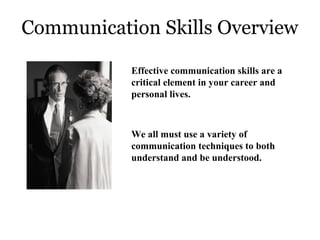
Communication Skills Overview
Effective communication skills are a
critical element in your career and
personal lives.

We all must use a variety of
communication techniques to both
understand and be understood.
What is Communication?
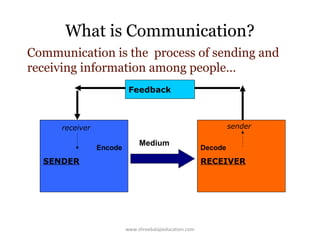
Communication is the process of sending and
receiving information among people…
Feedback

sender

receiver
Encode

Medium

SENDER

Decode

RECEIVER

www.shreebalajieducation.com
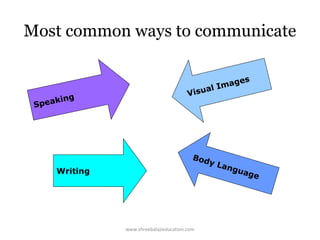
Most common ways to communicate

ing
peak
S

Writing

es
mag
lI
isua
V

Bod
y

www.shreebalajieducation.com

La n

gua
ge
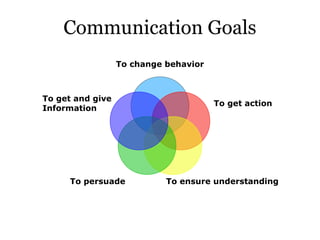
Communication Goals
To change behavior

To get and give
Information

To persuade

To get action

To ensure understanding
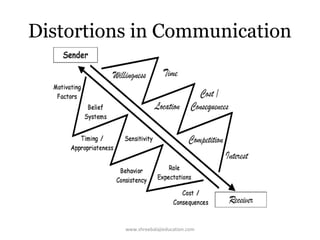
Distortions in Communication

www.shreebalajieducation.com
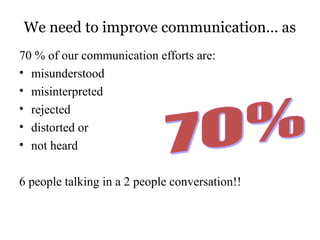
We need to improve communication... as
70 % of our communication efforts are:
• misunderstood
• misinterpreted
• rejected
• distorted or
• not heard
6 people talking in a 2 people conversation!!
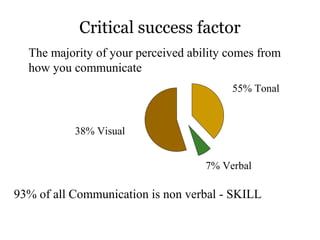
Critical success factor
The majority of your perceived ability comes from
how you communicate
55% Tonal

38% Visual
7% Verbal

93% of all Communication is non verbal - SKILL
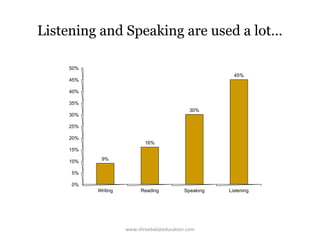
Listening and Speaking are used a lot…
50%
45%

45%
40%
35%
30%

30%
25%
20%

16%

15%
10%

9%

5%
0%
Writing

Reading

Speaking

www.shreebalajieducation.com

Listening
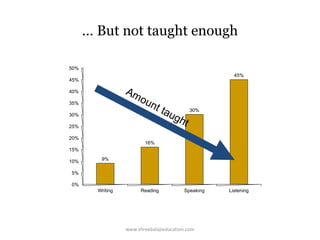
… But not taught enough
50%
45%

45%

Am
ou
nt
tau
gh

40%
35%
30%
25%
20%

30%

t

16%

15%
10%

9%

5%
0%
Writing

Reading

Speaking

www.shreebalajieducation.com

Listening
Common Communication Errors:
• Finishing others’ sentences
• Preparing our response before someone has
completed speaking
• Multitasking while ‘listening’
• Filtering content or meaning based on the
speaker
• Speaking for others (we…)
www.shreebalajieducation.com
A Good Algorithm
Communication is a two way process!
In order to have good communication:
• Listen to Understand
• Understand before speaking
• Speak to be understood
• Seek understanding before proceeding
• Repeat
www.shreebalajieducation.com
How can it be improved
•
•
•
•

Recognition
Pavlov study
Not being judgmental
Stop egocentric communication

www.shreebalajieducation.com
What today’s workshop can achieve
• Provide ‘knowledge’ about communication
• Give insight on ‘skills’ needed
• Suggest ways of going about it
What you need to do:
• Learn the tools
• Take up every opportunity
• Practice, Practice, Practice!
www.shreebalajieducation.com
Observe

PARIS
IN THE
THE SPRING

GOD IS NOWHERE

www.shreebalajieducation.com
Why is communication important
•
•
•
•
•

Inspires confidence
Builds respect in business and social life
Helps make friends
Develops a distinct personality
Reveals your ability to others

www.shreebalajieducation.com
Essentials of good communication
• Knowledge
– Spontaneity in conversation
– Level of conversation

• Organising your thoughts
• Participating in discussions
• Body Language
– Show v Tell

• Being a good listener
– Listening v hearing
www.shreebalajieducation.com
How to be an active listener
•
•
•
•
•

Set the stage
Ensure mutual understanding
Understand body language
Suspend judgment
Behaviors that hinder effective listening
–
–
–
–
–
–

Act distracted (look at your watch!)
Tell your own story without acknowledging theirs
Give no response
Invalidate response, be negative
Interrupt
Criticize
www.shreebalajieducation.com
Techniques to improve listening skills
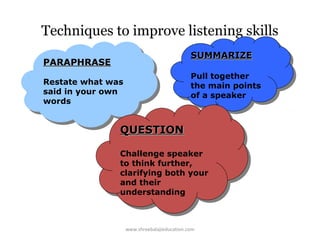
SUMMARIZE
SUMMARIZE

PARAPHRASE
PARAPHRASE
Restate what was
Restate what was
said in your own
said in your own
words
words

Pull together
Pull together
the main points
the main points
of a speaker
of a speaker

QUESTION
QUESTION
Challenge speaker
Challenge speaker
to think further,
to think further,
clarifying both your
and their
and their
understanding
understanding

www.shreebalajieducation.com
Two basic types of questions
1. Closed questions:
– Get a one-word response and inhibit thought.
– Questions begin with who, when and which

1. Open-ended questions:
– Invite unique thought, reflection or an explanation.
– Questions begin with how, what and how come (not why!).

www.shreebalajieducation.com
Practice Questioning
•

Rephrase the following closed questions to
make them open-ended:

1.
2.
3.
4.
5.

Are you feeling tired?
Isn’t it a nice day?
Was the last activity useful?
Is there anything bothering you?
So everything is fine, then?
www.shreebalajieducation.com
Adding colour to communication

www.shreebalajieducation.com
Adding colour to communication
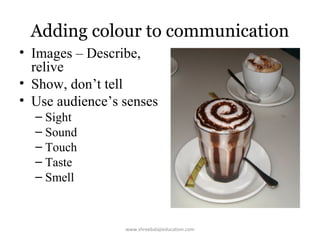
• Images – Describe,
relive
• Show, don’t tell
• Use audience’s senses
– Sight
– Sound
– Touch
– Taste
– Smell

www.shreebalajieducation.com
Improving communication
•
•
•
•
•
•
•
•

Don’t use cliches
Brevity
Sincerity
Don’t praise yourself
Avoid argument
Be tactful
Silence
Enunciation
– Clear, loud, syllables. Flexibility of tone
www.shreebalajieducation.com
Practice
• For distinct enunciation, every word, every syllable,
every sound, must be given it proper form and value.
• Think of the mouth chamber as a mold, in which the
correct form is given to every sound.
• Will you please move your lips more noticeably?
• The teeth should never be kept closed in speech.
• Through practices, we can learn to speak more
rapidly, but still with perfect distinctness

www.shreebalajieducation.com
Ways to gain effective conversation
•
•
•
•
•
•

Good use of English – avoid errors
Improved vocabulary – overlook v oversee
Avoid old phrases
Use humour
Add interesting story
Improve clarity of voice – practice

www.shreebalajieducation.com
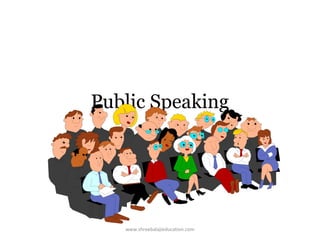
Public Speaking

www.shreebalajieducation.com
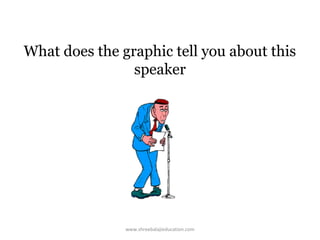
What does the graphic tell you about this
speaker

www.shreebalajieducation.com
The 5-P‘s
•
•
•
•
•

Prior
Preparation
Prevents
Poor
Performance

www.shreebalajieducation.com
From effective conversation to speech
• Overcoming Fear
– #1 fear

• Idea of speech
– Know your subject

• Know the audience
– Target their interest

• Organising the speech
– Tell them…
www.shreebalajieducation.com
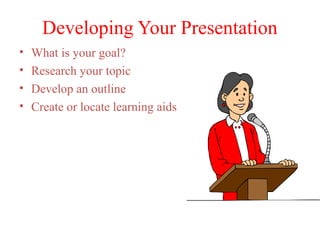
Developing Your Presentation
•
•
•
•

What is your goal?
Research your topic
Develop an outline
Create or locate learning aids
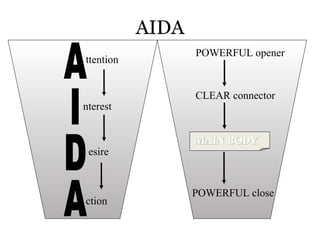
AIDA
ttention

nterest

esire

ction

POWERFUL opener

CLEAR connector

MAIN BODY

POWERFUL close
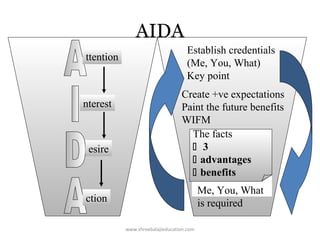
AIDA
ttention

nterest

esire

Establish credentials
(Me, You, What)
Key point
Create +ve expectations
Paint the future benefits
WIFM
The facts
The facts
 3
 advantages
 benefits
Me, You, What
is required

ction
www.shreebalajieducation.com
Developing Your Presentation
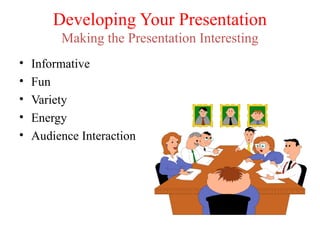
Making the Presentation Interesting
•
•
•
•
•

Informative
Fun
Variety
Energy
Audience Interaction
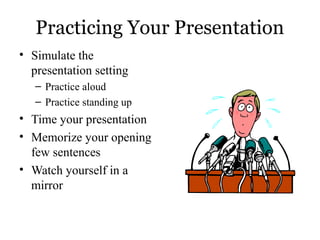
Practicing Your Presentation
• Simulate the
presentation setting
– Practice aloud
– Practice standing up

• Time your presentation
• Memorize your opening
few sentences
• Watch yourself in a
mirror
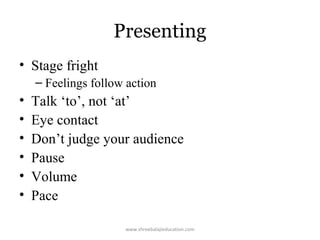
Presenting
• Stage fright
– Feelings follow action

•
•
•
•
•
•

Talk ‘to’, not ‘at’
Eye contact
Don’t judge your audience
Pause
Volume
Pace
www.shreebalajieducation.com
Summary
He who fails to prepare, prepares to fail!

www.shreebalajieducation.com
Thank You

www.shreebalajieducation.com

Communication skills-2

  • 1.
  • 2.
    A Thought A manis seldom better than his conversation - German Proverb www.shreebalajieducation.com
  • 3.
    Communication Skills Overview Effectivecommunication skills are a critical element in your career and personal lives. We all must use a variety of communication techniques to both understand and be understood.
  • 4.
    What is Communication? Communicationis the process of sending and receiving information among people… Feedback sender receiver Encode Medium SENDER Decode RECEIVER www.shreebalajieducation.com
  • 5.
    Most common waysto communicate ing peak S Writing es mag lI isua V Bod y www.shreebalajieducation.com La n gua ge
  • 6.
    Communication Goals To changebehavior To get and give Information To persuade To get action To ensure understanding
  • 7.
  • 8.
    We need toimprove communication... as 70 % of our communication efforts are: • misunderstood • misinterpreted • rejected • distorted or • not heard 6 people talking in a 2 people conversation!!
  • 9.
    Critical success factor Themajority of your perceived ability comes from how you communicate 55% Tonal 38% Visual 7% Verbal 93% of all Communication is non verbal - SKILL
  • 10.
    Listening and Speakingare used a lot… 50% 45% 45% 40% 35% 30% 30% 25% 20% 16% 15% 10% 9% 5% 0% Writing Reading Speaking www.shreebalajieducation.com Listening
  • 11.
    … But nottaught enough 50% 45% 45% Am ou nt tau gh 40% 35% 30% 25% 20% 30% t 16% 15% 10% 9% 5% 0% Writing Reading Speaking www.shreebalajieducation.com Listening
  • 12.
    Common Communication Errors: •Finishing others’ sentences • Preparing our response before someone has completed speaking • Multitasking while ‘listening’ • Filtering content or meaning based on the speaker • Speaking for others (we…) www.shreebalajieducation.com
  • 13.
    A Good Algorithm Communicationis a two way process! In order to have good communication: • Listen to Understand • Understand before speaking • Speak to be understood • Seek understanding before proceeding • Repeat www.shreebalajieducation.com
  • 14.
    How can itbe improved • • • • Recognition Pavlov study Not being judgmental Stop egocentric communication www.shreebalajieducation.com
  • 15.
    What today’s workshopcan achieve • Provide ‘knowledge’ about communication • Give insight on ‘skills’ needed • Suggest ways of going about it What you need to do: • Learn the tools • Take up every opportunity • Practice, Practice, Practice! www.shreebalajieducation.com
  • 16.
    Observe PARIS IN THE THE SPRING GODIS NOWHERE www.shreebalajieducation.com
  • 17.
    Why is communicationimportant • • • • • Inspires confidence Builds respect in business and social life Helps make friends Develops a distinct personality Reveals your ability to others www.shreebalajieducation.com
  • 18.
    Essentials of goodcommunication • Knowledge – Spontaneity in conversation – Level of conversation • Organising your thoughts • Participating in discussions • Body Language – Show v Tell • Being a good listener – Listening v hearing www.shreebalajieducation.com
  • 19.
    How to bean active listener • • • • • Set the stage Ensure mutual understanding Understand body language Suspend judgment Behaviors that hinder effective listening – – – – – – Act distracted (look at your watch!) Tell your own story without acknowledging theirs Give no response Invalidate response, be negative Interrupt Criticize www.shreebalajieducation.com
  • 20.
    Techniques to improvelistening skills SUMMARIZE SUMMARIZE PARAPHRASE PARAPHRASE Restate what was Restate what was said in your own said in your own words words Pull together Pull together the main points the main points of a speaker of a speaker QUESTION QUESTION Challenge speaker Challenge speaker to think further, to think further, clarifying both your clarifying both your and their and their understanding understanding www.shreebalajieducation.com
  • 21.
    Two basic typesof questions 1. Closed questions: – Get a one-word response and inhibit thought. – Questions begin with who, when and which 1. Open-ended questions: – Invite unique thought, reflection or an explanation. – Questions begin with how, what and how come (not why!). www.shreebalajieducation.com
  • 22.
    Practice Questioning • Rephrase thefollowing closed questions to make them open-ended: 1. 2. 3. 4. 5. Are you feeling tired? Isn’t it a nice day? Was the last activity useful? Is there anything bothering you? So everything is fine, then? www.shreebalajieducation.com
  • 23.
    Adding colour tocommunication www.shreebalajieducation.com
  • 24.
    Adding colour tocommunication • Images – Describe, relive • Show, don’t tell • Use audience’s senses – Sight – Sound – Touch – Taste – Smell www.shreebalajieducation.com
  • 25.
    Improving communication • • • • • • • • Don’t usecliches Brevity Sincerity Don’t praise yourself Avoid argument Be tactful Silence Enunciation – Clear, loud, syllables. Flexibility of tone www.shreebalajieducation.com
  • 26.
    Practice • For distinctenunciation, every word, every syllable, every sound, must be given it proper form and value. • Think of the mouth chamber as a mold, in which the correct form is given to every sound. • Will you please move your lips more noticeably? • The teeth should never be kept closed in speech. • Through practices, we can learn to speak more rapidly, but still with perfect distinctness www.shreebalajieducation.com
  • 27.
    Ways to gaineffective conversation • • • • • • Good use of English – avoid errors Improved vocabulary – overlook v oversee Avoid old phrases Use humour Add interesting story Improve clarity of voice – practice www.shreebalajieducation.com
  • 28.
  • 29.
    What does thegraphic tell you about this speaker www.shreebalajieducation.com
  • 30.
  • 31.
    From effective conversationto speech • Overcoming Fear – #1 fear • Idea of speech – Know your subject • Know the audience – Target their interest • Organising the speech – Tell them… www.shreebalajieducation.com
  • 32.
    Developing Your Presentation • • • • Whatis your goal? Research your topic Develop an outline Create or locate learning aids
  • 33.
  • 34.
    AIDA ttention nterest esire Establish credentials (Me, You,What) Key point Create +ve expectations Paint the future benefits WIFM The facts The facts  3  advantages  benefits Me, You, What is required ction www.shreebalajieducation.com
  • 35.
    Developing Your Presentation Makingthe Presentation Interesting • • • • • Informative Fun Variety Energy Audience Interaction
  • 36.
    Practicing Your Presentation •Simulate the presentation setting – Practice aloud – Practice standing up • Time your presentation • Memorize your opening few sentences • Watch yourself in a mirror
  • 37.
    Presenting • Stage fright –Feelings follow action • • • • • • Talk ‘to’, not ‘at’ Eye contact Don’t judge your audience Pause Volume Pace www.shreebalajieducation.com
  • 38.
    Summary He who failsto prepare, prepares to fail! www.shreebalajieducation.com
  • 39.