NEW HEADWAY  ELEMENTARY UNIT 6:  CAN YOU SPEAK ENGLISH?
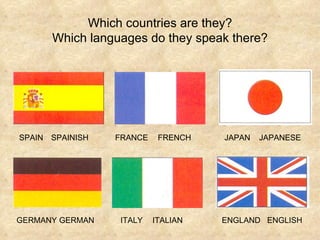
Which countries are they? Which languages do they speak there? SPAIN  SPAINISH  FRANCE  FRENCH  JAPAN JAPANESE GERMANY GERMAN ITALY ITALIAN ENGLAND ENGLISH
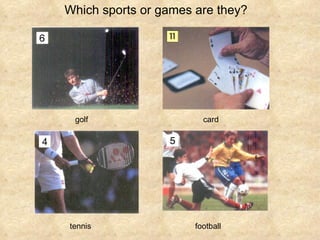
golf football tennis card Which sports or games are they?
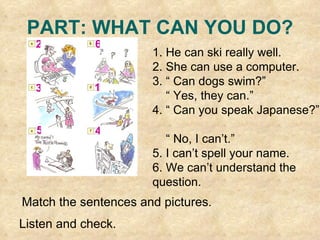
PART: WHAT CAN YOU DO? 1. He can ski really well. 2. She can use a computer. 3. “ Can dogs swim?”  “  Yes, they can.” 4. “ Can you speak Japanese?”  “  No, I can’t.” 5. I can’t spell your name. 6. We can’t understand the question. Match the sentences and pictures. Listen and check. 3 4 2 1 6 5
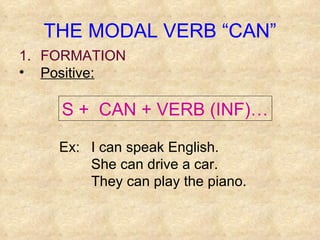
THE MODAL VERB “CAN” FORMATION Positive: S +  CAN + VERB (INF)… Ex:  I can speak English. She can drive a car. They can play the piano.
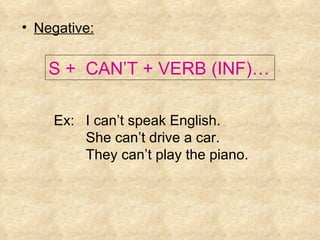
Negative: S +  CAN’T + VERB (INF)… Ex:  I can’t speak English. She can’t drive a car. They can’ t  play the piano.
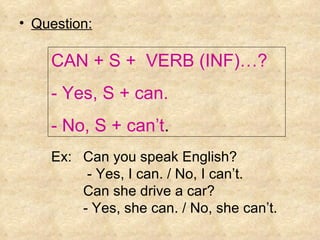
Question: CAN + S +  VERB (INF)…? - Yes, S + can. - No, S + can’t . Ex:  Can you speak English?   - Yes, I can. / No, I can’t. Can she drive a car? - Yes, she can. / No, she can’t.
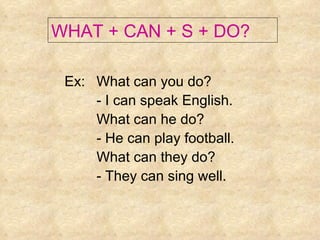
Ex: What can you do? - I can speak English. What can he do? - He can play football. What can they do? - They can sing well. WHAT + CAN + S + DO?
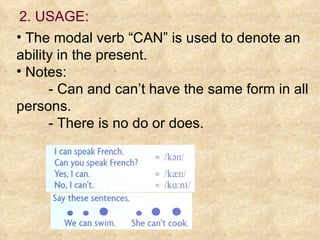
2. USAGE: The modal verb “CAN” is used to denote an ability in the present. Notes: - Can and can’t have the same form in all persons. - There is no do or does.
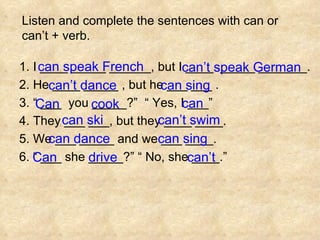
1. I ____ _____ ______, but I ____  _____ _______. 2. He ____ _____ , but he ___ ___ . 3. “ ___  you _____?”  “ Yes, I ___” 4. They ___ ___, but they ____ ____. 5. We ___ _____ and we ___ ____. 6. “ ___ she _____?” “ No, she ____.” can dance can’t speak German can sing can’t dance can speak French can ski can sing can’t swim drive Can Can cook can’t can Listen and complete the sentences with can or  can’t + verb.
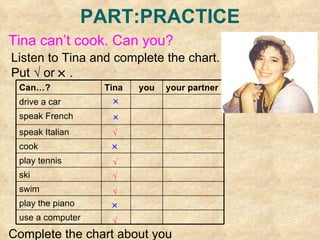
PART:PRACTICE Tina can’t cook. Can you? Listen to Tina and complete the chart.  Put  √  or    . Complete the chart about you use a computer play the piano swim ski play tennis cook speak Italian speak French drive a car your partner you Tina Can…?  √ √  √ √ √  
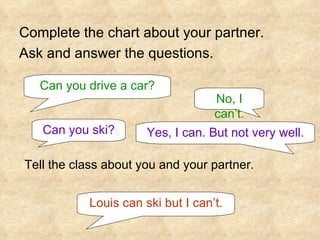
Complete the chart about your partner. Ask and answer the questions. Can you drive a car? No, I can’t. Can you ski? Yes, I can. But not very well. Tell the class about you and your partner. Louis can ski but I can’t.
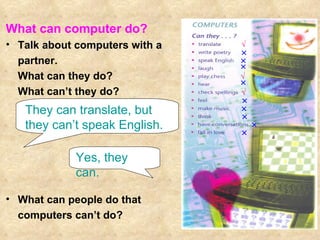
What can computer do? Talk about computers with a  partner.  What can they do? What can’t they do? What can people do that  computers can’t do? They can translate, but  they can’t speak English. Yes, they can.    √      √  √
 
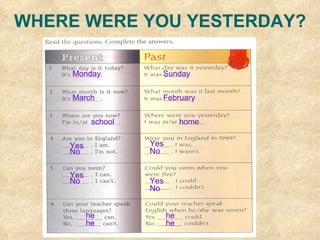
WHERE WERE YOU YESTERDAY? Monday  March  school Yes Yes No No he he February  home Sunday  Yes Yes No No he he
 
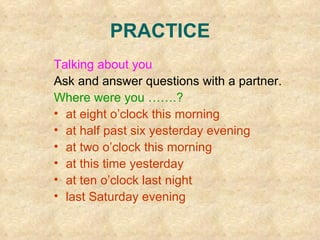
PRACTICE Talking about you Ask and answer questions with a partner. Where were you …….? at eight o’clock this morning at half past six yesterday evening at two o’clock this morning at this time yesterday at ten o’clock last night last Saturday evening
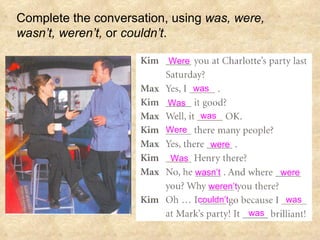
Complete the conversation, using  was, were, wasn’t, weren’t,  or  couldn’t . Were was was were Were Was were weren’t was was couldn’t Was wasn’t
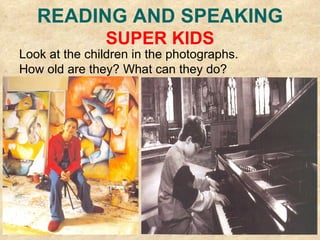
READING AND SPEAKING SUPER KIDS Look at the children in the photographs. How old are they? What can they do?
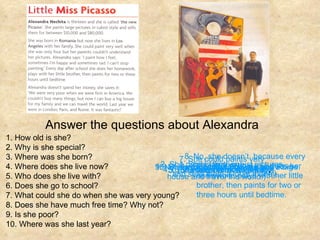
Answer the questions about Alexandra 1. How old is she? 2. Why is she special? 3. Where was she born? 4. Where does she live now? 5. Who does she live with? 6. Does she go to school? 7. What could she do when she was very young? 8. Does she have much free time? Why not? 9. Is she poor? 10. Where was she last year? 1. She is thirteen. 2. She paints large, cubist pictures, and sells them a lot of money. 4. (She lives) in Los Angeles. 3. (She was born) in Romania. 5. (She lives) with her family . 6. Yes, she does. 7. She could paints very well when she was four. 8. No, she doesn’t, because every day after school she does her homework, plays with her little brother, then paints for two or three hours until bedtime. 9. No, she doesn’t. ( She can buy a big house and travel the world.) 10. She was in London, Paris and Rome.
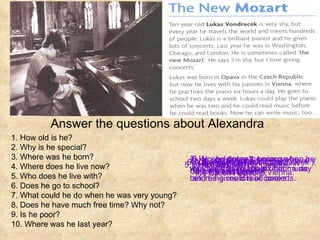
Answer the questions about Alexandra 1. How old is he? 2. Why is he special? 3. Where was he born? 4. Where does he live now? 5. Who does he live with? 6. Does he go to school? 7. What could he do when he was very young? 8. Does he have much free time? Why not? 9. Is he poor? 10. Where was he last year? 2. He can play the piano very well. / He’s a brilliant pianist. 1.   He’s ten. 3. ( He was born) in Opava in the Czech Republic. 6. Yes, he does ( two days a week ). 4. ( He was born) in Vienna. 5. ( He lives) with his parents. 7. He could play the piano when he was two and he could read music before he could read books. 8. No, he doesn’t, because he practises the piano six hour a day and he gives lots of concerts. 9. No, he doesn’t.  10. He was in Washington, Chicago and London.
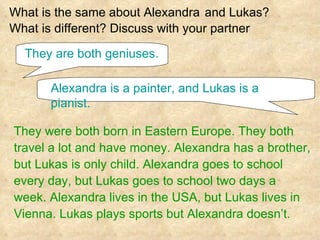
.  What is the same about Alexandra   and Lukas?   What is different? Discuss with your partner  They were both born in Eastern Europe. They both  travel a lot and have money. Alexandra has a brother,  but Lukas is only child. Alexandra goes to school  every day, but Lukas goes to school two days a  week. Alexandra lives in the USA, but Lukas lives in  Vienna. Lukas plays sports but Alexandra doesn’t. They are both geniuses. Alexandra is a painter, and Lukas is a pianist.
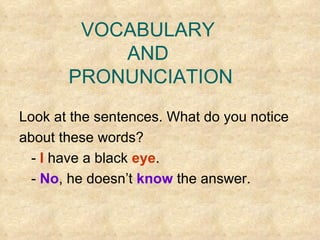
VOCABULARY  AND  PRONUNCIATION Look at the sentences. What do you notice  about these words? -   I  have a black  eye . -  No , he doesn’t  know  the answer.
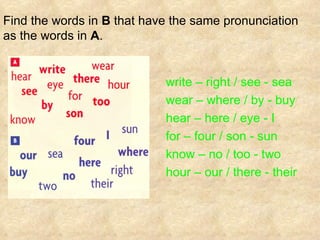
write – right / see - sea wear – where / by - buy hear – here / eye - I  for – four / son - sun know – no / too - two hour – our / there - their Find the words in  B  that have the same pronunciation as the words in  A .
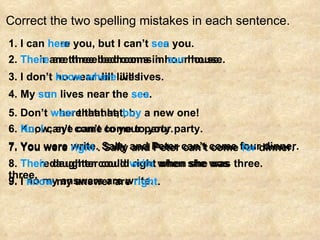
Correct the two spelling mistakes in each sentence. 1. I can here you, but I can’t sea you. 2. Their are three bedrooms in hour house. 3. I don’t no wear Jill lives. 4. My sun lives near the see. 5. Don’t where that hat, by a new one! 6. Know, eye can’t come to your party. 7. You were write. Sally and Peter can’t come four dinner. 8. There daughter could right when she was three. 9. I no my answers are write. 1. I can  hear  you, but I can’t  see  you. 2.  There  are three bedrooms in  our  house. 3. I don’t  know   where  Jill lives. 4. My  son  lives near the  sea . 5. Don’t  wear  that hat,  buy  a new one! 6.  No ,  I  can’t come to your party. 7. You were  right  . Sally and Peter can’t come  for  dinner.   8.  Their  daughter could  write  when she was three. 9. I  know  my answer are  right .
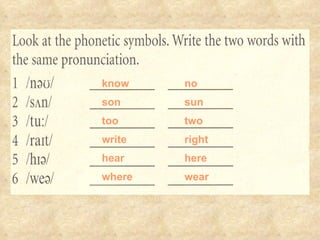
hear know no son sun too two write right wear here where
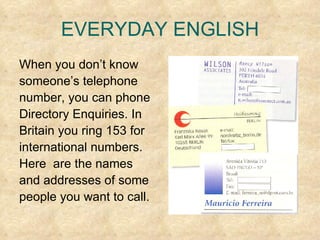
EVERYDAY ENGLISH When you don’t know  someone’s telephone  number, you can phone Directory Enquiries. In  Britain you ring 153 for  international numbers.  Here  are the names  and addresses of some  people you want to call.
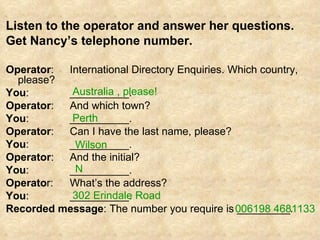
Listen to the operator and answer her questions.  Get Nancy’s telephone number. Operator :  International Directory Enquiries. Which country, please? You : __________. Operator : And which town? You : __________. Operator : Can I have the last name, please? You : __________. Operator : And the initial? You : __________. Operato r: What’s the address? You : __________. Recorded message : The number you require is _________. 006198 4681133 302 Erindale Road N  Wilson   Perth  Australia , please!
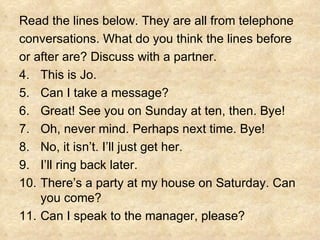
Read the lines below. They are all from telephone  conversations. What do you think the lines before  or after are? Discuss with a partner. This is Jo. Can I take a message? Great! See you on Sunday at ten, then. Bye! Oh, never mind. Perhaps next time. Bye! No, it isn’t. I’ll just get her. I’ll ring back later. There’s a party at my house on Saturday. Can you come? Can I speak to the manager, please?
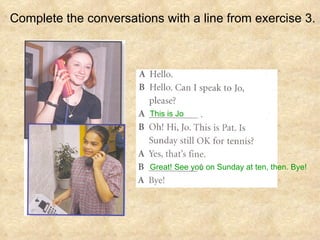
Complete the conversations with a line from exercise 3. This is Jo Great! See you on Sunday at ten, then. Bye!
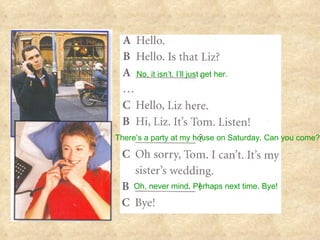
No, it isn’t. I’ll just get her. There’s a party at my house on Saturday. Can you come? Oh, never mind .  Perhaps next time. Bye!
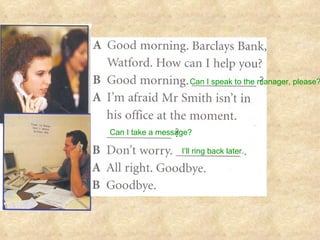
Can I speak to the manager, please? Can I take a message? I’ll ring back later.

Unit 6 : Can you speak English?

  • 1.
    NEW HEADWAY ELEMENTARY UNIT 6: CAN YOU SPEAK ENGLISH?
  • 2.
    Which countries arethey? Which languages do they speak there? SPAIN SPAINISH FRANCE FRENCH JAPAN JAPANESE GERMANY GERMAN ITALY ITALIAN ENGLAND ENGLISH
  • 3.
    golf football tenniscard Which sports or games are they?
  • 4.
    PART: WHAT CANYOU DO? 1. He can ski really well. 2. She can use a computer. 3. “ Can dogs swim?” “ Yes, they can.” 4. “ Can you speak Japanese?” “ No, I can’t.” 5. I can’t spell your name. 6. We can’t understand the question. Match the sentences and pictures. Listen and check. 3 4 2 1 6 5
  • 5.
    THE MODAL VERB“CAN” FORMATION Positive: S + CAN + VERB (INF)… Ex: I can speak English. She can drive a car. They can play the piano.
  • 6.
    Negative: S + CAN’T + VERB (INF)… Ex: I can’t speak English. She can’t drive a car. They can’ t play the piano.
  • 7.
    Question: CAN +S + VERB (INF)…? - Yes, S + can. - No, S + can’t . Ex: Can you speak English? - Yes, I can. / No, I can’t. Can she drive a car? - Yes, she can. / No, she can’t.
  • 8.
    Ex: What canyou do? - I can speak English. What can he do? - He can play football. What can they do? - They can sing well. WHAT + CAN + S + DO?
  • 9.
    2. USAGE: Themodal verb “CAN” is used to denote an ability in the present. Notes: - Can and can’t have the same form in all persons. - There is no do or does.
  • 10.
    1. I _________ ______, but I ____ _____ _______. 2. He ____ _____ , but he ___ ___ . 3. “ ___ you _____?” “ Yes, I ___” 4. They ___ ___, but they ____ ____. 5. We ___ _____ and we ___ ____. 6. “ ___ she _____?” “ No, she ____.” can dance can’t speak German can sing can’t dance can speak French can ski can sing can’t swim drive Can Can cook can’t can Listen and complete the sentences with can or can’t + verb.
  • 11.
    PART:PRACTICE Tina can’tcook. Can you? Listen to Tina and complete the chart. Put √ or  . Complete the chart about you use a computer play the piano swim ski play tennis cook speak Italian speak French drive a car your partner you Tina Can…?  √ √  √ √ √  
  • 12.
    Complete the chartabout your partner. Ask and answer the questions. Can you drive a car? No, I can’t. Can you ski? Yes, I can. But not very well. Tell the class about you and your partner. Louis can ski but I can’t.
  • 13.
    What can computerdo? Talk about computers with a partner. What can they do? What can’t they do? What can people do that computers can’t do? They can translate, but they can’t speak English. Yes, they can.    √      √  √
  • 14.
  • 15.
    WHERE WERE YOUYESTERDAY? Monday March school Yes Yes No No he he February home Sunday Yes Yes No No he he
  • 16.
  • 17.
    PRACTICE Talking aboutyou Ask and answer questions with a partner. Where were you …….? at eight o’clock this morning at half past six yesterday evening at two o’clock this morning at this time yesterday at ten o’clock last night last Saturday evening
  • 18.
    Complete the conversation,using was, were, wasn’t, weren’t, or couldn’t . Were was was were Were Was were weren’t was was couldn’t Was wasn’t
  • 19.
    READING AND SPEAKINGSUPER KIDS Look at the children in the photographs. How old are they? What can they do?
  • 20.
    Answer the questionsabout Alexandra 1. How old is she? 2. Why is she special? 3. Where was she born? 4. Where does she live now? 5. Who does she live with? 6. Does she go to school? 7. What could she do when she was very young? 8. Does she have much free time? Why not? 9. Is she poor? 10. Where was she last year? 1. She is thirteen. 2. She paints large, cubist pictures, and sells them a lot of money. 4. (She lives) in Los Angeles. 3. (She was born) in Romania. 5. (She lives) with her family . 6. Yes, she does. 7. She could paints very well when she was four. 8. No, she doesn’t, because every day after school she does her homework, plays with her little brother, then paints for two or three hours until bedtime. 9. No, she doesn’t. ( She can buy a big house and travel the world.) 10. She was in London, Paris and Rome.
  • 21.
    Answer the questionsabout Alexandra 1. How old is he? 2. Why is he special? 3. Where was he born? 4. Where does he live now? 5. Who does he live with? 6. Does he go to school? 7. What could he do when he was very young? 8. Does he have much free time? Why not? 9. Is he poor? 10. Where was he last year? 2. He can play the piano very well. / He’s a brilliant pianist. 1. He’s ten. 3. ( He was born) in Opava in the Czech Republic. 6. Yes, he does ( two days a week ). 4. ( He was born) in Vienna. 5. ( He lives) with his parents. 7. He could play the piano when he was two and he could read music before he could read books. 8. No, he doesn’t, because he practises the piano six hour a day and he gives lots of concerts. 9. No, he doesn’t. 10. He was in Washington, Chicago and London.
  • 22.
    . Whatis the same about Alexandra and Lukas? What is different? Discuss with your partner They were both born in Eastern Europe. They both travel a lot and have money. Alexandra has a brother, but Lukas is only child. Alexandra goes to school every day, but Lukas goes to school two days a week. Alexandra lives in the USA, but Lukas lives in Vienna. Lukas plays sports but Alexandra doesn’t. They are both geniuses. Alexandra is a painter, and Lukas is a pianist.
  • 23.
    VOCABULARY AND PRONUNCIATION Look at the sentences. What do you notice about these words? - I have a black eye . - No , he doesn’t know the answer.
  • 24.
    write – right/ see - sea wear – where / by - buy hear – here / eye - I for – four / son - sun know – no / too - two hour – our / there - their Find the words in B that have the same pronunciation as the words in A .
  • 25.
    Correct the twospelling mistakes in each sentence. 1. I can here you, but I can’t sea you. 2. Their are three bedrooms in hour house. 3. I don’t no wear Jill lives. 4. My sun lives near the see. 5. Don’t where that hat, by a new one! 6. Know, eye can’t come to your party. 7. You were write. Sally and Peter can’t come four dinner. 8. There daughter could right when she was three. 9. I no my answers are write. 1. I can hear you, but I can’t see you. 2. There are three bedrooms in our house. 3. I don’t know where Jill lives. 4. My son lives near the sea . 5. Don’t wear that hat, buy a new one! 6. No , I can’t come to your party. 7. You were right . Sally and Peter can’t come for dinner. 8. Their daughter could write when she was three. 9. I know my answer are right .
  • 26.
    hear know noson sun too two write right wear here where
  • 27.
    EVERYDAY ENGLISH Whenyou don’t know someone’s telephone number, you can phone Directory Enquiries. In Britain you ring 153 for international numbers. Here are the names and addresses of some people you want to call.
  • 28.
    Listen to theoperator and answer her questions. Get Nancy’s telephone number. Operator : International Directory Enquiries. Which country, please? You : __________. Operator : And which town? You : __________. Operator : Can I have the last name, please? You : __________. Operator : And the initial? You : __________. Operato r: What’s the address? You : __________. Recorded message : The number you require is _________. 006198 4681133 302 Erindale Road N Wilson Perth Australia , please!
  • 29.
    Read the linesbelow. They are all from telephone conversations. What do you think the lines before or after are? Discuss with a partner. This is Jo. Can I take a message? Great! See you on Sunday at ten, then. Bye! Oh, never mind. Perhaps next time. Bye! No, it isn’t. I’ll just get her. I’ll ring back later. There’s a party at my house on Saturday. Can you come? Can I speak to the manager, please?
  • 30.
    Complete the conversationswith a line from exercise 3. This is Jo Great! See you on Sunday at ten, then. Bye!
  • 31.
    No, it isn’t.I’ll just get her. There’s a party at my house on Saturday. Can you come? Oh, never mind . Perhaps next time. Bye!
  • 32.
    Can I speakto the manager, please? Can I take a message? I’ll ring back later.