BED MAKING
Since most important parts of the
environment of a hospitalized patient is bed,
bed making is important to nurses
A clean bed that is wrinkle – free and remains
intact when a patient moves around does a
great deal for the patient’s physical and
psychological comfort
Aims of Bed Making
Make the ward neat
Provide comfort to the patient
Save time and energy
Observe for and prevent pressure sores
Adapt the patient’s needs
PRINCIPLES OF ASEPSIS IN BED MAKING
 Micro – organisms move through space in air currents,
therefore:
 Handle linen carefully
 Avoid throwing it on the floor to prevent spread of any
micro – organisms present either on the floor or linen
 Avoid shaking or tossing it into the laundry hamper/
linen carrier
 Micro – organisms are transferred from one surface to
another on contact, therefore:
 Hold soiled linen and clean linen way from your
uniform to prevent contamination of either
 Proper hand washing before you begin and after bed
making
BODY MECHANICS IN BED MAKING
When bending, bend your knees, not your back in
order to keep the center of gravity above and
close to the base of support and help prevent
fatigue
Face your entire body in the direction that you
are moving to avoid twisting in order to prevent
strain or injury
Organize your work. Conserve your steps by
making a few trips around the bed as possible
Special Appliances used in Bed
Making
Special beds are used on many occasions for
the comfort of the patient, protection of bed
linen, prevention of pressure sores, facilitation
of easier putting of patients in bed and care of
patients with certain conditions
Extra appliances may be added to the
requirements for a simple bed in the
preparation of special beds
These appliances include:
Mackintosh
Water proof material used to protect the bottom
sheets, pillows and mattress from getting wet
Bed Cradle
Appliance used to keep the weight of the linen off
the patient e.g. in patient with burns to protect
linen from touching the area with wound
Bed Blocks
Made of wood and used to raise the bed on one
side e.g. to supply blood to vital organs like the
brain
Bed Rest/Back Rest
Help the patient sit in upright position. May be
attached to or separate from the bed and can be
adjusted to different degrees
Fracture Boards
They are boards (wooden) placed under the
mattress to provide a firm rigid foundation to the
bed and prevent the mattress from sagging. Aid in
immobilization on affected part of the body.
Sand Bags
Small bags made of impermeable material filled
with sand. They are used to support patients legs to
prevent foot drop. May also be used to immobilize
a fractured limb
Air – Rings
Rubber ring placed beneath the patient’s buttocks
to keep them from direct contact with the bed.
Relieve pressure hence prevent pressure sores.
Bed Tables
Specially made tables which can be drawn up in
front of the patient and may be used during meals
or for leaning slightly forward incase the patient has
difficulty in breathing
Hot Water Bottles
Bottles of rubber used to give warmth to the
patient. They may also be used to relieve pain
Foot Boards
Used to secure and support the patients foot
Water Beds
They are just like mattress though have a place
to fill with hot water
Air Beds
These are mattresses that are filled with air
Ripple Mattresses
Have segments and uses electricity to put air
pressure. Used to relieve pressure
ASSIGNMENT
Read and make notes on the procedures of making
the following types of beds
1. Occupied bed
2. Unoccupied bed (closed and open)
3. Admission bed
4. Post – operative bed
5. Fracture bed
6. Cardiac bed
7. Amputation bed
8. Divided bed
9. Tent bed
There are two broad categories of beds:
1. Occupied Bed
This is a bed that is occupied by a client, in most
cases by a bedridden patient or critically ill
patients
2. Unoccupied
This is a bed not occupied by patients
a) Closed: Made when preparing the unit and there
is no patient assigned to it
b) Open: Made for a client who is not in the bed at
that particular time. The top covers are folded 1/3
from top to bottom to facilitate easy getting in.
SPECIAL BEDS
1. Admission Bed
It is made like a simple bed with mackintosh,
one of the blankets/sheets/draw sheets
placed over it and tucked in.
The top bed clothes are now put on and are
individually turned over but not tucked in.
The bed clothes at the side of bed nearest to
the door are folded over, leaving this side
open to facilitate quick admission
Objectives
To have it made up in such a way that the patient
can be admitted without delay
To allow for immediate admission to bed of
acutely ill patients
Requirements:
2 Sheets
1 Draw sheet
Blankets
1 Bed cover
1 Draw mackintosh
Mattress and Mackintosh
Pillows and pillow covers
2. Post – Operative Bed
Objectives
To have a bed ready to receive a patient from
the operating theatre
To counteract shock
To get the patient as quickly as possible
To protect linen from vomitus or saliva
To clear the mouth of saliva or any vomitus for
which purpose a tray is prepared
Extra requirements:
A vomitus bowl
Post – operative tray containing gauze swabs,
air way, sponge holding forceps, metal
spatula, towel
Small extra mackintosh
Bed blocks
Drip stand
Observation chart
3. Fracture Bed
Fracture boards are placed on the frame of bed
under the mattress. The bed is then made up to
suit the requirements of the patient
Objective
To provide a firm base to prevent sagging of the
mattress
Extra requirement:
A fracture board
4. Cardiac Bed
It is specifically made for patients who have
failing heart and sometimes patients with
respiratory diseases where breathing is
difficult since the patients are more
comfortable when sitting in extreme upright
position.
The patient has to be kept warm since in heart
failure the circulation is impaired and the
patient is liable to feel cold.
The patient should be comfortable
Extra requirements:
A bed/ back rest
As many pillows as necessary for patient’s
comfort
A bed table and a soft pillow
Air ring in a cotton cover
A foot rest
5. Amputation Bed
Objectives
To keep the weight of the top linen off the
amputated limb
Extra requirements:
Dressing mackintosh
3 Dressing towels
2 Sand bags
Tourniquet
Bed cradle
Extra bed cover
6. Divided Bed
A bed made in two separate parts with a division
in the center
Objectives
Examination of lower abdomen
Examination of the rectum or vagina
During catheterization
Dressing wounds of the perineal region
Treatment of fracture of femur
Note: Extra requirements like those of amputation
bed except tourniquet, 3 dressing towels, 2
sandbags and dressing mackintosh
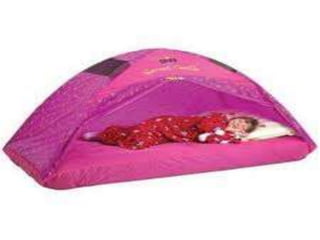
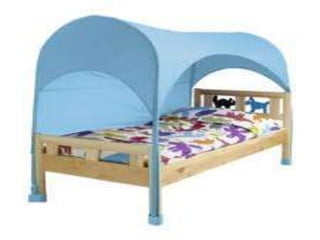
7. Tent Bed
They have an electrically powered fan that
circulates cool air and nebulized water particles
inside a canopy which covers the entire patient
Mostly used for infant and pediatric patients with
dried secretions especially those with
laryngotracheobronchitis (croup), bronchitis,
bronchiolitis, inhalation burns and other
edematous airway processes
Can be used to give oxygen concentrations to
approximately 50% if the canopy is well tucked
under the mattress.
Objectives
Provide continuous cool mist/ steam with
oxygen if needed
In management of laryngeal, tracheal or
bronchial edema
Help promote and improve cough mechanism
Hydrate dried secretions
Notes:
Must have a working circulation unit.
Malfunctions in this unit can cause excessive heat
and CO2 build up inside the tent canopy
Precautions for oxygen usage must be adhered to
Water reservoir must be monitored
Consistent O2 concentration can not be
maintained if canopy is opened frequently
Bed linen can become damp hence need to be
monitored and changed
Large volume nebulizers are susceptible to
contamination
Potential for electric shock or fire exists from
electric fan or static electricity from the plastic
Extra requirements:
A complete pediatric mist tent with nebulizer
unit, fan and drain bottle
Mist tent canopy
High – pressure O2 hose, about 6 feet in
length
O2 or air flow meter
Two liters of sterile water
Oxygen analyzer for monitoring O2
BED MAKING.pptx
BED MAKING.pptx
BED MAKING.pptx
BED MAKING.pptx

BED MAKING.pptx

  • 1.
  • 2.
    Since most importantparts of the environment of a hospitalized patient is bed, bed making is important to nurses A clean bed that is wrinkle – free and remains intact when a patient moves around does a great deal for the patient’s physical and psychological comfort
  • 3.
    Aims of BedMaking Make the ward neat Provide comfort to the patient Save time and energy Observe for and prevent pressure sores Adapt the patient’s needs
  • 4.
    PRINCIPLES OF ASEPSISIN BED MAKING  Micro – organisms move through space in air currents, therefore:  Handle linen carefully  Avoid throwing it on the floor to prevent spread of any micro – organisms present either on the floor or linen  Avoid shaking or tossing it into the laundry hamper/ linen carrier  Micro – organisms are transferred from one surface to another on contact, therefore:  Hold soiled linen and clean linen way from your uniform to prevent contamination of either  Proper hand washing before you begin and after bed making
  • 5.
    BODY MECHANICS INBED MAKING When bending, bend your knees, not your back in order to keep the center of gravity above and close to the base of support and help prevent fatigue Face your entire body in the direction that you are moving to avoid twisting in order to prevent strain or injury Organize your work. Conserve your steps by making a few trips around the bed as possible
  • 6.
    Special Appliances usedin Bed Making Special beds are used on many occasions for the comfort of the patient, protection of bed linen, prevention of pressure sores, facilitation of easier putting of patients in bed and care of patients with certain conditions Extra appliances may be added to the requirements for a simple bed in the preparation of special beds
  • 7.
    These appliances include: Mackintosh Waterproof material used to protect the bottom sheets, pillows and mattress from getting wet Bed Cradle Appliance used to keep the weight of the linen off the patient e.g. in patient with burns to protect linen from touching the area with wound Bed Blocks Made of wood and used to raise the bed on one side e.g. to supply blood to vital organs like the brain
  • 8.
    Bed Rest/Back Rest Helpthe patient sit in upright position. May be attached to or separate from the bed and can be adjusted to different degrees Fracture Boards They are boards (wooden) placed under the mattress to provide a firm rigid foundation to the bed and prevent the mattress from sagging. Aid in immobilization on affected part of the body. Sand Bags Small bags made of impermeable material filled with sand. They are used to support patients legs to prevent foot drop. May also be used to immobilize a fractured limb
  • 9.
    Air – Rings Rubberring placed beneath the patient’s buttocks to keep them from direct contact with the bed. Relieve pressure hence prevent pressure sores. Bed Tables Specially made tables which can be drawn up in front of the patient and may be used during meals or for leaning slightly forward incase the patient has difficulty in breathing Hot Water Bottles Bottles of rubber used to give warmth to the patient. They may also be used to relieve pain
  • 10.
    Foot Boards Used tosecure and support the patients foot Water Beds They are just like mattress though have a place to fill with hot water Air Beds These are mattresses that are filled with air Ripple Mattresses Have segments and uses electricity to put air pressure. Used to relieve pressure
  • 11.
    ASSIGNMENT Read and makenotes on the procedures of making the following types of beds 1. Occupied bed 2. Unoccupied bed (closed and open) 3. Admission bed 4. Post – operative bed 5. Fracture bed 6. Cardiac bed 7. Amputation bed 8. Divided bed 9. Tent bed
  • 12.
    There are twobroad categories of beds: 1. Occupied Bed This is a bed that is occupied by a client, in most cases by a bedridden patient or critically ill patients 2. Unoccupied This is a bed not occupied by patients a) Closed: Made when preparing the unit and there is no patient assigned to it b) Open: Made for a client who is not in the bed at that particular time. The top covers are folded 1/3 from top to bottom to facilitate easy getting in.
  • 13.
    SPECIAL BEDS 1. AdmissionBed It is made like a simple bed with mackintosh, one of the blankets/sheets/draw sheets placed over it and tucked in. The top bed clothes are now put on and are individually turned over but not tucked in. The bed clothes at the side of bed nearest to the door are folded over, leaving this side open to facilitate quick admission
  • 14.
    Objectives To have itmade up in such a way that the patient can be admitted without delay To allow for immediate admission to bed of acutely ill patients Requirements: 2 Sheets 1 Draw sheet Blankets 1 Bed cover 1 Draw mackintosh Mattress and Mackintosh Pillows and pillow covers
  • 15.
    2. Post –Operative Bed Objectives To have a bed ready to receive a patient from the operating theatre To counteract shock To get the patient as quickly as possible To protect linen from vomitus or saliva To clear the mouth of saliva or any vomitus for which purpose a tray is prepared
  • 16.
    Extra requirements: A vomitusbowl Post – operative tray containing gauze swabs, air way, sponge holding forceps, metal spatula, towel Small extra mackintosh Bed blocks Drip stand Observation chart
  • 17.
    3. Fracture Bed Fractureboards are placed on the frame of bed under the mattress. The bed is then made up to suit the requirements of the patient Objective To provide a firm base to prevent sagging of the mattress Extra requirement: A fracture board
  • 18.
    4. Cardiac Bed Itis specifically made for patients who have failing heart and sometimes patients with respiratory diseases where breathing is difficult since the patients are more comfortable when sitting in extreme upright position. The patient has to be kept warm since in heart failure the circulation is impaired and the patient is liable to feel cold. The patient should be comfortable
  • 19.
    Extra requirements: A bed/back rest As many pillows as necessary for patient’s comfort A bed table and a soft pillow Air ring in a cotton cover A foot rest
  • 20.
    5. Amputation Bed Objectives Tokeep the weight of the top linen off the amputated limb Extra requirements: Dressing mackintosh 3 Dressing towels 2 Sand bags Tourniquet Bed cradle Extra bed cover
  • 21.
    6. Divided Bed Abed made in two separate parts with a division in the center Objectives Examination of lower abdomen Examination of the rectum or vagina During catheterization Dressing wounds of the perineal region Treatment of fracture of femur Note: Extra requirements like those of amputation bed except tourniquet, 3 dressing towels, 2 sandbags and dressing mackintosh
  • 22.
    7. Tent Bed Theyhave an electrically powered fan that circulates cool air and nebulized water particles inside a canopy which covers the entire patient Mostly used for infant and pediatric patients with dried secretions especially those with laryngotracheobronchitis (croup), bronchitis, bronchiolitis, inhalation burns and other edematous airway processes Can be used to give oxygen concentrations to approximately 50% if the canopy is well tucked under the mattress.
  • 23.
    Objectives Provide continuous coolmist/ steam with oxygen if needed In management of laryngeal, tracheal or bronchial edema Help promote and improve cough mechanism Hydrate dried secretions
  • 24.
    Notes: Must have aworking circulation unit. Malfunctions in this unit can cause excessive heat and CO2 build up inside the tent canopy Precautions for oxygen usage must be adhered to Water reservoir must be monitored Consistent O2 concentration can not be maintained if canopy is opened frequently Bed linen can become damp hence need to be monitored and changed Large volume nebulizers are susceptible to contamination Potential for electric shock or fire exists from electric fan or static electricity from the plastic
  • 25.
    Extra requirements: A completepediatric mist tent with nebulizer unit, fan and drain bottle Mist tent canopy High – pressure O2 hose, about 6 feet in length O2 or air flow meter Two liters of sterile water Oxygen analyzer for monitoring O2