Machinery, Equipments and Linen
By
Phebe Esther .J B.sc Nsg..
Nursing Tutor,
Ganga College of Nursing, Cbe
B.sc nsg..
OUTLINES INTRODUCTION
 MATERIALS AND ITS TYPES
 EQUIPMENTS AND ITS TYPES
 CARE OF LINEN
 CARE OF RUBBER GOODS
 CARE OF STAINLESS STEEL GOODS
 CARE OF GLASS EQUIPMENTS
 CARE OF PLASTIC ITEMS
 CARE OF FURNITURE
 CARE OF MACHINERY EQUIPMENTS
 MAINTANENCE OF WARD INVENTORY
Machinery and equipments are essential and basic tools for
hospital services, used on an everyday basis for patient care
Handling materials and equipments are very important
responsibility of the nurse working in the hospital
Types Of Materials Used In Hospital
Materials
Supplies
 For daily use
 diagnostic & treatment
 cotton, gauze, syringes,
needles, linen, etc
Facilities
non – movable materials
used for long time.
Eg: lifts, water tanks, telephone
Drugs And Medicines
For treatment of
diseases and prevention
Equipments and Instruments
These include furniture,
instruments and equipments such
as x – ray machine, etc
It refers to various devices, tools, instruments that are
used in hospitals and health care works
These equipments must be well functioning and
adequate supplies must be there to provide optimum
nursing care
Insufficient and ill functioning equipments results in
increased work and dangerous for patient
1. Self care equipments (for patient’s daily life)
2. Electronic equipments (ECG monitor, ventilator, etc)
3. Diagnostic equipments (tools used to test)
4. Surgical equipments (stainless steel tools, OT tools)
5. Acute care equipments (dressing materials, etc)
6. Storage and transport equipments
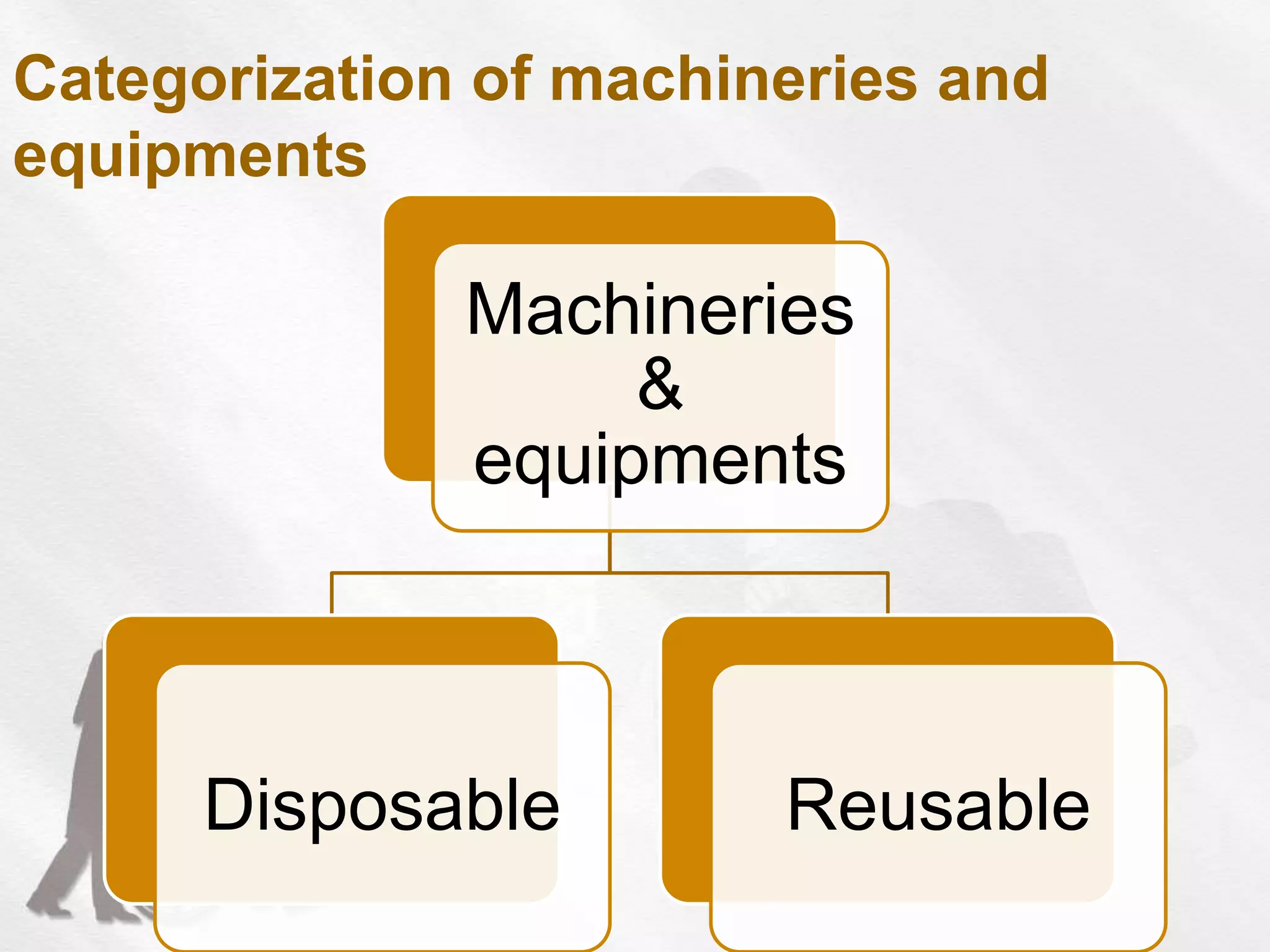
Categorization of machineries and
equipments
Machineries
&
equipments
Disposable Reusable
Disposable Equipments:
• items used only once
• discarded after use
• new item for each patient
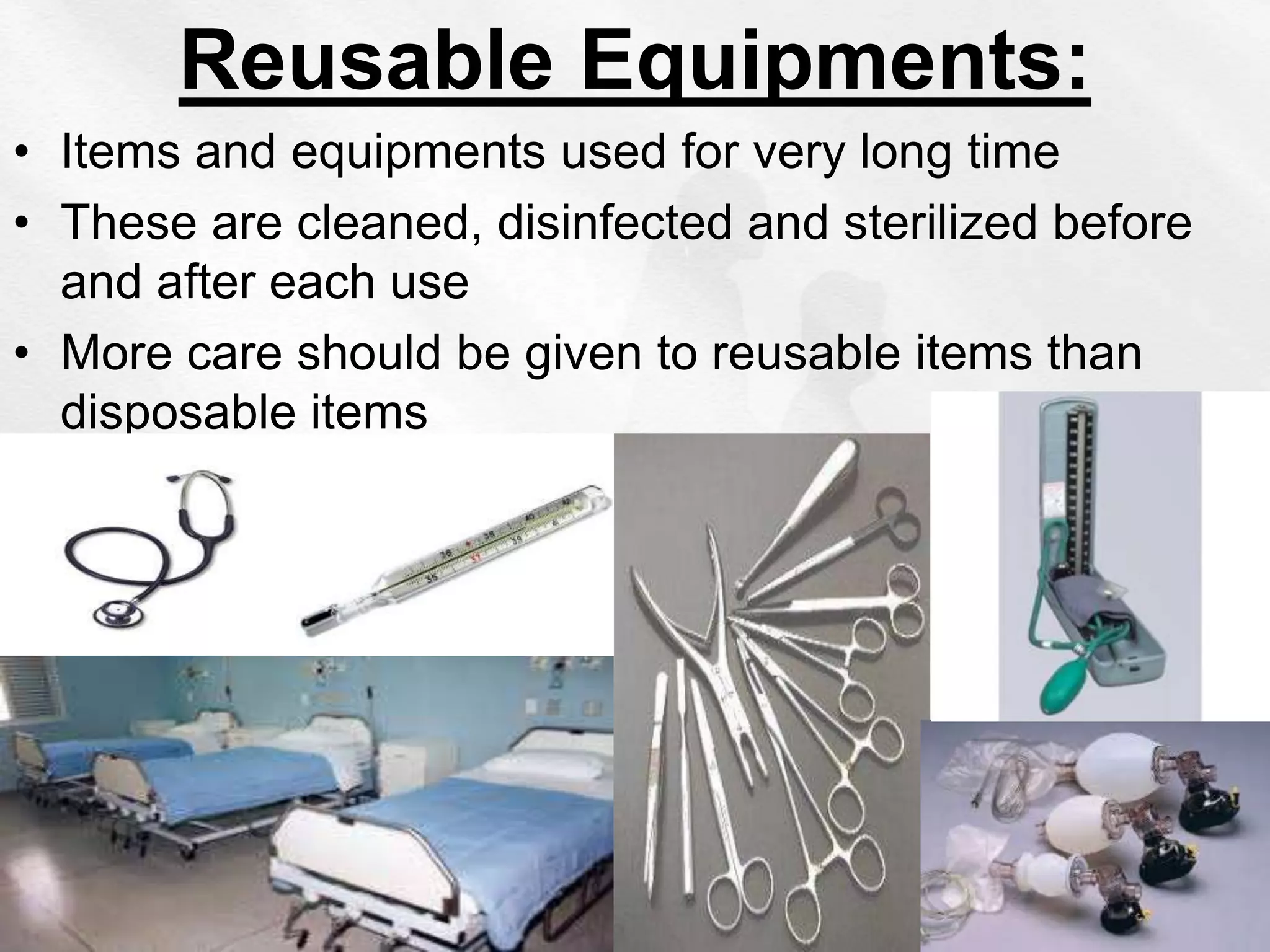
Reusable Equipments:
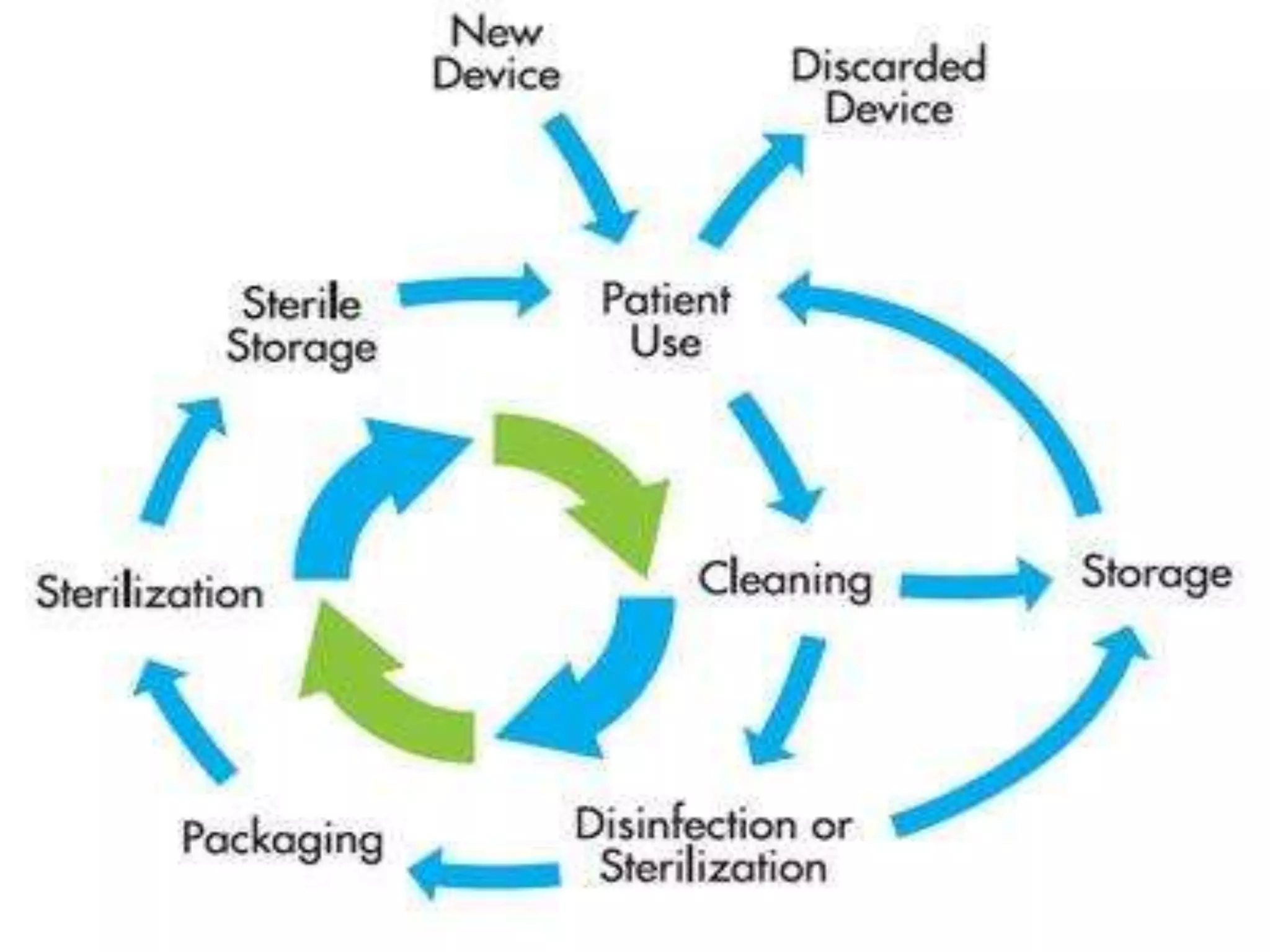
• Items and equipments used for very long time
• These are cleaned, disinfected and sterilized before
and after each use
• More care should be given to reusable items than
disposable items
LINENS
• Linen is a fabric made from fibers
• It includes clothes, sheets, etc
• In hospital setting, linens are used for many purposes such as
covering the bed, articles, etc
Linens used in hospital setup
• Bed sheets
• Blankets
• Curtains
• Cloth covers : pillows, mattress, hot water bottle, air cushion,
inhaler cover, etc
• Towels
• Wrappers for trays, dressing set, etc
• Patient’s clothes : gowns, shirts
• Staff clothes : mask, cap, gown, OT dress, etc
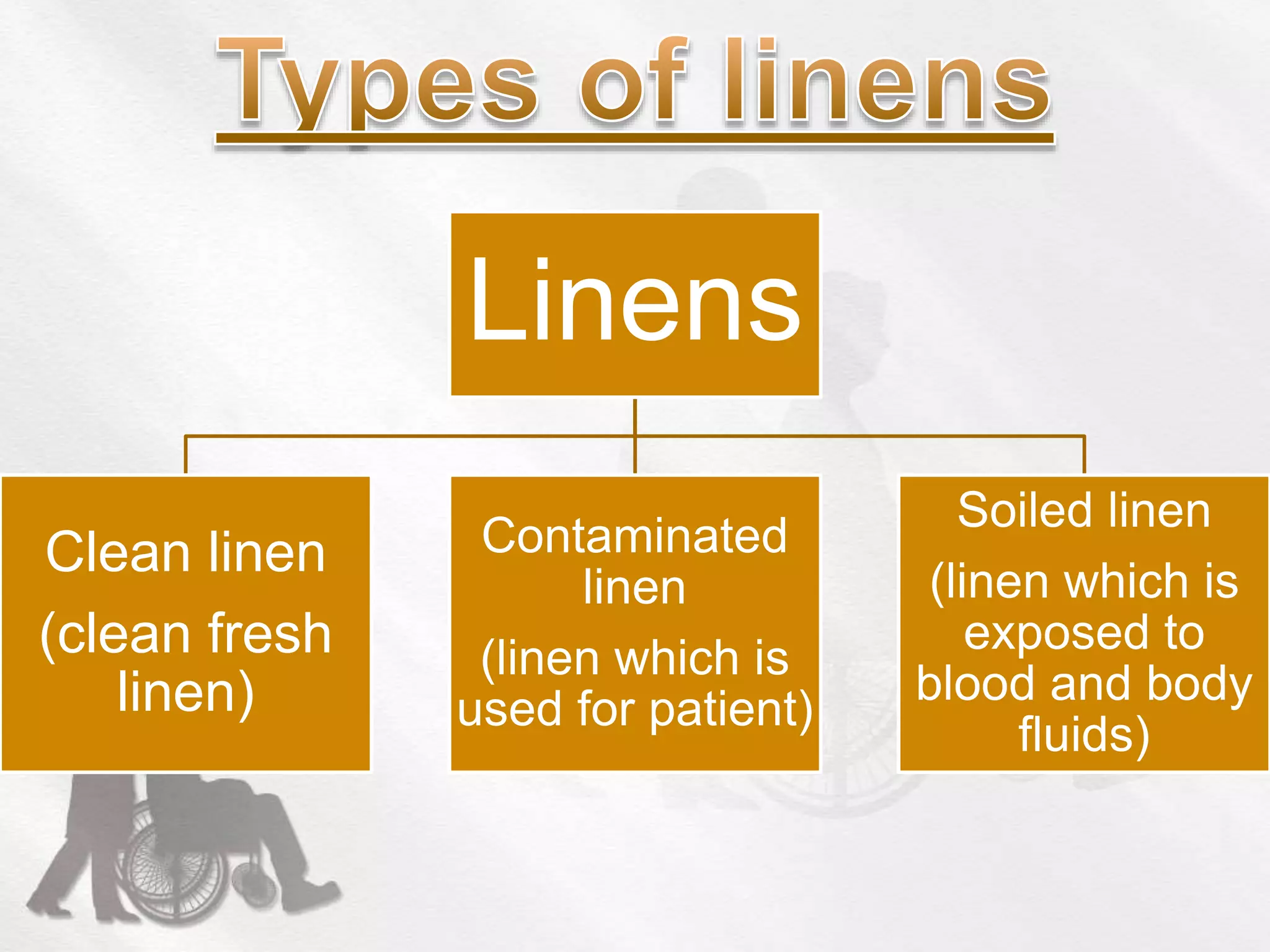
Linens
Clean linen
(clean fresh
linen)
Contaminated
linen
(linen which is
used for patient)
Soiled linen
(linen which is
exposed to
blood and body
fluids)
Care of linens
Care of linen is important, as it is an expensive item in the running
of a hospital
General instructions to avoid spoiling
and wastage of linen
 Follow hospital policy for maintenance of linen
 Store the clean linen in cupboard and maintain stock register
 Lock the cupboard when not in use
 Care should be taken to avoid linen being taken home by the
clients on their discharge
 Stocks should be checked at regular intervals
 Torn linen should not be used on the bed but sent for mending
 Soiled linen should not be placed on the floor
 Regularly send the dirty linen to laundry for washing and ironing
 Damp linen should be dried
 Try to remove fresh stains by using appropriate stain remover
 Draw mackintosh over bed sheets to protect from stains
 The linen used for an infectious patient should be disinfected
first before they are sent to laundry
 Always use mackintosh over top linen while doing any
procedure
 Teach the importance of keeping clean hospital linen to the
patient and family members
Removal of stains
STAINS
Medicine
stain
(apply spirit)
Rust marks
(apply salt
and lemon
juice)
Tea/coffee
stain
(pour milk &
wash)
Blood stain
• fresh – soak in cold
water
• old – soak in H2O2
• thick – apply thick
paste of starch & dry in
sun
Iodine
(dip in rice
water)
Paint
(turpentine,
alcohol)
Ink stain
•Dip in cool
water
• Sprinkle salt
and lemon
•Dry in sun
Food stain
(apply salt
and pour hot
water)
Disinfection of contaminated/Soiled
Linen
• Always use laundry box/hamper trolley for collecting
contaminated linen.
• It should not be put on the floor, as it will cause more
contamination.
• Dip the linen in a bucket containing 0.5% solution of chlorine for
10 minutes.
• Rinse it in water and get dry in sun.
• Send for autoclaving(sterilization)
• After disinfecting the linen, store them in appropriate
cupboards.
Autoclave
Disinfectants used for cleaning
• Sodium hypochloride solution 0.5%
Duration – 5 minutes
• Glutaraldehyde 2%
Duration – 20 to 30 minutes
• For sterilization, glutaraldehyde 2%
Duration – 10 hours
Care of blankets
• Blankets are expensive articles and it will shrink while washing
• Blankets should not be washed, it should be dusted in open
place then dried in sunlight to disinfect
• They should not be exposed to dust
• While storing, blankets should be carefully protected from moth
using naphthalene balls
• They should be covered with dust proof sheets
Care of mattresses and pillows
• They should be prevented from becoming wet and stained
• They should be brushed at regular intervals to prevent
collection of dust
• Washable covers should be covered over the mattresses and
pillows
• They are disinfected by exposing them to sunlight
• If needed to wash, wash it under running cold water
Importance of maintaining linen in hospital
• We can provide clean and tidy linen and bed to the
patient
• Provides comfort to the patient
• Limits cross – infection
• Promotes cost – effectiveness of hospital by
prolonging the life of the items
List of rubber articles used in hospitals
• Mackintosh
• Rubber tubing : ( drainage, rectal, catheters, suction tube,
enema tubes, gastric lavage, etc )
• Gloves ( reusable )
• AMBU bag & its mouth piece
• Breast pump
• Hot water bottle, air pillow, ice caps, air cushion, etc.
Storage and handling:
Rubber mackintosh should be stored in dry, dark and
cool place. It should not be exposed to sunlight.
They should be folded by rolling them to avoid
breakage
Avoid using sharp articles like blade, pins, etc as they
can cut rubber easily
Avoid using kerosene, benzene, oils and hot water for
cleaning
Wrong folding
rolling
Cleaning and disinfecting:
 Spread it on a flat surface and wet it with cold water
 Rub the upper surface with soap and water using a clean cloth
 Turn the other side and repeat the same
 Wash both surfaces under running water
 If stains are present, it should be removed by appropriate
method
 For disinfection, Lysol or Dettol is used in the ratio 1:40
 Hand them horizontally in shade to dry
 When both surfaces are dried, powder them with French chalk
powder
 Roll it and store in dark cool place
Cleaning:
 keep the rubber tubes upside down and run water through it
 Make use of swab stick to remove any organic matter for
ensuring patency of tube
 Apply soap and water on the surface of the tube to remove dirt,
grease or any other matter
 Wash them again under running water
 To sterilize them, boil the tubes for 5 minutes by putting them in
the boiling water
 Hang the tubings for drying in shaded place
 Coil the tube and store it in cupboard
Cleaning:
• The wearer of the gloves should wash them on their hands just
before they are removed
• After removing from the hands, they are washed with soap and
cold water, first on outside, then invert and repeat on inside
• Rinse well with water, both inside and outside
• Holes and tears are discovered by submerging the glove filled
with air in the water. If there are holes, the bubbles will pass up,
separate torn gloves
• Hang then to dry. When the outside is dried, turn inside out and
dry
• After drying, they are powdered inside and outside, then
packed in pairs
• If sterilization is needed, send it for autoclaving
Care Of Air Cushion, Rubber Beds, Ice Caps,
Hot Water Bottles
• Remove the cloth cover of bottle, caps, cushions and decontaminate
the covers
• Keep the bottle, caps, cushions empty by removing water, ice and air
before cleaning
• The valves of the air cushions or beds should never be immersed in
water
• Clean the outer surface with soap and water
• Hang them upside down for drying
• When the bags are completely dried inflate them with air, water or ice
• In case of hot water bottles, ice caps, etc empty the contents
immediately after use
Care Of AMBU Bags
• Clean the rubber part with a clean cloth
• Disinfect it using methylated spirit swab
Sterilization Of Rubber Articles
Autoclaving:
At 120°c temperature with minimum pressure for 15
minutes
Chemical sterilization:
• Alcohol 50 – 70% ( for 20 to 30 minutes )
• Savlon ( for 30 minutes )
List of steel items
• Forceps
• Sharp instruments
• Scopes ( endoscopes, laryngoscopes, etc )
Cleaning
• Steel items get sterilized using chemicals and autoclaving
• Wear gloves while handling these items
• Dip items in 5% chlorine for 5 to 6 minutes then wash under
running water
• Make sure that tips, toothed ends, grooves of forceps are
cleaned properly
• Instruments with fine tip are covered in hard rubber cap
• After drying, send it for sterilization
Care of laryngoscope
Cleaning
• Take dry gauze piece to clean saliva from
laryngoscope
• Separate blade from laryngoscope and dip it in
disinfectant for 20 – 30 minutes
• With the help of cheatle forceps, take it out and dry it
• Reattach blade to laryngoscope and store on
emergency trolley for resuscitation
Articles made up of glass are very fragile and
special care is needed while handling them
List of glass items
• Test tubes
• Funnel
• Slides
• Specimen bottle
• Thermometers
• Ounce glass, jar
Care and cleaning
• Immerse the used glass item in disinfectant 5%
chlorine for 5 minutes in a container covered
with lid
• Clean tubes and jars with plastic brush
• Patient’s utensils and items are cleaned with
soapy solution
• If the items is soiled or very much
contaminated, must be discarded in puncture
proof container
Items made up of polyvinyl chloride(PVC) are the
plastic items. These items are heat sensitive and
hence they should be protected from heat,
radiations, etc
List of plastic items
• Basin, bowl
• Kidney tray
• Bad pan, urinal
• Syringes
• Airways, connectors
• Oxygen hood
Care of kidney tray/bed pan/urinals
• The contents of kidney tray, bed pan or urinals should be
discarded in appropriate area. Its contents should not be left
standing for a long time
• Rinse it in cold running water
• Wash with soap and warm water using a brush and rinse it well
to disinfect, soak them in Lysol 1:40 for one hour
• They can be placed in direct sunlight for few hours
• Furniture is movable article in a room established to fit for living
or working.
• In hospital setting, it is a collective term used for different types
of portable objects.
TYPES OF FURNITURE
Wooden furniture
* Table, chairs
* cupboard, locker
* stool, sofa
* bed, bench
Metal furniture
* bed, trolley
* chair, wheel chair
* locker, back rest
* OT table
* IV stand, screen
* Bowl stand, bed cradle
Care and maintenance of furniture
• Always keep the furniture dust free, clean it with a piece of soft
cloth
• They can be disinfected with glutaraldehyde or savlon and also
washed with soap and water
• Hospital beds should be cleaned daily
• Trolleys, lockers, IV stand and treatment table must be
disinfected after discharge or death of a patient
• Iron furniture should be cleaned with dry duster
• Repair of furniture must be done regularly
• Stock record of furniture should be maintained and old
damaged furniture are sent for condeminization
Importance of maintaining furniture
• Maintenance of furniture is very important for
preserving its maximum usefulness
• It gives aesthetic sense for patient
• It prevents cross infection
• It helps in prolonging the life of furniture
• It provides favorable environment for the
recovery of the patient
Care Of Machinery
Equipments
Items using electric current are included in this category. It
includes
• Suction apparatus
• Defibrillator
• Nebulizer machine
• Refrigerator
• Monitor
• Ventilator
• Pulse oxymeter
Points to remember
• Power off the equipments when not in use
• Clean the equipments and its parts with wet soft cloth
• In suction apparatus, the tubings should changed for every 24
hours
• The working condition of the equipments should be checked
before using it
• The equipments should be kept in safe and appropriate place
• The defibrillator should be in the charge always
• In refrigerator, unnecessary things such as food items, expired
medicines, opened medications, unused blood samples, etc
should not be kept
MAINTENANCE OF WARDINVENTORY
INVENTORY
Inventory is a list of articles available in ward, their characteristics,
standard number. It is record of articles available in the ward.
Inventory control means stocking an adequate number and type of
stores, so that the materials are available whenever required
Inventory control is the process of maintaining the optimum
needed quantity that is sufficient for the smooth operation of the
organization
Purposes/uses of maintaining ward inventory
• To provide maximum supply of materials
• To facilitate the smooth functioning of the ward
• To avoid shortage and insufficiency
• To determine the condition of articles and to order repair or
replacement if necessary
• To provide a cushion between availability of material and the
actual demand for a material
• To reduce financial investment
• Inventory helps to handle unforeseen circumstances
• Inventory also helps to avoid workers and machinery being idle
• To check the functioning status of article
• To return the articles to its proper place
• It helps to avoid missing of articles and to keep a check on the
article
INDENT
Indent is a list of items made for availing in the ward. A list of
items is made, which are not available in the stock.
Indent is done weekly/monthly basis depending upon the shortage
of items. After making the list, it is been sent to the main store.
Record is maintained on register/note book know as Indent Book
Model Indent Book
Name of the Hospital
Name of the ward
Date, Year and Time
S.No ITEMS QUANTITY Indent Issued
Initials
MODEL INVENTORY
GANGA HOSPITAL - COIMBATORE
Pediatric ward
Emergency article checklist
S.No Items Qnty
Months
Jan Feb Mar Apr May June July Aug
Signature of ward in charge
Signature of nursing
superintendent
Machinery , equipments and linen  -gihs

Machinery , equipments and linen -gihs

  • 1.
    Machinery, Equipments andLinen By Phebe Esther .J B.sc Nsg.. Nursing Tutor, Ganga College of Nursing, Cbe
  • 2.
  • 3.
    OUTLINES INTRODUCTION  MATERIALSAND ITS TYPES  EQUIPMENTS AND ITS TYPES  CARE OF LINEN  CARE OF RUBBER GOODS  CARE OF STAINLESS STEEL GOODS  CARE OF GLASS EQUIPMENTS  CARE OF PLASTIC ITEMS  CARE OF FURNITURE  CARE OF MACHINERY EQUIPMENTS  MAINTANENCE OF WARD INVENTORY
  • 5.
    Machinery and equipmentsare essential and basic tools for hospital services, used on an everyday basis for patient care Handling materials and equipments are very important responsibility of the nurse working in the hospital
  • 6.
    Types Of MaterialsUsed In Hospital Materials Supplies  For daily use  diagnostic & treatment  cotton, gauze, syringes, needles, linen, etc Facilities non – movable materials used for long time. Eg: lifts, water tanks, telephone Drugs And Medicines For treatment of diseases and prevention Equipments and Instruments These include furniture, instruments and equipments such as x – ray machine, etc
  • 7.
    It refers tovarious devices, tools, instruments that are used in hospitals and health care works These equipments must be well functioning and adequate supplies must be there to provide optimum nursing care Insufficient and ill functioning equipments results in increased work and dangerous for patient
  • 8.
    1. Self careequipments (for patient’s daily life) 2. Electronic equipments (ECG monitor, ventilator, etc) 3. Diagnostic equipments (tools used to test) 4. Surgical equipments (stainless steel tools, OT tools) 5. Acute care equipments (dressing materials, etc) 6. Storage and transport equipments
  • 10.
    Categorization of machineriesand equipments Machineries & equipments Disposable Reusable
  • 11.
    Disposable Equipments: • itemsused only once • discarded after use • new item for each patient
  • 12.
    Reusable Equipments: • Itemsand equipments used for very long time • These are cleaned, disinfected and sterilized before and after each use • More care should be given to reusable items than disposable items
  • 15.
    LINENS • Linen isa fabric made from fibers • It includes clothes, sheets, etc • In hospital setting, linens are used for many purposes such as covering the bed, articles, etc
  • 16.
    Linens used inhospital setup • Bed sheets • Blankets • Curtains • Cloth covers : pillows, mattress, hot water bottle, air cushion, inhaler cover, etc • Towels • Wrappers for trays, dressing set, etc • Patient’s clothes : gowns, shirts • Staff clothes : mask, cap, gown, OT dress, etc
  • 17.
    Linens Clean linen (clean fresh linen) Contaminated linen (linenwhich is used for patient) Soiled linen (linen which is exposed to blood and body fluids)
  • 18.
    Care of linens Careof linen is important, as it is an expensive item in the running of a hospital
  • 19.
    General instructions toavoid spoiling and wastage of linen  Follow hospital policy for maintenance of linen  Store the clean linen in cupboard and maintain stock register  Lock the cupboard when not in use  Care should be taken to avoid linen being taken home by the clients on their discharge  Stocks should be checked at regular intervals  Torn linen should not be used on the bed but sent for mending  Soiled linen should not be placed on the floor  Regularly send the dirty linen to laundry for washing and ironing
  • 20.
     Damp linenshould be dried  Try to remove fresh stains by using appropriate stain remover  Draw mackintosh over bed sheets to protect from stains  The linen used for an infectious patient should be disinfected first before they are sent to laundry  Always use mackintosh over top linen while doing any procedure  Teach the importance of keeping clean hospital linen to the patient and family members
  • 23.
    Removal of stains STAINS Medicine stain (applyspirit) Rust marks (apply salt and lemon juice) Tea/coffee stain (pour milk & wash) Blood stain • fresh – soak in cold water • old – soak in H2O2 • thick – apply thick paste of starch & dry in sun Iodine (dip in rice water) Paint (turpentine, alcohol) Ink stain •Dip in cool water • Sprinkle salt and lemon •Dry in sun Food stain (apply salt and pour hot water)
  • 24.
    Disinfection of contaminated/Soiled Linen •Always use laundry box/hamper trolley for collecting contaminated linen. • It should not be put on the floor, as it will cause more contamination. • Dip the linen in a bucket containing 0.5% solution of chlorine for 10 minutes. • Rinse it in water and get dry in sun. • Send for autoclaving(sterilization) • After disinfecting the linen, store them in appropriate cupboards.
  • 25.
  • 26.
    Disinfectants used forcleaning • Sodium hypochloride solution 0.5% Duration – 5 minutes • Glutaraldehyde 2% Duration – 20 to 30 minutes • For sterilization, glutaraldehyde 2% Duration – 10 hours
  • 27.
    Care of blankets •Blankets are expensive articles and it will shrink while washing • Blankets should not be washed, it should be dusted in open place then dried in sunlight to disinfect • They should not be exposed to dust • While storing, blankets should be carefully protected from moth using naphthalene balls • They should be covered with dust proof sheets
  • 28.
    Care of mattressesand pillows • They should be prevented from becoming wet and stained • They should be brushed at regular intervals to prevent collection of dust • Washable covers should be covered over the mattresses and pillows • They are disinfected by exposing them to sunlight • If needed to wash, wash it under running cold water
  • 29.
    Importance of maintaininglinen in hospital • We can provide clean and tidy linen and bed to the patient • Provides comfort to the patient • Limits cross – infection • Promotes cost – effectiveness of hospital by prolonging the life of the items
  • 31.
    List of rubberarticles used in hospitals • Mackintosh • Rubber tubing : ( drainage, rectal, catheters, suction tube, enema tubes, gastric lavage, etc ) • Gloves ( reusable ) • AMBU bag & its mouth piece • Breast pump • Hot water bottle, air pillow, ice caps, air cushion, etc.
  • 34.
    Storage and handling: Rubbermackintosh should be stored in dry, dark and cool place. It should not be exposed to sunlight. They should be folded by rolling them to avoid breakage Avoid using sharp articles like blade, pins, etc as they can cut rubber easily Avoid using kerosene, benzene, oils and hot water for cleaning Wrong folding rolling
  • 35.
    Cleaning and disinfecting: Spread it on a flat surface and wet it with cold water  Rub the upper surface with soap and water using a clean cloth  Turn the other side and repeat the same  Wash both surfaces under running water  If stains are present, it should be removed by appropriate method  For disinfection, Lysol or Dettol is used in the ratio 1:40  Hand them horizontally in shade to dry  When both surfaces are dried, powder them with French chalk powder  Roll it and store in dark cool place
  • 37.
    Cleaning:  keep therubber tubes upside down and run water through it  Make use of swab stick to remove any organic matter for ensuring patency of tube  Apply soap and water on the surface of the tube to remove dirt, grease or any other matter  Wash them again under running water  To sterilize them, boil the tubes for 5 minutes by putting them in the boiling water  Hang the tubings for drying in shaded place  Coil the tube and store it in cupboard
  • 40.
    Cleaning: • The wearerof the gloves should wash them on their hands just before they are removed • After removing from the hands, they are washed with soap and cold water, first on outside, then invert and repeat on inside • Rinse well with water, both inside and outside • Holes and tears are discovered by submerging the glove filled with air in the water. If there are holes, the bubbles will pass up, separate torn gloves • Hang then to dry. When the outside is dried, turn inside out and dry • After drying, they are powdered inside and outside, then packed in pairs • If sterilization is needed, send it for autoclaving
  • 41.
    Care Of AirCushion, Rubber Beds, Ice Caps, Hot Water Bottles • Remove the cloth cover of bottle, caps, cushions and decontaminate the covers • Keep the bottle, caps, cushions empty by removing water, ice and air before cleaning • The valves of the air cushions or beds should never be immersed in water • Clean the outer surface with soap and water • Hang them upside down for drying • When the bags are completely dried inflate them with air, water or ice • In case of hot water bottles, ice caps, etc empty the contents immediately after use
  • 42.
    Care Of AMBUBags • Clean the rubber part with a clean cloth • Disinfect it using methylated spirit swab
  • 43.
    Sterilization Of RubberArticles Autoclaving: At 120°c temperature with minimum pressure for 15 minutes Chemical sterilization: • Alcohol 50 – 70% ( for 20 to 30 minutes ) • Savlon ( for 30 minutes )
  • 45.
    List of steelitems • Forceps • Sharp instruments • Scopes ( endoscopes, laryngoscopes, etc )
  • 47.
    Cleaning • Steel itemsget sterilized using chemicals and autoclaving • Wear gloves while handling these items • Dip items in 5% chlorine for 5 to 6 minutes then wash under running water • Make sure that tips, toothed ends, grooves of forceps are cleaned properly • Instruments with fine tip are covered in hard rubber cap • After drying, send it for sterilization
  • 48.
  • 49.
    Cleaning • Take drygauze piece to clean saliva from laryngoscope • Separate blade from laryngoscope and dip it in disinfectant for 20 – 30 minutes • With the help of cheatle forceps, take it out and dry it • Reattach blade to laryngoscope and store on emergency trolley for resuscitation
  • 51.
    Articles made upof glass are very fragile and special care is needed while handling them
  • 52.
    List of glassitems • Test tubes • Funnel • Slides • Specimen bottle • Thermometers • Ounce glass, jar
  • 53.
    Care and cleaning •Immerse the used glass item in disinfectant 5% chlorine for 5 minutes in a container covered with lid • Clean tubes and jars with plastic brush • Patient’s utensils and items are cleaned with soapy solution • If the items is soiled or very much contaminated, must be discarded in puncture proof container
  • 55.
    Items made upof polyvinyl chloride(PVC) are the plastic items. These items are heat sensitive and hence they should be protected from heat, radiations, etc
  • 56.
    List of plasticitems • Basin, bowl • Kidney tray • Bad pan, urinal • Syringes • Airways, connectors • Oxygen hood
  • 58.
    Care of kidneytray/bed pan/urinals • The contents of kidney tray, bed pan or urinals should be discarded in appropriate area. Its contents should not be left standing for a long time • Rinse it in cold running water • Wash with soap and warm water using a brush and rinse it well to disinfect, soak them in Lysol 1:40 for one hour • They can be placed in direct sunlight for few hours
  • 60.
    • Furniture ismovable article in a room established to fit for living or working. • In hospital setting, it is a collective term used for different types of portable objects.
  • 61.
    TYPES OF FURNITURE Woodenfurniture * Table, chairs * cupboard, locker * stool, sofa * bed, bench Metal furniture * bed, trolley * chair, wheel chair * locker, back rest * OT table * IV stand, screen * Bowl stand, bed cradle
  • 64.
    Care and maintenanceof furniture • Always keep the furniture dust free, clean it with a piece of soft cloth • They can be disinfected with glutaraldehyde or savlon and also washed with soap and water • Hospital beds should be cleaned daily • Trolleys, lockers, IV stand and treatment table must be disinfected after discharge or death of a patient • Iron furniture should be cleaned with dry duster • Repair of furniture must be done regularly • Stock record of furniture should be maintained and old damaged furniture are sent for condeminization
  • 65.
    Importance of maintainingfurniture • Maintenance of furniture is very important for preserving its maximum usefulness • It gives aesthetic sense for patient • It prevents cross infection • It helps in prolonging the life of furniture • It provides favorable environment for the recovery of the patient
  • 66.
  • 67.
    Items using electriccurrent are included in this category. It includes • Suction apparatus • Defibrillator • Nebulizer machine • Refrigerator • Monitor • Ventilator • Pulse oxymeter
  • 70.
    Points to remember •Power off the equipments when not in use • Clean the equipments and its parts with wet soft cloth • In suction apparatus, the tubings should changed for every 24 hours • The working condition of the equipments should be checked before using it • The equipments should be kept in safe and appropriate place • The defibrillator should be in the charge always • In refrigerator, unnecessary things such as food items, expired medicines, opened medications, unused blood samples, etc should not be kept
  • 71.
  • 72.
    INVENTORY Inventory is alist of articles available in ward, their characteristics, standard number. It is record of articles available in the ward. Inventory control means stocking an adequate number and type of stores, so that the materials are available whenever required Inventory control is the process of maintaining the optimum needed quantity that is sufficient for the smooth operation of the organization
  • 73.
    Purposes/uses of maintainingward inventory • To provide maximum supply of materials • To facilitate the smooth functioning of the ward • To avoid shortage and insufficiency • To determine the condition of articles and to order repair or replacement if necessary • To provide a cushion between availability of material and the actual demand for a material • To reduce financial investment • Inventory helps to handle unforeseen circumstances • Inventory also helps to avoid workers and machinery being idle • To check the functioning status of article • To return the articles to its proper place • It helps to avoid missing of articles and to keep a check on the article
  • 74.
    INDENT Indent is alist of items made for availing in the ward. A list of items is made, which are not available in the stock. Indent is done weekly/monthly basis depending upon the shortage of items. After making the list, it is been sent to the main store. Record is maintained on register/note book know as Indent Book
  • 75.
    Model Indent Book Nameof the Hospital Name of the ward Date, Year and Time S.No ITEMS QUANTITY Indent Issued Initials
  • 76.
    MODEL INVENTORY GANGA HOSPITAL- COIMBATORE Pediatric ward Emergency article checklist S.No Items Qnty Months Jan Feb Mar Apr May June July Aug Signature of ward in charge Signature of nursing superintendent