Comfort Devices
SUBMITTED TO- Dr. Monika Dutta
Lecturer, NINE
PGIMER
Chandigarh
SUBMITTED TO- Nisha Yadav
MSc Nursing 1st Year
NINE, PGIMER
Chandigarh
Outline
• Comfort & Comfort devices- Introduction
• Purposes of comfort devices
• Common comfort devices
• Cardiac table
• Footboard
• Foot block
• Air cushions
• Cotton rings
• Hot water bottles
• Bed cradle
• Air/ water mattress
• Sandbags
• Pillow
• Trochanter roll
• Trapeze bar
Learning Objectives
At the end of class, students will be able to -
• Define Comfort & Comfort devices
• Explain purposes of comfort devices
• Enlist Common comfort devices
• Describe Cardiac table and its uses
• Describe Footboard and its uses
• Describe Foot block and its uses
• Describe Air cushions and its uses
• Describe Cotton ring and its uses
• Describe Hot water bottle and its uses
• Describe Bed cradle and its uses
• Describe Air/ water mattress and its uses
• Describe Sandbag and its uses
• Describe Pillow and its uses
• Describe Trochanter roll and its uses
• Describe Trapeze bar and its uses
Comfort
 Comfort is a state of free from pain, discomfort, tension and anxiety.
 Comfort is defined as the contented enjoyment in physical or mental
well-being freedom from pain or trouble.
 Discomfort is defined as want of comfort or ease due to pain or
annoyance.
Comfort devices
Comfort devices are articles which would add to the comfort of the
patient when used, by relieving discomfort and helping to maintain
correct posture.
Purposes of comfort devices
 To promote comfort.
 To prevent discomfort.
 To alleviate discomfort.
 To ensure that the patient has/her rest.
 To assist the patient to obtain an adequate sleep to meet his
requirement.
 To maintain correct posture.
Common Comfort Devices
• Cardiac table
• Back rest
• Foot board
• Air cushions
• Cotton rings
• Hot water bottles
• Bed cradle
• Air/ water mattresses
• Sandbags
• Pillow
• Trochanter roll
• Trapeze bar
CARDIAC TABLE
 It is a device designed as an over bed table.
 It is placed in front of the patient while he/
she is in the fowler’s position.
 It is so called because normally this is used
by the cardiac patients, who can lean
forward on a pillow placed over the bed.
Uses of cardiac table
 Patients who are propped up in sitting position for
change of position.
 Cardiac table placed in front with a pillow on it, helps
patient to lean forward and take rest.
 Table without a pillow is used for writing and feeding
by the patient
 Used by patients with cardiac problems & respiratory
problems.
 Position should be changed to relieve fatigue
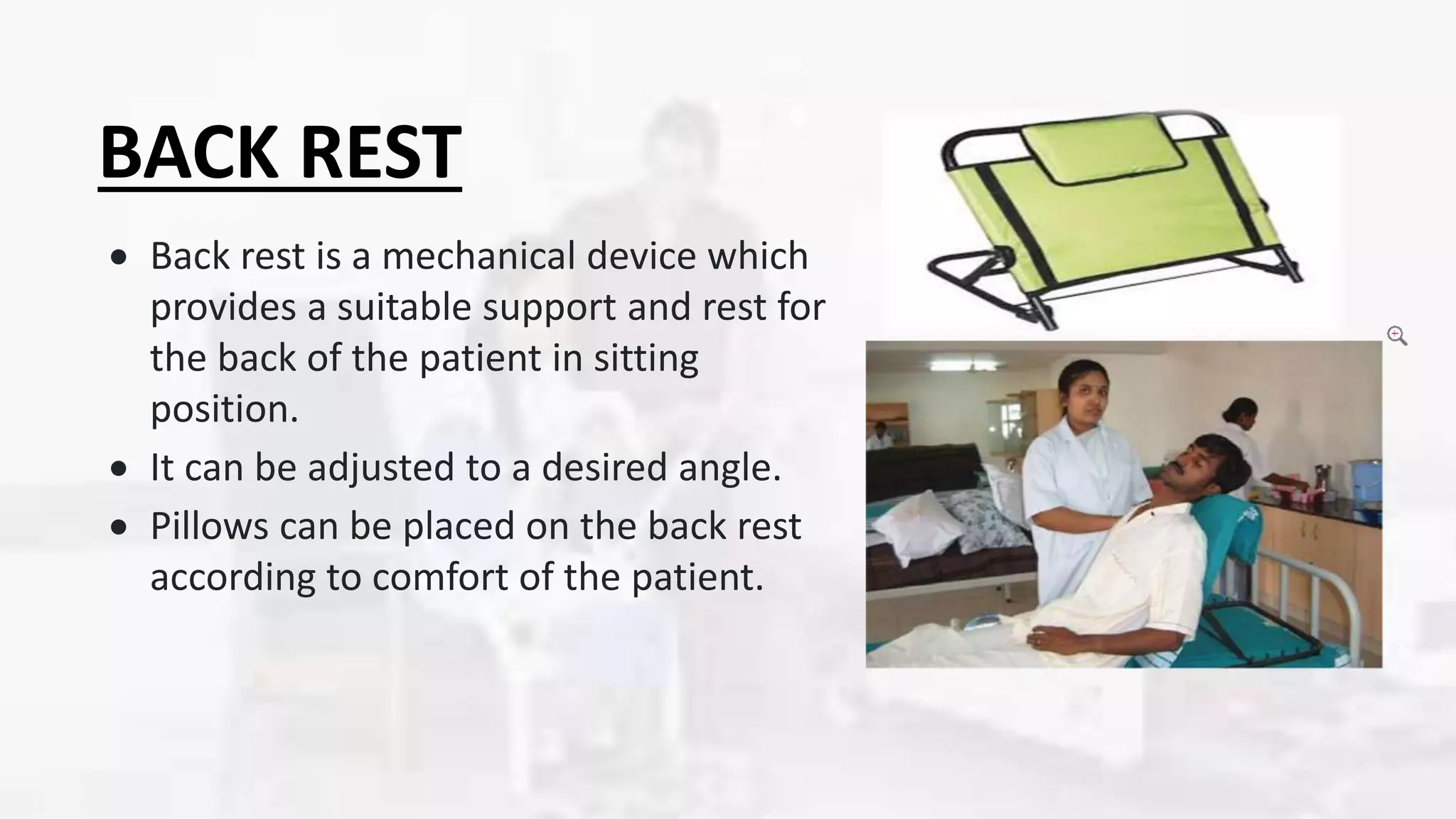
BACK REST
 Back rest is a mechanical device which
provides a suitable support and rest for
the back of the patient in sitting
position.
 It can be adjusted to a desired angle.
 Pillows can be placed on the back rest
according to comfort of the patient.
Uses of back rest
 To support back in sitting position.
 To facilitates easy breathing.
 To aid the postoperative patients.
 It is given especially for patients with
cardiac and pulmonary problems.
 Nowadays modified beds are used.
FOOTBOARD
 It is a flat panel made of wood or plastic.
 It is placed at the foot end of the bed.
 It may be attached to the foot of the bed to
prevent abnormal plantar flexion or a
deformity called footdrop, which may occur
when a client remains in bed for a prolonged
period of time.
 The footboard has a slight angle to it and is
placed to support the client’s feet in a
simulated standing position.
Uses of footboard
 It provides support to the patient’s feet, keeps the top- bed
covers off the patient’s feet and makes the foot comfortable.
 It helps in preventing foot drop.
FOOTBLOCK
 These are made up of wood, or metal.
 Used to raise the foot end or head end of the bed.
Uses of foot block
They are used to-
 Prevent shock
 Arrest hemorrhage
 Retain enema
 After spinal anesthesia
AIR CUSHIONS
 These are made up of rubber and can be
inflated with air.
 Air cushions are round in shape. These are
used to take off the weight of the body.
 Air cushion should not apply directly in
contact with skin. They should have a cover.
Uses of air cushions
 They are used to take weight of the body off the sacral region.
 They prevent bedsores at the buttocks.
COTTON RINGS
 These are made up of cotton.
 These are placed under the bony
prominences such as heels, elbows, etc.
Uses of cotton rings
 They are used to relieve pressure on
certain parts of body like elbows, heels,
occiput, etc. to prevent from pressure
ulcer.
 It improves the circulation.
HOT WATER BOTTLES
• These are rubber bags which can be filled
with hot water
• They should always be used with cover
Uses of hot water bottles
• Provide warmth
• Make the patient and environment
comfortable.
BED CRADLE
 It is a device designed to keep the top bed
clothes off the feet, legs and abdomen of
a patient.
 Bed cradles vary widely in size and in
material. Bed cradles are of wooden,
metal or electronic. The bed cradles
support and take off the weight of the
bedding.
 Bed cradle are semicircular in shape made
of wood or metal or entirely made-up of
metal tubing or slats.
Uses of bed cradle
 It is used in case of burn
 To apply heat for drying plaster
casts
 In observing patients with lower
limb amputation.
AIR/ WATER MATTRESS
 Air and water mattresses are used for very thin or
obese patients and for those who are prone to get
pressure sores.
 The principles are that pressure exerted by the
body, will be distributed equally in all directions.
 Air and water mattresses are plastic mattresses with
two sets of chambers.
 To use them place the mattress on the bed and fill
air or water in the compartment.
 Cover the mattress with light bottom clothes.
Purposes
 To improve circulation.
 To provide comfort.
 To prevent pressure sores.
 Used for very thin or very obese patients.
 Used for chronic bedridden patients.
Caution: Avoid punctures in the mattress with needles, pins or other
sharp objects.
SANDBAGS
 Sand bags are canvas, rubber or plastic
bags filled with sand and are 1, 5 and 10
lbs. in weight.
 These are sand filled bags which are
available in various sizes. Sand bags are
used to immobilize a part.
Purposes
 To relieve discomfort.
 Used to support the body part.
 Used to immobilize the body part.
 Used to support as in fracture bones.
 To prevent foot drop or wrist drop.
 Used in application of pressure in case of bleeding.
 Used to provide support and shape to body contours, and maintains
specific body alignment
PILLOW
• Pillows are used to give
comfortable position to the
patient.
• These are most commonly used
to support various body parts.
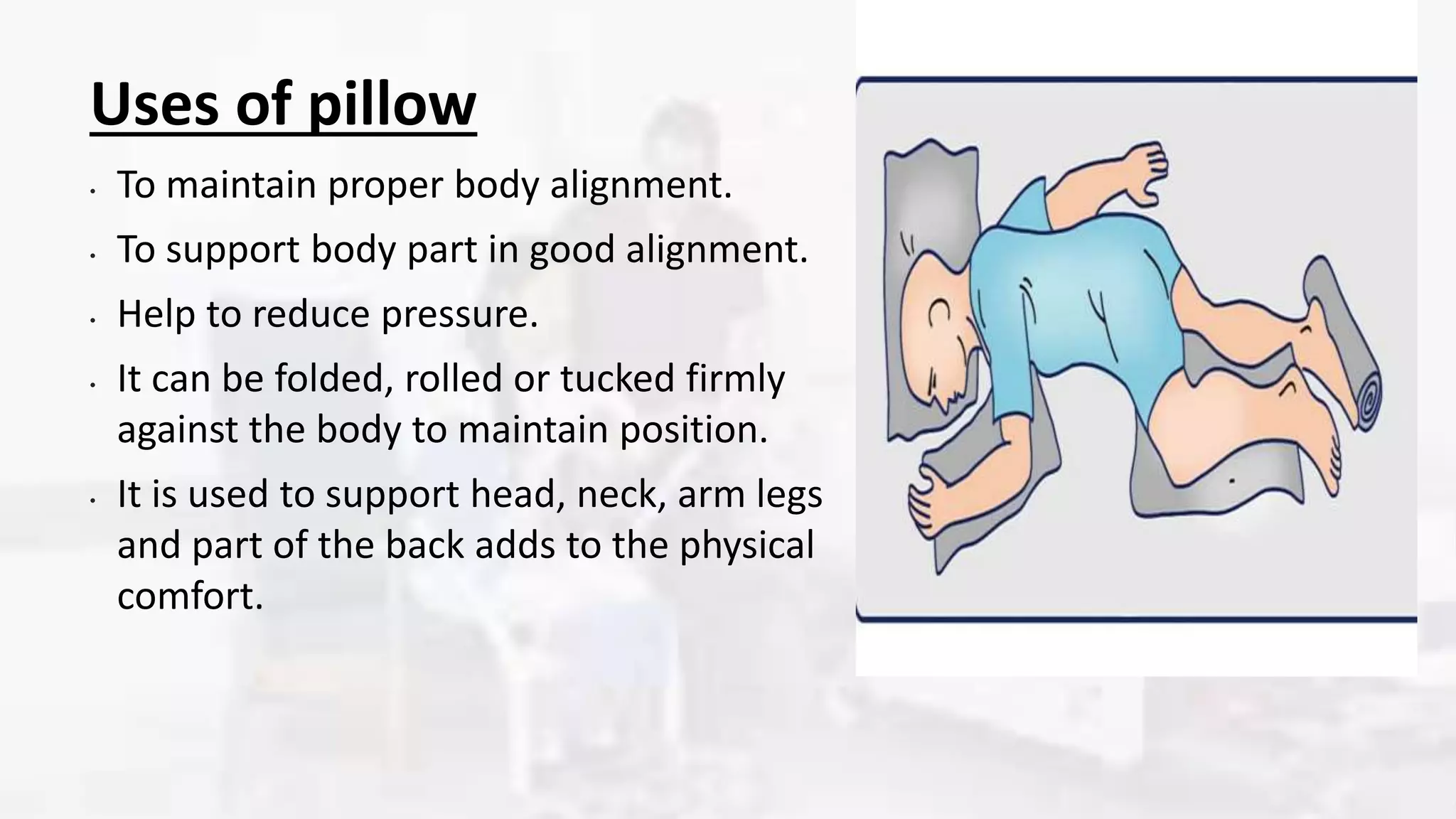
Uses of pillow
• To maintain proper body alignment.
• To support body part in good alignment.
• Help to reduce pressure.
• It can be folded, rolled or tucked firmly
against the body to maintain position.
• It is used to support head, neck, arm legs
and part of the back adds to the physical
comfort.
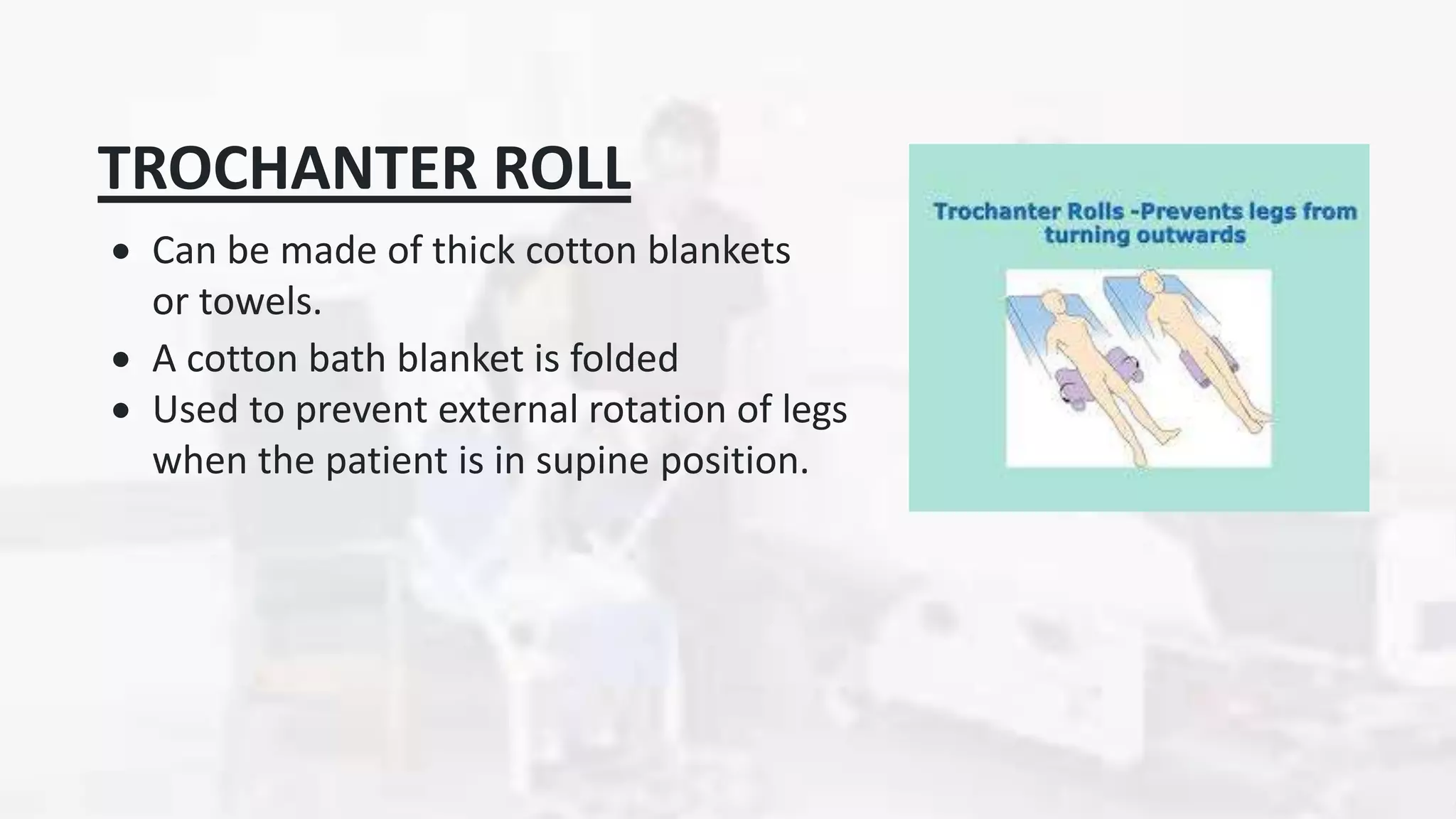
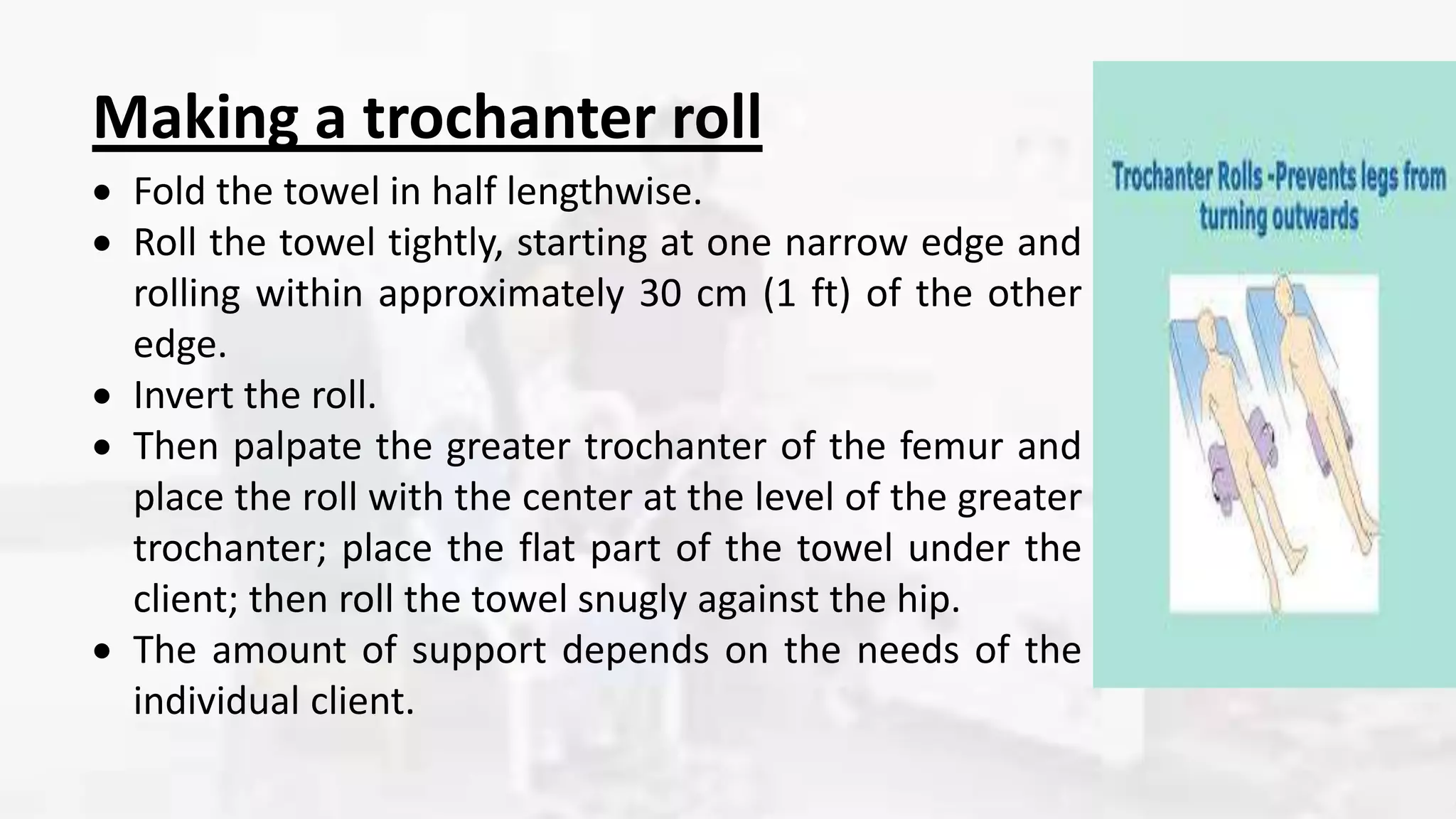
TROCHANTER ROLL
 Can be made of thick cotton blankets
or towels.
 A cotton bath blanket is folded
 Used to prevent external rotation of legs
when the patient is in supine position.
Making a trochanter roll
 Fold the towel in half lengthwise.
 Roll the towel tightly, starting at one narrow edge and
rolling within approximately 30 cm (1 ft) of the other
edge.
 Invert the roll.
 Then palpate the greater trochanter of the femur and
place the roll with the center at the level of the greater
trochanter; place the flat part of the towel under the
client; then roll the towel snugly against the hip.
 The amount of support depends on the needs of the
individual client.
TRAPEZE BAR
 It is a triangular device that is attached to an
overbed frame.
 It is ideal for patients with traction and plaster
cast for assisting with changing positions with
bed.
Uses of trapeze bar
 Used in patients to raise trunk from bed
 Used in patients to move from bed to wheel
chair
 Used to help patient in performing exercises
that strengthen the upper arms.
ANY QUESTIONS ??
REFERENCES
1. Kaur AK. Kaur S. et al. Clinical Nursing Procedures. 1st ed. CBS publishers & Distributors Pvt. Ltd.
p. 53-56
2. Fundamentals of Nursing: A procedure manual. TNAI. New Delhi. p. 148.
3. Jacob A. Tarachand JS. et al. Clinical Nursing Procedures: The Art of Nursing Procedures. 2nd ed.
Jaypee Medical Publishers Pvt. Ltd. 2010; p 103-106.
4. Clement I. Basic concepts on nursing procedures. 1st ed. Jaypee Medical Publishers Pvt. Ltd.
2007; p 47-50.
5. Berman A. Snyder S. Frandsen G. Kozier & Erb’s Fundamentals of Nursing Concepts, Processes
and Practice. 10th ed. 2016; p 1026-1027.
THANKYOU

Comfort devices

  • 1.
    Comfort Devices SUBMITTED TO-Dr. Monika Dutta Lecturer, NINE PGIMER Chandigarh SUBMITTED TO- Nisha Yadav MSc Nursing 1st Year NINE, PGIMER Chandigarh
  • 2.
    Outline • Comfort &Comfort devices- Introduction • Purposes of comfort devices • Common comfort devices • Cardiac table • Footboard • Foot block • Air cushions • Cotton rings • Hot water bottles • Bed cradle • Air/ water mattress • Sandbags • Pillow • Trochanter roll • Trapeze bar
  • 3.
    Learning Objectives At theend of class, students will be able to - • Define Comfort & Comfort devices • Explain purposes of comfort devices • Enlist Common comfort devices • Describe Cardiac table and its uses • Describe Footboard and its uses • Describe Foot block and its uses • Describe Air cushions and its uses • Describe Cotton ring and its uses • Describe Hot water bottle and its uses • Describe Bed cradle and its uses • Describe Air/ water mattress and its uses • Describe Sandbag and its uses • Describe Pillow and its uses • Describe Trochanter roll and its uses • Describe Trapeze bar and its uses
  • 4.
    Comfort  Comfort isa state of free from pain, discomfort, tension and anxiety.  Comfort is defined as the contented enjoyment in physical or mental well-being freedom from pain or trouble.  Discomfort is defined as want of comfort or ease due to pain or annoyance.
  • 5.
    Comfort devices Comfort devicesare articles which would add to the comfort of the patient when used, by relieving discomfort and helping to maintain correct posture.
  • 6.
    Purposes of comfortdevices  To promote comfort.  To prevent discomfort.  To alleviate discomfort.  To ensure that the patient has/her rest.  To assist the patient to obtain an adequate sleep to meet his requirement.  To maintain correct posture.
  • 7.
    Common Comfort Devices •Cardiac table • Back rest • Foot board • Air cushions • Cotton rings • Hot water bottles • Bed cradle • Air/ water mattresses • Sandbags • Pillow • Trochanter roll • Trapeze bar
  • 8.
    CARDIAC TABLE  Itis a device designed as an over bed table.  It is placed in front of the patient while he/ she is in the fowler’s position.  It is so called because normally this is used by the cardiac patients, who can lean forward on a pillow placed over the bed.
  • 9.
    Uses of cardiactable  Patients who are propped up in sitting position for change of position.  Cardiac table placed in front with a pillow on it, helps patient to lean forward and take rest.  Table without a pillow is used for writing and feeding by the patient  Used by patients with cardiac problems & respiratory problems.  Position should be changed to relieve fatigue
  • 10.
    BACK REST  Backrest is a mechanical device which provides a suitable support and rest for the back of the patient in sitting position.  It can be adjusted to a desired angle.  Pillows can be placed on the back rest according to comfort of the patient.
  • 11.
    Uses of backrest  To support back in sitting position.  To facilitates easy breathing.  To aid the postoperative patients.  It is given especially for patients with cardiac and pulmonary problems.  Nowadays modified beds are used.
  • 12.
    FOOTBOARD  It isa flat panel made of wood or plastic.  It is placed at the foot end of the bed.  It may be attached to the foot of the bed to prevent abnormal plantar flexion or a deformity called footdrop, which may occur when a client remains in bed for a prolonged period of time.  The footboard has a slight angle to it and is placed to support the client’s feet in a simulated standing position.
  • 13.
    Uses of footboard It provides support to the patient’s feet, keeps the top- bed covers off the patient’s feet and makes the foot comfortable.  It helps in preventing foot drop.
  • 14.
    FOOTBLOCK  These aremade up of wood, or metal.  Used to raise the foot end or head end of the bed. Uses of foot block They are used to-  Prevent shock  Arrest hemorrhage  Retain enema  After spinal anesthesia
  • 15.
    AIR CUSHIONS  Theseare made up of rubber and can be inflated with air.  Air cushions are round in shape. These are used to take off the weight of the body.  Air cushion should not apply directly in contact with skin. They should have a cover.
  • 16.
    Uses of aircushions  They are used to take weight of the body off the sacral region.  They prevent bedsores at the buttocks.
  • 17.
    COTTON RINGS  Theseare made up of cotton.  These are placed under the bony prominences such as heels, elbows, etc. Uses of cotton rings  They are used to relieve pressure on certain parts of body like elbows, heels, occiput, etc. to prevent from pressure ulcer.  It improves the circulation.
  • 18.
    HOT WATER BOTTLES •These are rubber bags which can be filled with hot water • They should always be used with cover Uses of hot water bottles • Provide warmth • Make the patient and environment comfortable.
  • 19.
    BED CRADLE  Itis a device designed to keep the top bed clothes off the feet, legs and abdomen of a patient.  Bed cradles vary widely in size and in material. Bed cradles are of wooden, metal or electronic. The bed cradles support and take off the weight of the bedding.  Bed cradle are semicircular in shape made of wood or metal or entirely made-up of metal tubing or slats.
  • 20.
    Uses of bedcradle  It is used in case of burn  To apply heat for drying plaster casts  In observing patients with lower limb amputation.
  • 21.
    AIR/ WATER MATTRESS Air and water mattresses are used for very thin or obese patients and for those who are prone to get pressure sores.  The principles are that pressure exerted by the body, will be distributed equally in all directions.  Air and water mattresses are plastic mattresses with two sets of chambers.  To use them place the mattress on the bed and fill air or water in the compartment.  Cover the mattress with light bottom clothes.
  • 22.
    Purposes  To improvecirculation.  To provide comfort.  To prevent pressure sores.  Used for very thin or very obese patients.  Used for chronic bedridden patients. Caution: Avoid punctures in the mattress with needles, pins or other sharp objects.
  • 23.
    SANDBAGS  Sand bagsare canvas, rubber or plastic bags filled with sand and are 1, 5 and 10 lbs. in weight.  These are sand filled bags which are available in various sizes. Sand bags are used to immobilize a part.
  • 24.
    Purposes  To relievediscomfort.  Used to support the body part.  Used to immobilize the body part.  Used to support as in fracture bones.  To prevent foot drop or wrist drop.  Used in application of pressure in case of bleeding.  Used to provide support and shape to body contours, and maintains specific body alignment
  • 25.
    PILLOW • Pillows areused to give comfortable position to the patient. • These are most commonly used to support various body parts.
  • 26.
    Uses of pillow •To maintain proper body alignment. • To support body part in good alignment. • Help to reduce pressure. • It can be folded, rolled or tucked firmly against the body to maintain position. • It is used to support head, neck, arm legs and part of the back adds to the physical comfort.
  • 27.
    TROCHANTER ROLL  Canbe made of thick cotton blankets or towels.  A cotton bath blanket is folded  Used to prevent external rotation of legs when the patient is in supine position.
  • 28.
    Making a trochanterroll  Fold the towel in half lengthwise.  Roll the towel tightly, starting at one narrow edge and rolling within approximately 30 cm (1 ft) of the other edge.  Invert the roll.  Then palpate the greater trochanter of the femur and place the roll with the center at the level of the greater trochanter; place the flat part of the towel under the client; then roll the towel snugly against the hip.  The amount of support depends on the needs of the individual client.
  • 29.
    TRAPEZE BAR  Itis a triangular device that is attached to an overbed frame.  It is ideal for patients with traction and plaster cast for assisting with changing positions with bed.
  • 30.
    Uses of trapezebar  Used in patients to raise trunk from bed  Used in patients to move from bed to wheel chair  Used to help patient in performing exercises that strengthen the upper arms.
  • 31.
  • 32.
    REFERENCES 1. Kaur AK.Kaur S. et al. Clinical Nursing Procedures. 1st ed. CBS publishers & Distributors Pvt. Ltd. p. 53-56 2. Fundamentals of Nursing: A procedure manual. TNAI. New Delhi. p. 148. 3. Jacob A. Tarachand JS. et al. Clinical Nursing Procedures: The Art of Nursing Procedures. 2nd ed. Jaypee Medical Publishers Pvt. Ltd. 2010; p 103-106. 4. Clement I. Basic concepts on nursing procedures. 1st ed. Jaypee Medical Publishers Pvt. Ltd. 2007; p 47-50. 5. Berman A. Snyder S. Frandsen G. Kozier & Erb’s Fundamentals of Nursing Concepts, Processes and Practice. 10th ed. 2016; p 1026-1027.
  • 33.