Combined Footing
Nishwa Patel (08)
Pankti Gajjar (07)
Megha Modi (06)
Nikunj Lunagaria(05)
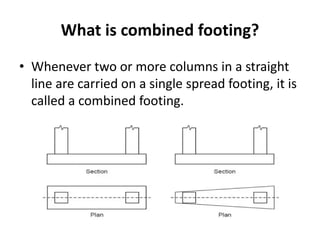
What is combined footing?
• Whenever two or more columns in a straight
line are carried on a single spread footing, it is
called a combined footing.
How many types??
• The combined footing may be
1. Rectangular
2. Trapezoidal
3. Tee-shaped in plan.
• The geometric proportions and shape are so
fixed that the centeroid of the footing area
coincides with the resultant of the column
loads. This results in uniform pressure below
the entire area of footing.
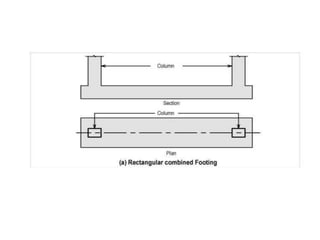
Rectangular combined footing
• Longitudinally, the footing acts as an upward loaded
beam spanning between columns and cantilevering
beyond. Using statics, the shear force and bending
moment diagrams in the longitudinal direction are
drawn. Moment is checked at the faces of the column.
Shear force is critical at distance ‘d’ from the faces of
columns or at the point of contra flexure. Two-way
shear is checked under the heavier column.
• The footing is also subjected to transverse bending and
this bending is spread over a transverse strip near the
column.
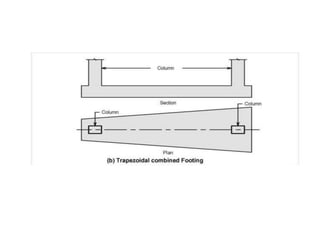
Trapezoidal footing
• Trapezoidal footing is provided when one
column load is much more than the other. As
a result, the both projections of footing
beyond the faces of the columns will be
restricted
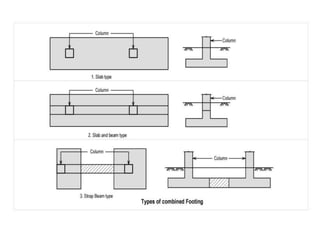
There are three different types of combined footings:
• Slab type combined footing : It supports two or
more column with bottom slab only.
• Slab-beam type combined footing : supports two or
more column with bottom slab and beam.
• Strap-beam type combined footing : It is used
when one column is located on a property line,
resulting in is an eccentric load on a portion of the
footing. Therefore provide a beam in the footing to
the adjacent column footing to restrain
the overturning effect.
Combined footing
Combined footing

Combined footing

  • 1.
    Combined Footing Nishwa Patel(08) Pankti Gajjar (07) Megha Modi (06) Nikunj Lunagaria(05)
  • 2.
    What is combinedfooting? • Whenever two or more columns in a straight line are carried on a single spread footing, it is called a combined footing.
  • 3.
    How many types?? •The combined footing may be 1. Rectangular 2. Trapezoidal 3. Tee-shaped in plan. • The geometric proportions and shape are so fixed that the centeroid of the footing area coincides with the resultant of the column loads. This results in uniform pressure below the entire area of footing.
  • 4.
    Rectangular combined footing •Longitudinally, the footing acts as an upward loaded beam spanning between columns and cantilevering beyond. Using statics, the shear force and bending moment diagrams in the longitudinal direction are drawn. Moment is checked at the faces of the column. Shear force is critical at distance ‘d’ from the faces of columns or at the point of contra flexure. Two-way shear is checked under the heavier column. • The footing is also subjected to transverse bending and this bending is spread over a transverse strip near the column.
  • 6.
    Trapezoidal footing • Trapezoidalfooting is provided when one column load is much more than the other. As a result, the both projections of footing beyond the faces of the columns will be restricted
  • 8.
    There are threedifferent types of combined footings: • Slab type combined footing : It supports two or more column with bottom slab only. • Slab-beam type combined footing : supports two or more column with bottom slab and beam. • Strap-beam type combined footing : It is used when one column is located on a property line, resulting in is an eccentric load on a portion of the footing. Therefore provide a beam in the footing to the adjacent column footing to restrain the overturning effect.