This document discusses different types of columns used in construction. It defines a column as a structural member subjected to compressive axial loads. Columns are classified as long, short, or intermediate based on their length-to-minimum radius of gyration ratio. Long columns have a ratio greater than 50, short columns less than 15-50, and intermediate between 30-100. The document provides examples of column types and discusses effective length, radius of gyration, buckling load, and Euler's formula for calculating crippling load.
What is acolumn?
A structural member subjected to axial
compressive force is called a column.
Normally, columns carry heavy
compressive loads.
Columns are used in concrete and steel
buildings.
Classification
LONG COLUMN:
When length of column is more as
compared to its c/s dimension, it is
called long column.
Long Column
Le/rmin > 50
Where,
Le = effective length of column
rmin = Minimum radius of gyration
7.
Real world example:
Here in picture we can see long columns
on front of building in “The White house”
Washington D.C(USA).
8.
SHORT COLUMN :
When length of column is less as
compared to its c/s dimension, it is called
Short column.
Short Column
Le/rmin <50
Or,
Le/d < 15
Crushing Load : The load at which short
column fails by crushing is called crushing
load.
9.
INTERMEDIATE COLUMN:
Columnis intermediate when
4d < L < 30d
and
30 < Le /r min < 100 or Critical
slenderness ratio.
10.
Before we moveonward….
Crippling Load (Pcr)
Radius of gyration (r)
Moment of inertia (I)
Area (A)
Effective Length (Le)
Slenderness ratio (λ)
Stronger Axis
Weaker Axis
11.
Types of supports
Roller type support (1)
Pin type support (2)
Fixed support (3)
12.
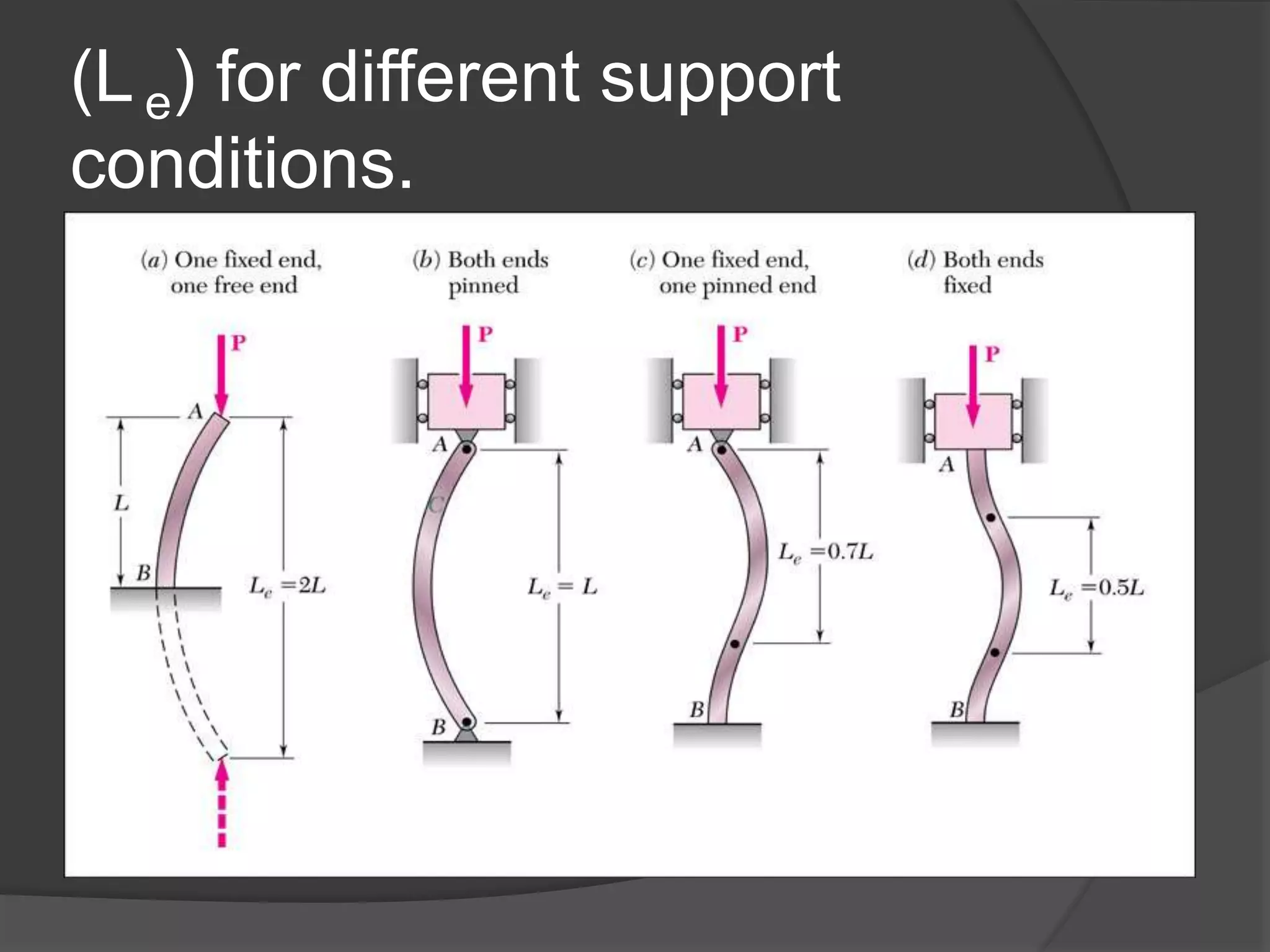
Effective Length (Le)
The distance between points of two zero
moments.
Depends upon the type of support
conditions.
13.
COLUMN END CONDITION
ANDEFFECTIVE LENTH :
1.Both ends hinged.
2.Both ends fixed.
3.One end fixed and other hinged.
4.One end fixed and other free.
Slenderness ratio (λ)
Slenderness ratio is the ratio of the
length of a column and the least radius
of gyration of its cross section. Often
denoted by lambda. It is used
extensively for finding out the design
load as well as in classifying various
columns in short/intermediate/long.
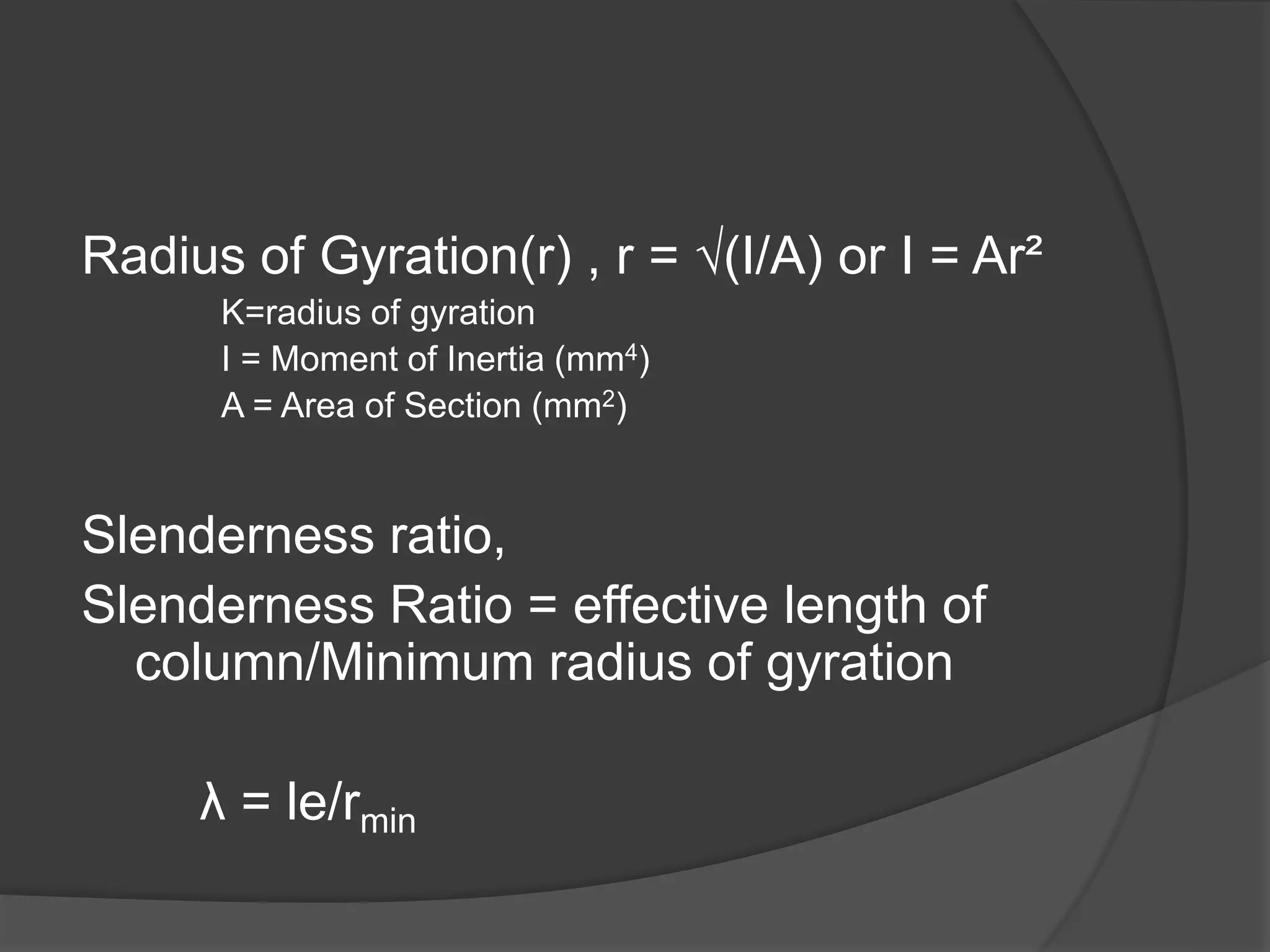
λ = le/rmin
16.
Radius of Gyration(r), r = √(I/A) or I = Ar²
K=radius of gyration
I = Moment of Inertia (mm4)
A = Area of Section (mm2)
Slenderness ratio,
Slenderness Ratio = effective length of
column/Minimum radius of gyration
λ = le/rmin
17.
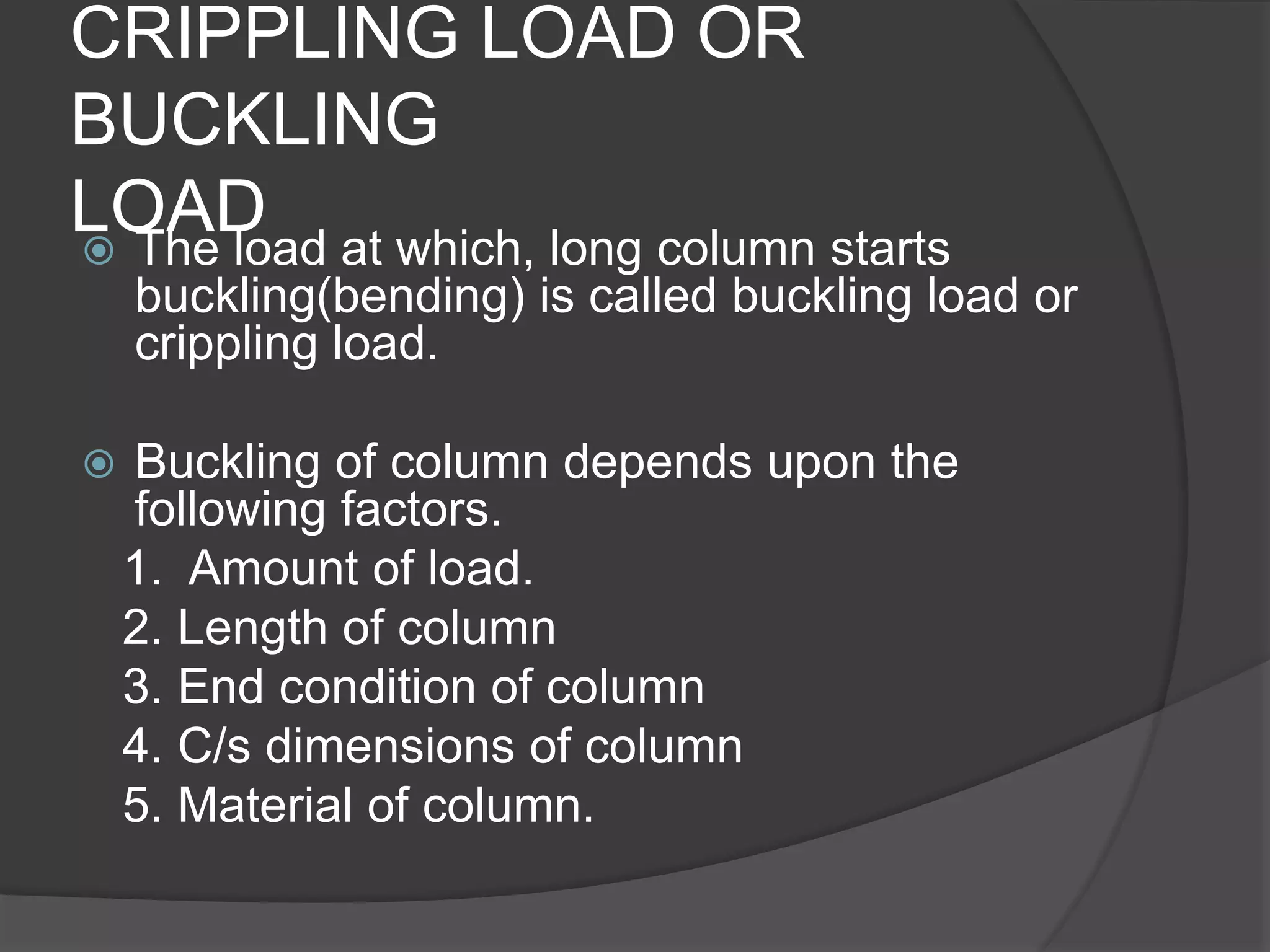
CRIPPLING LOAD OR
BUCKLING
LOADThe load at which, long column starts
buckling(bending) is called buckling load or
crippling load.
Buckling of column depends upon the
following factors.
1. Amount of load.
2. Length of column
3. End condition of column
4. C/s dimensions of column
5. Material of column.
18.
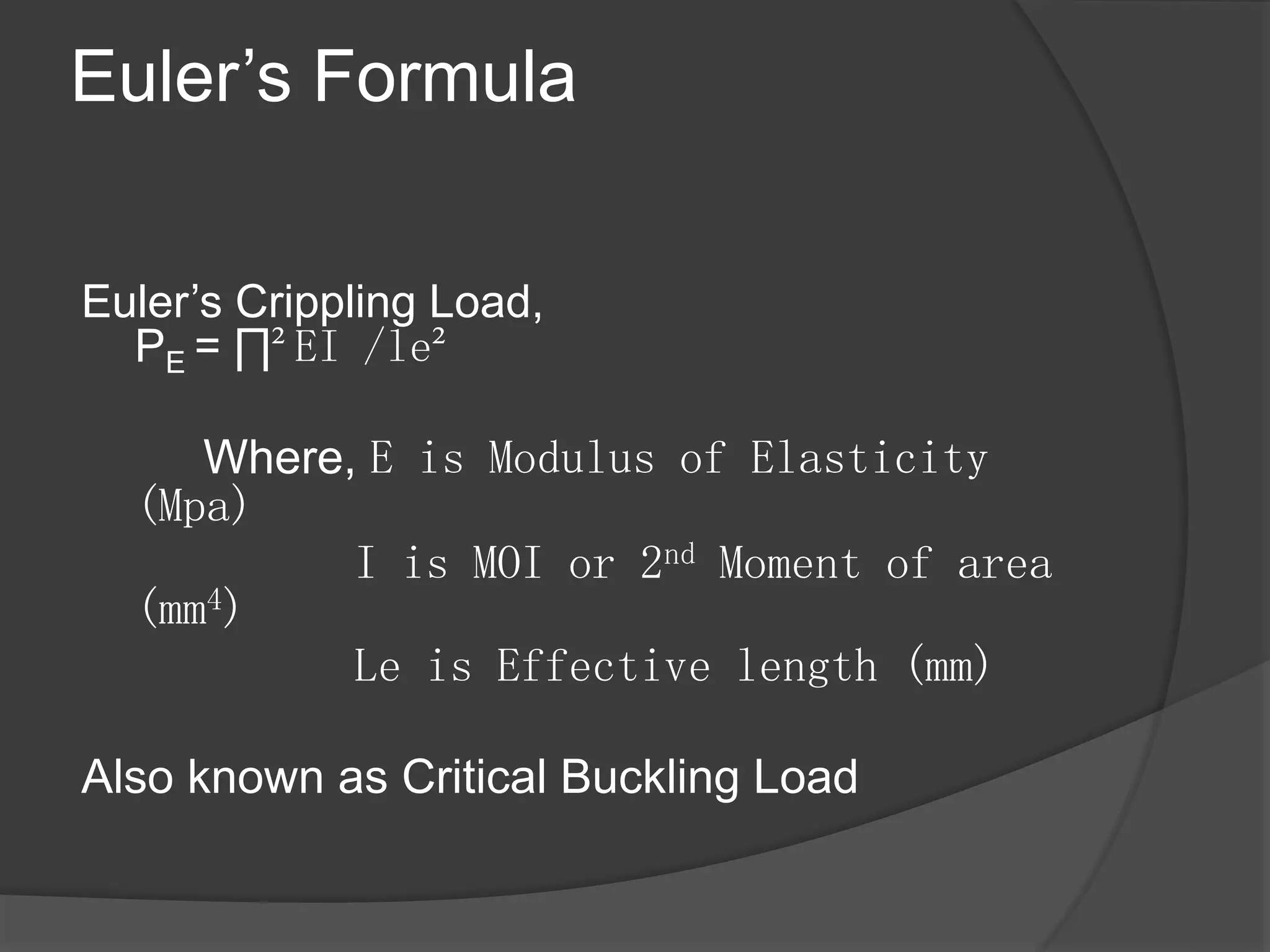
Euler’s Formula
Euler’s CripplingLoad,
PE = ∏²EI /le²
Where, E is Modulus of Elasticity
(Mpa)
I is MOI or 2nd Moment of area
(mm4)
Le is Effective length (mm)
Also known as Critical Buckling Load












![Vibe Coding vs. Spec-Driven Development [Free Meetup]](https://cdn.slidesharecdn.com/ss_thumbnails/vibecodingvsspecdrivendevelopment-251209105622-43f455e7-thumbnail.jpg?width=640&height=640&fit=bounds)


