Seminar
on
Connection
By
Manish Kumar Anshu
Connection:-
• The various members of a steel structure like tension
member, compression member, and flexural member
are connected by connection.
• Connection are of following types-
i) Rivet
ii) Bolts
iii) Pins
iv) Welds
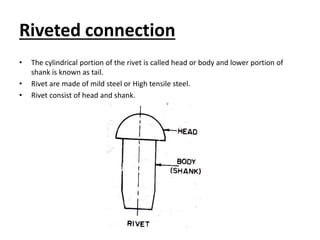
Riveted connection
• The cylindrical portion of the rivet is called head or body and lower portion of
shank is known as tail.
• Rivet are made of mild steel or High tensile steel.
• Rivet consist of head and shank.
i) Ease of riveting processes.
ii) Rivet connection is
permanent in nature.
iii) Cheaper fabrication cost.
iv) Low maintenance cost.
v) Rivet connection is
possible without
electricity in any area.
vi) Dissimilar metal can also
be jointed even non
metallic joint are possible
with rivet joint.
i) Necessity of pre-
heating the rivet
prior to driving.
ii) High level of noise.
iii)Skilled work
necessary for
inspection of
connection.
iv)Labor cost is high.
Advantage of Rivet Disadvantage of Rivet
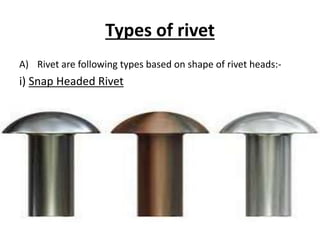
Types of rivet
A) Rivet are following types based on shape of rivet heads:-
i) Snap Headed Rivet
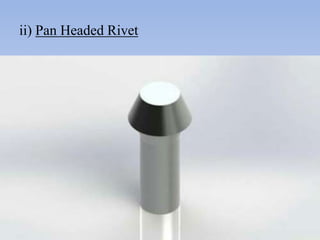
ii) Pan Headed Rivet
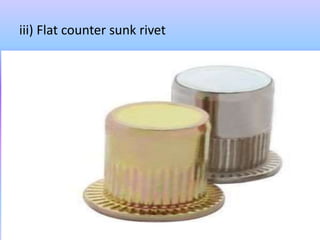
iii) Flat counter sunk rivet
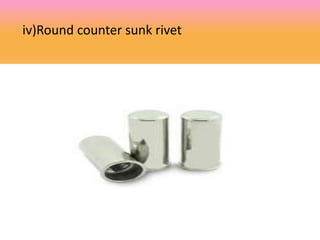
iv)Round counter sunk rivet
B) Rivet are following type based on method and place
of driving of rivets.
i) Power Driven shop rivet
ii) Hand Driven shop rivet
iii) Field rivet
iv) Hot rivet
v) Cold driven rivet
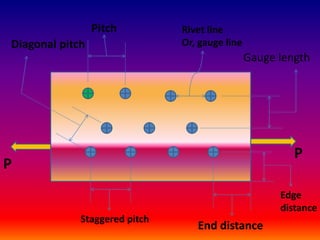
Pitch Rivet line
Or, gauge line
Gauge length
Diagonal pitch
Staggered pitch
End distance
P
P
Edge
distance
Types of Rivet Joints
• Riveted joints are following types:-
i) Lap joint
ii) Butt joint
Lap joint:- In lap joint the members are connected together by
overlapping. The jointing of members are done by using one row
of rivet or more than one row of rivet.
 There are following types of Lap Joint-
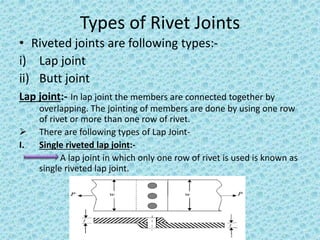
I. Single riveted lap joint:-
A lap joint in which only one row of rivet is used is known as
single riveted lap joint.
II. Double riveted lap joint:-
A lap joint in which two row of rivet are used is
known as double riveted lap joint.
Double riveted lap joint
Rivet
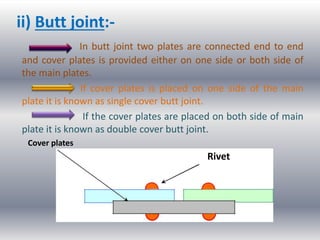
ii) Butt joint:-
In butt joint two plates are connected end to end
and cover plates is provided either on one side or both side of
the main plates.
If cover plates is placed on one side of the main
plate it is known as single cover butt joint.
If the cover plates are placed on both side of main
plate it is known as double cover butt joint.
Cover plates
Rivet
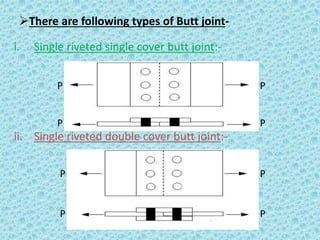
There are following types of Butt joint-
i. Single riveted single cover butt joint:-
ii. Single riveted double cover butt joint:-
P
P
P
P
P
PP
P
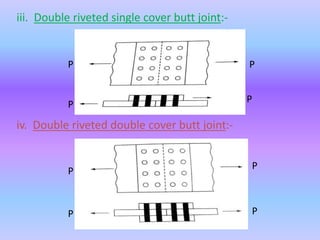
iii. Double riveted single cover butt joint:-
iv. Double riveted double cover butt joint:-
P
P
P
P
P
PP
P
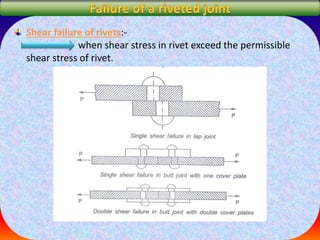
Shear failure of rivets:-
when shear stress in rivet exceed the permissible
shear stress of rivet.
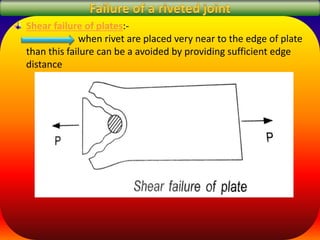
Shear failure of plates:-
when rivet are placed very near to the edge of plate
than this failure can be a avoided by providing sufficient edge
distance
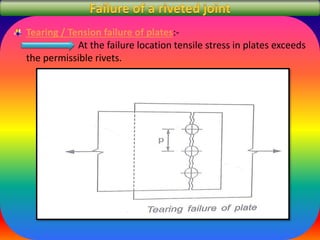
Tearing / Tension failure of plates:-
At the failure location tensile stress in plates exceeds
the permissible rivets.
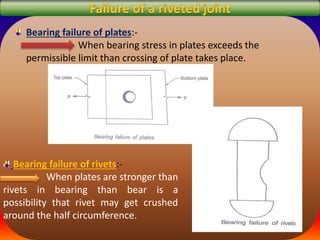
Bearing failure of plates:-
When bearing stress in plates exceeds the
permissible limit than crossing of plate takes place.
Bearing failure of rivets:-
When plates are stronger than
rivets in bearing than bear is a
possibility that rivet may get crushed
around the half circumference.
Rivet connection

Rivet connection

  • 1.
  • 2.
    Connection:- • The variousmembers of a steel structure like tension member, compression member, and flexural member are connected by connection. • Connection are of following types- i) Rivet ii) Bolts iii) Pins iv) Welds
  • 3.
    Riveted connection • Thecylindrical portion of the rivet is called head or body and lower portion of shank is known as tail. • Rivet are made of mild steel or High tensile steel. • Rivet consist of head and shank.
  • 4.
    i) Ease ofriveting processes. ii) Rivet connection is permanent in nature. iii) Cheaper fabrication cost. iv) Low maintenance cost. v) Rivet connection is possible without electricity in any area. vi) Dissimilar metal can also be jointed even non metallic joint are possible with rivet joint. i) Necessity of pre- heating the rivet prior to driving. ii) High level of noise. iii)Skilled work necessary for inspection of connection. iv)Labor cost is high. Advantage of Rivet Disadvantage of Rivet
  • 5.
    Types of rivet A)Rivet are following types based on shape of rivet heads:- i) Snap Headed Rivet
  • 6.
  • 7.
  • 8.
  • 9.
    B) Rivet arefollowing type based on method and place of driving of rivets. i) Power Driven shop rivet ii) Hand Driven shop rivet iii) Field rivet iv) Hot rivet v) Cold driven rivet
  • 10.
    Pitch Rivet line Or,gauge line Gauge length Diagonal pitch Staggered pitch End distance P P Edge distance
  • 11.
    Types of RivetJoints • Riveted joints are following types:- i) Lap joint ii) Butt joint Lap joint:- In lap joint the members are connected together by overlapping. The jointing of members are done by using one row of rivet or more than one row of rivet.  There are following types of Lap Joint- I. Single riveted lap joint:- A lap joint in which only one row of rivet is used is known as single riveted lap joint.
  • 12.
    II. Double rivetedlap joint:- A lap joint in which two row of rivet are used is known as double riveted lap joint. Double riveted lap joint Rivet
  • 13.
    ii) Butt joint:- Inbutt joint two plates are connected end to end and cover plates is provided either on one side or both side of the main plates. If cover plates is placed on one side of the main plate it is known as single cover butt joint. If the cover plates are placed on both side of main plate it is known as double cover butt joint. Cover plates Rivet
  • 14.
    There are followingtypes of Butt joint- i. Single riveted single cover butt joint:- ii. Single riveted double cover butt joint:- P P P P P PP P
  • 15.
    iii. Double rivetedsingle cover butt joint:- iv. Double riveted double cover butt joint:- P P P P P PP P
  • 16.
    Shear failure ofrivets:- when shear stress in rivet exceed the permissible shear stress of rivet.
  • 17.
    Shear failure ofplates:- when rivet are placed very near to the edge of plate than this failure can be a avoided by providing sufficient edge distance
  • 18.
    Tearing / Tensionfailure of plates:- At the failure location tensile stress in plates exceeds the permissible rivets.
  • 19.
    Bearing failure ofplates:- When bearing stress in plates exceeds the permissible limit than crossing of plate takes place. Bearing failure of rivets:- When plates are stronger than rivets in bearing than bear is a possibility that rivet may get crushed around the half circumference.