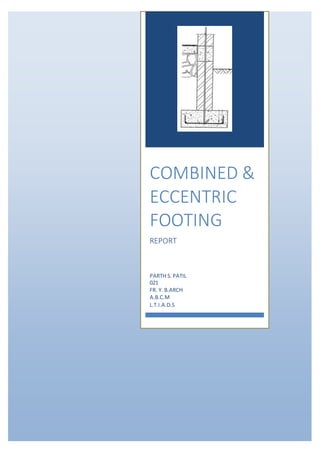
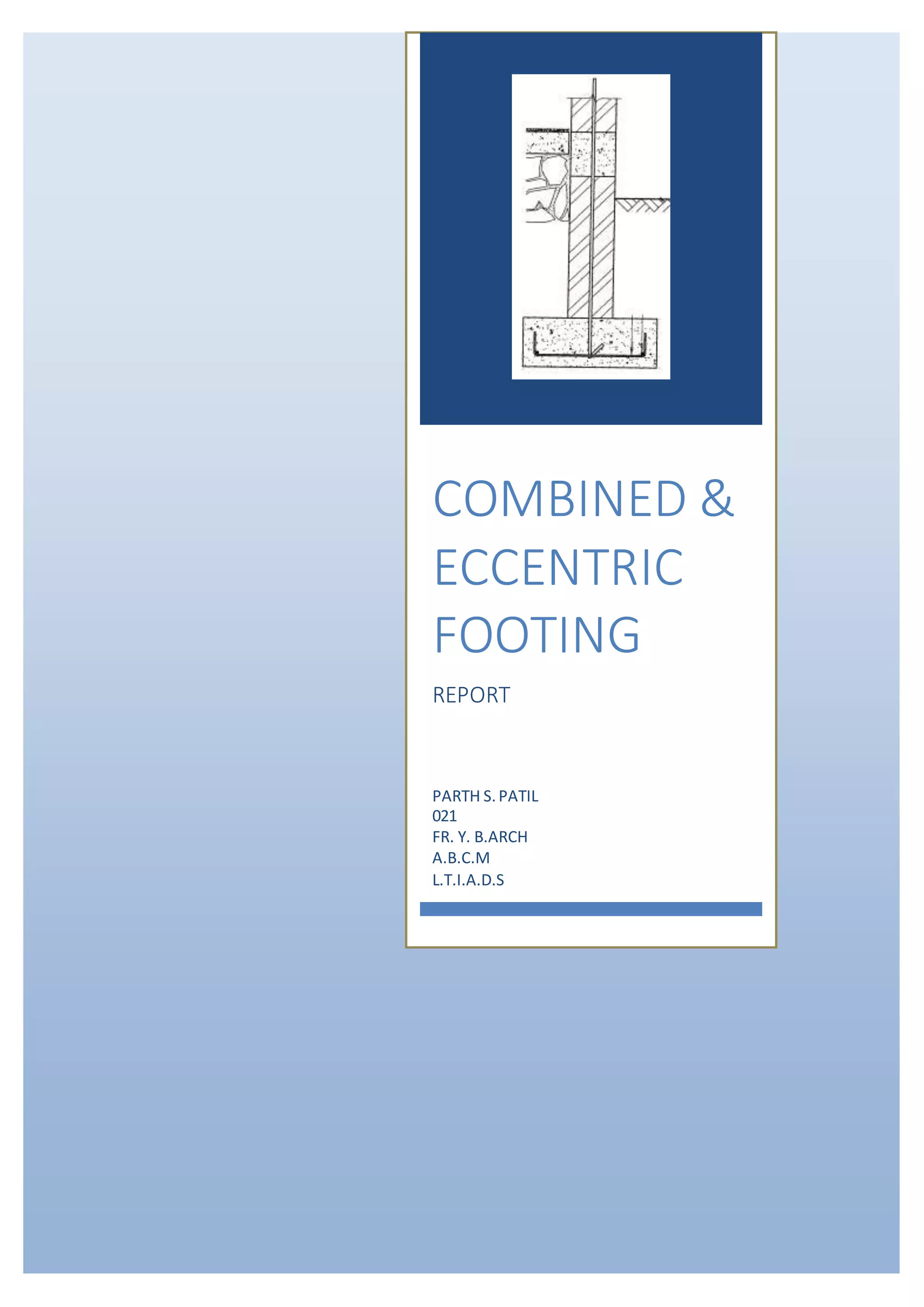
COMBINED &
ECCENTRIC
FOOTING
REPORT
PARTH S.PATIL
021
FR. Y. B.ARCH
A.B.C.M
L.T.I.A.D.S
FOUNDATION
Partof a structuralsystem that supportsand anchorsthe superstructureof a
building and transmitsits loads directly to the earth. Every building consist of
two basic components: the SUPER-STRUCTUREand the SUBSTRUCTUREor
FOUNDATION. TheSuper-structureisusually that part of the building which is
above ground, and which serves the purposeof its intended use. The
Superstructureor Foundation isthe lower portion of the building, usually
located below ground level, which transmitsthe load of the super-structureto
the sub- soil. A FOUNDATIONis thereforethat partof structure which is in
direct contactwith the ground to which the loads transmitted. The soil which is
located below the base of the foundation is called the SUB-SOIL, while the
lowermost portion of the foundation which is in direct contactwith the sub-soil
is called the FOOTING.
The basic function of a foundation isto transmit the dead load, super-imposed
loads (or live loads) and wind loads from a building to the soil on which the
building rests, in such a way that (A) settlements arewithin permissible limits,
without causing cracks in the super-structure, and (B) the soil does not fail.
When loads are transmitted to the sub-soil, it settles. If this settlements is slight
and uniform throughout, no damagewill be caused to the building. But if the
settlement is excessive or unequal, seriousdamagemay result in the form of
cracked walls, distorted doorsand windowopenings, cracked lintels, walls
thrown out of plumb etc., and sometimes the complete collapse of the building.
TYPES OF FOUNDATION
 Deep foundation
o Pile Foundation
o Pier Foundation
o Caisson or Well Foundation.
 Shallow foundation
o Continuous Foundation
o Isolated Foundation
o Combined Foundation
o Eccentric Foundation
Combined Footing
A combined footing is the one which supports two columns. If the footing supports
more than two columns, it is known as a continuous footing. A combined footing is provide
under the following circumstances:
i. When the column are very near to each other so that their footings overlap.
ii. When the bearing capacity of the soil is less, requiring more area under individual
footing.
iii. When the end column is near a property line so that its footing cannot spread in that
direction.
A combined footing may be rectangular or trapezoidal in plan. The aim is to get uniform
pressure distribution under the footing. For this, the centre of gravity (C.G.) of the footing
area should coincide with the C.G. of the combined loads of the two columns. If the outer
column, near the property line, carries heavier load, provision of trapezoidal column
becomes essential to bring the C.G. of the footing in line with the C.G. of the two column
loads. In other case a rectangular footing may be preferred.
 The combined footing may be rectangular, trapezoidal or Tree-shaped in plan.
 The geometric proportion and shape are so fixed that the centroid of the column
loads. This results in uniform pressure below the entire area of footing.
 Trapezoidal footing is provided when one column load is much more than the other.
As a result, the both projections of footing beyond the faces of the column will be
restricted.
 Rectangular footing is provided when one of the projections of the footing is
restricted or the width of the footing is restricted.
It is used when the two columns are so close to each other that their individual footings
would overlap. A combined footing is also provided when the property line is so close to one
column that a spread footing would be eccentrically loaded when kept entirely within the
property line. By combining it with that of an interior column, the load is evenly distributed. A
combine footing may be rectangular or trapezoidal in plan. Trapezoidal footing is provided
when the load on one of the columns is larger than the other column.
Eccentric footing
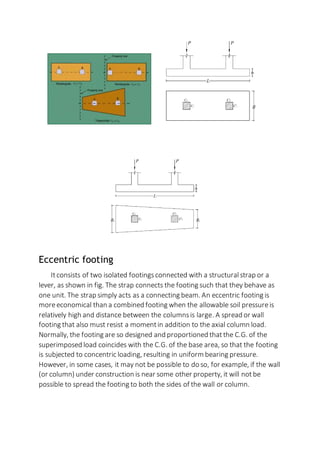
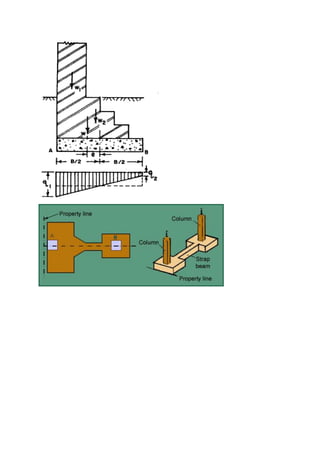
Itconsists of two isolated footingsconnected with a structuralstrap or a
lever, as shown in fig. The strap connects the footing such that they behave as
one unit. The strap simply acts as a connecting beam. An eccentric footing is
moreeconomical than a combined footing when the allowable soil pressureis
relatively high and distance between the columnsis large. A spread or wall
footing that also must resist a momentin addition to the axial column load.
Normally, the footing are so designed and proportioned thatthe C.G. of the
superimposed load coincides with the C.G. of the base area, so that the footing
is subjected to concentric loading, resulting in uniform bearing pressure.
However, in some cases, it may not be possible to do so, for example, if the wall
(or column) under construction is near some other property, it will notbe
possible to spread the footing to both the sides of the wall or column.
Combined & Eccentric Footing

Combined & Eccentric Footing

  • 1.
  • 2.
    FOUNDATION Partof a structuralsystemthat supportsand anchorsthe superstructureof a building and transmitsits loads directly to the earth. Every building consist of two basic components: the SUPER-STRUCTUREand the SUBSTRUCTUREor FOUNDATION. TheSuper-structureisusually that part of the building which is above ground, and which serves the purposeof its intended use. The Superstructureor Foundation isthe lower portion of the building, usually located below ground level, which transmitsthe load of the super-structureto the sub- soil. A FOUNDATIONis thereforethat partof structure which is in direct contactwith the ground to which the loads transmitted. The soil which is located below the base of the foundation is called the SUB-SOIL, while the lowermost portion of the foundation which is in direct contactwith the sub-soil is called the FOOTING. The basic function of a foundation isto transmit the dead load, super-imposed loads (or live loads) and wind loads from a building to the soil on which the building rests, in such a way that (A) settlements arewithin permissible limits, without causing cracks in the super-structure, and (B) the soil does not fail. When loads are transmitted to the sub-soil, it settles. If this settlements is slight and uniform throughout, no damagewill be caused to the building. But if the settlement is excessive or unequal, seriousdamagemay result in the form of cracked walls, distorted doorsand windowopenings, cracked lintels, walls thrown out of plumb etc., and sometimes the complete collapse of the building. TYPES OF FOUNDATION  Deep foundation o Pile Foundation o Pier Foundation o Caisson or Well Foundation.  Shallow foundation o Continuous Foundation o Isolated Foundation o Combined Foundation o Eccentric Foundation
  • 3.
    Combined Footing A combinedfooting is the one which supports two columns. If the footing supports more than two columns, it is known as a continuous footing. A combined footing is provide under the following circumstances: i. When the column are very near to each other so that their footings overlap. ii. When the bearing capacity of the soil is less, requiring more area under individual footing. iii. When the end column is near a property line so that its footing cannot spread in that direction. A combined footing may be rectangular or trapezoidal in plan. The aim is to get uniform pressure distribution under the footing. For this, the centre of gravity (C.G.) of the footing area should coincide with the C.G. of the combined loads of the two columns. If the outer column, near the property line, carries heavier load, provision of trapezoidal column becomes essential to bring the C.G. of the footing in line with the C.G. of the two column loads. In other case a rectangular footing may be preferred.  The combined footing may be rectangular, trapezoidal or Tree-shaped in plan.  The geometric proportion and shape are so fixed that the centroid of the column loads. This results in uniform pressure below the entire area of footing.  Trapezoidal footing is provided when one column load is much more than the other. As a result, the both projections of footing beyond the faces of the column will be restricted.  Rectangular footing is provided when one of the projections of the footing is restricted or the width of the footing is restricted. It is used when the two columns are so close to each other that their individual footings would overlap. A combined footing is also provided when the property line is so close to one column that a spread footing would be eccentrically loaded when kept entirely within the property line. By combining it with that of an interior column, the load is evenly distributed. A combine footing may be rectangular or trapezoidal in plan. Trapezoidal footing is provided when the load on one of the columns is larger than the other column.
  • 4.
    Eccentric footing Itconsists oftwo isolated footingsconnected with a structuralstrap or a lever, as shown in fig. The strap connects the footing such that they behave as one unit. The strap simply acts as a connecting beam. An eccentric footing is moreeconomical than a combined footing when the allowable soil pressureis relatively high and distance between the columnsis large. A spread or wall footing that also must resist a momentin addition to the axial column load. Normally, the footing are so designed and proportioned thatthe C.G. of the superimposed load coincides with the C.G. of the base area, so that the footing is subjected to concentric loading, resulting in uniform bearing pressure. However, in some cases, it may not be possible to do so, for example, if the wall (or column) under construction is near some other property, it will notbe possible to spread the footing to both the sides of the wall or column.