Cinematography
 There are many ways to compose a shot and, subsequently, to
   convey meaning. Be it through film or video, the subject’s
     spatial relationship to the camera is very important in
establishing, maintaining, or altering the sense of character and
                      context for the viewer.
Distance
   Shot
    ◦ Point of view
    ◦ Framing
      Aspect ratio
      Mask
      Camera distance
    ◦ Depth of field
    ◦ Color
    ◦ Movement


Key terms
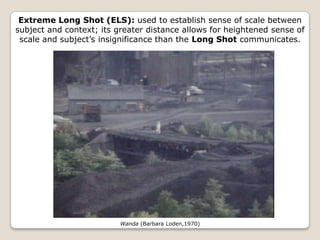
Extreme Long Shot (ELS): used to establish sense of scale between
subject and context; its greater distance allows for heightened sense of
 scale and subject’s insignificance than the Long Shot communicates.


                          Wanda (Barbara Loden,1970)
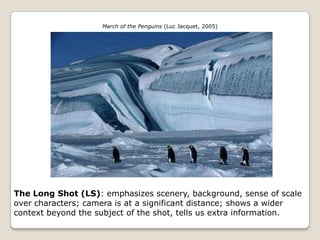
March of the Penguins (Luc Jacquet, 2005)


The Long Shot (LS): emphasizes scenery, background, sense of scale
over characters; camera is at a significant distance; shows a wider
context beyond the subject of the shot, tells us extra information.
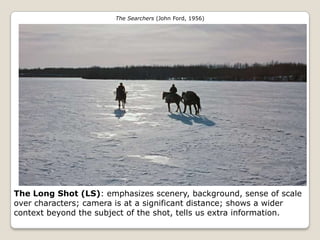
The Searchers (John Ford, 1956)


The Long Shot (LS): emphasizes scenery, background, sense of scale
over characters; camera is at a significant distance; shows a wider
context beyond the subject of the shot, tells us extra information.
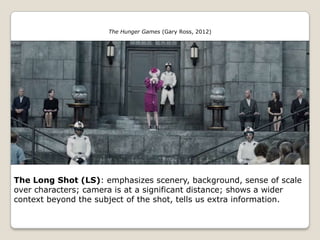
The Hunger Games (Gary Ross, 2012)


The Long Shot (LS): emphasizes scenery, background, sense of scale
over characters; camera is at a significant distance; shows a wider
context beyond the subject of the shot, tells us extra information.
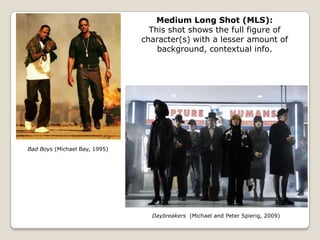
Medium Long Shot (MLS):
                                 This shot shows the full figure of
                               character(s) with a lesser amount of
                                   background, contextual info.


Bad Boys (Michael Bay, 1995)


                                 Daybreakers (Michael and Peter Spierig, 2009)
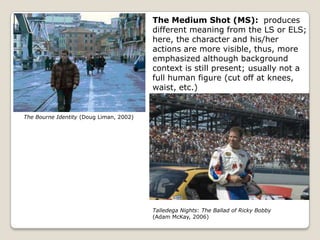
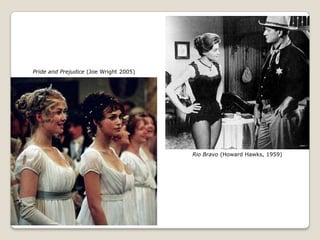
The Medium Shot (MS): produces
                                         different meaning from the LS or ELS;
                                         here, the character and his/her
                                         actions are more visible, thus, more
                                         emphasized although background
                                         context is still present; usually not a
                                         full human figure (cut off at knees,
                                         waist, etc.)


The Bourne Identity (Doug Liman, 2002)


                                         Talledega Nights: The Ballad of Ricky Bobby
                                         (Adam McKay, 2006)
Pride and Prejudice (Joe Wright 2005)


                                        Rio Bravo (Howard Hawks, 1959)
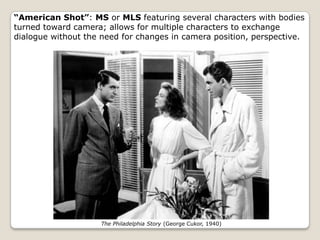
“American Shot”: MS or MLS featuring several characters with bodies
turned toward camera; allows for multiple characters to exchange
dialogue without the need for changes in camera position, perspective.


                     The Philadelphia Story (George Cukor, 1940)
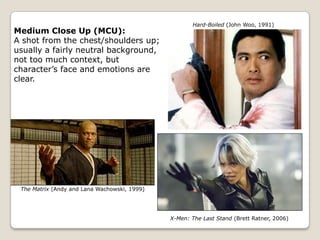
Hard-Boiled (John Woo, 1991)
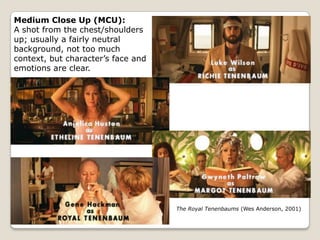
Medium Close Up (MCU):
A shot from the chest/shoulders up;
usually a fairly neutral background,
not too much context, but
character’s face and emotions are
clear.


 The Matrix (Andy and Lana Wachowski, 1999)


                                              X-Men: The Last Stand (Brett Ratner, 2006)
Medium Close Up (MCU):
A shot from the chest/shoulders
up; usually a fairly neutral
background, not too much
context, but character’s face and
emotions are clear.


                                    The Royal Tenenbaums (Wes Anderson, 2001)
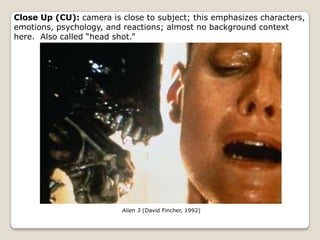
Close Up (CU): camera is close to subject; this emphasizes characters,
emotions, psychology, and reactions; almost no background context
here. Also called “head shot.”


                          Alien 3 (David Fincher, 1992)
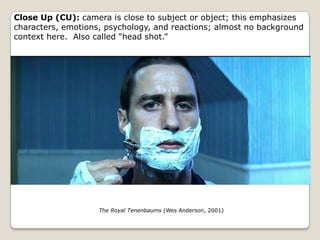
Close Up (CU): camera is close to subject or object; this emphasizes
characters, emotions, psychology, and reactions; almost no background
context here. Also called “head shot.”


                    The Royal Tenenbaums (Wes Anderson, 2001)
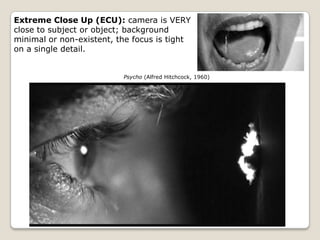
Extreme Close Up (ECU): camera is VERY
close to subject or object; background
minimal or non-existent, the focus is tight
on a single detail.


                          Psycho (Alfred Hitchcock, 1960)
Height/Angle
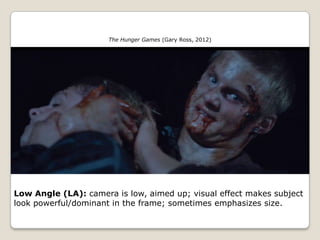
The Hunger Games (Gary Ross, 2012)


Low Angle (LA): camera is low, aimed up; visual effect makes subject
look powerful/dominant in the frame; sometimes emphasizes size.
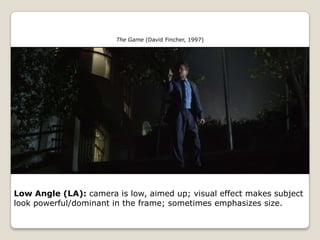
The Game (David Fincher, 1997)


Low Angle (LA): camera is low, aimed up; visual effect makes subject
look powerful/dominant in the frame; sometimes emphasizes size.
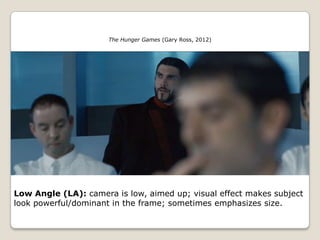
The Hunger Games (Gary Ross, 2012)


Low Angle (LA): camera is low, aimed up; visual effect makes subject
look powerful/dominant in the frame; sometimes emphasizes size.
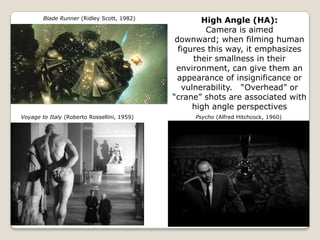
Blade Runner (Ridley Scott, 1982)            High Angle (HA):
                                                      Camera is aimed
                                              downward; when filming human
                                               figures this way, it emphasizes
                                                   their smallness in their
                                              environment, can give them an
                                               appearance of insignificance or
                                                vulnerability. “Overhead” or
                                             “crane” shots are associated with
                                                   high angle perspectives
Voyage to Italy (Roberto Rossellini, 1959)        Psycho (Alfred Hitchcock, 1960)
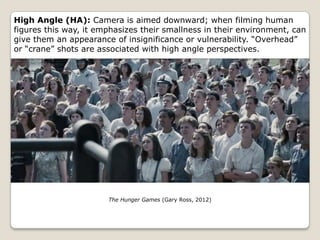
High Angle (HA): Camera is aimed downward; when filming human
figures this way, it emphasizes their smallness in their environment, can
give them an appearance of insignificance or vulnerability. “Overhead”
or “crane” shots are associated with high angle perspectives.


                       The Hunger Games (Gary Ross, 2012)
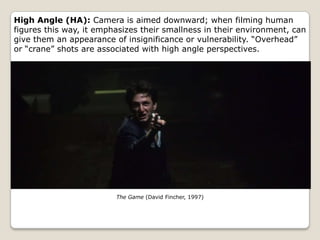
High Angle (HA): Camera is aimed downward; when filming human
figures this way, it emphasizes their smallness in their environment, can
give them an appearance of insignificance or vulnerability. “Overhead”
or “crane” shots are associated with high angle perspectives.


                         The Game (David Fincher, 1997)
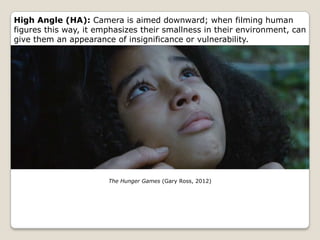
High Angle (HA): Camera is aimed downward; when filming human
figures this way, it emphasizes their smallness in their environment, can
give them an appearance of insignificance or vulnerability.


                       The Hunger Games (Gary Ross, 2012)
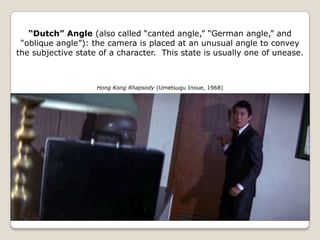
“Dutch” Angle (also called “canted angle,” “German angle,” and
 “oblique angle”): the camera is placed at an unusual angle to convey
the subjective state of a character. This state is usually one of unease.


                    Hong Kong Rhapsody (Umetsugu Inoue, 1968)
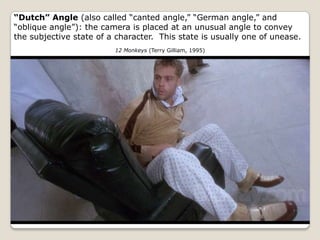
“Dutch” Angle (also called “canted angle,” “German angle,” and
“oblique angle”): the camera is placed at an unusual angle to convey
the subjective state of a character. This state is usually one of unease.
                         12 Monkeys (Terry Gilliam, 1995)
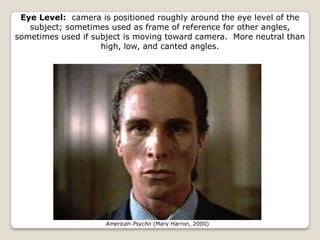
Eye Level: camera is positioned roughly around the eye level of the
   subject; sometimes used as frame of reference for other angles,
sometimes used if subject is moving toward camera. More neutral than
                    high, low, and canted angles.


                     American Psycho (Mary Harron, 2000)
Depth of field/Focus
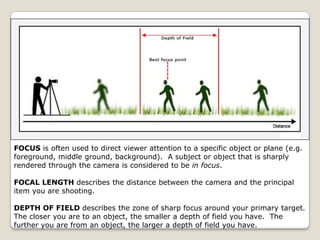
FOCUS is often used to direct viewer attention to a specific object or plane (e.g.
foreground, middle ground, background). A subject or object that is sharply
rendered through the camera is considered to be in focus.
FOCAL LENGTH describes the distance between the camera and the principal
item you are shooting.

DEPTH OF FIELD describes the zone of sharp focus around your primary target.
The closer you are to an object, the smaller a depth of field you have. The
further you are from an object, the larger a depth of field you have.
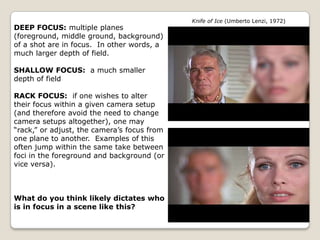
Knife of Ice (Umberto Lenzi, 1972)
DEEP FOCUS: multiple planes
(foreground, middle ground, background)
of a shot are in focus. In other words, a
much larger depth of field.

SHALLOW FOCUS: a much smaller
depth of field

RACK FOCUS: if one wishes to alter
their focus within a given camera setup
(and therefore avoid the need to change
camera setups altogether), one may
“rack,” or adjust, the camera’s focus from
one plane to another. Examples of this
often jump within the same take between
foci in the foreground and background (or
vice versa).


What do you think likely dictates who
is in focus in a scene like this?
Movement
ESTABLISHING SHOT: shot that sets a scene or establishes
location; they are often stationary shots, and are usually (but not
always) LS or ELS. They can, but do not have to, include characters.
They can be mobile.

TRACKING SHOT (“DOLLY,” “FOLLOW,” and “TRUCKING”
SHOTs): camera moves freely on a mobile base through the scene,
often following (but sometimes leading) the subject. The proximity
between camera and subject can change during the shot.

PAN SHOT (“PAN”): camera moves horizontally on a fixed base.

TILT SHOT (“TILT”): camera moves vertically on a fixed base.

BOOM SHOT (“CRANE SHOT”): camera moves through the scene
on a crane; camera is off the ground and can move in a non-linear
way that a person holding it could not do.

When the camera moves from one position to another within the
same shot, the frame has been changed and REFRAMING has
occurred. These can be very small or very dramatic changes.

Com 248 Cinematography Powerpoint

  • 1.
    Cinematography There aremany ways to compose a shot and, subsequently, to convey meaning. Be it through film or video, the subject’s spatial relationship to the camera is very important in establishing, maintaining, or altering the sense of character and context for the viewer.
  • 2.
  • 3.
    Shot ◦ Point of view ◦ Framing  Aspect ratio  Mask  Camera distance ◦ Depth of field ◦ Color ◦ Movement Key terms
  • 4.
    Extreme Long Shot(ELS): used to establish sense of scale between subject and context; its greater distance allows for heightened sense of scale and subject’s insignificance than the Long Shot communicates. Wanda (Barbara Loden,1970)
  • 5.
    March of thePenguins (Luc Jacquet, 2005) The Long Shot (LS): emphasizes scenery, background, sense of scale over characters; camera is at a significant distance; shows a wider context beyond the subject of the shot, tells us extra information.
  • 6.
    The Searchers (JohnFord, 1956) The Long Shot (LS): emphasizes scenery, background, sense of scale over characters; camera is at a significant distance; shows a wider context beyond the subject of the shot, tells us extra information.
  • 7.
    The Hunger Games(Gary Ross, 2012) The Long Shot (LS): emphasizes scenery, background, sense of scale over characters; camera is at a significant distance; shows a wider context beyond the subject of the shot, tells us extra information.
  • 8.
    Medium Long Shot(MLS): This shot shows the full figure of character(s) with a lesser amount of background, contextual info. Bad Boys (Michael Bay, 1995) Daybreakers (Michael and Peter Spierig, 2009)
  • 9.
    The Medium Shot(MS): produces different meaning from the LS or ELS; here, the character and his/her actions are more visible, thus, more emphasized although background context is still present; usually not a full human figure (cut off at knees, waist, etc.) The Bourne Identity (Doug Liman, 2002) Talledega Nights: The Ballad of Ricky Bobby (Adam McKay, 2006)
  • 10.
    Pride and Prejudice(Joe Wright 2005) Rio Bravo (Howard Hawks, 1959)
  • 11.
    “American Shot”: MSor MLS featuring several characters with bodies turned toward camera; allows for multiple characters to exchange dialogue without the need for changes in camera position, perspective. The Philadelphia Story (George Cukor, 1940)
  • 12.
    Hard-Boiled (John Woo,1991) Medium Close Up (MCU): A shot from the chest/shoulders up; usually a fairly neutral background, not too much context, but character’s face and emotions are clear. The Matrix (Andy and Lana Wachowski, 1999) X-Men: The Last Stand (Brett Ratner, 2006)
  • 13.
    Medium Close Up(MCU): A shot from the chest/shoulders up; usually a fairly neutral background, not too much context, but character’s face and emotions are clear. The Royal Tenenbaums (Wes Anderson, 2001)
  • 14.
    Close Up (CU):camera is close to subject; this emphasizes characters, emotions, psychology, and reactions; almost no background context here. Also called “head shot.” Alien 3 (David Fincher, 1992)
  • 15.
    Close Up (CU):camera is close to subject or object; this emphasizes characters, emotions, psychology, and reactions; almost no background context here. Also called “head shot.” The Royal Tenenbaums (Wes Anderson, 2001)
  • 16.
    Extreme Close Up(ECU): camera is VERY close to subject or object; background minimal or non-existent, the focus is tight on a single detail. Psycho (Alfred Hitchcock, 1960)
  • 17.
  • 18.
    The Hunger Games(Gary Ross, 2012) Low Angle (LA): camera is low, aimed up; visual effect makes subject look powerful/dominant in the frame; sometimes emphasizes size.
  • 19.
    The Game (DavidFincher, 1997) Low Angle (LA): camera is low, aimed up; visual effect makes subject look powerful/dominant in the frame; sometimes emphasizes size.
  • 20.
    The Hunger Games(Gary Ross, 2012) Low Angle (LA): camera is low, aimed up; visual effect makes subject look powerful/dominant in the frame; sometimes emphasizes size.
  • 21.
    Blade Runner (RidleyScott, 1982) High Angle (HA): Camera is aimed downward; when filming human figures this way, it emphasizes their smallness in their environment, can give them an appearance of insignificance or vulnerability. “Overhead” or “crane” shots are associated with high angle perspectives Voyage to Italy (Roberto Rossellini, 1959) Psycho (Alfred Hitchcock, 1960)
  • 22.
    High Angle (HA):Camera is aimed downward; when filming human figures this way, it emphasizes their smallness in their environment, can give them an appearance of insignificance or vulnerability. “Overhead” or “crane” shots are associated with high angle perspectives. The Hunger Games (Gary Ross, 2012)
  • 23.
    High Angle (HA):Camera is aimed downward; when filming human figures this way, it emphasizes their smallness in their environment, can give them an appearance of insignificance or vulnerability. “Overhead” or “crane” shots are associated with high angle perspectives. The Game (David Fincher, 1997)
  • 24.
    High Angle (HA):Camera is aimed downward; when filming human figures this way, it emphasizes their smallness in their environment, can give them an appearance of insignificance or vulnerability. The Hunger Games (Gary Ross, 2012)
  • 25.
    “Dutch” Angle (alsocalled “canted angle,” “German angle,” and “oblique angle”): the camera is placed at an unusual angle to convey the subjective state of a character. This state is usually one of unease. Hong Kong Rhapsody (Umetsugu Inoue, 1968)
  • 26.
    “Dutch” Angle (alsocalled “canted angle,” “German angle,” and “oblique angle”): the camera is placed at an unusual angle to convey the subjective state of a character. This state is usually one of unease. 12 Monkeys (Terry Gilliam, 1995)
  • 27.
    Eye Level: camerais positioned roughly around the eye level of the subject; sometimes used as frame of reference for other angles, sometimes used if subject is moving toward camera. More neutral than high, low, and canted angles. American Psycho (Mary Harron, 2000)
  • 28.
  • 29.
    FOCUS is oftenused to direct viewer attention to a specific object or plane (e.g. foreground, middle ground, background). A subject or object that is sharply rendered through the camera is considered to be in focus. FOCAL LENGTH describes the distance between the camera and the principal item you are shooting. DEPTH OF FIELD describes the zone of sharp focus around your primary target. The closer you are to an object, the smaller a depth of field you have. The further you are from an object, the larger a depth of field you have.
  • 30.
    Knife of Ice(Umberto Lenzi, 1972) DEEP FOCUS: multiple planes (foreground, middle ground, background) of a shot are in focus. In other words, a much larger depth of field. SHALLOW FOCUS: a much smaller depth of field RACK FOCUS: if one wishes to alter their focus within a given camera setup (and therefore avoid the need to change camera setups altogether), one may “rack,” or adjust, the camera’s focus from one plane to another. Examples of this often jump within the same take between foci in the foreground and background (or vice versa). What do you think likely dictates who is in focus in a scene like this?
  • 31.
  • 32.
    ESTABLISHING SHOT: shotthat sets a scene or establishes location; they are often stationary shots, and are usually (but not always) LS or ELS. They can, but do not have to, include characters. They can be mobile. TRACKING SHOT (“DOLLY,” “FOLLOW,” and “TRUCKING” SHOTs): camera moves freely on a mobile base through the scene, often following (but sometimes leading) the subject. The proximity between camera and subject can change during the shot. PAN SHOT (“PAN”): camera moves horizontally on a fixed base. TILT SHOT (“TILT”): camera moves vertically on a fixed base. BOOM SHOT (“CRANE SHOT”): camera moves through the scene on a crane; camera is off the ground and can move in a non-linear way that a person holding it could not do. When the camera moves from one position to another within the same shot, the frame has been changed and REFRAMING has occurred. These can be very small or very dramatic changes.