Initial Videography Research (AC1: Informing Ideas)
Camera Shots (Shot size):
Establishing Shot:
This is typically a wide shot, used to show the viewer perhaps where the character
is, the time of day or the size of a character in comparison to their surroundings. It is
also used as a transition between scenes and is used often in science fiction movies
such as Star Wars, blade runner and others like this. It’s a crucial introductory
component of any scene as it can introduce crucial details and location.
Master Shot:
This usually follows an establishing shot and it can be used to confirm the location of
the scene and which characters are in the scene (and where they are in relation to
each other.)
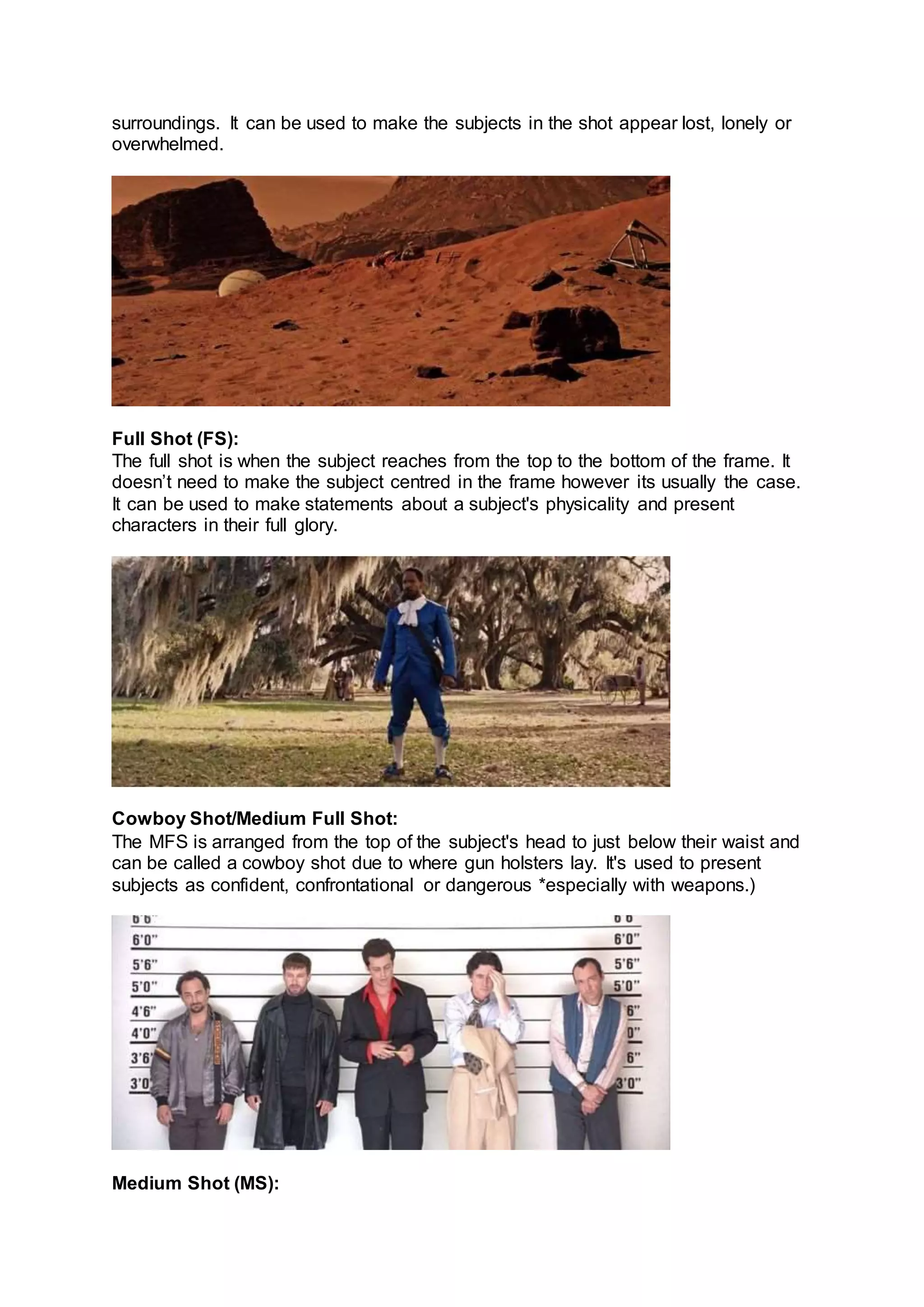
Wide Shot (WS):
The wide shot positions the subject/s far from the camera to represent their
relationship to their environment and the scale of them in comparison to their
surroundings. It can be used to make the subjects in the shot appear lost, lonely or
overwhelmed.
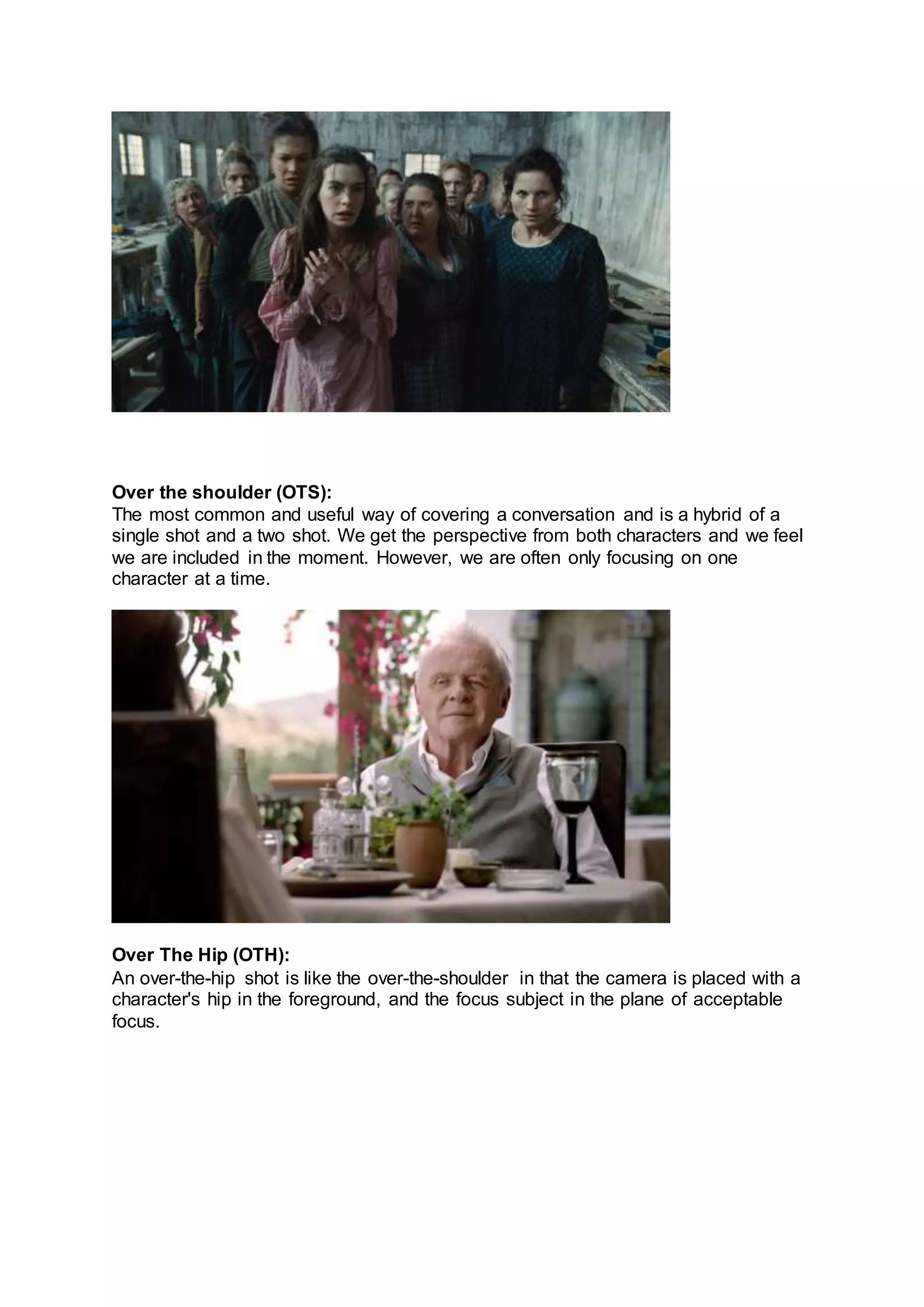
Full Shot (FS):
The full shot is when the subject reaches from the top to the bottom of the frame. It
doesn’t need to make the subject centred in the frame however its usually the case.
It can be used to make statements about a subject's physicality and present
characters in their full glory.
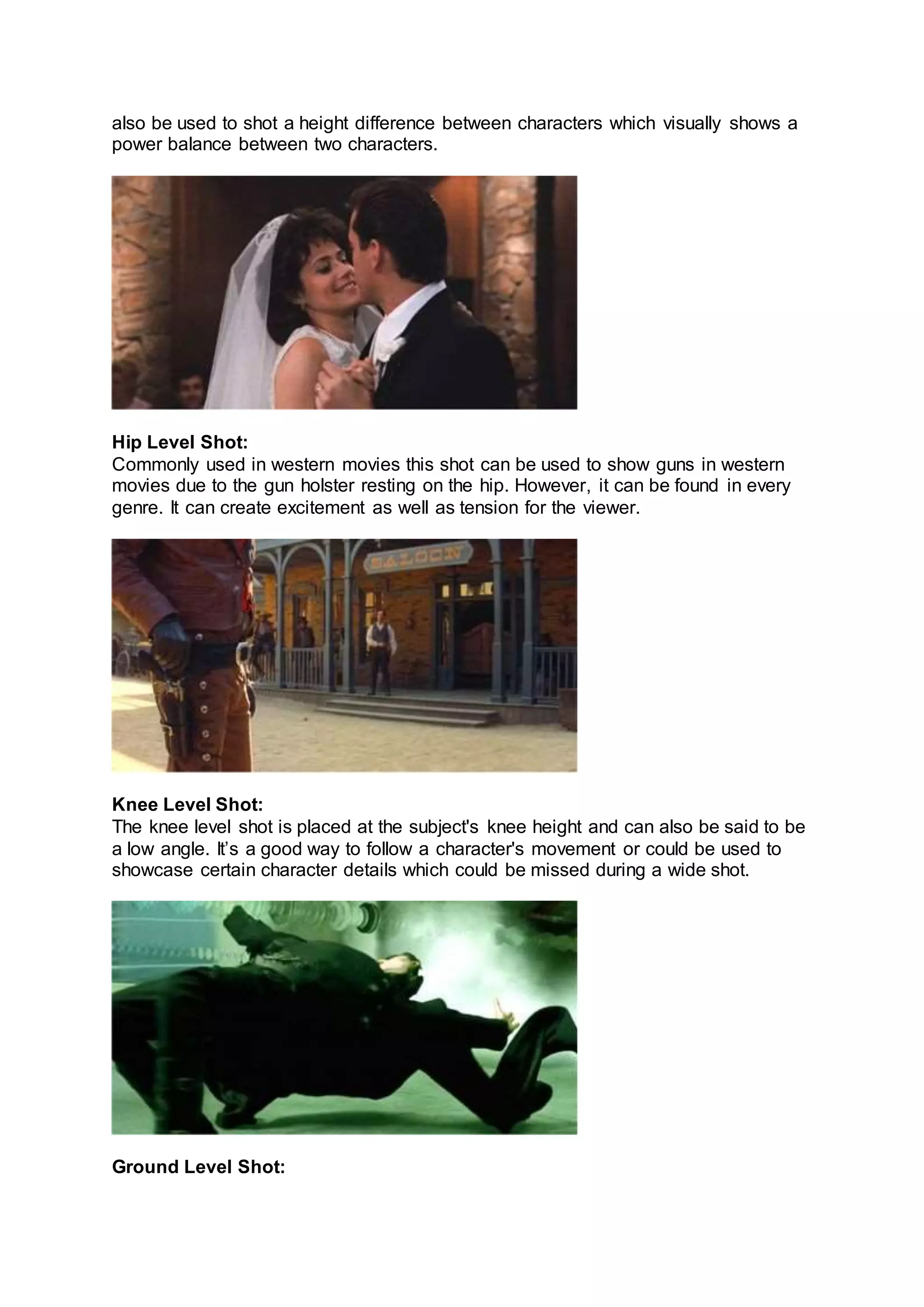
Cowboy Shot/Medium Full Shot:
The MFS is arranged from the top of the subject's head to just below their waist and
can be called a cowboy shot due to where gun holsters lay. It's used to present
subjects as confident, confrontational or dangerous *especially with weapons.)
Medium Shot (MS):
The medium shot is one of the most commonly used shots in cinema, most likely
because it is a neutral shot unlike wide shots and close ups. It captured subjects in a
size similar to how we interact with people. It usually frames the subject from above
their waist but below their chest and ends just above their head.
Medium Close Up Shot (MCU):
This shot usually has the subjects from their mid chest to above their head. This shot
is used to minimalize distractions and prioritise character/story details. It can be used
to get intimate with subjects without losing their physicality. It usually can be used to
show emotion from characters.
Close up Shot:
This shot is usually arranged at eye level to show a change of emotion. It gives us a
front row seat to the subject's thoughts or feelings. It's about empathy and is used to
show us the dramatic effects in times of decision or anxiety.
Extreme Close Up Shot (ECU) / Insert Shot:
An ECU frames the subject to isolate a specific area, such as the eyes, nose or lips
however its commonly the eyes. It can also be used to show the function of a
specific prop or an intimate detail of the story. They're commonly used to highlight
something crucial to the story/narrative.
Camera Framing:
Single/Dirty Single:
The single short features one character alone in the frame and this character is then
the primary focus of that frame. There are two types of single shot, a clean single
and a dirty single. A clean single is used when no character is in the frame, and it is
best used to convey the characters isolation. However, a dirty single includes a
limited presence of another character in the frame.
Two shot:
To be considered a two shot both the characters’ faces must be included clearly in
the frame and is used to create a visual relationship between two characters. This
relationship can vary though.
Crowd Shot:
When more characters are added to the frame the shot can be adjusted to a three or
four shot etc, however when there are more characters it is easier to call it a crowd
shot instead of numbering it. This shot, despite the number of characters will always
be used to create a relationship between the characters.
Over the shoulder (OTS):
The most common and useful way of covering a conversation and is a hybrid of a
single shot and a two shot. We get the perspective from both characters and we feel
we are included in the moment. However, we are often only focusing on one
character at a time.
Over The Hip (OTH):
An over-the-hip shot is like the over-the-shoulder in that the camera is placed with a
character's hip in the foreground, and the focus subject in the plane of acceptable
focus.
Point of view (POV):
This is used to get the perspective of a character. It can be used to get the
perspective from all kinds of things such as people, animals or even cameras and is
usually paired with POV audio to see what the character sees and hear what they
hear.
Insert Shot:
It is used to go in tight on a detail in frame and can also be paired with a POV shot,
third person perspective or a hybrid frame. The way that the detail is framed however
can be more important than how prominent it is on screen.
Camera Angles:
Low Angle (AN):
A low angle shot is a shot below the subject's eye line looking up at them. The low
angle is usually used to make the subject look more powerful and can be subtle or
extreme, this angle also isn’t confined to human subjects. It is commonly used on
heroes and villains alike.
High Angle (HA):
Often paired with the low angle to heighten the imbalance of power between two
subjects. It is used to look down on characters and beat them down, diminish them
and make them appear weak or vulnerable. (An extreme version is the ariel short to
establish environments, landscapes, cities or movement.) The high angle can be
used to illicit the viewers emotional response, convey narrative or to convey
character details.
Overhead Shot:
Also known as the bird's eye view (or the gods eye view), the overhead shot is shot
directly above a character shooting straight down. They are great for showing off
complex movements, could suggest a connection to the divine or even to capture the
details of a crime scene.
Dutch Angle:
The Dutch angle skews the horizontal axis of the frame for an off-balance view,
which can create a sense of unease, mania, terror or bewilderment. It can also be
used to magnify tension. The angle of a tilt can show something such as a rise in
anger between characters such as in “Do the Right Thing” (1989).
Eye Level Shot:
The eye level shot is commonly used in media as it is the most natural height to
regard a character and it doesn’t impose judgement on a character like in other shots
such as high angle shots or low angle shots.
Shoulder Level Shot:
The shoulder level shot is also commonly used in media, and they're often used in
conversations (also using OTS shots commonly during these scenes.) This shot can
also be used to shot a height difference between characters which visually shows a
power balance between two characters.
Hip Level Shot:
Commonly used in western movies this shot can be used to show guns in western
movies due to the gun holster resting on the hip. However, it can be found in every
genre. It can create excitement as well as tension for the viewer.
Knee Level Shot:
The knee level shot is placed at the subject's knee height and can also be said to be
a low angle. It’s a good way to follow a character's movement or could be used to
showcase certain character details which could be missed during a wide shot.
Ground Level Shot:
A ground level shot is placed on the ground however if there is a slight angle tilt it
can also be viewed as a low angle. Shooting from the ground level can be used to
capture details in setting or even to track a characters movement as we see in “The
Shining” when Danny is on his tricycle through the halls of the hotel.
Camera Focus/Depth of Field:
Deep Focus:
When both the subject and the background are seen in crisp detail its known as
deep focus. Shots with deep focus offer more visual detail to the viewer and it allows
the viewers eyes to travel at their own pace and allows dynamic action to play out on
multiple plains. Deep focus can create layered images.
Shallow Focus:
This renders a portion of the frame in sharp detail and leaves the rest of the detail
soft, creating a background and a foreground. It can be used for a romantic effect, to
isolate a subject, to create a bouquet effect or imbue an element with meaning.
Shallow focus is commonly used in film. It's useful to guide the viewers' attention or
to suggest a character's emotional state.
Soft Focus:
This keeps nothing in the frame focused, meaning nothing in the frame is 100%
sharp unlike in the shallow focus or deep focus. It is achieved by imperfections built
into the lens or by using diffusion filters. It was used in movies in the past to heighten
the beauty of female stars, however these days that’s rare. It is now used more
commonly now in dream sequences and flashbacks. The movie AI used soft focus
from beginning to end which is very uncommon. It suggests a dream like landscape.
Rack Focus:
This changes the focus throughout within a shot. It comes from the verb racking, and
racking focus is the art of transitioning a shallow depth of field between different
points of focus within a shot. Racking Focus directs the audience's attention with
precision and allows a sequence to play out throughout a single shot. For complex
tracking shot this requires constant precise focus racking which is carried out using a
focus puller using a follow focus.
(I can’t exactly include and image for this one as it’s a transition between two types
of camera focus.)
Split Diopter:
This is used to capture two separate focal points in focus whilst leaving the area
between them out of focus which is achieves by specialised lenses which can
independently focusing on two different focal points. This can be used when there is
important information in the foreground and background but do not wish to use deep
focus. However, this can also be used when two characters speaking at two focus
differences and want them both to appear crisp without racking focus. However, this
is not used often as it looks unusual.
Tilt Shift/Swing Shift:
This is also created with a specialised lens to create striking visuals. This lens bends
the light to create distortions in which a small portion of the frame is in focus and the
rest is out of focus/blurry. Filming a life-size subject through a tilt shift lens at times
can give the impression that whatever is in frame is a miniature. This can be also
used to enhance the characters perspective if they are drunk or high.
Camera Gear/Rig:
Handheld:
Many handheld shots are taken with a shoulder rig or an easy rig. Handheld shots
are meant to be shaky and film makers use jagged handheld shots to heighten the
intensity of a scene. It could also be used subtly to suggest intimacy. In the opening
of avengers end game, the shot goes from subtle to intense. When he begins to
panic the shot gets shakier.
Tripod:
Tripods are a fixed three-legged support mechanism and great for static shots or for
movement if movement is needed in a scene. A fluid head tripod allows for smooth
movement are used to not distract from the scenes, like in dialogue scenes,
emotional single shots and shots that focus on blocking and staging.
Pedestal:
The pedestal is a camera mechanism that can move vertically, for smaller
movements and it is used to match the movement of an actor, to build suspense or
to establish a world.
Crane/Jib:
The Crane/Jib is a piece of equipment to make big vertical movements and they use
arms to extend the camera outwards and smoothly guide it left, right, up or down. It
can also be used to highlight a specific emotion in a shot, such as isolation, freedom
or spectacle.
Overhead:
An overhead rig can be used as a POV, a god view shot or to communicate details
within insert shots. Martin Scorsese uses overhead rigs often in his movies. An
example of this is in Casino where he uses overhead rigs to show the perspective of
a security camera.
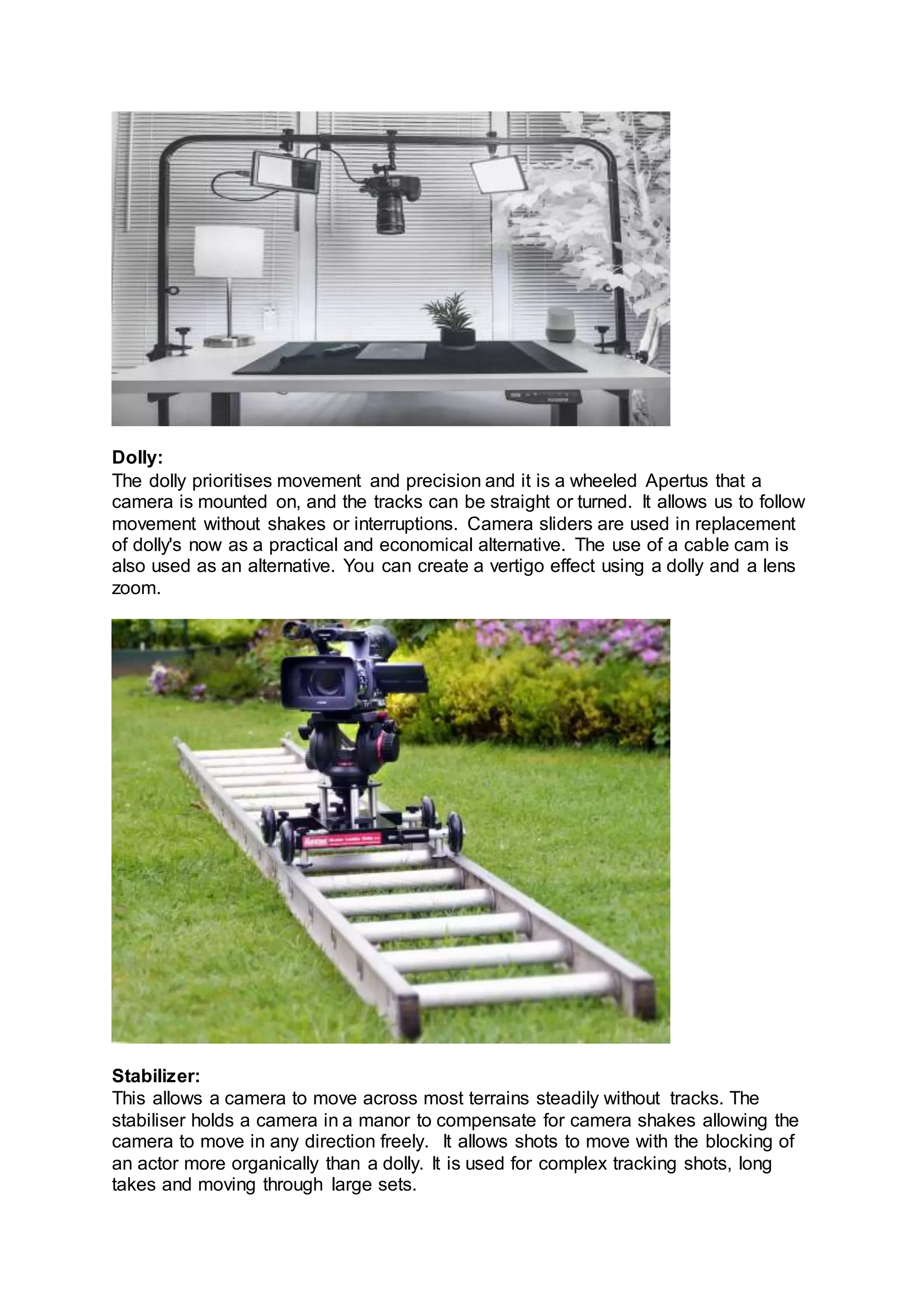
Dolly:
The dolly prioritises movement and precision and it is a wheeled Apertus that a
camera is mounted on, and the tracks can be straight or turned. It allows us to follow
movement without shakes or interruptions. Camera sliders are used in replacement
of dolly's now as a practical and economical alternative. The use of a cable cam is
also used as an alternative. You can create a vertigo effect using a dolly and a lens
zoom.
Stabilizer:
This allows a camera to move across most terrains steadily without tracks. The
stabiliser holds a camera in a manor to compensate for camera shakes allowing the
camera to move in any direction freely. It allows shots to move with the blocking of
an actor more organically than a dolly. It is used for complex tracking shots, long
takes and moving through large sets.
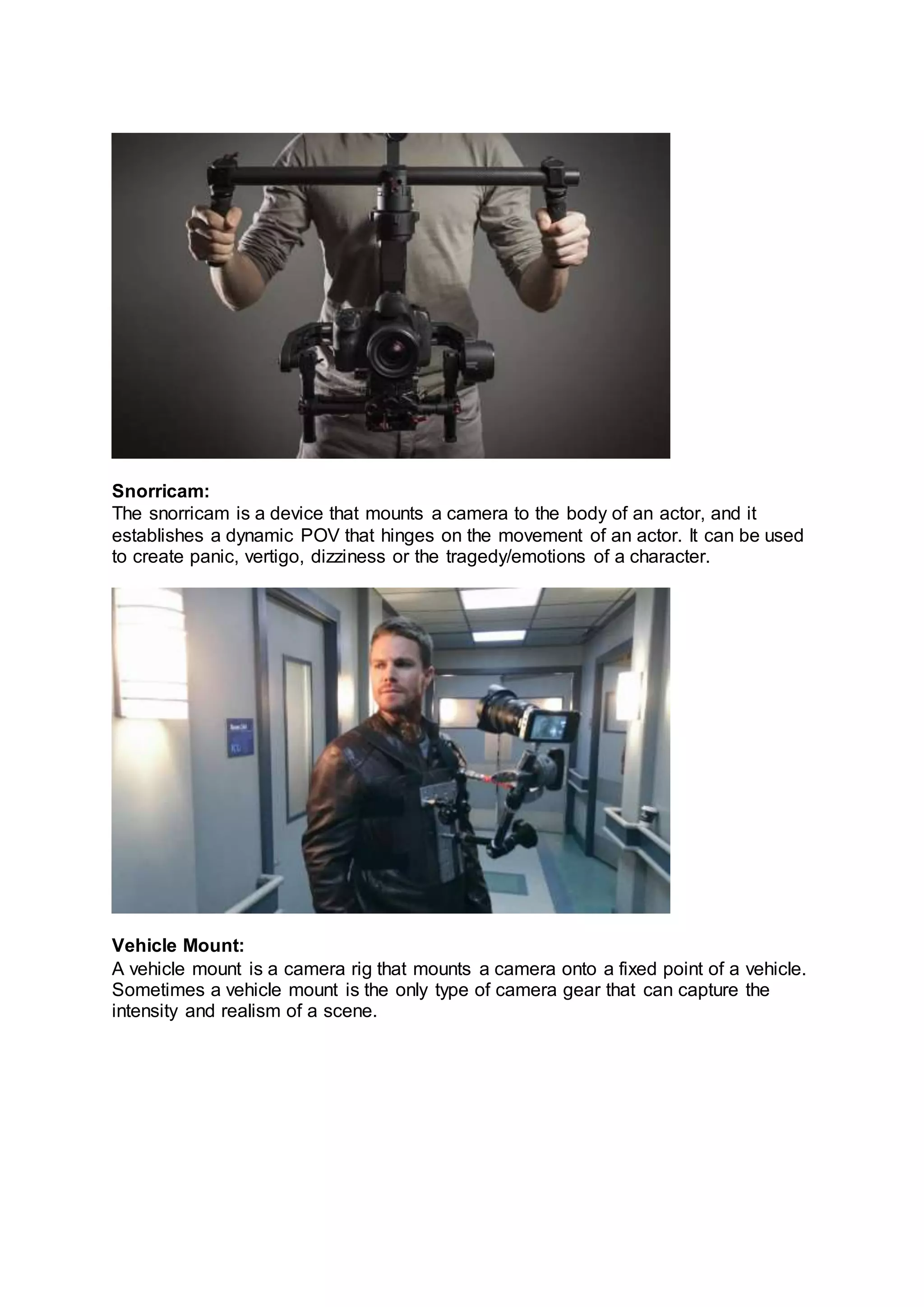
Snorricam:
The snorricam is a device that mounts a camera to the body of an actor, and it
establishes a dynamic POV that hinges on the movement of an actor. It can be used
to create panic, vertigo, dizziness or the tragedy/emotions of a character.
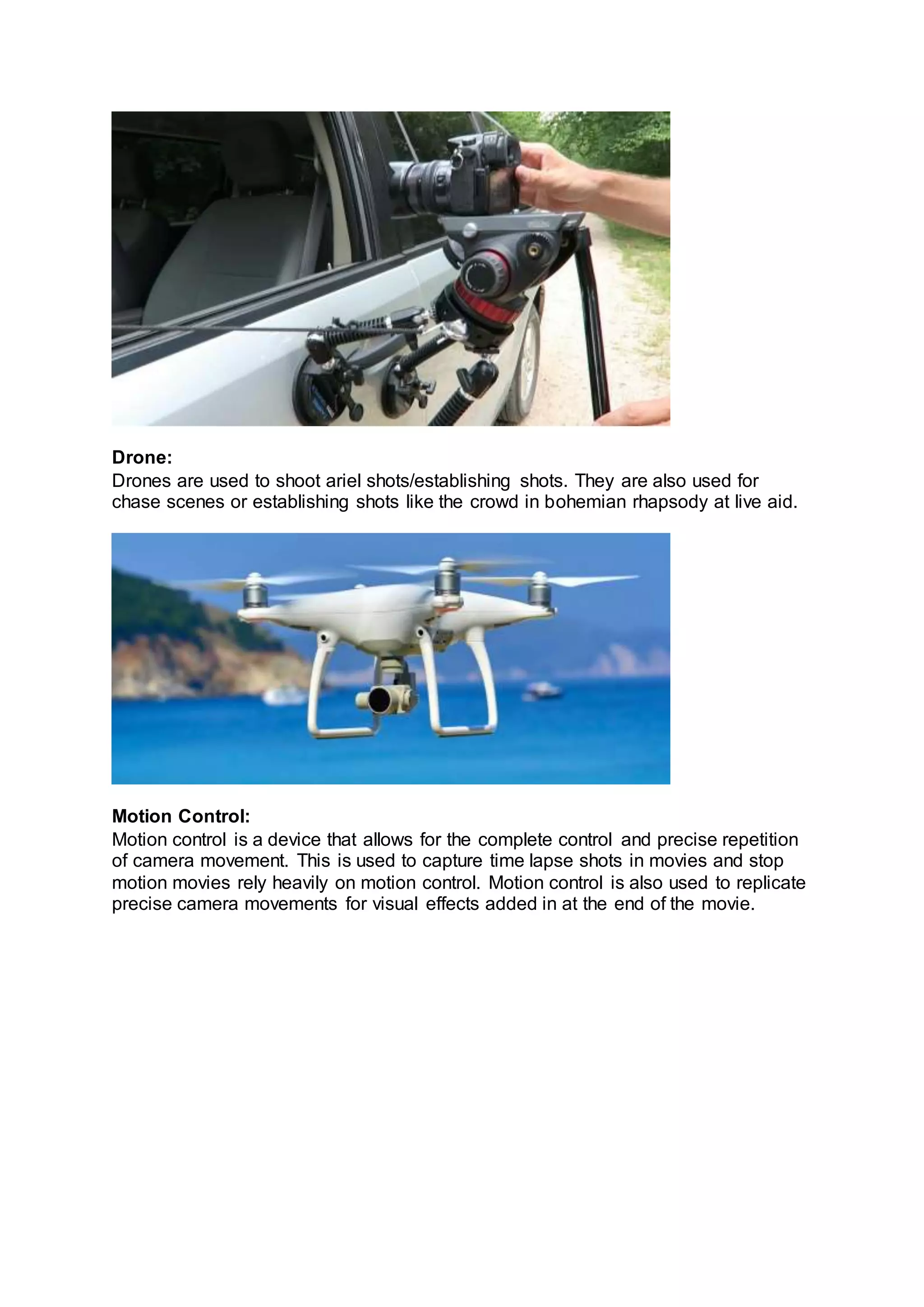
Vehicle Mount:
A vehicle mount is a camera rig that mounts a camera onto a fixed point of a vehicle.
Sometimes a vehicle mount is the only type of camera gear that can capture the
intensity and realism of a scene.
Drone:
Drones are used to shoot ariel shots/establishing shots. They are also used for
chase scenes or establishing shots like the crowd in bohemian rhapsody at live aid.
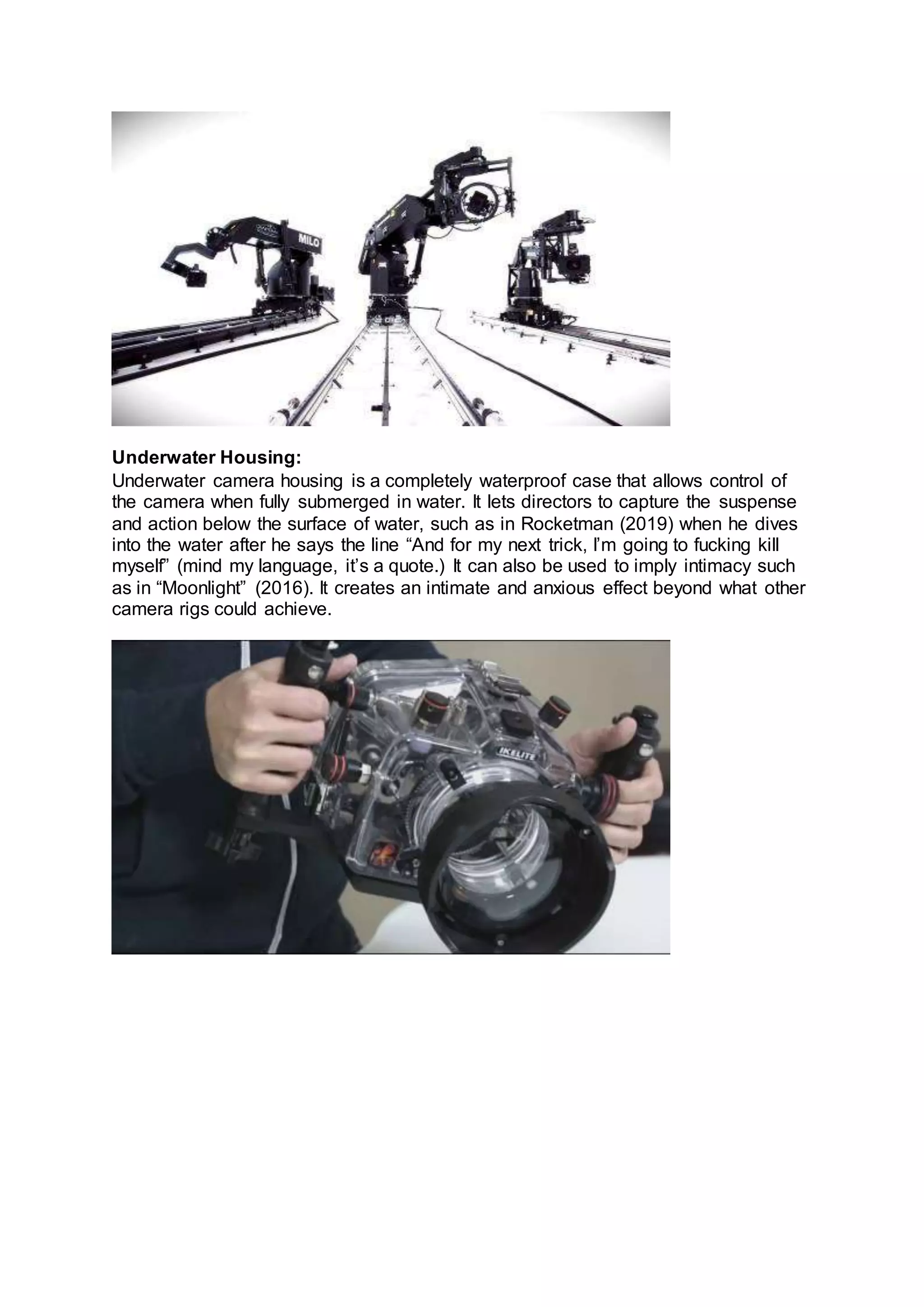
Motion Control:
Motion control is a device that allows for the complete control and precise repetition
of camera movement. This is used to capture time lapse shots in movies and stop
motion movies rely heavily on motion control. Motion control is also used to replicate
precise camera movements for visual effects added in at the end of the movie.
Underwater Housing:
Underwater camera housing is a completely waterproof case that allows control of
the camera when fully submerged in water. It lets directors to capture the suspense
and action below the surface of water, such as in Rocketman (2019) when he dives
into the water after he says the line “And for my next trick, I’m going to fucking kill
myself” (mind my language, it’s a quote.) It can also be used to imply intimacy such
as in “Moonlight” (2016). It creates an intimate and anxious effect beyond what other
camera rigs could achieve.

Initial videography research

  • 1.
    Initial Videography Research(AC1: Informing Ideas) Camera Shots (Shot size): Establishing Shot: This is typically a wide shot, used to show the viewer perhaps where the character is, the time of day or the size of a character in comparison to their surroundings. It is also used as a transition between scenes and is used often in science fiction movies such as Star Wars, blade runner and others like this. It’s a crucial introductory component of any scene as it can introduce crucial details and location. Master Shot: This usually follows an establishing shot and it can be used to confirm the location of the scene and which characters are in the scene (and where they are in relation to each other.) Wide Shot (WS): The wide shot positions the subject/s far from the camera to represent their relationship to their environment and the scale of them in comparison to their
  • 2.
    surroundings. It canbe used to make the subjects in the shot appear lost, lonely or overwhelmed. Full Shot (FS): The full shot is when the subject reaches from the top to the bottom of the frame. It doesn’t need to make the subject centred in the frame however its usually the case. It can be used to make statements about a subject's physicality and present characters in their full glory. Cowboy Shot/Medium Full Shot: The MFS is arranged from the top of the subject's head to just below their waist and can be called a cowboy shot due to where gun holsters lay. It's used to present subjects as confident, confrontational or dangerous *especially with weapons.) Medium Shot (MS):
  • 3.
    The medium shotis one of the most commonly used shots in cinema, most likely because it is a neutral shot unlike wide shots and close ups. It captured subjects in a size similar to how we interact with people. It usually frames the subject from above their waist but below their chest and ends just above their head. Medium Close Up Shot (MCU): This shot usually has the subjects from their mid chest to above their head. This shot is used to minimalize distractions and prioritise character/story details. It can be used to get intimate with subjects without losing their physicality. It usually can be used to show emotion from characters. Close up Shot: This shot is usually arranged at eye level to show a change of emotion. It gives us a front row seat to the subject's thoughts or feelings. It's about empathy and is used to show us the dramatic effects in times of decision or anxiety.
  • 4.
    Extreme Close UpShot (ECU) / Insert Shot: An ECU frames the subject to isolate a specific area, such as the eyes, nose or lips however its commonly the eyes. It can also be used to show the function of a specific prop or an intimate detail of the story. They're commonly used to highlight something crucial to the story/narrative. Camera Framing: Single/Dirty Single: The single short features one character alone in the frame and this character is then the primary focus of that frame. There are two types of single shot, a clean single and a dirty single. A clean single is used when no character is in the frame, and it is best used to convey the characters isolation. However, a dirty single includes a limited presence of another character in the frame.
  • 5.
    Two shot: To beconsidered a two shot both the characters’ faces must be included clearly in the frame and is used to create a visual relationship between two characters. This relationship can vary though. Crowd Shot: When more characters are added to the frame the shot can be adjusted to a three or four shot etc, however when there are more characters it is easier to call it a crowd shot instead of numbering it. This shot, despite the number of characters will always be used to create a relationship between the characters.
  • 6.
    Over the shoulder(OTS): The most common and useful way of covering a conversation and is a hybrid of a single shot and a two shot. We get the perspective from both characters and we feel we are included in the moment. However, we are often only focusing on one character at a time. Over The Hip (OTH): An over-the-hip shot is like the over-the-shoulder in that the camera is placed with a character's hip in the foreground, and the focus subject in the plane of acceptable focus.
  • 7.
    Point of view(POV): This is used to get the perspective of a character. It can be used to get the perspective from all kinds of things such as people, animals or even cameras and is usually paired with POV audio to see what the character sees and hear what they hear. Insert Shot: It is used to go in tight on a detail in frame and can also be paired with a POV shot, third person perspective or a hybrid frame. The way that the detail is framed however can be more important than how prominent it is on screen.
  • 8.
    Camera Angles: Low Angle(AN): A low angle shot is a shot below the subject's eye line looking up at them. The low angle is usually used to make the subject look more powerful and can be subtle or extreme, this angle also isn’t confined to human subjects. It is commonly used on heroes and villains alike. High Angle (HA): Often paired with the low angle to heighten the imbalance of power between two subjects. It is used to look down on characters and beat them down, diminish them and make them appear weak or vulnerable. (An extreme version is the ariel short to establish environments, landscapes, cities or movement.) The high angle can be used to illicit the viewers emotional response, convey narrative or to convey character details. Overhead Shot: Also known as the bird's eye view (or the gods eye view), the overhead shot is shot directly above a character shooting straight down. They are great for showing off complex movements, could suggest a connection to the divine or even to capture the details of a crime scene.
  • 9.
    Dutch Angle: The Dutchangle skews the horizontal axis of the frame for an off-balance view, which can create a sense of unease, mania, terror or bewilderment. It can also be used to magnify tension. The angle of a tilt can show something such as a rise in anger between characters such as in “Do the Right Thing” (1989). Eye Level Shot: The eye level shot is commonly used in media as it is the most natural height to regard a character and it doesn’t impose judgement on a character like in other shots such as high angle shots or low angle shots. Shoulder Level Shot: The shoulder level shot is also commonly used in media, and they're often used in conversations (also using OTS shots commonly during these scenes.) This shot can
  • 10.
    also be usedto shot a height difference between characters which visually shows a power balance between two characters. Hip Level Shot: Commonly used in western movies this shot can be used to show guns in western movies due to the gun holster resting on the hip. However, it can be found in every genre. It can create excitement as well as tension for the viewer. Knee Level Shot: The knee level shot is placed at the subject's knee height and can also be said to be a low angle. It’s a good way to follow a character's movement or could be used to showcase certain character details which could be missed during a wide shot. Ground Level Shot:
  • 11.
    A ground levelshot is placed on the ground however if there is a slight angle tilt it can also be viewed as a low angle. Shooting from the ground level can be used to capture details in setting or even to track a characters movement as we see in “The Shining” when Danny is on his tricycle through the halls of the hotel. Camera Focus/Depth of Field: Deep Focus: When both the subject and the background are seen in crisp detail its known as deep focus. Shots with deep focus offer more visual detail to the viewer and it allows the viewers eyes to travel at their own pace and allows dynamic action to play out on multiple plains. Deep focus can create layered images. Shallow Focus: This renders a portion of the frame in sharp detail and leaves the rest of the detail soft, creating a background and a foreground. It can be used for a romantic effect, to isolate a subject, to create a bouquet effect or imbue an element with meaning. Shallow focus is commonly used in film. It's useful to guide the viewers' attention or to suggest a character's emotional state.
  • 12.
    Soft Focus: This keepsnothing in the frame focused, meaning nothing in the frame is 100% sharp unlike in the shallow focus or deep focus. It is achieved by imperfections built into the lens or by using diffusion filters. It was used in movies in the past to heighten the beauty of female stars, however these days that’s rare. It is now used more commonly now in dream sequences and flashbacks. The movie AI used soft focus from beginning to end which is very uncommon. It suggests a dream like landscape. Rack Focus: This changes the focus throughout within a shot. It comes from the verb racking, and racking focus is the art of transitioning a shallow depth of field between different points of focus within a shot. Racking Focus directs the audience's attention with precision and allows a sequence to play out throughout a single shot. For complex tracking shot this requires constant precise focus racking which is carried out using a focus puller using a follow focus. (I can’t exactly include and image for this one as it’s a transition between two types of camera focus.)
  • 13.
    Split Diopter: This isused to capture two separate focal points in focus whilst leaving the area between them out of focus which is achieves by specialised lenses which can independently focusing on two different focal points. This can be used when there is important information in the foreground and background but do not wish to use deep focus. However, this can also be used when two characters speaking at two focus differences and want them both to appear crisp without racking focus. However, this is not used often as it looks unusual. Tilt Shift/Swing Shift: This is also created with a specialised lens to create striking visuals. This lens bends the light to create distortions in which a small portion of the frame is in focus and the rest is out of focus/blurry. Filming a life-size subject through a tilt shift lens at times can give the impression that whatever is in frame is a miniature. This can be also used to enhance the characters perspective if they are drunk or high. Camera Gear/Rig: Handheld: Many handheld shots are taken with a shoulder rig or an easy rig. Handheld shots are meant to be shaky and film makers use jagged handheld shots to heighten the intensity of a scene. It could also be used subtly to suggest intimacy. In the opening of avengers end game, the shot goes from subtle to intense. When he begins to panic the shot gets shakier.
  • 14.
    Tripod: Tripods are afixed three-legged support mechanism and great for static shots or for movement if movement is needed in a scene. A fluid head tripod allows for smooth movement are used to not distract from the scenes, like in dialogue scenes, emotional single shots and shots that focus on blocking and staging. Pedestal: The pedestal is a camera mechanism that can move vertically, for smaller movements and it is used to match the movement of an actor, to build suspense or to establish a world.
  • 15.
    Crane/Jib: The Crane/Jib isa piece of equipment to make big vertical movements and they use arms to extend the camera outwards and smoothly guide it left, right, up or down. It can also be used to highlight a specific emotion in a shot, such as isolation, freedom or spectacle. Overhead: An overhead rig can be used as a POV, a god view shot or to communicate details within insert shots. Martin Scorsese uses overhead rigs often in his movies. An example of this is in Casino where he uses overhead rigs to show the perspective of a security camera.
  • 16.
    Dolly: The dolly prioritisesmovement and precision and it is a wheeled Apertus that a camera is mounted on, and the tracks can be straight or turned. It allows us to follow movement without shakes or interruptions. Camera sliders are used in replacement of dolly's now as a practical and economical alternative. The use of a cable cam is also used as an alternative. You can create a vertigo effect using a dolly and a lens zoom. Stabilizer: This allows a camera to move across most terrains steadily without tracks. The stabiliser holds a camera in a manor to compensate for camera shakes allowing the camera to move in any direction freely. It allows shots to move with the blocking of an actor more organically than a dolly. It is used for complex tracking shots, long takes and moving through large sets.
  • 17.
    Snorricam: The snorricam isa device that mounts a camera to the body of an actor, and it establishes a dynamic POV that hinges on the movement of an actor. It can be used to create panic, vertigo, dizziness or the tragedy/emotions of a character. Vehicle Mount: A vehicle mount is a camera rig that mounts a camera onto a fixed point of a vehicle. Sometimes a vehicle mount is the only type of camera gear that can capture the intensity and realism of a scene.
  • 18.
    Drone: Drones are usedto shoot ariel shots/establishing shots. They are also used for chase scenes or establishing shots like the crowd in bohemian rhapsody at live aid. Motion Control: Motion control is a device that allows for the complete control and precise repetition of camera movement. This is used to capture time lapse shots in movies and stop motion movies rely heavily on motion control. Motion control is also used to replicate precise camera movements for visual effects added in at the end of the movie.
  • 19.
    Underwater Housing: Underwater camerahousing is a completely waterproof case that allows control of the camera when fully submerged in water. It lets directors to capture the suspense and action below the surface of water, such as in Rocketman (2019) when he dives into the water after he says the line “And for my next trick, I’m going to fucking kill myself” (mind my language, it’s a quote.) It can also be used to imply intimacy such as in “Moonlight” (2016). It creates an intimate and anxious effect beyond what other camera rigs could achieve.