An Introduction to Cinematography
Why Study Film?
 In 1965, Marshal McLuhan pointed out that old mediums become the content of
the new medium. So, photography became the content of film, novels and
drama became the source of films, and films became the content of television.
 Like traditional print texts, film and television have a grammar of their own,
produced through camera techniques and editing. It is crucial in the 21st
Century that children and teens are taught how to read, i.e. analyze and write,
i.e. produce non-print media like film and television. Noted media educator and
theorist Len Masterman (1982) argues that young people need to be made
aware that film and television are ‘constructions’ that convey meanings and
ideology.
 It is the role of not only media educators but also English Language Arts
educators to help students understand who, why, how and for what purposes
media are created. Young people must also be conscious of how the values and
ideologies in media texts help to position them as readers.
Cinematography
 Photography
– “writing in light”
 Cinematography
– “writing in movement”
 Cinematography includes:
– lighting
– shot composition
– selection of cameras, lenses, and filters
– special effects
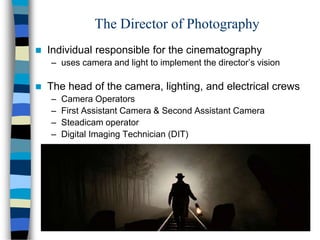
The Director of Photography
 Individual responsible for the cinematography
– uses camera and light to implement the director’s vision
 The head of the camera, lighting, and electrical crews
– Camera Operators
– First Assistant Camera & Second Assistant Camera
– Steadicam operator
– Digital Imaging Technician (DIT)
Director of Photography (DP)
 The DP was usually also the director and the person
operating the camera
– when movies were a new art form
 As the art form and technology evolved, a separation
between director and camera operator emerged.
Shot Composition
 A shot is the continuous run of the camera.
– the moment between when the camera starts & stops recording
 Shot composition refers to the framing of the image.
– as well as the arrangement of objects within the frame
– also referred to as framing
The Rule of Thirds
 Compositional guideline
– used by artists to compose aesthetically pleasing images
 Divides the frame into:
– three vertical sections
– three horizontal sections
The Rule of Thirds & Aesthetics
 Helps artists produce aesthetically pleasing images
– a guide for the off-center placement of subjects
– rule comes from hundreds of years of artistic experimentation
 Subjects should be placed along the lines.
“Hotspots”
 The intersection points are called hotspots
– objects of interest are placed at the intersection of these lines
 Produces a more engaging composition
The Rule of Thirds & Balance
 The rule can be used to create symmetrical compositions
– shots with equal distribution of objects within the frame
– also referred to as a balanced composition
Symmetry
 Objects on either side of the frame match each other
– size, shape, and relative position of objects matches
– a mirror-image arrangement of objects
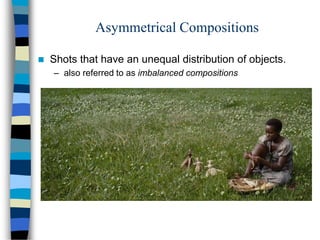
Asymmetrical Compositions
 Shots that have an unequal distribution of objects.
– also referred to as imbalanced compositions
Asymmetry
 Objects on either side do not reflect each other.
– The sides of the frame are not identical.
– the absence of symmetry
Plane of Depth
 The film frame is composed of three planes of depth:
– foreground
– middle-ground
– background
Planes of Depth
 The film frame is a two-dimensional image.
– placing objects or people in various planes gives the image the
perception of depth
Depth of Field
 Distance in front of the camera that will appear in focus
– a zone of sharp focus
Shallow Depth of Field
 Only one plane is in focus.
– often used to direct the audience’s attention
– create a sense of claustrophobia
Deep Depth of Field
 Multiple planes of the film frame are in focus.
Lenses
 Depth of field varies by lens.
– Wide-angle lenses have a wider depth of field.
– Telephoto lenses have a shallower depth of field.
 Types of lenses
– normal lens
– wide-angle lens
– telephoto lens
– zoom lens
Wide-Angle Lens
 Exaggerates the frame’s depth
– expands space between objects
– distorts straight lines, bulging them outward
– Wide-angle lenses have a deep depth of field.
Telephoto Lens
 Reduces the frame’s depth
– compresses space between objects
– the background and foreground seem squashed together
– Telephoto lenses have a shallow depth of field.
Zoom Lens
 Alters the size of the subject without changing the
distance between the subject and camera.
– magnifies the subject
– minimizes the subject
 The camera doesn’t necessary move.
 Permits filmmaker to change from wide-angle and
telephoto lenses during shooting.
Rack Focus or Pull Focus
 the practice of changing the focus of the lens during a
shot, this can refer to small or large changes of focus.
 if the focus is shallow, then the technique becomes
more noticeable
Shot Composition
 Shot composition is determined by:
– camera distance
– camera angle
– camera level
– camera movement
Camera Distance
 The names of shots refer to camera distance
– the space between the camera and the subject
– the subject-to-camera distance
 Extreme long shot (XLS)
– The subject is barely visible.
Long Shot (LS)
 The subject is more prominent
– the background still dominates the frame
Medium Long Shot (MLS)
 The subject is framed from the knees up.
Medium Shot (MS)
 The subject is framed from the waist up.
Medium Close-Up (MCU)
 The subject is framed from the chest up.
Close-up (CU)
 Just the head, hands, feet, etc appear in the frame.
Extreme Close-up (XCU)
 Only a small portion of the body appears in the frame
Camera Angle
 Low-angle shot
– camera is positioned below the subject
– aimed upward
– The subject appears powerful or important.
Camera Angle
 High-angle shot
– camera is positioned above the character
– aimed downward
– subject often appears vulnerable or powerless
Overhead Shot
 The camera is directly above the subject.
– also referred to as a bird’s eye view shot
Dutch Angle
 The camera is tilted
– the framing is not level
– often signifies a moment of imbalance, dynamism, or stress
– also referred to as canted framing
The Origin of the Term
 The term is derived from Deutch
– which is the German word for “German”
 Used extensively in German Expressionist films
– in the 1920s
Point-of-View
 Camera simulates a character’s field of vision
– depicts the action through a character’s eyes
– a subjective shot
Camera Movement
 Mobile camerawork changes the distance, angle, level,
during the shot.
 Types of camera movement
– pan
– tilt
– dolly
– crane
– Steadicam
– handheld
Pan & Tilt
 Pan
– Camera rotates left or right
– Camera body does not move
 Tilt
– Camera rotates up or down
– Camera body does not move
Dolly Shot
 A shot in which the entire camera moves on a wheeled
platform.
– enables the smooth movement of the camera
The Dolly Zoom
 Technique achieved when the camera:
– dollys out while zooming in
– dollys in while zooming out
 Often used to produce an unsettling effect
– The camera moves but the framing stays consistent.
 Invented by director Alfred Hitchcock and cameraman
Irmin Roberts in Vertigo (1953)
– also referred to as a “trombone shot”
Crane Shot
 Shot made from a camera mounted on an elevating arm
– the crane can be raised or lowered
– the crane can also move through space
The Steadicam
 A stabilizing camera mount
– consisting of a shock-absorbing arm
– attached to the operator’s body
 Enables a smooth shot
– even over uneven terrain
Handheld
 A shot accomplished without any sort of stabilizing tools
– such as a tripod, dolly, or Steadicam
 Characterized by shakiness
– often represents a loss of control
– also used to represent realism (or documentary realism)
The Long Take
 A shot that continues for an unusually long period of time
– before the next shot begins
 A long take generally lasts a minute or longer.
– The average shot length is 4-6 seconds.
 Should not be confused with the long shot
Lighting
 DP is also the head of the lighting department.
– Lighting refers to more than illumination.
– painting with light
 The active viewer is continually analyzing how light and
shadow work together.
“I am very, very concerned with the emotions of the story.
I am much less concerned with the reality of what the
lighting would be at that particular moment or in that
particular situation.”
~Michael Slovis, Director of Photography
Lighting & Color
 Different temperatures of light produce different colors
of light.
– Higher temperatures produce “cool” colors (blue)
– Lower temperatures produce “warm” colors (orange)
Lighting & Color
 Filmmakers can also add colored gels to lighting
instruments to create different colors.
– a transparent, colored sheet of plastic used as a filter
Three-point Lighting
 Most common lighting technique is three-point lighting
– key light (the main source of light)
– fill light (fills in the shadows created by the key light)
– back light (separates the subject from the background)
High-key Lighting
 The lighting design that creates little contrast
– the shot is uniformly illuminated
– reduces the presence and severity of shadows
Low-key Lighting
 Lighting style that creates strong contrasts
– extremely dark and light regions within the frame
– produces sharp, deep shadows
Transitions
 https://youtu.be/OAH0MoAv2CI
Diegetic Sound
 noise which has a source on-screen
and has not been edited in
– dialogue
– footsteps
– radio playing in the background
 “actual sound”
– source
Non-Diegetic Sound
 noise whose source is neither visible on
the screen nor has been implied to be
present in the action
 comes from a source outside the story
– narrator's commentary
– sound effects which are added for the
dramatic effect
– mood music
– commentary music
Anachronistic Sound
 music in a film which does not match
the film’s setting
– music older than the setting
• creates nostalgia or out-of-touch characters
– music more modern than the setting
• time travel? artistic license?
– Source
 Ex: The Great Gatsby (2013)
Continuity
 the practice of ensuring that details in a
shot are consistent from shot to shot
within a film scene.
 audiences have a greater suspension
of disbelief and will be more engaged

Cinematography

  • 1.
    An Introduction toCinematography
  • 2.
    Why Study Film? In 1965, Marshal McLuhan pointed out that old mediums become the content of the new medium. So, photography became the content of film, novels and drama became the source of films, and films became the content of television.  Like traditional print texts, film and television have a grammar of their own, produced through camera techniques and editing. It is crucial in the 21st Century that children and teens are taught how to read, i.e. analyze and write, i.e. produce non-print media like film and television. Noted media educator and theorist Len Masterman (1982) argues that young people need to be made aware that film and television are ‘constructions’ that convey meanings and ideology.  It is the role of not only media educators but also English Language Arts educators to help students understand who, why, how and for what purposes media are created. Young people must also be conscious of how the values and ideologies in media texts help to position them as readers.
  • 3.
    Cinematography  Photography – “writingin light”  Cinematography – “writing in movement”  Cinematography includes: – lighting – shot composition – selection of cameras, lenses, and filters – special effects
  • 4.
    The Director ofPhotography  Individual responsible for the cinematography – uses camera and light to implement the director’s vision  The head of the camera, lighting, and electrical crews – Camera Operators – First Assistant Camera & Second Assistant Camera – Steadicam operator – Digital Imaging Technician (DIT)
  • 7.
    Director of Photography(DP)  The DP was usually also the director and the person operating the camera – when movies were a new art form  As the art form and technology evolved, a separation between director and camera operator emerged.
  • 8.
    Shot Composition  Ashot is the continuous run of the camera. – the moment between when the camera starts & stops recording  Shot composition refers to the framing of the image. – as well as the arrangement of objects within the frame – also referred to as framing
  • 9.
    The Rule ofThirds  Compositional guideline – used by artists to compose aesthetically pleasing images  Divides the frame into: – three vertical sections – three horizontal sections
  • 10.
    The Rule ofThirds & Aesthetics  Helps artists produce aesthetically pleasing images – a guide for the off-center placement of subjects – rule comes from hundreds of years of artistic experimentation  Subjects should be placed along the lines.
  • 19.
    “Hotspots”  The intersectionpoints are called hotspots – objects of interest are placed at the intersection of these lines  Produces a more engaging composition
  • 26.
    The Rule ofThirds & Balance  The rule can be used to create symmetrical compositions – shots with equal distribution of objects within the frame – also referred to as a balanced composition
  • 27.
    Symmetry  Objects oneither side of the frame match each other – size, shape, and relative position of objects matches – a mirror-image arrangement of objects
  • 36.
    Asymmetrical Compositions  Shotsthat have an unequal distribution of objects. – also referred to as imbalanced compositions
  • 37.
    Asymmetry  Objects oneither side do not reflect each other. – The sides of the frame are not identical. – the absence of symmetry
  • 43.
    Plane of Depth The film frame is composed of three planes of depth: – foreground – middle-ground – background
  • 44.
    Planes of Depth The film frame is a two-dimensional image. – placing objects or people in various planes gives the image the perception of depth
  • 48.
    Depth of Field Distance in front of the camera that will appear in focus – a zone of sharp focus
  • 49.
    Shallow Depth ofField  Only one plane is in focus. – often used to direct the audience’s attention – create a sense of claustrophobia
  • 51.
    Deep Depth ofField  Multiple planes of the film frame are in focus.
  • 53.
    Lenses  Depth offield varies by lens. – Wide-angle lenses have a wider depth of field. – Telephoto lenses have a shallower depth of field.  Types of lenses – normal lens – wide-angle lens – telephoto lens – zoom lens
  • 56.
    Wide-Angle Lens  Exaggeratesthe frame’s depth – expands space between objects – distorts straight lines, bulging them outward – Wide-angle lenses have a deep depth of field.
  • 57.
    Telephoto Lens  Reducesthe frame’s depth – compresses space between objects – the background and foreground seem squashed together – Telephoto lenses have a shallow depth of field.
  • 60.
    Zoom Lens  Altersthe size of the subject without changing the distance between the subject and camera. – magnifies the subject – minimizes the subject  The camera doesn’t necessary move.  Permits filmmaker to change from wide-angle and telephoto lenses during shooting.
  • 61.
    Rack Focus orPull Focus  the practice of changing the focus of the lens during a shot, this can refer to small or large changes of focus.  if the focus is shallow, then the technique becomes more noticeable
  • 62.
    Shot Composition  Shotcomposition is determined by: – camera distance – camera angle – camera level – camera movement
  • 63.
    Camera Distance  Thenames of shots refer to camera distance – the space between the camera and the subject – the subject-to-camera distance  Extreme long shot (XLS) – The subject is barely visible.
  • 64.
    Long Shot (LS) The subject is more prominent – the background still dominates the frame
  • 65.
    Medium Long Shot(MLS)  The subject is framed from the knees up.
  • 66.
    Medium Shot (MS) The subject is framed from the waist up.
  • 67.
    Medium Close-Up (MCU) The subject is framed from the chest up.
  • 68.
    Close-up (CU)  Justthe head, hands, feet, etc appear in the frame.
  • 69.
    Extreme Close-up (XCU) Only a small portion of the body appears in the frame
  • 70.
    Camera Angle  Low-angleshot – camera is positioned below the subject – aimed upward – The subject appears powerful or important.
  • 73.
    Camera Angle  High-angleshot – camera is positioned above the character – aimed downward – subject often appears vulnerable or powerless
  • 77.
    Overhead Shot  Thecamera is directly above the subject. – also referred to as a bird’s eye view shot
  • 82.
    Dutch Angle  Thecamera is tilted – the framing is not level – often signifies a moment of imbalance, dynamism, or stress – also referred to as canted framing
  • 83.
    The Origin ofthe Term  The term is derived from Deutch – which is the German word for “German”  Used extensively in German Expressionist films – in the 1920s
  • 88.
    Point-of-View  Camera simulatesa character’s field of vision – depicts the action through a character’s eyes – a subjective shot
  • 95.
    Camera Movement  Mobilecamerawork changes the distance, angle, level, during the shot.  Types of camera movement – pan – tilt – dolly – crane – Steadicam – handheld
  • 96.
    Pan & Tilt Pan – Camera rotates left or right – Camera body does not move  Tilt – Camera rotates up or down – Camera body does not move
  • 97.
    Dolly Shot  Ashot in which the entire camera moves on a wheeled platform. – enables the smooth movement of the camera
  • 101.
    The Dolly Zoom Technique achieved when the camera: – dollys out while zooming in – dollys in while zooming out  Often used to produce an unsettling effect – The camera moves but the framing stays consistent.  Invented by director Alfred Hitchcock and cameraman Irmin Roberts in Vertigo (1953) – also referred to as a “trombone shot”
  • 102.
    Crane Shot  Shotmade from a camera mounted on an elevating arm – the crane can be raised or lowered – the crane can also move through space
  • 104.
    The Steadicam  Astabilizing camera mount – consisting of a shock-absorbing arm – attached to the operator’s body  Enables a smooth shot – even over uneven terrain
  • 106.
    Handheld  A shotaccomplished without any sort of stabilizing tools – such as a tripod, dolly, or Steadicam  Characterized by shakiness – often represents a loss of control – also used to represent realism (or documentary realism)
  • 107.
    The Long Take A shot that continues for an unusually long period of time – before the next shot begins  A long take generally lasts a minute or longer. – The average shot length is 4-6 seconds.  Should not be confused with the long shot
  • 108.
    Lighting  DP isalso the head of the lighting department. – Lighting refers to more than illumination. – painting with light  The active viewer is continually analyzing how light and shadow work together.
  • 109.
    “I am very,very concerned with the emotions of the story. I am much less concerned with the reality of what the lighting would be at that particular moment or in that particular situation.” ~Michael Slovis, Director of Photography
  • 112.
    Lighting & Color Different temperatures of light produce different colors of light. – Higher temperatures produce “cool” colors (blue) – Lower temperatures produce “warm” colors (orange)
  • 113.
    Lighting & Color Filmmakers can also add colored gels to lighting instruments to create different colors. – a transparent, colored sheet of plastic used as a filter
  • 118.
    Three-point Lighting  Mostcommon lighting technique is three-point lighting – key light (the main source of light) – fill light (fills in the shadows created by the key light) – back light (separates the subject from the background)
  • 119.
    High-key Lighting  Thelighting design that creates little contrast – the shot is uniformly illuminated – reduces the presence and severity of shadows
  • 122.
    Low-key Lighting  Lightingstyle that creates strong contrasts – extremely dark and light regions within the frame – produces sharp, deep shadows
  • 126.
  • 127.
    Diegetic Sound  noisewhich has a source on-screen and has not been edited in – dialogue – footsteps – radio playing in the background  “actual sound” – source
  • 128.
    Non-Diegetic Sound  noisewhose source is neither visible on the screen nor has been implied to be present in the action  comes from a source outside the story – narrator's commentary – sound effects which are added for the dramatic effect – mood music – commentary music
  • 129.
    Anachronistic Sound  musicin a film which does not match the film’s setting – music older than the setting • creates nostalgia or out-of-touch characters – music more modern than the setting • time travel? artistic license? – Source  Ex: The Great Gatsby (2013)
  • 130.
    Continuity  the practiceof ensuring that details in a shot are consistent from shot to shot within a film scene.  audiences have a greater suspension of disbelief and will be more engaged