Co-funded by the Intelligent Energy Europe
Programme of the European Union

Introduction - Theory - Exercises - Business Case - Summary

1
Overview
 Introduction
 Theory




Identification of lighting requirements for
each area
Analysis of lighting quality and design
Management of lighting

 Exercises
 Business Case
 Summary

Co-funded by the Intelligent Energy Europe
Programme of the European Union

Introduction - Theory - Exercises - Business Case - Summary

2
Co-funded by the Intelligent Energy Europe
Programme of the European Union

Introduction - Theory - Exercises - Business Case - Summary

3
Reasons for excess
consumption
 Excess consumption through technical issues:
– Reduced area for natural lighting
– Use of outdated and low efficiency lamp
technology
– Use of ferromagnetic ballasts
– Inexistent reflectors on fixtures
– Over lightened areas
– Use of general instead of located lighting
 Excess consumption through behavioral issues:
– Dirty reflectors on fixtures
– Lighting turned on unnecessarily
[1, p. 10]

Co-funded by the Intelligent Energy Europe
Programme of the European Union

Introduction - Theory - Exercises - Business Case - Summary

4
Modernisation of
production sectors
and storage areas
will deliver savings
of up to 80 %.
[2, p. 38, 39]

Co-funded by the Intelligent Energy Europe
Programme of the European Union

Introduction - Theory - Exercises - Business Case - Summary

5
Political aspects
 Since September 2009, non-clear (frosted)
lamps have to be of A-class standard
according to the EU's lamp energy label.
 Conventional incandescent and halogen
bulbs which cannot meet these
requirements were gradually phased out
from the EU market till late 2012.
 Only compact fluorescent lamps and LED
lamps can achieve the A-class standard - all
the more inefficient non-clear types will
disappear.
[3]

Co-funded by the Intelligent Energy Europe
Programme of the European Union

Introduction - Theory - Exercises - Business Case - Summary

6
Co-funded by the Intelligent Energy Europe
Programme of the European Union

Introduction - Theory - Exercises - Business Case - Summary

7
Co-funded by the Intelligent Energy Europe
Programme of the European Union

Introduction - Theory - Exercises - Business Case - Summary

8
Approach
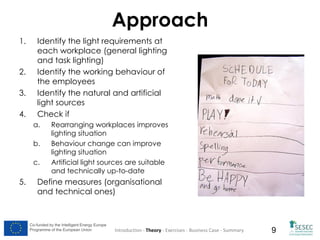
1.

2.

3.
4.

Identify the light requirements at
each workplace (general lighting
and task lighting)
Identify the working behaviour of
the employees
Identify the natural and artificial
light sources
Check if
a.

b.
c.

5.

Rearranging workplaces improves
lighting situation
Behaviour change can improve
lighting situation
Artificial light sources are suitable
and technically up-to-date

Define measures (organisational
and technical ones)

Co-funded by the Intelligent Energy Europe
Programme of the European Union

Introduction - Theory - Exercises - Business Case - Summary

9
1. Identify light requirements at
each workplace
Recommended indoor lighting levels by task and area

[6, p. 2]
Co-funded by the Intelligent Energy Europe
Programme of the European Union

Introduction - Theory - Exercises - Business Case - Summary

10
2. Identify working behaviour
of employees
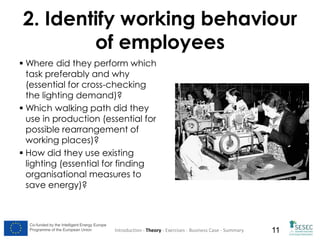
 Where did they perform which
task preferably and why
(essential for cross-checking
the lighting demand)?
 Which walking path did they
use in production (essential for
possible rearrangement of
working places)?
 How did they use existing
lighting (essential for finding
organisational measures to
save energy)?

Co-funded by the Intelligent Energy Europe
Programme of the European Union

Introduction - Theory - Exercises - Business Case - Summary

11
3. Identify natural and
artificial light sources
 The integration of space planning with
interior design (including choice of
interior surfaces and room geometries)
to optimize the use of natural light.
 Planning activities to optimize the use of
natural light
 Consideration of the spectral content
required for any activities needing
artificial light
 Selection of fixtures and lamp types
that reflect best available techniques
for energy conservation

[5, p. 246]

Co-funded by the Intelligent Energy Europe
Programme of the European Union

Introduction - Theory - Exercises - Business Case - Summary

12
4. Organisational Measures
a. Rearrange
workplace
b. Change
behaviour
c. Technical
measures
Co-funded by the Intelligent Energy Europe
Programme of the European Union

Introduction - Theory - Exercises - Business Case - Summary

13
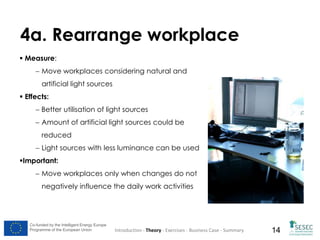
4a. Rearrange workplace
 Measure:
 Move workplaces considering natural and
artificial light sources
 Effects:

 Better utilisation of light sources
 Amount of artificial light sources could be
reduced
 Light sources with less luminance can be used

Important:
 Move workplaces only when changes do not
negatively influence the daily work activities

Co-funded by the Intelligent Energy Europe
Programme of the European Union

Introduction - Theory - Exercises - Business Case - Summary

14
4b. Change behaviour
 Measure:
 Clean reflectors regularly
 Use light only when the working place is
used

 Effects:
 Up to 20 % energy saving
 Prolonging the life of the lamp
 Lower replacement costs

Important:
 Consider the frequency of usage for
working instructions

Co-funded by the Intelligent Energy Europe
Programme of the European Union

Introduction - Theory - Exercises - Business Case - Summary

15
4c. Technical Measures
 Lamp replacement
 Efficient lights

 Interior design
 Lighting control

Co-funded by the Intelligent Energy Europe
Programme of the European Union

Introduction - Theory - Exercises - Business Case - Summary

16
Lamp replacement
 Measure:
 Change-over from T8/T12 fluorescent lamps
with conventional ballasts (CBs) to T5 lamps
with electronic ballasts

 Effects:
 Up to 40 % energy saving
 Prolonging the life of the lamp
 Lower replacement costs

Important:
 Cooperation with manufactures
 Replacement of the whole lamp, not only
of the bulb

Co-funded by the Intelligent Energy Europe
Programme of the European Union

[2, p. 39]

Introduction - Theory - Exercises - Business Case - Summary

17
Efficient lights
Measure:
 Installation of mirrored reflectors which are
adjusted on the current room height
 Effect:

 Optimum light yield, right up to the triple
value [8]
 Important:
 Concerning the geometric shape, the

mirrored reflectors should be adjusted to
the room height to avoid early expansion
of the light
[2, p. 39]

Co-funded by the Intelligent Energy Europe
Programme of the European Union

Introduction - Theory - Exercises - Business Case - Summary

18
Interior design
Measures:
 Selection of bright floor and wall colours
 Adaption of the light arrangement and the
classification of the switching group to the
respective task areas, the visual performance
and daylight
 Effect:
 Raise of the room utilisation factor
 Important:
 Avoiding shadowing through cable conduits,
pipelines, plant components and high-bay
racks
[2, p. 41]
Co-funded by the Intelligent Energy Europe
Programme of the European Union

Introduction - Theory - Exercises - Business Case - Summary

19
Lighting control
 Measures:
 In rooms with high daylight admission: daylightdependent lighting control system
 Link of the lighting to the machine power supply
 Lighting adapted to the operating time through
timer function[2, p. 41]
 Effect:
 Reduction of energy consumption up to 82 % [9, p. 1]
 Reduction of operating costs [10]
 Important:
 Installation of an occupancy-based control with
presence detection is mainly useful for highly
frequented rooms such as corridors, social and
storage area [2, p. 41]

Co-funded by the Intelligent Energy Europe
Programme of the European Union

Introduction - Theory - Exercises - Business Case - Summary

20
5. Define measures
 Define measures that are
adequate (realise 90% energy
potential not the final 10%).
 Define measures that are
affordable (short ROI, within
budget of company).
 Define measures that are future
oriented (do not select
technology that is already
succeeded by new ones).
Co-funded by the Intelligent Energy Europe
Programme of the European Union

Introduction - Theory - Exercises - Business Case - Summary

21
Exercises.

Co-funded by the Intelligent Energy Europe
Programme of the European Union

Introduction - Theory - Exercises - Business Case - Summary

22
Lamp replacement
What is the effect of a change-over
from lamps with conventional ballasts
(CBs) to T5 lamps with electronic
ballasts?
a.Up to 20% energy saving
b.Up to 40 % energy saving

Co-funded by the Intelligent Energy Europe
Programme of the European Union

Introduction - Theory - Exercises - Business Case - Summary

23
Lamp replacement
What is the effect of a change-over
from lamps with conventional ballasts
(CBs) to T5 lamps with electronic
ballasts?
a.Up to 20% energy saving
b.Up to 40 % energy saving

Co-funded by the Intelligent Energy Europe
Programme of the European Union

Introduction - Theory - Exercises - Business Case - Summary

24
Efficient lights
What can be done to improve the
efficiency of lights?
a. Installation of mirrored reflectors
b. Installation of prismatics

Co-funded by the Intelligent Energy Europe
Programme of the European Union

Introduction - Theory - Exercises - Business Case - Summary

25
Efficient lights
What can be done to improve the
efficiency of lights?
a. Installation of mirrored reflectors
b. Installation of prismatics

Co-funded by the Intelligent Energy Europe
Programme of the European Union

Introduction - Theory - Exercises - Business Case - Summary

26
Interior design
What could be measures to save
energy in context of the interior
design?
a. Selection of bright floor and wall
colours, avoiding shadowing through
cable conduits, pipelines, plant
components and high-bay racks
b. Using drapes to avoid shadowing,
selection of pastel floor and wall
colours
Co-funded by the Intelligent Energy Europe
Programme of the European Union

Introduction - Theory - Exercises - Business Case - Summary

27
Interior design
What could be measures to save
energy in context of the interior
design?
a. Selection of bright floor and wall
colours, avoiding shadowing through
cable conduits, pipelines, plant
components and high-bay racks
b. Using drapes to avoid shadowing,
selection of pastel floor and wall
colours
Co-funded by the Intelligent Energy Europe
Programme of the European Union

Introduction - Theory - Exercises - Business Case - Summary

28
Analysis
Analyse a room of
your choice
considering the
workplaces as well
as the natural and
artificial light
sources.

Co-funded by the Intelligent Energy Europe
Programme of the European Union

Introduction - Theory - Exercises - Business Case - Summary

29
Analysis
 Did you consider the frequency
and time of use (day/night,
duration)?
 Did you identify all artificial light
sources including mobile lamps
used by employees?
 Did you identify all types
of usage of the workplaces?
Co-funded by the Intelligent Energy Europe
Programme of the European Union

Introduction - Theory - Exercises - Business Case - Summary

30
Organisational Measures
Can the light
situation in this
room be improved
by organisational
measures?

Co-funded by the Intelligent Energy Europe
Programme of the European Union

Introduction - Theory - Exercises - Business Case - Summary

31
Organisational Measures
 Did you consider walking
routes?
 Did the changes disturbe the
flow of activities in any
workingplace?
 Is the lighting ok even in
exceptional circumstances
(e.g. additional night shift)?

Co-funded by the Intelligent Energy Europe
Programme of the European Union

Introduction - Theory - Exercises - Business Case - Summary

32
Business Case.

Co-funded by the Intelligent Energy Europe
Programme of the European Union

Introduction - Theory - Exercises - Business Case - Summary

33
Practical example - Würzburg
Transport services
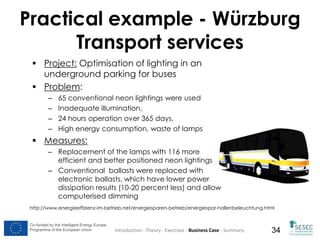
 Project: Optimisation of lighting in an
underground parking for buses
 Problem:
–
–
–
–

65 conventional neon lightings were used
Inadequate illumination,
24 hours operation over 365 days,
High energy consumption, waste of lamps

 Measures:
– Replacement of the lamps with 116 more
efficient and better positioned neon lightings
– Conventional ballasts were replaced with
electronic ballasts, which have lower power
dissipation results (10-20 percent less) and allow
computerised dimming
http://www.energieeffizienz-im-betrieb.net/energiesparen-betrieb/energiespar-hallenbeleuchtung.html

Co-funded by the Intelligent Energy Europe
Programme of the European Union

Introduction - Theory - Exercises - Business Case - Summary

34
Practical example - Würzburg
Transport services
Lighting improvements: Savings and Amortisation
ISSUE

COSTS

Investment costs

48.770 €

Amortisation

Around 7 years (statically)

Energy saving

29.900 kWh/year

CO2 saving

16.400 kg/year

Cost savings

6.900 €/year

Source: LEEN, via http://www.energieeffizienz-im-betrieb.net/energiesparenbetrieb/energiespar-hallenbeleuchtung.html

Co-funded by the Intelligent Energy Europe
Programme of the European Union

Introduction - Theory - Exercises - Business Case - Summary

35
Summary.

Co-funded by the Intelligent Energy Europe
Programme of the European Union

Introduction - Theory - Exercises - Business Case - Summary

36
Repetition









Excess energy consumption through lighting is
caused by technichal as well as behavioural issues.
Through the modernisation of the production sectors
and storage areas savings of up to 80 % are possible.
Lamp replacement can effect up to 40 % energy
saving.
Efficient lights through installation of mirrored
reflectors
Through the selection of bright wall colors, the
adaption of the light arrangement and the
installation of cable conduits, pipelines, plant
components and high-bay racks the room utilisation
factor can raise.
Lighting control through control systems, timer
function and the linking of the lighting to the
machine power supply.

Co-funded by the Intelligent Energy Europe
Programme of the European Union

Introduction - Theory - Exercises - Business Case - Summary

37
Readings












[1] CITEVE (2013): Critical Energy Saving Points for the Clothing Manufacturing
Process/Factory Environment, Deliverable D3.1.
[2] EnergieAgentur.NRW (2012): Leitfaden. Effiziente Energienutzung in der Textilveredlung.
[3] European Commission: Changes – bulbs and packaging. URL:
http://ec.europa.eu/energy/lumen/overview/whatchanges/index_en.htm.
[4] OÖ Energiesparverband: Buy Smart. Energieeffiziente Beschaffung. Presentation.
[5] European Commission (2009): Reference Document on Best Available Techniques for
Energy Efficiency.
[6] IAPA (2008): Lighting at work. URL: http://www.iapa.ca/pdf/lightin.pdf.
[7] European Commission (2009): Energy Efficiency.
[8] Hörbrand Effiziente Lichttechnik: Spiegelreflektoren zum Nachrüsten. URL:
http://www.hoerbrand-licht.de/produkte-und-loesungen/spiegelreflektoren/.
[9] Reichenbach, Franz: Energieeffizienz mit intelligenter Lichsteuerung. URL:
http://www.zublin-energieeffizienz.com/pdf/Fachbeitrag_Energieeffizienz.pdf.
[10] Frank Elektrotechnik: Beleuchtungsregelung. URL: http: //www.frankelektrotechnik.net/index.php?id=52
[11] Once: Understanding LED and LED lighting. URL:
http://www.onceinnovations.com/downloads/und_led.pdf

Co-funded by the Intelligent Energy Europe
Programme of the European Union

Introduction - Theory - Exercises - Business Case - Summary

38
More readings
General
Ashok, S. : Energy Savings & Audit In Textile Industry. URL: http://www.emtindia.net/process/textiles/pdf/Energy%20savings%20audit%20in%20textile%20industry.pdf.
Burthun, C./Kistamah, N./Chummun, J.: Energy saving strategies in textile industry: The case of Mauritius.
URL: http://active.cput.ac.za/energy/past_papers/ICUE/2006/PDF/15%20-%20Q058%20%20C%20Bhurtun%20-%20Paper.pdf.
Hassanbeigi, Ali: Energy-Efficiency Improvement Opportunities for the Textile Industry. URL:
http://www.energystar.gov/buildings/sites/default/uploads/tools/EE_Guidebook_for_Textile_industry.pdf.
Sharma, Sarita: Energy Management In Textile Industry. In: International Journal of Power System
Operation and Energy Management ISSN (PRINT): 2231 – 4407, Volume - 2, Issue - 1,2. URL:
http://www.idconline.com/technical_references/pdfs/electrical_engineering/ENERGY%20MANAGEMENT%20IN.pdf.







LED





Once: Understanding LED and LED lighting. URL:
http://www.onceinnovations.com/downloads/und_led.pdf
OÖ Energiesparverband: Buy Smart. Energieeffiziente Beschaffung. Presentation.
ArrowEurope: Lighting guide. URL: http://www.arroweurope.com/marketssolutions/markets/lighting/lighting-technologies-products/lenses-optics.html

Co-funded by the Intelligent Energy Europe
Programme of the European Union

Introduction - Theory - Exercises - Business Case - Summary

39
Pictures -1








Slide 1 – Sam de Clercq : Licht Festival Gent 2011 – URI:
http://www.flickr.com/photos/samdecle/5401328770/sizes/s/in/photostream/ Lizenz: CC BY-SA 2.0
(http://creativecommons.org/licenses/by-sa/2.0/)
Slide 2 – reflex477: Overview over Paris from Sacré-Cœur – URI:
http://www.flickr.com/photos/35164559@N04/4223238879/sizes/m/in/photostream/ Lizenz: CC BY 2.0
(http://creativecommons.org/licenses/by/2.0/)
Slide 3 – Dbduo Photography: Lamp – URI:
http://www.flickr.com/photos/drb62/515589256/sizes/m/in/photolist-MywHW5FAScn-A1WPM-57Rc68HWtNW-5uirCU-dMV1r-dorFj-8yd5d-vjae1-8TXAVj-6wFxdB-8krkZo-3RgJB-5n1H2Z-cQFsBh-8KQeJa-bTzctbTzbC-dffwA5-5jfpFc-fGKVHM-4LXxbb-7vxUoM-7Qxkbf-7MtQr-8q8MLj-CgiGA-cHg3Ah-6tdFjj-jMnCV6t9wWx-2oGeZE-HaBPH-NrUsy-6tdEUQ-sAKv2-bkcDHW-4HyEHn-5A3SLM-bw5RT7-7hnofE-dRLgo8-e3C95D5pM9Zw-7DUiPu-fzLw3-eptc-8G4BQ-bq5PT-9h9mKn/ Lizenz: CC BY-SA 2.0
(http://creativecommons.org/licenses/by-sa/2.0/)
Slide 4 – zoon bar: Lamps – URI:
http://www.flickr.com/photos/zoonabar/331721430/sizes/m/in/photostream/ Lizenz: CC BY 2.0
(http://creativecommons.org/licenses/by/2.0/)
Slide 5 – USCPSC: Floor Lamps Recalled by Dolan Northwest – URI:
http://www.flickr.com/photos/uscpsc/8390153148/sizes/z/in/photostream/ Lizenz: CC BY 2.0
(http://creativecommons.org/licenses/by/2.0/)
Slide 6 – SPÖ Presse und Kommunikation: 3.4.2009: SPÖ Bundesparteirat – URI:
http://www.flickr.com/photos/sozialdemokratie/3409066665/sizes/m/in/photostream/ Lizenz: CC BY-SA
2.0 (http://creativecommons.org/licenses/by-sa/2.0/)

Co-funded by the Intelligent Energy Europe
Programme of the European Union

Introduction - Theory - Exercises - Business Case - Summary

40
Pictures -2








Slide 7 – janemetsast: Lamp – URI:
http://www.flickr.com/photos/55972098@N07/5182487300/sizes/m/in/photostream/ Lizenz: CC BY 2.0
(http://creativecommons.org/licenses/by/2.0/)
Slide 8 – Skley: Grübel – URI: http://www.flickr.com/photos/dskley/8627475625/sizes/z/in/photostream/
Lizenz: CC BY-ND 2.0 (http://creativecommons.org/licenses/by-nd/2.0/)
Slide 9 – Carissa GoodNCrazy: kid to do list, list, Be happy and go home – URI:
http://www.flickr.com/photos/rog2bark/3437630552/sizes/m/in/photolist-6eLKNh-c1mn5W-9Lcbki-9jeZKuCdE9B-6tQG1N-8cuPQg-6oCMfR-5R2t5b-9uCMNF-7WWKna-82Z8Cz-87uSWj-839wC-8QW9Yq-7pHc1U6qsYHC-gu1Ra-7Jq5QH-7Mfehz-7VWPxJ-6J37Hp-4QCVn9-8QzzeL-8w3ARY-5JaQRk-5wvNsm-fMnd2ffgRgs-4yar1X-dr9xUw-dJLTso-3bLKoc-5sane8-eT8xC-5QjTMr-55xTxK-iYZum-i8xKL-61m8xK-6YzqVs-7JKQkd5SyRgw-4VSKqq-avZUVo-4ZwxHC-3svSV-4qU25r-4sCr3S-PVLFS-5rMwqS/ Lizenz: CC BY 2.0
(http://creativecommons.org/licenses/by/2.0/)
Slide 11 – BiblioArchives/ LibraryArchives: Female workers manufacturing military uniforms, Toronto, Ont.
/ Ouvrière fabriquant des uniformes militaires à Toronto (Ontario) – URI:
http://www.flickr.com/photos/lac-bac/4679194570/sizes/m/in/photostream/ Lizenz: CC BY 2.0
(http://creativecommons.org/licenses/by/2.0/)
Slide 12 – shuttermonkey: Create Your Own Light... – URI:
http://www.flickr.com/photos/shuttermonkey/3424750103/sizes/m/in/photolist-6dCJTz-6moqAN-e4xSV756eizp-rWnyK-7GTZm-4qKru-aR6Ccv-4wW88o-2VTuCE-bQdEGR-dbsfPr-4PYgvW-5pir9f-aydpGU-97pxoja5s8gA-4PYgyW-FbKBT-5Eiofc-4PYgt5-6TpLHt-4TVJnE-fksjoM-7rPuR9-9eh1G9-7S48QD-e8LbLi-eHXUzp6vSnoS-8RNKUN-9dQmEP-8hjYaC-dnep5T-dPJJUi-dRJMJ1-DRv9P-bLxCjX-ea4bYJ-6dezar-x4Rya-8EEtQN53K7N5-4arj5X-bo8dvk-5e7YEX-S1vD6-bn1uLk-b9CChF-5gVq8J-9bmtES/ Lizenz: CC BY 2.0
(http://creativecommons.org/licenses/by/2.0/)

Co-funded by the Intelligent Energy Europe
Programme of the European Union

Introduction - Theory - Exercises - Business Case - Summary

41
Pictures - 3
















Slide 13 – Peter Kaminski: STOP AL WAY – URI:
http://www.flickr.com/photos/peterkaminski/1510724/sizes/m/in/photostream/ Lizenz: CC BY 2.0
(http://creativecommons.org/licenses/by/2.0/)
Slide 14 – jan_krutisch: my workplace, lensbaby'd – URI:
http://www.flickr.com/photos/jankrutisch/116847458/sizes/m/in/photostream/ Lizenz: CC BY-SA 2.0
(http://creativecommons.org/licenses/by-sa/2.0/)
Slide 15- Anton Fomkin: The incandescent light bulb – URI:
http://www.flickr.com/photos/antonfomkin/3045744275/sizes/m/in/photostream/ Lizenz: CC BY 2.0
(http://creativecommons.org/licenses/by/2.0/)
Slide 16 – remography: bulb – URI: http://www.flickr.com/photos/rkottonau/161053228/sizes/m/in/photostream/
Lizenz: CC BY-SA 2.0 (http://creativecommons.org/licenses/by-sa/2.0/)
Slide 17 – AndYaDontStop: The road of life twists and turns and no two directions are ever the same. Yet our
lessons come from the journey, not the destination......365/365 – URI:
http://www.flickr.com/photos/thenovys/3833212599/sizes/m/in/photostream/ Lizenz: CC BY 2.0
(http://creativecommons.org/licenses/by/2.0/)
Slide 18 - dierk schaefer : Göppinger Taube mit Blick auf die Neue Mitte – URI:
http://www.flickr.com/photos/dierkschaefer/2516612934/sizes/m/in/photostream/ Lizenz: CC BY 2.0
(http://creativecommons.org/licenses/by/2.0/)
Slide 19 – net_efekt: Preparing for The Wave – URI:
http://www.flickr.com/photos/wheatfields/4114177553/sizes/m/in/photostream/ Lizenz: CC BY 2.0
(http://creativecommons.org/licenses/by/2.0/)
Slide 20 – marc faladerau: Bulb – URI:
http://www.flickr.com/photos/49889874@N05/5595820741/sizes/m/in/photostream/ Lizenz: CC BY 2.0
(http://creativecommons.org/licenses/by/2.0/)

Co-funded by the Intelligent Energy Europe
Programme of the European Union

Introduction - Theory - Exercises - Business Case - Summary

42
Pictures - 4













Slide 21 - Folded Word: Ticking Off – URI:
http://www.flickr.com/photos/foldedword/4893948301/sizes/m/in/photostream/ Lizenz: CC BY-SA 2.0
(http://creativecommons.org/licenses/by-sa/2.0/)
Slide 22 – Hangout Lifestyle: Arbeiten von zu Hause mit dem Laptop – URI: http://www.flickr.com/photos/hangoutlifestyle/5865980513/sizes/z/in/photostream/ Lizenz: CC BY 2.0 (http://creativecommons.org/licenses/by/2.0/)
Slide 23, 25, 27, 29, 31 – Bilal Kamoon: Question Mark Graffiti – URI: http://www.flickr.com/photos/bilalkamoon/6835060992/sizes/m/in/photostream/ Lizenz: CC BY 2.0 (http://creativecommons.org/licenses/by/2.0/)
Slide 24, 26, 28, 30, 32 – Photocapy: ! – URI:
http://www.flickr.com/photos/photocapy/3834784192/sizes/m/in/photostream/ Lizenz: CC BY-SA 2.0
(http://creativecommons.org/licenses/by-sa/2.0/)
Slide 33 - Son of Groucho: Not Our Guide – URI:
http://www.flickr.com/photos/sonofgroucho/3855487710/sizes/z/in/photostream/ Lizenz: CC BY 2.0
(http://creativecommons.org/licenses/by/2.0/)
Slide 34 - pantranco_bus: Bus Livery Design – URI:
http://www.flickr.com/photos/busesinthephilippines/4075803794/sizes/m/in/photostream/ Lizenz: CC BY 2.0
(http://creativecommons.org/licenses/by/2.0/)
Slide 36 - Kutchala Sutchi: Repetition, 23.03.'10, Abidjan-Yopougon (4640) – URI:
http://www.flickr.com/photos/kutchala/4469943694/sizes/o/in/photostream/ Lizenz: CC BY 2.0
(http://creativecommons.org/licenses/by/2.0/)
Slide 37 - evoo73: Windows – URI: http:// www.flickr.com/photos/evoo73/3702164848/sizes/m/in/photolist6D9yCq-6vRS9w-92UgLg-bBKKcC-83Z1LS-92D1wh-8Lp4DZ-9eFpNm-85cqDq-44D8GC-NVZY-8mUXHM-dRVtGQ8Sjmt9-8JHTXm-4smbxn-9T2Fmc-5uHqK6-8SgeHc-8SgeMv-8SgeRT-9Hdiuh-9Hdiy1-5x46B-xZsfi-6wej7A-3bYyF6-79FaT97x2qhZ-a2nVe-dG6o3i-8VLmtq-4uvVap-ueCfx-egoGtL-bvxMTN-dYKBiv-dYRiLU-dYGVKk-dYKwmn-dXXG7B-dYtuTpdYvwCv-4oVuHB-eBhcr-75KwuU-8WJ5td-8WJ5DW-akG62P-69MYKT-7GhAZZ Lizenz: CC BY 2.0
(http://creativecommons.org/licenses/by/2.0/)
Co-funded by the Intelligent Energy Europe
Programme of the European Union

Introduction - Theory - Exercises - Business Case - Summary

43

SESEC Training Module 6: Lighting

  • 1.
    Co-funded by theIntelligent Energy Europe Programme of the European Union Introduction - Theory - Exercises - Business Case - Summary 1
  • 2.
    Overview  Introduction  Theory    Identificationof lighting requirements for each area Analysis of lighting quality and design Management of lighting  Exercises  Business Case  Summary Co-funded by the Intelligent Energy Europe Programme of the European Union Introduction - Theory - Exercises - Business Case - Summary 2
  • 3.
    Co-funded by theIntelligent Energy Europe Programme of the European Union Introduction - Theory - Exercises - Business Case - Summary 3
  • 4.
    Reasons for excess consumption Excess consumption through technical issues: – Reduced area for natural lighting – Use of outdated and low efficiency lamp technology – Use of ferromagnetic ballasts – Inexistent reflectors on fixtures – Over lightened areas – Use of general instead of located lighting  Excess consumption through behavioral issues: – Dirty reflectors on fixtures – Lighting turned on unnecessarily [1, p. 10] Co-funded by the Intelligent Energy Europe Programme of the European Union Introduction - Theory - Exercises - Business Case - Summary 4
  • 5.
    Modernisation of production sectors andstorage areas will deliver savings of up to 80 %. [2, p. 38, 39] Co-funded by the Intelligent Energy Europe Programme of the European Union Introduction - Theory - Exercises - Business Case - Summary 5
  • 6.
    Political aspects  SinceSeptember 2009, non-clear (frosted) lamps have to be of A-class standard according to the EU's lamp energy label.  Conventional incandescent and halogen bulbs which cannot meet these requirements were gradually phased out from the EU market till late 2012.  Only compact fluorescent lamps and LED lamps can achieve the A-class standard - all the more inefficient non-clear types will disappear. [3] Co-funded by the Intelligent Energy Europe Programme of the European Union Introduction - Theory - Exercises - Business Case - Summary 6
  • 7.
    Co-funded by theIntelligent Energy Europe Programme of the European Union Introduction - Theory - Exercises - Business Case - Summary 7
  • 8.
    Co-funded by theIntelligent Energy Europe Programme of the European Union Introduction - Theory - Exercises - Business Case - Summary 8
  • 9.
    Approach 1. 2. 3. 4. Identify the lightrequirements at each workplace (general lighting and task lighting) Identify the working behaviour of the employees Identify the natural and artificial light sources Check if a. b. c. 5. Rearranging workplaces improves lighting situation Behaviour change can improve lighting situation Artificial light sources are suitable and technically up-to-date Define measures (organisational and technical ones) Co-funded by the Intelligent Energy Europe Programme of the European Union Introduction - Theory - Exercises - Business Case - Summary 9
  • 10.
    1. Identify lightrequirements at each workplace Recommended indoor lighting levels by task and area [6, p. 2] Co-funded by the Intelligent Energy Europe Programme of the European Union Introduction - Theory - Exercises - Business Case - Summary 10
  • 11.
    2. Identify workingbehaviour of employees  Where did they perform which task preferably and why (essential for cross-checking the lighting demand)?  Which walking path did they use in production (essential for possible rearrangement of working places)?  How did they use existing lighting (essential for finding organisational measures to save energy)? Co-funded by the Intelligent Energy Europe Programme of the European Union Introduction - Theory - Exercises - Business Case - Summary 11
  • 12.
    3. Identify naturaland artificial light sources  The integration of space planning with interior design (including choice of interior surfaces and room geometries) to optimize the use of natural light.  Planning activities to optimize the use of natural light  Consideration of the spectral content required for any activities needing artificial light  Selection of fixtures and lamp types that reflect best available techniques for energy conservation [5, p. 246] Co-funded by the Intelligent Energy Europe Programme of the European Union Introduction - Theory - Exercises - Business Case - Summary 12
  • 13.
    4. Organisational Measures a.Rearrange workplace b. Change behaviour c. Technical measures Co-funded by the Intelligent Energy Europe Programme of the European Union Introduction - Theory - Exercises - Business Case - Summary 13
  • 14.
    4a. Rearrange workplace Measure:  Move workplaces considering natural and artificial light sources  Effects:  Better utilisation of light sources  Amount of artificial light sources could be reduced  Light sources with less luminance can be used Important:  Move workplaces only when changes do not negatively influence the daily work activities Co-funded by the Intelligent Energy Europe Programme of the European Union Introduction - Theory - Exercises - Business Case - Summary 14
  • 15.
    4b. Change behaviour Measure:  Clean reflectors regularly  Use light only when the working place is used  Effects:  Up to 20 % energy saving  Prolonging the life of the lamp  Lower replacement costs Important:  Consider the frequency of usage for working instructions Co-funded by the Intelligent Energy Europe Programme of the European Union Introduction - Theory - Exercises - Business Case - Summary 15
  • 16.
    4c. Technical Measures Lamp replacement  Efficient lights  Interior design  Lighting control Co-funded by the Intelligent Energy Europe Programme of the European Union Introduction - Theory - Exercises - Business Case - Summary 16
  • 17.
    Lamp replacement  Measure: Change-over from T8/T12 fluorescent lamps with conventional ballasts (CBs) to T5 lamps with electronic ballasts  Effects:  Up to 40 % energy saving  Prolonging the life of the lamp  Lower replacement costs Important:  Cooperation with manufactures  Replacement of the whole lamp, not only of the bulb Co-funded by the Intelligent Energy Europe Programme of the European Union [2, p. 39] Introduction - Theory - Exercises - Business Case - Summary 17
  • 18.
    Efficient lights Measure:  Installationof mirrored reflectors which are adjusted on the current room height  Effect:  Optimum light yield, right up to the triple value [8]  Important:  Concerning the geometric shape, the mirrored reflectors should be adjusted to the room height to avoid early expansion of the light [2, p. 39] Co-funded by the Intelligent Energy Europe Programme of the European Union Introduction - Theory - Exercises - Business Case - Summary 18
  • 19.
    Interior design Measures:  Selectionof bright floor and wall colours  Adaption of the light arrangement and the classification of the switching group to the respective task areas, the visual performance and daylight  Effect:  Raise of the room utilisation factor  Important:  Avoiding shadowing through cable conduits, pipelines, plant components and high-bay racks [2, p. 41] Co-funded by the Intelligent Energy Europe Programme of the European Union Introduction - Theory - Exercises - Business Case - Summary 19
  • 20.
    Lighting control  Measures: In rooms with high daylight admission: daylightdependent lighting control system  Link of the lighting to the machine power supply  Lighting adapted to the operating time through timer function[2, p. 41]  Effect:  Reduction of energy consumption up to 82 % [9, p. 1]  Reduction of operating costs [10]  Important:  Installation of an occupancy-based control with presence detection is mainly useful for highly frequented rooms such as corridors, social and storage area [2, p. 41] Co-funded by the Intelligent Energy Europe Programme of the European Union Introduction - Theory - Exercises - Business Case - Summary 20
  • 21.
    5. Define measures Define measures that are adequate (realise 90% energy potential not the final 10%).  Define measures that are affordable (short ROI, within budget of company).  Define measures that are future oriented (do not select technology that is already succeeded by new ones). Co-funded by the Intelligent Energy Europe Programme of the European Union Introduction - Theory - Exercises - Business Case - Summary 21
  • 22.
    Exercises. Co-funded by theIntelligent Energy Europe Programme of the European Union Introduction - Theory - Exercises - Business Case - Summary 22
  • 23.
    Lamp replacement What isthe effect of a change-over from lamps with conventional ballasts (CBs) to T5 lamps with electronic ballasts? a.Up to 20% energy saving b.Up to 40 % energy saving Co-funded by the Intelligent Energy Europe Programme of the European Union Introduction - Theory - Exercises - Business Case - Summary 23
  • 24.
    Lamp replacement What isthe effect of a change-over from lamps with conventional ballasts (CBs) to T5 lamps with electronic ballasts? a.Up to 20% energy saving b.Up to 40 % energy saving Co-funded by the Intelligent Energy Europe Programme of the European Union Introduction - Theory - Exercises - Business Case - Summary 24
  • 25.
    Efficient lights What canbe done to improve the efficiency of lights? a. Installation of mirrored reflectors b. Installation of prismatics Co-funded by the Intelligent Energy Europe Programme of the European Union Introduction - Theory - Exercises - Business Case - Summary 25
  • 26.
    Efficient lights What canbe done to improve the efficiency of lights? a. Installation of mirrored reflectors b. Installation of prismatics Co-funded by the Intelligent Energy Europe Programme of the European Union Introduction - Theory - Exercises - Business Case - Summary 26
  • 27.
    Interior design What couldbe measures to save energy in context of the interior design? a. Selection of bright floor and wall colours, avoiding shadowing through cable conduits, pipelines, plant components and high-bay racks b. Using drapes to avoid shadowing, selection of pastel floor and wall colours Co-funded by the Intelligent Energy Europe Programme of the European Union Introduction - Theory - Exercises - Business Case - Summary 27
  • 28.
    Interior design What couldbe measures to save energy in context of the interior design? a. Selection of bright floor and wall colours, avoiding shadowing through cable conduits, pipelines, plant components and high-bay racks b. Using drapes to avoid shadowing, selection of pastel floor and wall colours Co-funded by the Intelligent Energy Europe Programme of the European Union Introduction - Theory - Exercises - Business Case - Summary 28
  • 29.
    Analysis Analyse a roomof your choice considering the workplaces as well as the natural and artificial light sources. Co-funded by the Intelligent Energy Europe Programme of the European Union Introduction - Theory - Exercises - Business Case - Summary 29
  • 30.
    Analysis  Did youconsider the frequency and time of use (day/night, duration)?  Did you identify all artificial light sources including mobile lamps used by employees?  Did you identify all types of usage of the workplaces? Co-funded by the Intelligent Energy Europe Programme of the European Union Introduction - Theory - Exercises - Business Case - Summary 30
  • 31.
    Organisational Measures Can thelight situation in this room be improved by organisational measures? Co-funded by the Intelligent Energy Europe Programme of the European Union Introduction - Theory - Exercises - Business Case - Summary 31
  • 32.
    Organisational Measures  Didyou consider walking routes?  Did the changes disturbe the flow of activities in any workingplace?  Is the lighting ok even in exceptional circumstances (e.g. additional night shift)? Co-funded by the Intelligent Energy Europe Programme of the European Union Introduction - Theory - Exercises - Business Case - Summary 32
  • 33.
    Business Case. Co-funded bythe Intelligent Energy Europe Programme of the European Union Introduction - Theory - Exercises - Business Case - Summary 33
  • 34.
    Practical example -Würzburg Transport services  Project: Optimisation of lighting in an underground parking for buses  Problem: – – – – 65 conventional neon lightings were used Inadequate illumination, 24 hours operation over 365 days, High energy consumption, waste of lamps  Measures: – Replacement of the lamps with 116 more efficient and better positioned neon lightings – Conventional ballasts were replaced with electronic ballasts, which have lower power dissipation results (10-20 percent less) and allow computerised dimming http://www.energieeffizienz-im-betrieb.net/energiesparen-betrieb/energiespar-hallenbeleuchtung.html Co-funded by the Intelligent Energy Europe Programme of the European Union Introduction - Theory - Exercises - Business Case - Summary 34
  • 35.
    Practical example -Würzburg Transport services Lighting improvements: Savings and Amortisation ISSUE COSTS Investment costs 48.770 € Amortisation Around 7 years (statically) Energy saving 29.900 kWh/year CO2 saving 16.400 kg/year Cost savings 6.900 €/year Source: LEEN, via http://www.energieeffizienz-im-betrieb.net/energiesparenbetrieb/energiespar-hallenbeleuchtung.html Co-funded by the Intelligent Energy Europe Programme of the European Union Introduction - Theory - Exercises - Business Case - Summary 35
  • 36.
    Summary. Co-funded by theIntelligent Energy Europe Programme of the European Union Introduction - Theory - Exercises - Business Case - Summary 36
  • 37.
    Repetition       Excess energy consumptionthrough lighting is caused by technichal as well as behavioural issues. Through the modernisation of the production sectors and storage areas savings of up to 80 % are possible. Lamp replacement can effect up to 40 % energy saving. Efficient lights through installation of mirrored reflectors Through the selection of bright wall colors, the adaption of the light arrangement and the installation of cable conduits, pipelines, plant components and high-bay racks the room utilisation factor can raise. Lighting control through control systems, timer function and the linking of the lighting to the machine power supply. Co-funded by the Intelligent Energy Europe Programme of the European Union Introduction - Theory - Exercises - Business Case - Summary 37
  • 38.
    Readings            [1] CITEVE (2013):Critical Energy Saving Points for the Clothing Manufacturing Process/Factory Environment, Deliverable D3.1. [2] EnergieAgentur.NRW (2012): Leitfaden. Effiziente Energienutzung in der Textilveredlung. [3] European Commission: Changes – bulbs and packaging. URL: http://ec.europa.eu/energy/lumen/overview/whatchanges/index_en.htm. [4] OÖ Energiesparverband: Buy Smart. Energieeffiziente Beschaffung. Presentation. [5] European Commission (2009): Reference Document on Best Available Techniques for Energy Efficiency. [6] IAPA (2008): Lighting at work. URL: http://www.iapa.ca/pdf/lightin.pdf. [7] European Commission (2009): Energy Efficiency. [8] Hörbrand Effiziente Lichttechnik: Spiegelreflektoren zum Nachrüsten. URL: http://www.hoerbrand-licht.de/produkte-und-loesungen/spiegelreflektoren/. [9] Reichenbach, Franz: Energieeffizienz mit intelligenter Lichsteuerung. URL: http://www.zublin-energieeffizienz.com/pdf/Fachbeitrag_Energieeffizienz.pdf. [10] Frank Elektrotechnik: Beleuchtungsregelung. URL: http: //www.frankelektrotechnik.net/index.php?id=52 [11] Once: Understanding LED and LED lighting. URL: http://www.onceinnovations.com/downloads/und_led.pdf Co-funded by the Intelligent Energy Europe Programme of the European Union Introduction - Theory - Exercises - Business Case - Summary 38
  • 39.
    More readings General Ashok, S.: Energy Savings & Audit In Textile Industry. URL: http://www.emtindia.net/process/textiles/pdf/Energy%20savings%20audit%20in%20textile%20industry.pdf. Burthun, C./Kistamah, N./Chummun, J.: Energy saving strategies in textile industry: The case of Mauritius. URL: http://active.cput.ac.za/energy/past_papers/ICUE/2006/PDF/15%20-%20Q058%20%20C%20Bhurtun%20-%20Paper.pdf. Hassanbeigi, Ali: Energy-Efficiency Improvement Opportunities for the Textile Industry. URL: http://www.energystar.gov/buildings/sites/default/uploads/tools/EE_Guidebook_for_Textile_industry.pdf. Sharma, Sarita: Energy Management In Textile Industry. In: International Journal of Power System Operation and Energy Management ISSN (PRINT): 2231 – 4407, Volume - 2, Issue - 1,2. URL: http://www.idconline.com/technical_references/pdfs/electrical_engineering/ENERGY%20MANAGEMENT%20IN.pdf.     LED    Once: Understanding LED and LED lighting. URL: http://www.onceinnovations.com/downloads/und_led.pdf OÖ Energiesparverband: Buy Smart. Energieeffiziente Beschaffung. Presentation. ArrowEurope: Lighting guide. URL: http://www.arroweurope.com/marketssolutions/markets/lighting/lighting-technologies-products/lenses-optics.html Co-funded by the Intelligent Energy Europe Programme of the European Union Introduction - Theory - Exercises - Business Case - Summary 39
  • 40.
    Pictures -1       Slide 1– Sam de Clercq : Licht Festival Gent 2011 – URI: http://www.flickr.com/photos/samdecle/5401328770/sizes/s/in/photostream/ Lizenz: CC BY-SA 2.0 (http://creativecommons.org/licenses/by-sa/2.0/) Slide 2 – reflex477: Overview over Paris from Sacré-Cœur – URI: http://www.flickr.com/photos/35164559@N04/4223238879/sizes/m/in/photostream/ Lizenz: CC BY 2.0 (http://creativecommons.org/licenses/by/2.0/) Slide 3 – Dbduo Photography: Lamp – URI: http://www.flickr.com/photos/drb62/515589256/sizes/m/in/photolist-MywHW5FAScn-A1WPM-57Rc68HWtNW-5uirCU-dMV1r-dorFj-8yd5d-vjae1-8TXAVj-6wFxdB-8krkZo-3RgJB-5n1H2Z-cQFsBh-8KQeJa-bTzctbTzbC-dffwA5-5jfpFc-fGKVHM-4LXxbb-7vxUoM-7Qxkbf-7MtQr-8q8MLj-CgiGA-cHg3Ah-6tdFjj-jMnCV6t9wWx-2oGeZE-HaBPH-NrUsy-6tdEUQ-sAKv2-bkcDHW-4HyEHn-5A3SLM-bw5RT7-7hnofE-dRLgo8-e3C95D5pM9Zw-7DUiPu-fzLw3-eptc-8G4BQ-bq5PT-9h9mKn/ Lizenz: CC BY-SA 2.0 (http://creativecommons.org/licenses/by-sa/2.0/) Slide 4 – zoon bar: Lamps – URI: http://www.flickr.com/photos/zoonabar/331721430/sizes/m/in/photostream/ Lizenz: CC BY 2.0 (http://creativecommons.org/licenses/by/2.0/) Slide 5 – USCPSC: Floor Lamps Recalled by Dolan Northwest – URI: http://www.flickr.com/photos/uscpsc/8390153148/sizes/z/in/photostream/ Lizenz: CC BY 2.0 (http://creativecommons.org/licenses/by/2.0/) Slide 6 – SPÖ Presse und Kommunikation: 3.4.2009: SPÖ Bundesparteirat – URI: http://www.flickr.com/photos/sozialdemokratie/3409066665/sizes/m/in/photostream/ Lizenz: CC BY-SA 2.0 (http://creativecommons.org/licenses/by-sa/2.0/) Co-funded by the Intelligent Energy Europe Programme of the European Union Introduction - Theory - Exercises - Business Case - Summary 40
  • 41.
    Pictures -2      Slide 7– janemetsast: Lamp – URI: http://www.flickr.com/photos/55972098@N07/5182487300/sizes/m/in/photostream/ Lizenz: CC BY 2.0 (http://creativecommons.org/licenses/by/2.0/) Slide 8 – Skley: Grübel – URI: http://www.flickr.com/photos/dskley/8627475625/sizes/z/in/photostream/ Lizenz: CC BY-ND 2.0 (http://creativecommons.org/licenses/by-nd/2.0/) Slide 9 – Carissa GoodNCrazy: kid to do list, list, Be happy and go home – URI: http://www.flickr.com/photos/rog2bark/3437630552/sizes/m/in/photolist-6eLKNh-c1mn5W-9Lcbki-9jeZKuCdE9B-6tQG1N-8cuPQg-6oCMfR-5R2t5b-9uCMNF-7WWKna-82Z8Cz-87uSWj-839wC-8QW9Yq-7pHc1U6qsYHC-gu1Ra-7Jq5QH-7Mfehz-7VWPxJ-6J37Hp-4QCVn9-8QzzeL-8w3ARY-5JaQRk-5wvNsm-fMnd2ffgRgs-4yar1X-dr9xUw-dJLTso-3bLKoc-5sane8-eT8xC-5QjTMr-55xTxK-iYZum-i8xKL-61m8xK-6YzqVs-7JKQkd5SyRgw-4VSKqq-avZUVo-4ZwxHC-3svSV-4qU25r-4sCr3S-PVLFS-5rMwqS/ Lizenz: CC BY 2.0 (http://creativecommons.org/licenses/by/2.0/) Slide 11 – BiblioArchives/ LibraryArchives: Female workers manufacturing military uniforms, Toronto, Ont. / Ouvrière fabriquant des uniformes militaires à Toronto (Ontario) – URI: http://www.flickr.com/photos/lac-bac/4679194570/sizes/m/in/photostream/ Lizenz: CC BY 2.0 (http://creativecommons.org/licenses/by/2.0/) Slide 12 – shuttermonkey: Create Your Own Light... – URI: http://www.flickr.com/photos/shuttermonkey/3424750103/sizes/m/in/photolist-6dCJTz-6moqAN-e4xSV756eizp-rWnyK-7GTZm-4qKru-aR6Ccv-4wW88o-2VTuCE-bQdEGR-dbsfPr-4PYgvW-5pir9f-aydpGU-97pxoja5s8gA-4PYgyW-FbKBT-5Eiofc-4PYgt5-6TpLHt-4TVJnE-fksjoM-7rPuR9-9eh1G9-7S48QD-e8LbLi-eHXUzp6vSnoS-8RNKUN-9dQmEP-8hjYaC-dnep5T-dPJJUi-dRJMJ1-DRv9P-bLxCjX-ea4bYJ-6dezar-x4Rya-8EEtQN53K7N5-4arj5X-bo8dvk-5e7YEX-S1vD6-bn1uLk-b9CChF-5gVq8J-9bmtES/ Lizenz: CC BY 2.0 (http://creativecommons.org/licenses/by/2.0/) Co-funded by the Intelligent Energy Europe Programme of the European Union Introduction - Theory - Exercises - Business Case - Summary 41
  • 42.
    Pictures - 3         Slide13 – Peter Kaminski: STOP AL WAY – URI: http://www.flickr.com/photos/peterkaminski/1510724/sizes/m/in/photostream/ Lizenz: CC BY 2.0 (http://creativecommons.org/licenses/by/2.0/) Slide 14 – jan_krutisch: my workplace, lensbaby'd – URI: http://www.flickr.com/photos/jankrutisch/116847458/sizes/m/in/photostream/ Lizenz: CC BY-SA 2.0 (http://creativecommons.org/licenses/by-sa/2.0/) Slide 15- Anton Fomkin: The incandescent light bulb – URI: http://www.flickr.com/photos/antonfomkin/3045744275/sizes/m/in/photostream/ Lizenz: CC BY 2.0 (http://creativecommons.org/licenses/by/2.0/) Slide 16 – remography: bulb – URI: http://www.flickr.com/photos/rkottonau/161053228/sizes/m/in/photostream/ Lizenz: CC BY-SA 2.0 (http://creativecommons.org/licenses/by-sa/2.0/) Slide 17 – AndYaDontStop: The road of life twists and turns and no two directions are ever the same. Yet our lessons come from the journey, not the destination......365/365 – URI: http://www.flickr.com/photos/thenovys/3833212599/sizes/m/in/photostream/ Lizenz: CC BY 2.0 (http://creativecommons.org/licenses/by/2.0/) Slide 18 - dierk schaefer : Göppinger Taube mit Blick auf die Neue Mitte – URI: http://www.flickr.com/photos/dierkschaefer/2516612934/sizes/m/in/photostream/ Lizenz: CC BY 2.0 (http://creativecommons.org/licenses/by/2.0/) Slide 19 – net_efekt: Preparing for The Wave – URI: http://www.flickr.com/photos/wheatfields/4114177553/sizes/m/in/photostream/ Lizenz: CC BY 2.0 (http://creativecommons.org/licenses/by/2.0/) Slide 20 – marc faladerau: Bulb – URI: http://www.flickr.com/photos/49889874@N05/5595820741/sizes/m/in/photostream/ Lizenz: CC BY 2.0 (http://creativecommons.org/licenses/by/2.0/) Co-funded by the Intelligent Energy Europe Programme of the European Union Introduction - Theory - Exercises - Business Case - Summary 42
  • 43.
    Pictures - 4        Slide21 - Folded Word: Ticking Off – URI: http://www.flickr.com/photos/foldedword/4893948301/sizes/m/in/photostream/ Lizenz: CC BY-SA 2.0 (http://creativecommons.org/licenses/by-sa/2.0/) Slide 22 – Hangout Lifestyle: Arbeiten von zu Hause mit dem Laptop – URI: http://www.flickr.com/photos/hangoutlifestyle/5865980513/sizes/z/in/photostream/ Lizenz: CC BY 2.0 (http://creativecommons.org/licenses/by/2.0/) Slide 23, 25, 27, 29, 31 – Bilal Kamoon: Question Mark Graffiti – URI: http://www.flickr.com/photos/bilalkamoon/6835060992/sizes/m/in/photostream/ Lizenz: CC BY 2.0 (http://creativecommons.org/licenses/by/2.0/) Slide 24, 26, 28, 30, 32 – Photocapy: ! – URI: http://www.flickr.com/photos/photocapy/3834784192/sizes/m/in/photostream/ Lizenz: CC BY-SA 2.0 (http://creativecommons.org/licenses/by-sa/2.0/) Slide 33 - Son of Groucho: Not Our Guide – URI: http://www.flickr.com/photos/sonofgroucho/3855487710/sizes/z/in/photostream/ Lizenz: CC BY 2.0 (http://creativecommons.org/licenses/by/2.0/) Slide 34 - pantranco_bus: Bus Livery Design – URI: http://www.flickr.com/photos/busesinthephilippines/4075803794/sizes/m/in/photostream/ Lizenz: CC BY 2.0 (http://creativecommons.org/licenses/by/2.0/) Slide 36 - Kutchala Sutchi: Repetition, 23.03.'10, Abidjan-Yopougon (4640) – URI: http://www.flickr.com/photos/kutchala/4469943694/sizes/o/in/photostream/ Lizenz: CC BY 2.0 (http://creativecommons.org/licenses/by/2.0/) Slide 37 - evoo73: Windows – URI: http:// www.flickr.com/photos/evoo73/3702164848/sizes/m/in/photolist6D9yCq-6vRS9w-92UgLg-bBKKcC-83Z1LS-92D1wh-8Lp4DZ-9eFpNm-85cqDq-44D8GC-NVZY-8mUXHM-dRVtGQ8Sjmt9-8JHTXm-4smbxn-9T2Fmc-5uHqK6-8SgeHc-8SgeMv-8SgeRT-9Hdiuh-9Hdiy1-5x46B-xZsfi-6wej7A-3bYyF6-79FaT97x2qhZ-a2nVe-dG6o3i-8VLmtq-4uvVap-ueCfx-egoGtL-bvxMTN-dYKBiv-dYRiLU-dYGVKk-dYKwmn-dXXG7B-dYtuTpdYvwCv-4oVuHB-eBhcr-75KwuU-8WJ5td-8WJ5DW-akG62P-69MYKT-7GhAZZ Lizenz: CC BY 2.0 (http://creativecommons.org/licenses/by/2.0/) Co-funded by the Intelligent Energy Europe Programme of the European Union Introduction - Theory - Exercises - Business Case - Summary 43