CAMERA ANGLES
By Rahim Rahat
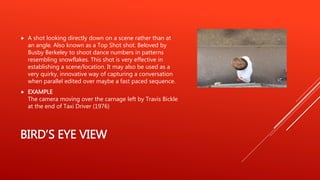
BIRD’S EYE VIEW
 A shot looking directly down on a scene rather than at
an angle. Also known as a Top Shot shot. Beloved by
Busby Berkeley to shoot dance numbers in patterns
resembling snowflakes. This shot is very effective in
establishing a scene/location. It may also be used as a
very quirky, innovative way of capturing a conversation
when parallel edited over maybe a fast paced sequence.
 EXAMPLE
The camera moving over the carnage left by Travis Bickle
at the end of Taxi Driver (1976)
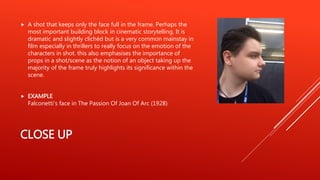
CLOSE UP
 A shot that keeps only the face full in the frame. Perhaps the
most important building block in cinematic storytelling. It is
dramatic and slightly clichéd but is a very common mainstay in
film especially in thrillers to really focus on the emotion of the
characters in shot. this also emphasises the importance of
props in a shot/scene as the notion of an object taking up the
majority of the frame truly highlights its significance within the
scene.
 EXAMPLE
Falconetti's face in The Passion Of Joan Of Arc (1928)
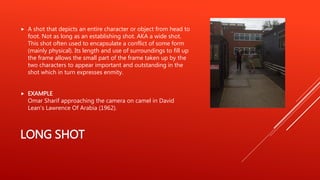
LONG SHOT
 A shot that depicts an entire character or object from head to
foot. Not as long as an establishing shot. AKA a wide shot.
This shot often used to encapsulate a conflict of some form
(mainly physical). Its length and use of surroundings to fill up
the frame allows the small part of the frame taken up by the
two characters to appear important and outstanding in the
shot which in turn expresses enmity.
 EXAMPLE
Omar Sharif approaching the camera on camel in David
Lean's Lawrence Of Arabia (1962).
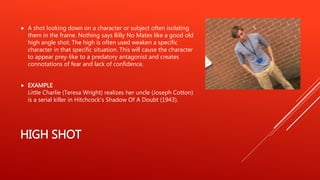
HIGH SHOT
 A shot looking down on a character or subject often isolating
them in the frame. Nothing says Billy No Mates like a good old
high angle shot. The high is often used weaken a specific
character in that specific situation. This will cause the character
to appear prey-like to a predatory antagonist and creates
connotations of fear and lack of confidence.
 EXAMPLE
Little Charlie (Teresa Wright) realizes her uncle (Joseph Cotton)
is a serial killer in Hitchcock's Shadow Of A Doubt (1943).
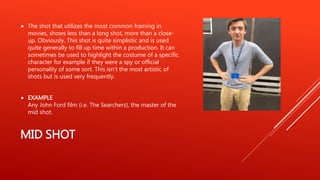
MID SHOT
 The shot that utilizes the most common framing in
movies, shows less than a long shot, more than a close-
up. Obviously. This shot is quite simplistic and is used
quite generally to fill up time within a production. It can
sometimes be used to highlight the costume of a specific
character for example if they were a spy or official
personality of some sort. This isn’t the most artistic of
shots but is used very frequently.
 EXAMPLE
Any John Ford film (i.e. The Searchers), the master of the
mid shot.
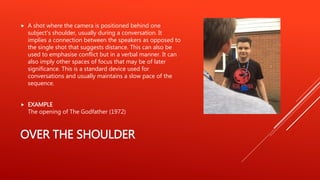
OVER THE SHOULDER
 A shot where the camera is positioned behind one
subject's shoulder, usually during a conversation. It
implies a connection between the speakers as opposed to
the single shot that suggests distance. This can also be
used to emphasise conflict but in a verbal manner. It can
also imply other spaces of focus that may be of later
significance. This is a standard device used for
conversations and usually maintains a slow pace of the
sequence.
 EXAMPLE
The opening of The Godfather (1972)
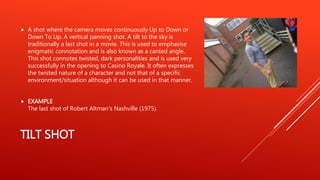
TILT SHOT
 A shot where the camera moves continuously Up to Down or
Down To Up. A vertical panning shot. A tilt to the sky is
traditionally a last shot in a movie. This is used to emphasise
enigmatic connotation and is also known as a canted angle.
This shot connotes twisted, dark personalities and is used very
successfully in the opening to Casino Royale. It often expresses
the twisted nature of a character and not that of a specific
environment/situation although it can be used in that manner.
 EXAMPLE
The last shot of Robert Altman's Nashville (1975).
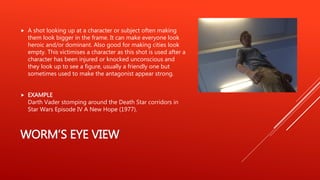
WORM’S EYE VIEW
 A shot looking up at a character or subject often making
them look bigger in the frame. It can make everyone look
heroic and/or dominant. Also good for making cities look
empty. This victimises a character as this shot is used after a
character has been injured or knocked unconscious and
they look up to see a figure, usually a friendly one but
sometimes used to make the antagonist appear strong.
 EXAMPLE
Darth Vader stomping around the Death Star corridors in
Star Wars Episode IV A New Hope (1977).

Camera angles improved version

  • 1.
  • 2.
    BIRD’S EYE VIEW A shot looking directly down on a scene rather than at an angle. Also known as a Top Shot shot. Beloved by Busby Berkeley to shoot dance numbers in patterns resembling snowflakes. This shot is very effective in establishing a scene/location. It may also be used as a very quirky, innovative way of capturing a conversation when parallel edited over maybe a fast paced sequence.  EXAMPLE The camera moving over the carnage left by Travis Bickle at the end of Taxi Driver (1976)
  • 3.
    CLOSE UP  Ashot that keeps only the face full in the frame. Perhaps the most important building block in cinematic storytelling. It is dramatic and slightly clichéd but is a very common mainstay in film especially in thrillers to really focus on the emotion of the characters in shot. this also emphasises the importance of props in a shot/scene as the notion of an object taking up the majority of the frame truly highlights its significance within the scene.  EXAMPLE Falconetti's face in The Passion Of Joan Of Arc (1928)
  • 4.
    LONG SHOT  Ashot that depicts an entire character or object from head to foot. Not as long as an establishing shot. AKA a wide shot. This shot often used to encapsulate a conflict of some form (mainly physical). Its length and use of surroundings to fill up the frame allows the small part of the frame taken up by the two characters to appear important and outstanding in the shot which in turn expresses enmity.  EXAMPLE Omar Sharif approaching the camera on camel in David Lean's Lawrence Of Arabia (1962).
  • 5.
    HIGH SHOT  Ashot looking down on a character or subject often isolating them in the frame. Nothing says Billy No Mates like a good old high angle shot. The high is often used weaken a specific character in that specific situation. This will cause the character to appear prey-like to a predatory antagonist and creates connotations of fear and lack of confidence.  EXAMPLE Little Charlie (Teresa Wright) realizes her uncle (Joseph Cotton) is a serial killer in Hitchcock's Shadow Of A Doubt (1943).
  • 6.
    MID SHOT  Theshot that utilizes the most common framing in movies, shows less than a long shot, more than a close- up. Obviously. This shot is quite simplistic and is used quite generally to fill up time within a production. It can sometimes be used to highlight the costume of a specific character for example if they were a spy or official personality of some sort. This isn’t the most artistic of shots but is used very frequently.  EXAMPLE Any John Ford film (i.e. The Searchers), the master of the mid shot.
  • 7.
    OVER THE SHOULDER A shot where the camera is positioned behind one subject's shoulder, usually during a conversation. It implies a connection between the speakers as opposed to the single shot that suggests distance. This can also be used to emphasise conflict but in a verbal manner. It can also imply other spaces of focus that may be of later significance. This is a standard device used for conversations and usually maintains a slow pace of the sequence.  EXAMPLE The opening of The Godfather (1972)
  • 8.
    TILT SHOT  Ashot where the camera moves continuously Up to Down or Down To Up. A vertical panning shot. A tilt to the sky is traditionally a last shot in a movie. This is used to emphasise enigmatic connotation and is also known as a canted angle. This shot connotes twisted, dark personalities and is used very successfully in the opening to Casino Royale. It often expresses the twisted nature of a character and not that of a specific environment/situation although it can be used in that manner.  EXAMPLE The last shot of Robert Altman's Nashville (1975).
  • 9.
    WORM’S EYE VIEW A shot looking up at a character or subject often making them look bigger in the frame. It can make everyone look heroic and/or dominant. Also good for making cities look empty. This victimises a character as this shot is used after a character has been injured or knocked unconscious and they look up to see a figure, usually a friendly one but sometimes used to make the antagonist appear strong.  EXAMPLE Darth Vader stomping around the Death Star corridors in Star Wars Episode IV A New Hope (1977).