Choose a partner.
Exchange one copy of your Proposal with each other.
   1. Use the copy of your partner’s Proposal in front of you to take
   notes. Mark the locations in the text where they are responding to
   my questions.
   2. If they do not answer a question, make note of it on the
   Proposal so that you can bring it up with them at a later time.
   3. Remember that you and your classmate have the tools to do
   critical analysis. If they have not demonstrated so in their Proposal,
   you need to ask them to be more specific, to demonstrate that
   knowledge.
   4. Be professional and collegial in your questions and your
   discussion. You are asking questions because you want their
   Proposal, and the work that grows out of the Proposal to be as
   strong as it possibly can be. Asking questions, and answering them
   often enables us to think about things in different ways than we
   otherwise would.
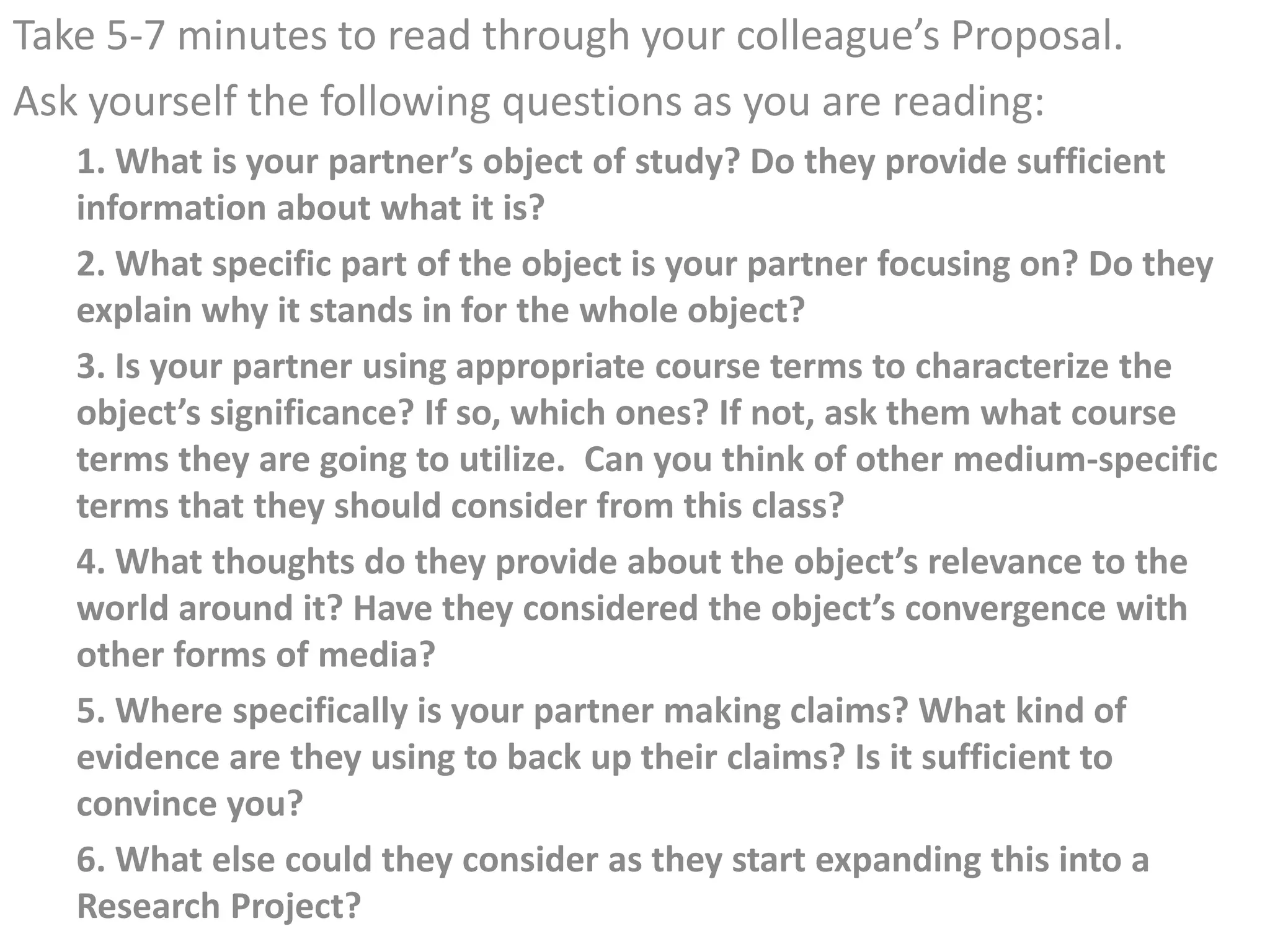
Take 5-7 minutes to read through your colleague’s Proposal.
Ask yourself the following questions as you are reading:
   1. What is your partner’s object of study? Do they provide sufficient
   information about what it is?
   2. What specific part of the object is your partner focusing on? Do they
   explain why it stands in for the whole object?
   3. Is your partner using appropriate course terms to characterize the
   object’s significance? If so, which ones? If not, ask them what course
   terms they are going to utilize. Can you think of other medium-specific
   terms that they should consider from this class?
   4. What thoughts do they provide about the object’s relevance to the
   world around it? Have they considered the object’s convergence with
   other forms of media?
   5. Where specifically is your partner making claims? What kind of
   evidence are they using to back up their claims? Is it sufficient to
   convince you?
   6. What else could they consider as they start expanding this into a
   Research Project?
Now take 5-7 minutes to exchange responses to each
other’s Proposal.
  1. Provide for them an oral synopsis of your written notes
  regarding their Proposal.
  2. Go through your individual responses to the questions
  posed above.
  3. Make reference to your classmate’s Proposal and to
  your notes. Point out the areas in the text where they are
  responding to (or should be responding to) the above
  questions.
  4. Ask them to specify and to clarify if something seems
  vague.
  5. Ask questions and be respectful.
On Tuesday we will wrap up our discussion of the Internet and will begin to
talk about media effects. Come to class ready to answer the following
questions:
        *What is the “hypodermic-needle model” theory of media
        effects? During what time does it come into use? What surrounding
        historical events contribute to the popularity of this theory?

       *What is the “minimal-effects model” theory? What research
       techniques enable social scientists to complicate earlier theories of
       media effects? What does the “minimal-effects model” still assume?

       *What is the “uses and gratifications model” theory? How do
       researchers approach their research subjects differently in this
       theoretical model than with the other two models?

       *What does “cultural studies” research focus on?

       At the end of Tuesday’s class we will go through the Peer Review
       assignment. You will be matched up with a colleague for the Peer
       Review assignment.

Com 250 11.8.12

  • 1.
    Choose a partner. Exchangeone copy of your Proposal with each other. 1. Use the copy of your partner’s Proposal in front of you to take notes. Mark the locations in the text where they are responding to my questions. 2. If they do not answer a question, make note of it on the Proposal so that you can bring it up with them at a later time. 3. Remember that you and your classmate have the tools to do critical analysis. If they have not demonstrated so in their Proposal, you need to ask them to be more specific, to demonstrate that knowledge. 4. Be professional and collegial in your questions and your discussion. You are asking questions because you want their Proposal, and the work that grows out of the Proposal to be as strong as it possibly can be. Asking questions, and answering them often enables us to think about things in different ways than we otherwise would.
  • 2.
    Take 5-7 minutesto read through your colleague’s Proposal. Ask yourself the following questions as you are reading: 1. What is your partner’s object of study? Do they provide sufficient information about what it is? 2. What specific part of the object is your partner focusing on? Do they explain why it stands in for the whole object? 3. Is your partner using appropriate course terms to characterize the object’s significance? If so, which ones? If not, ask them what course terms they are going to utilize. Can you think of other medium-specific terms that they should consider from this class? 4. What thoughts do they provide about the object’s relevance to the world around it? Have they considered the object’s convergence with other forms of media? 5. Where specifically is your partner making claims? What kind of evidence are they using to back up their claims? Is it sufficient to convince you? 6. What else could they consider as they start expanding this into a Research Project?
  • 3.
    Now take 5-7minutes to exchange responses to each other’s Proposal. 1. Provide for them an oral synopsis of your written notes regarding their Proposal. 2. Go through your individual responses to the questions posed above. 3. Make reference to your classmate’s Proposal and to your notes. Point out the areas in the text where they are responding to (or should be responding to) the above questions. 4. Ask them to specify and to clarify if something seems vague. 5. Ask questions and be respectful.
  • 4.
    On Tuesday wewill wrap up our discussion of the Internet and will begin to talk about media effects. Come to class ready to answer the following questions: *What is the “hypodermic-needle model” theory of media effects? During what time does it come into use? What surrounding historical events contribute to the popularity of this theory? *What is the “minimal-effects model” theory? What research techniques enable social scientists to complicate earlier theories of media effects? What does the “minimal-effects model” still assume? *What is the “uses and gratifications model” theory? How do researchers approach their research subjects differently in this theoretical model than with the other two models? *What does “cultural studies” research focus on? At the end of Tuesday’s class we will go through the Peer Review assignment. You will be matched up with a colleague for the Peer Review assignment.