FM1 Exploring
Film Form
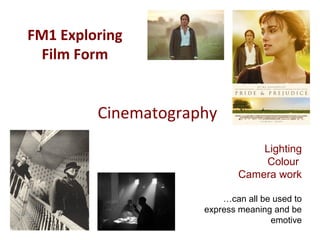
Cinematography
Lighting
Colour
Camera work
…can all be used to
express meaning and be
emotive
Lighting
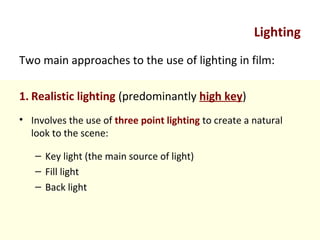
Two main approaches to the use of lighting in film:
1. Realistic lighting (predominantly high key)
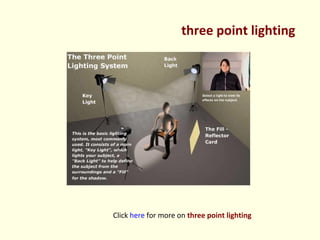
• Involves the use of three point lighting to create a natural
look to the scene:
– Key light (the main source of light)
– Fill light
– Back light
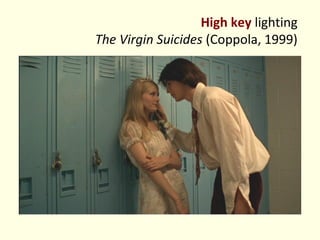
High key lighting
The Virgin Suicides (Coppola, 1999)
three point lighting
Click here for more on three point lighting
Lighting
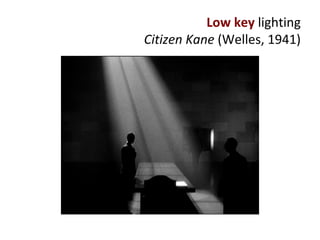
2. Expressive lighting (predominately low key. )
• High contrast and shadow to convey a dark
expressive mood.
• Subjects are sometimes back lit only to create a
silhouetted figure.
• May also involve the use of single hue ‘gels’, filters
and other optical effects to create a specific mood.
Low key lighting
Citizen Kane (Welles, 1941)
COLOUR
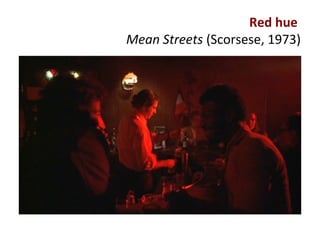
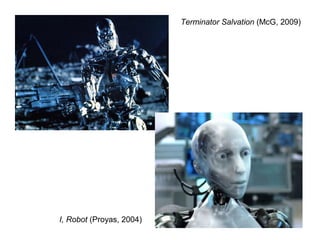
Red hue
Mean Streets (Scorsese, 1973)
I, Robot (Proyas, 2004)
Terminator Salvation (McG, 2009)
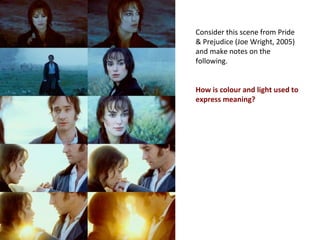
Consider this scene from Pride
& Prejudice (Joe Wright, 2005)
and make notes on the
following.
How is colour and light used to
express meaning?
Camera work
In looking at camera work the following areas need
to be considered:
• Angle
• Movement
• Position / framing
• Composition
• Depth of field
Angle
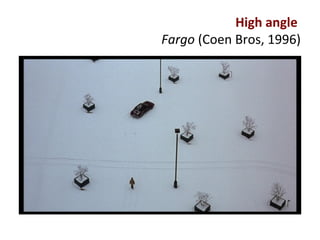
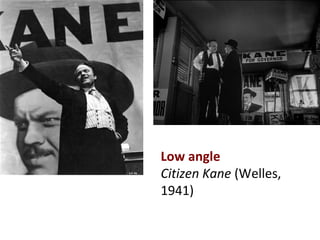
• High and low angle shots
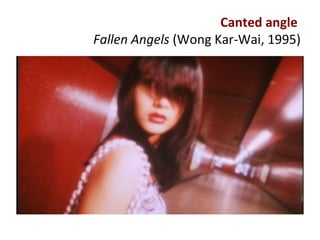
A filmmaker may also use a canted angle (sometimes
called ‘dutch’) to create a skewed frame.
Often used to reinforce the idea of chaos or instability.
High angle
Fargo (Coen Bros, 1996)
Low angle
Citizen Kane (Welles,
1941)
Canted angle
Fallen Angels (Wong Kar-Wai, 1995)
Movement
• pan – horizontal movement of the camera from a static position.
• tracking – camera tracks the movement of a subject
• tilt – movement on the vertical (up or down)
• crab – a subtle movement on the horizontal (left or right)
• crane – the camera is mounted on to a crane so that it can move dramatically
up or down and from side to side. Sometimes cranes are put on tracks to create
spectacular tracking and craning movement. Click here to see a tracking and
craning shot from Touch of Evil (Welles,1958)
• handheld – a shaky movement the follows the movement of the camera
operator. Click here to see the use of handheld camera in Cloverfield (Reeves,
2008). Often used to create realism, urgent and sudden figure movement or to
create a point of view shot (we are seeing things through the eyes of a
character).
• zoom lens – creates the illusion of movement by altering the lens length.
Position
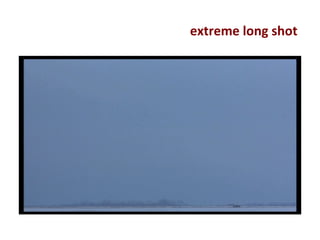
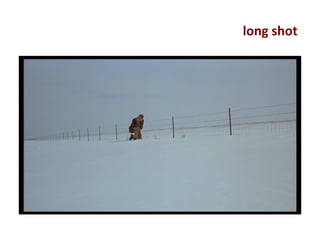
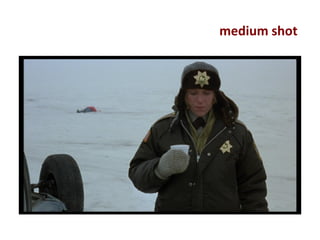
• The distance between the camera and the subject.
• The position selected relates to the information the
filmmaker is trying to communicate.
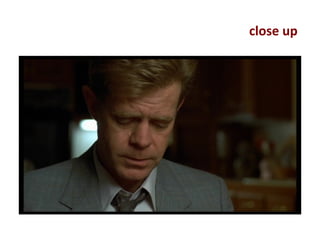
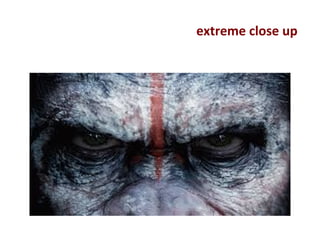
• Camera distances can be defined as in the following
slides. Examples are from Fargo (Coen Bros, 1996)
• Think about the different information you get in each
shot type.
extreme long shot
long shot
medium shot
close up
extreme close up
Position
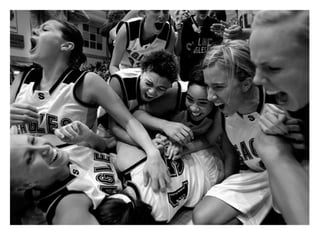
• The camera is the viewers eyes in a scene so
the camera position also dictates the viewers
relationship with the action or characters in
the scene.
• How do the following images make you feel?
Composition
• The way a frame is composed can help to convey
important information.
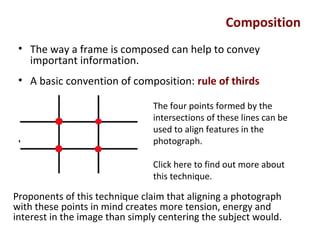
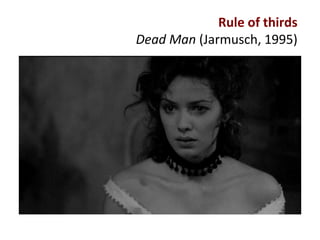
• A basic convention of composition: rule of thirds
•
The four points formed by the
intersections of these lines can be
used to align features in the
photograph.
Click here to find out more about
this technique.
Proponents of this technique claim that aligning a photograph
with these points in mind creates more tension, energy and
interest in the image than simply centering the subject would.
Rule of thirds
Dead Man (Jarmusch, 1995)
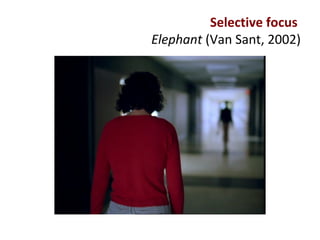
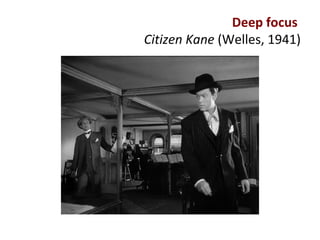
Depth of field
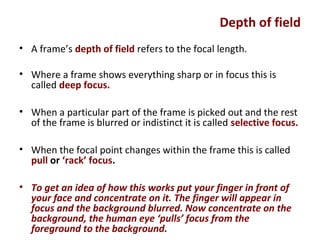
• A frame’s depth of field refers to the focal length.
• Where a frame shows everything sharp or in focus this is
called deep focus.
• When a particular part of the frame is picked out and the rest
of the frame is blurred or indistinct it is called selective focus.
• When the focal point changes within the frame this is called
pull or ‘rack’ focus.
• To get an idea of how this works put your finger in front of
your face and concentrate on it. The finger will appear in
focus and the background blurred. Now concentrate on the
background, the human eye ‘pulls’ focus from the
foreground to the background.
Selective focus
Elephant (Van Sant, 2002)
Deep focus
Citizen Kane (Welles, 1941)
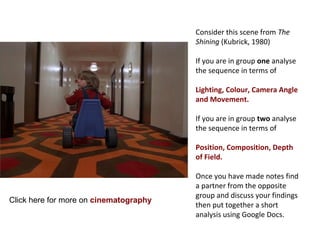
Consider this scene from The
Shining (Kubrick, 1980)
If you are in group one analyse
the sequence in terms of
Lighting, Colour, Camera Angle
and Movement.
If you are in group two analyse
the sequence in terms of
Position, Composition, Depth
of Field.
Once you have made notes find
a partner from the opposite
group and discuss your findings
then put together a short
analysis using Google Docs.
Click here for more on cinematography

Film Language - Cinematography

  • 1.
    FM1 Exploring Film Form Cinematography Lighting Colour Camerawork …can all be used to express meaning and be emotive
  • 2.
    Lighting Two main approachesto the use of lighting in film: 1. Realistic lighting (predominantly high key) • Involves the use of three point lighting to create a natural look to the scene: – Key light (the main source of light) – Fill light – Back light
  • 3.
    High key lighting TheVirgin Suicides (Coppola, 1999)
  • 4.
    three point lighting Clickhere for more on three point lighting
  • 5.
    Lighting 2. Expressive lighting(predominately low key. ) • High contrast and shadow to convey a dark expressive mood. • Subjects are sometimes back lit only to create a silhouetted figure. • May also involve the use of single hue ‘gels’, filters and other optical effects to create a specific mood.
  • 6.
    Low key lighting CitizenKane (Welles, 1941)
  • 7.
  • 8.
    Red hue Mean Streets(Scorsese, 1973)
  • 9.
    I, Robot (Proyas,2004) Terminator Salvation (McG, 2009)
  • 10.
    Consider this scenefrom Pride & Prejudice (Joe Wright, 2005) and make notes on the following. How is colour and light used to express meaning?
  • 11.
    Camera work In lookingat camera work the following areas need to be considered: • Angle • Movement • Position / framing • Composition • Depth of field
  • 12.
    Angle • High andlow angle shots A filmmaker may also use a canted angle (sometimes called ‘dutch’) to create a skewed frame. Often used to reinforce the idea of chaos or instability.
  • 13.
  • 14.
    Low angle Citizen Kane(Welles, 1941)
  • 15.
    Canted angle Fallen Angels(Wong Kar-Wai, 1995)
  • 16.
    Movement • pan –horizontal movement of the camera from a static position. • tracking – camera tracks the movement of a subject • tilt – movement on the vertical (up or down) • crab – a subtle movement on the horizontal (left or right) • crane – the camera is mounted on to a crane so that it can move dramatically up or down and from side to side. Sometimes cranes are put on tracks to create spectacular tracking and craning movement. Click here to see a tracking and craning shot from Touch of Evil (Welles,1958) • handheld – a shaky movement the follows the movement of the camera operator. Click here to see the use of handheld camera in Cloverfield (Reeves, 2008). Often used to create realism, urgent and sudden figure movement or to create a point of view shot (we are seeing things through the eyes of a character). • zoom lens – creates the illusion of movement by altering the lens length.
  • 17.
    Position • The distancebetween the camera and the subject. • The position selected relates to the information the filmmaker is trying to communicate. • Camera distances can be defined as in the following slides. Examples are from Fargo (Coen Bros, 1996) • Think about the different information you get in each shot type.
  • 18.
  • 19.
  • 20.
  • 21.
  • 22.
  • 23.
    Position • The camerais the viewers eyes in a scene so the camera position also dictates the viewers relationship with the action or characters in the scene. • How do the following images make you feel?
  • 26.
    Composition • The waya frame is composed can help to convey important information. • A basic convention of composition: rule of thirds • The four points formed by the intersections of these lines can be used to align features in the photograph. Click here to find out more about this technique. Proponents of this technique claim that aligning a photograph with these points in mind creates more tension, energy and interest in the image than simply centering the subject would.
  • 27.
    Rule of thirds DeadMan (Jarmusch, 1995)
  • 28.
    Depth of field •A frame’s depth of field refers to the focal length. • Where a frame shows everything sharp or in focus this is called deep focus. • When a particular part of the frame is picked out and the rest of the frame is blurred or indistinct it is called selective focus. • When the focal point changes within the frame this is called pull or ‘rack’ focus. • To get an idea of how this works put your finger in front of your face and concentrate on it. The finger will appear in focus and the background blurred. Now concentrate on the background, the human eye ‘pulls’ focus from the foreground to the background.
  • 29.
  • 30.
  • 31.
    Consider this scenefrom The Shining (Kubrick, 1980) If you are in group one analyse the sequence in terms of Lighting, Colour, Camera Angle and Movement. If you are in group two analyse the sequence in terms of Position, Composition, Depth of Field. Once you have made notes find a partner from the opposite group and discuss your findings then put together a short analysis using Google Docs. Click here for more on cinematography