Different types of Single Camera shots
CHANEL ESHOH
Camera Shot Types :
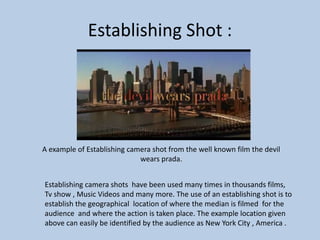
Establishing Shot :
A example of Establishing camera shot from the well known film the devil
wears prada.
Establishing camera shots have been used many times in thousands films,
Tv show , Music Videos and many more. The use of an establishing shot is to
establish the geographical location of where the median is filmed for the
audience and where the action is taken place. The example location given
above can easily be identified by the audience as New York City , America .
Master Shot :
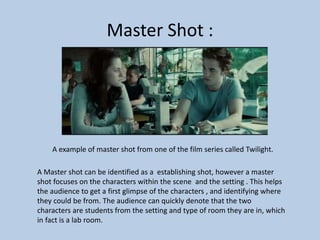
A example of master shot from one of the film series called Twilight.
A Master shot can be identified as a establishing shot, however a master
shot focuses on the characters within the scene and the setting . This helps
the audience to get a first glimpse of the characters , and identifying where
they could be from. The audience can quickly denote that the two
characters are students from the setting and type of room they are in, which
in fact is a lab room.
Tracking shots :
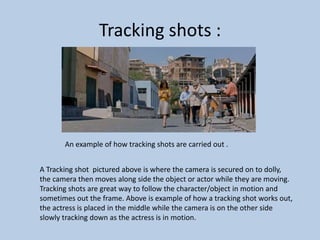
An example of how tracking shots are carried out .
A Tracking shot pictured above is where the camera is secured on to dolly,
the camera then moves along side the object or actor while they are moving.
Tracking shots are great way to follow the character/object in motion and
sometimes out the frame. Above is example of how a tracking shot works out,
the actress is placed in the middle while the camera is on the other side
slowly tracking down as the actress is in motion.
Cutaways :
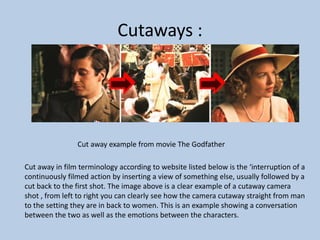
Cut away example from movie The Godfather
Cut away in film terminology according to website listed below is the ‘interruption of a
continuously filmed action by inserting a view of something else, usually followed by a
cut back to the first shot. The image above is a clear example of a cutaway camera
shot , from left to right you can clearly see how the camera cutaway straight from man
to the setting they are in back to women. This is an example showing a conversation
between the two as well as the emotions between the characters.
Camera Angles :
Eye Level :
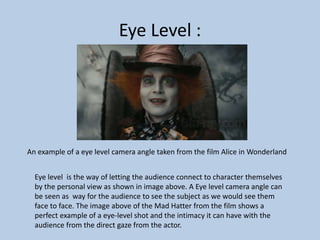
An example of a eye level camera angle taken from the film Alice in Wonderland
Eye level is the way of letting the audience connect to character themselves
by the personal view as shown in image above. A Eye level camera angle can
be seen as way for the audience to see the subject as we would see them
face to face. The image above of the Mad Hatter from the film shows a
perfect example of a eye-level shot and the intimacy it can have with the
audience from the direct gaze from the actor.
Birds-eye angle :
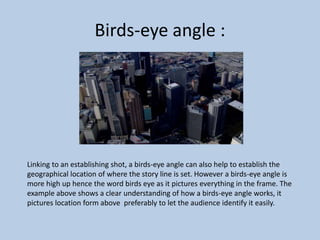
Linking to an establishing shot, a birds-eye angle can also help to establish the
geographical location of where the story line is set. However a birds-eye angle is
more high up hence the word birds eye as it pictures everything in the frame. The
example above shows a clear understanding of how a birds-eye angle works, it
pictures location form above preferably to let the audience identify it easily.
High Angle :
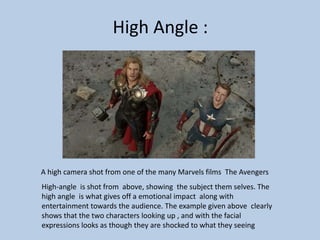
A high camera shot from one of the many Marvels films The Avengers
High-angle is shot from above, showing the subject them selves. The
high angle is what gives off a emotional impact along with
entertainment towards the audience. The example given above clearly
shows that the two characters looking up , and with the facial
expressions looks as though they are shocked to what they seeing
Low Angle :
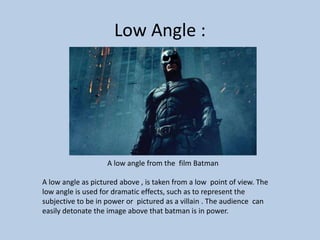
A low angle from the film Batman
A low angle as pictured above , is taken from a low point of view. The
low angle is used for dramatic effects, such as to represent the
subjective to be in power or pictured as a villain . The audience can
easily detonate the image above that batman is in power.
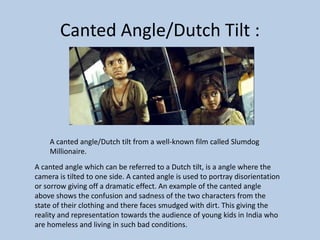
Canted Angle/Dutch Tilt :
A canted angle/Dutch tilt from a well-known film called Slumdog
Millionaire.
A canted angle which can be referred to a Dutch tilt, is a angle where the
camera is tilted to one side. A canted angle is used to portray disorientation
or sorrow giving off a dramatic effect. An example of the canted angle
above shows the confusion and sadness of the two characters from the
state of their clothing and there faces smudged with dirt. This giving the
reality and representation towards the audience of young kids in India who
are homeless and living in such bad conditions.
Camera Shot Framing
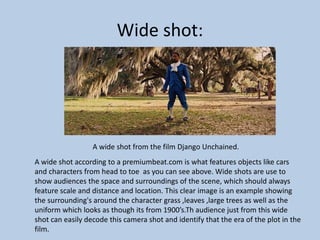
Wide shot:
A wide shot from the film Django Unchained.
A wide shot according to a premiumbeat.com is what features objects like cars
and characters from head to toe as you can see above. Wide shots are use to
show audiences the space and surroundings of the scene, which should always
feature scale and distance and location. This clear image is an example showing
the surrounding's around the character grass ,leaves ,large trees as well as the
uniform which looks as though its from 1900’s.Th audience just from this wide
shot can easily decode this camera shot and identify that the era of the plot in the
film.
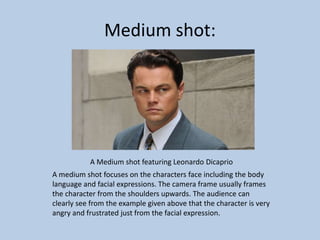
Medium shot:
A Medium shot featuring Leonardo Dicaprio
A medium shot focuses on the characters face including the body
language and facial expressions. The camera frame usually frames
the character from the shoulders upwards. The audience can
clearly see from the example given above that the character is very
angry and frustrated just from the facial expression.
2 shot :
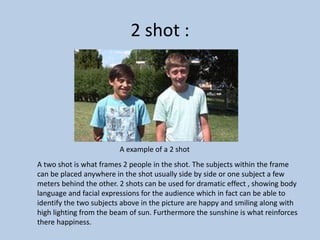
A example of a 2 shot
A two shot is what frames 2 people in the shot. The subjects within the frame
can be placed anywhere in the shot usually side by side or one subject a few
meters behind the other. 2 shots can be used for dramatic effect , showing body
language and facial expressions for the audience which in fact can be able to
identify the two subjects above in the picture are happy and smiling along with
high lighting from the beam of sun. Furthermore the sunshine is what reinforces
there happiness.
Extreme close-up shot (ECU) :
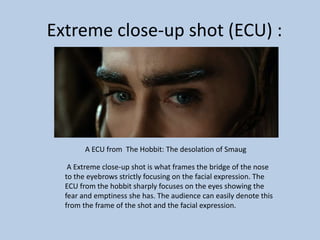
A ECU from The Hobbit: The desolation of Smaug
A Extreme close-up shot is what frames the bridge of the nose
to the eyebrows strictly focusing on the facial expression. The
ECU from the hobbit sharply focuses on the eyes showing the
fear and emptiness she has. The audience can easily denote this
from the frame of the shot and the facial expression.
Point Of View shot (POV):
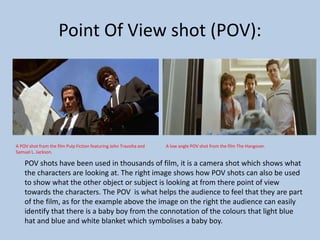
A POV shot from the film Pulp Fiction featuring John Travolta and
Samuel L. Jackson.
POV shots have been used in thousands of film, it is a camera shot which shows what
the characters are looking at. The right image shows how POV shots can also be used
to show what the other object or subject is looking at from there point of view
towards the characters. The POV is what helps the audience to feel that they are part
of the film, as for the example above the image on the right the audience can easily
identify that there is a baby boy from the connotation of the colours that light blue
hat and blue and white blanket which symbolises a baby boy.
A low angle POV shot from the film The Hangover.
Rule of thirds (ROT) :
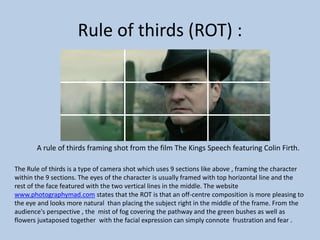
A rule of thirds framing shot from the film The Kings Speech featuring Colin Firth.
The Rule of thirds is a type of camera shot which uses 9 sections like above , framing the character
within the 9 sections. The eyes of the character is usually framed with top horizontal line and the
rest of the face featured with the two vertical lines in the middle. The website
www.photographymad.com states that the ROT is that an off-centre composition is more pleasing to
the eye and looks more natural than placing the subject right in the middle of the frame. From the
audience's perspective , the mist of fog covering the pathway and the green bushes as well as
flowers juxtaposed together with the facial expression can simply connote frustration and fear .
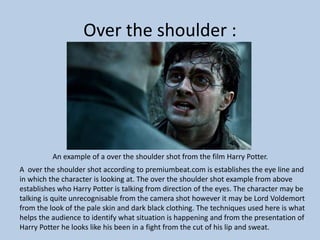
Over the shoulder :
An example of a over the shoulder shot from the film Harry Potter.
A over the shoulder shot according to premiumbeat.com is establishes the eye line and
in which the character is looking at. The over the shoulder shot example from above
establishes who Harry Potter is talking from direction of the eyes. The character may be
talking is quite unrecognisable from the camera shot however it may be Lord Voldemort
from the look of the pale skin and dark black clothing. The techniques used here is what
helps the audience to identify what situation is happening and from the presentation of
Harry Potter he looks like his been in a fight from the cut of his lip and sweat.
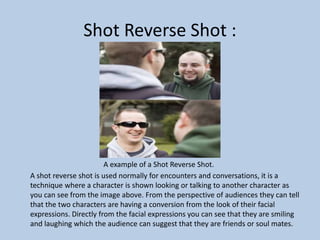
Shot Reverse Shot :
A example of a Shot Reverse Shot.
A shot reverse shot is used normally for encounters and conversations, it is a
technique where a character is shown looking or talking to another character as
you can see from the image above. From the perspective of audiences they can tell
that the two characters are having a conversion from the look of their facial
expressions. Directly from the facial expressions you can see that they are smiling
and laughing which the audience can suggest that they are friends or soul mates.

Single Camera Techniques

  • 1.
    Different types ofSingle Camera shots CHANEL ESHOH
  • 2.
  • 3.
    Establishing Shot : Aexample of Establishing camera shot from the well known film the devil wears prada. Establishing camera shots have been used many times in thousands films, Tv show , Music Videos and many more. The use of an establishing shot is to establish the geographical location of where the median is filmed for the audience and where the action is taken place. The example location given above can easily be identified by the audience as New York City , America .
  • 4.
    Master Shot : Aexample of master shot from one of the film series called Twilight. A Master shot can be identified as a establishing shot, however a master shot focuses on the characters within the scene and the setting . This helps the audience to get a first glimpse of the characters , and identifying where they could be from. The audience can quickly denote that the two characters are students from the setting and type of room they are in, which in fact is a lab room.
  • 5.
    Tracking shots : Anexample of how tracking shots are carried out . A Tracking shot pictured above is where the camera is secured on to dolly, the camera then moves along side the object or actor while they are moving. Tracking shots are great way to follow the character/object in motion and sometimes out the frame. Above is example of how a tracking shot works out, the actress is placed in the middle while the camera is on the other side slowly tracking down as the actress is in motion.
  • 6.
    Cutaways : Cut awayexample from movie The Godfather Cut away in film terminology according to website listed below is the ‘interruption of a continuously filmed action by inserting a view of something else, usually followed by a cut back to the first shot. The image above is a clear example of a cutaway camera shot , from left to right you can clearly see how the camera cutaway straight from man to the setting they are in back to women. This is an example showing a conversation between the two as well as the emotions between the characters.
  • 7.
  • 8.
    Eye Level : Anexample of a eye level camera angle taken from the film Alice in Wonderland Eye level is the way of letting the audience connect to character themselves by the personal view as shown in image above. A Eye level camera angle can be seen as way for the audience to see the subject as we would see them face to face. The image above of the Mad Hatter from the film shows a perfect example of a eye-level shot and the intimacy it can have with the audience from the direct gaze from the actor.
  • 9.
    Birds-eye angle : Linkingto an establishing shot, a birds-eye angle can also help to establish the geographical location of where the story line is set. However a birds-eye angle is more high up hence the word birds eye as it pictures everything in the frame. The example above shows a clear understanding of how a birds-eye angle works, it pictures location form above preferably to let the audience identify it easily.
  • 10.
    High Angle : Ahigh camera shot from one of the many Marvels films The Avengers High-angle is shot from above, showing the subject them selves. The high angle is what gives off a emotional impact along with entertainment towards the audience. The example given above clearly shows that the two characters looking up , and with the facial expressions looks as though they are shocked to what they seeing
  • 11.
    Low Angle : Alow angle from the film Batman A low angle as pictured above , is taken from a low point of view. The low angle is used for dramatic effects, such as to represent the subjective to be in power or pictured as a villain . The audience can easily detonate the image above that batman is in power.
  • 12.
    Canted Angle/Dutch Tilt: A canted angle/Dutch tilt from a well-known film called Slumdog Millionaire. A canted angle which can be referred to a Dutch tilt, is a angle where the camera is tilted to one side. A canted angle is used to portray disorientation or sorrow giving off a dramatic effect. An example of the canted angle above shows the confusion and sadness of the two characters from the state of their clothing and there faces smudged with dirt. This giving the reality and representation towards the audience of young kids in India who are homeless and living in such bad conditions.
  • 13.
  • 14.
    Wide shot: A wideshot from the film Django Unchained. A wide shot according to a premiumbeat.com is what features objects like cars and characters from head to toe as you can see above. Wide shots are use to show audiences the space and surroundings of the scene, which should always feature scale and distance and location. This clear image is an example showing the surrounding's around the character grass ,leaves ,large trees as well as the uniform which looks as though its from 1900’s.Th audience just from this wide shot can easily decode this camera shot and identify that the era of the plot in the film.
  • 15.
    Medium shot: A Mediumshot featuring Leonardo Dicaprio A medium shot focuses on the characters face including the body language and facial expressions. The camera frame usually frames the character from the shoulders upwards. The audience can clearly see from the example given above that the character is very angry and frustrated just from the facial expression.
  • 16.
    2 shot : Aexample of a 2 shot A two shot is what frames 2 people in the shot. The subjects within the frame can be placed anywhere in the shot usually side by side or one subject a few meters behind the other. 2 shots can be used for dramatic effect , showing body language and facial expressions for the audience which in fact can be able to identify the two subjects above in the picture are happy and smiling along with high lighting from the beam of sun. Furthermore the sunshine is what reinforces there happiness.
  • 17.
    Extreme close-up shot(ECU) : A ECU from The Hobbit: The desolation of Smaug A Extreme close-up shot is what frames the bridge of the nose to the eyebrows strictly focusing on the facial expression. The ECU from the hobbit sharply focuses on the eyes showing the fear and emptiness she has. The audience can easily denote this from the frame of the shot and the facial expression.
  • 18.
    Point Of Viewshot (POV): A POV shot from the film Pulp Fiction featuring John Travolta and Samuel L. Jackson. POV shots have been used in thousands of film, it is a camera shot which shows what the characters are looking at. The right image shows how POV shots can also be used to show what the other object or subject is looking at from there point of view towards the characters. The POV is what helps the audience to feel that they are part of the film, as for the example above the image on the right the audience can easily identify that there is a baby boy from the connotation of the colours that light blue hat and blue and white blanket which symbolises a baby boy. A low angle POV shot from the film The Hangover.
  • 19.
    Rule of thirds(ROT) : A rule of thirds framing shot from the film The Kings Speech featuring Colin Firth. The Rule of thirds is a type of camera shot which uses 9 sections like above , framing the character within the 9 sections. The eyes of the character is usually framed with top horizontal line and the rest of the face featured with the two vertical lines in the middle. The website www.photographymad.com states that the ROT is that an off-centre composition is more pleasing to the eye and looks more natural than placing the subject right in the middle of the frame. From the audience's perspective , the mist of fog covering the pathway and the green bushes as well as flowers juxtaposed together with the facial expression can simply connote frustration and fear .
  • 20.
    Over the shoulder: An example of a over the shoulder shot from the film Harry Potter. A over the shoulder shot according to premiumbeat.com is establishes the eye line and in which the character is looking at. The over the shoulder shot example from above establishes who Harry Potter is talking from direction of the eyes. The character may be talking is quite unrecognisable from the camera shot however it may be Lord Voldemort from the look of the pale skin and dark black clothing. The techniques used here is what helps the audience to identify what situation is happening and from the presentation of Harry Potter he looks like his been in a fight from the cut of his lip and sweat.
  • 21.
    Shot Reverse Shot: A example of a Shot Reverse Shot. A shot reverse shot is used normally for encounters and conversations, it is a technique where a character is shown looking or talking to another character as you can see from the image above. From the perspective of audiences they can tell that the two characters are having a conversion from the look of their facial expressions. Directly from the facial expressions you can see that they are smiling and laughing which the audience can suggest that they are friends or soul mates.