D I F F E R E N T T Y P E S O F S H O T S
CINEMATOGRAPHY
CINEMATOGRAPHY
• PAN
• A pan shot is a technique that involves moving the
camera left or right horizontally. It is usually used to track
an object or movement. You can do the pan shot hand
held, however for professional results it is best to use a
tripod. The pan shot can also be useful in order to
familiarize the audience with the location.
• https://www.youtube.com/watch?v=1XZNQP3Abes
CINEMATOGRAPHY
• DOLLY SHOT
• A dolly shot is filmed on a moving dolly. The camera is
mounted on the dolly (which is a platform with wheels
that is pushed along rails) to create a long moving shot.
CINEMATOGRAPHY
• TRACKING SHOT
• A tracking shot can often be considered the same as a
dolly shot, however tracking shots can be created using
a steadicam attachment or even handheld, rather than
just using a dolly platform.
• https://www.youtube.com/watch?v=3Sr-vxVaY_M
CINEMATOGRAPHY
• TILT
• A tilt shot is essentially the same as a pan shot, however
it is going up or down vertically instead of left and right
horizontally.
• https://www.youtube.com/watch?v=UHYFKsZH82o
CINEMATOGRAPHY
• HAND HELD
• A hand held shot is pretty self explanatory. It is a shot
created by holding the camera in your hand and not
using any attachments. These shots are often used in
more urban and indie clips. They can also be used to
create a personal relationship between the audience and
the character on screen.
• https://www.youtube.com/watch?v=O2Mpivv-G94
CINEMATOGRAPHY
• HIGH ANGLE/ LOW ANGLE.
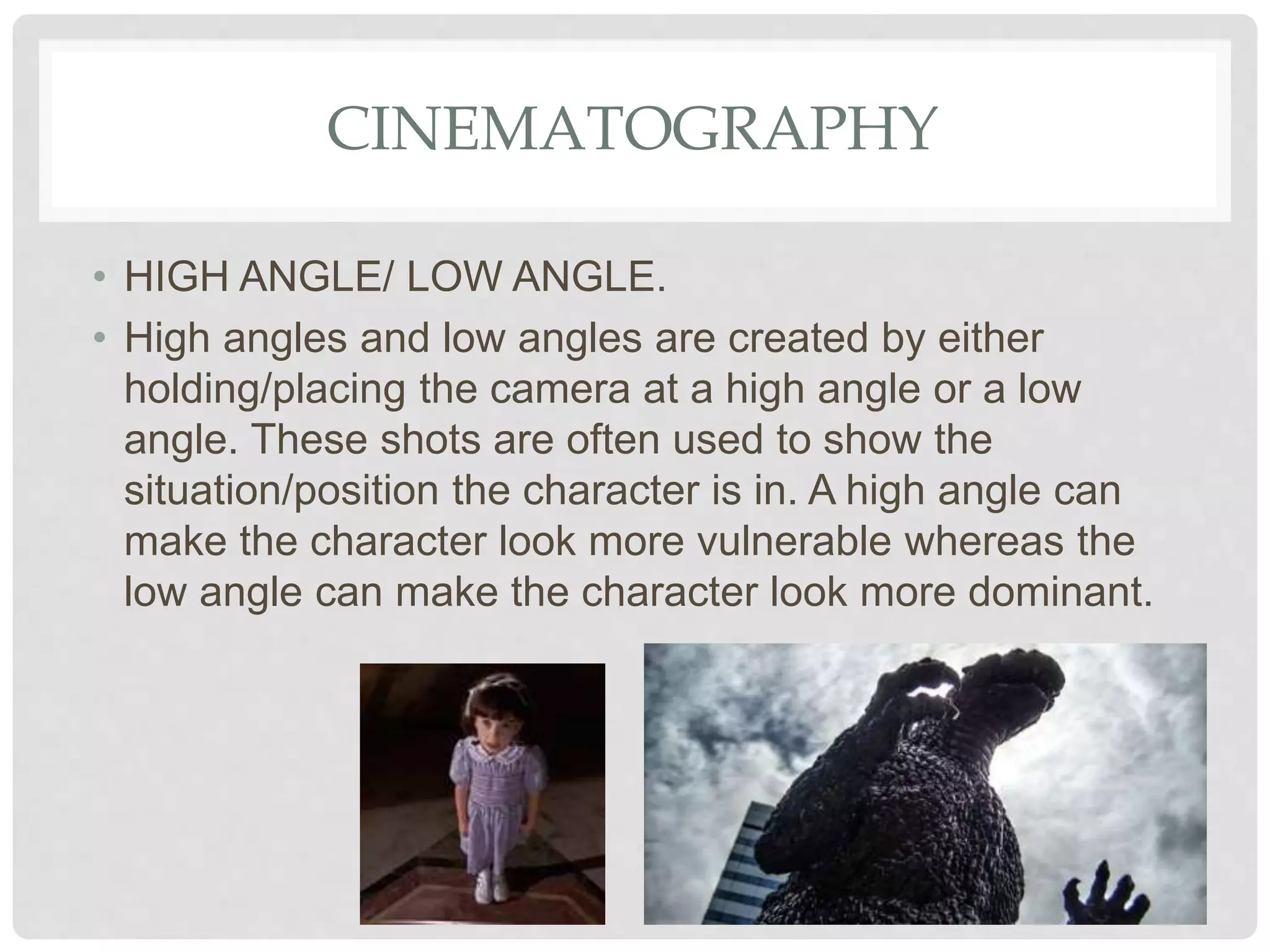
• High angles and low angles are created by either
holding/placing the camera at a high angle or a low
angle. These shots are often used to show the
situation/position the character is in. A high angle can
make the character look more vulnerable whereas the
low angle can make the character look more dominant.
CINEMATOGRAPHY
• ESTABLISHING SHOT
• An establishing shot is used to help the audience
establish the location of a new scene. Depending on the
mood and setting of the media text a wide angle may be
used to show more of the location. Establishing shots
are always at the beginning of a text/scene.
• https://www.youtube.com/watch?v=Axt0nETgEXo
CINEMATOGRAPHY
• CLOSE UP
• A close up shot is between the shoulders and the top of
the head. It is often used to create empathy between the
audience and the character or identify the character with
the audience.
CINEMATOGRAPHY
• EXTREME CLOSE UP
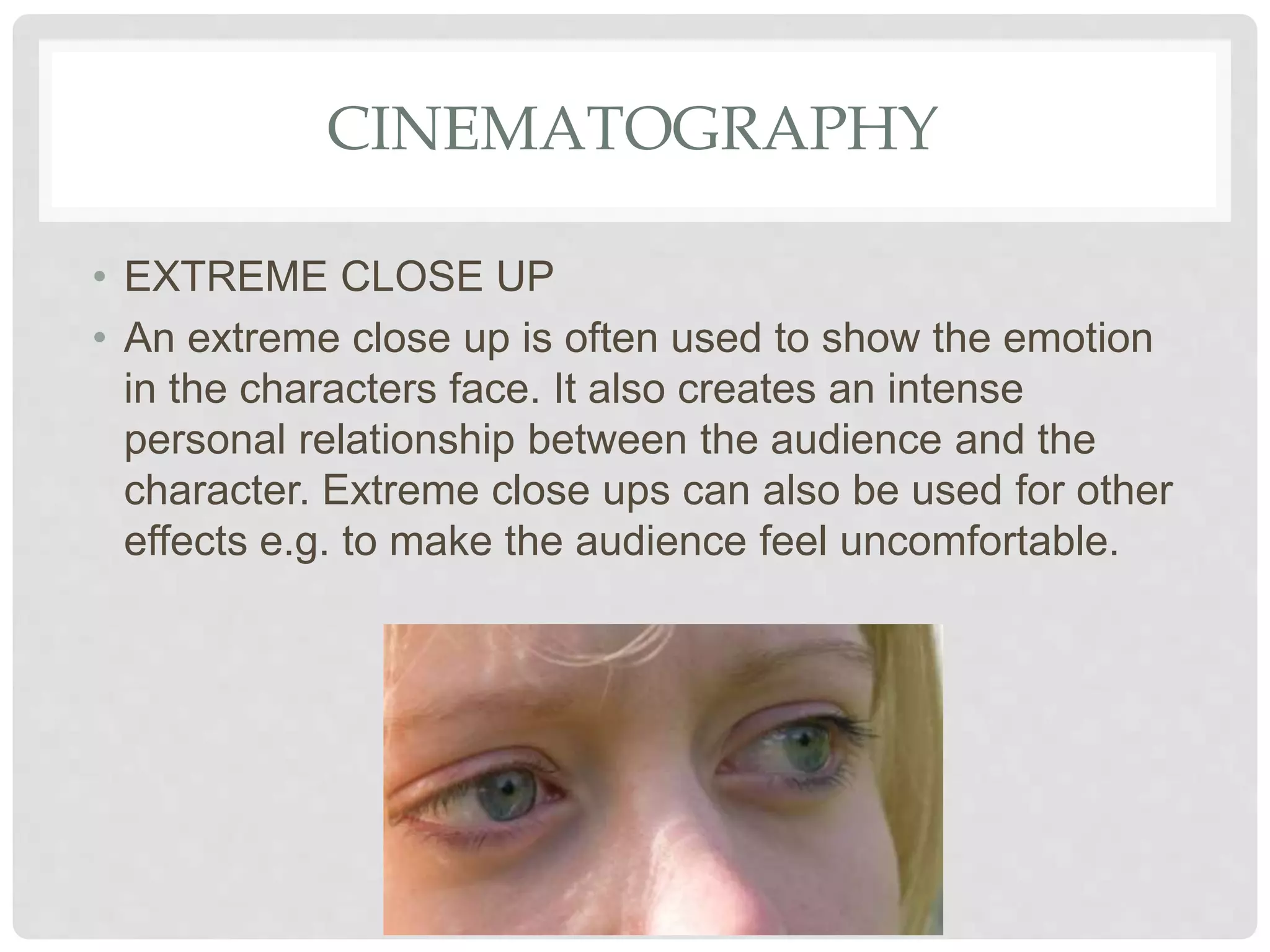
• An extreme close up is often used to show the emotion
in the characters face. It also creates an intense
personal relationship between the audience and the
character. Extreme close ups can also be used for other
effects e.g. to make the audience feel uncomfortable.
CINEMATOGRAPHY
• PULL FOCUS
• Pull focus is when the focus in a shot can be changed in
order to put the attention on a specific object. For
example:
In this picture the focus starts on the
flower but then pulls to the girl in the
background.
CINEMATOGRAPHY
• SHOT REVERSE SHOT
• Shot reverse shot is used to create verisimilitude within
the diegesis of a media text. It is often used when two
people are having a discussion or to make the audience
understand that they are in the same location.
CINEMATOGRAPHY
• MATCH ON ACTION
• Match on action is a continuity shot used to create
verisimilitude within a text. The first shot will show the
character beginning an action, it will then cut to the next
shot where the character will be continuing the same
action.
CINEMATOGRAPHY
• GRAPHIC MATCH
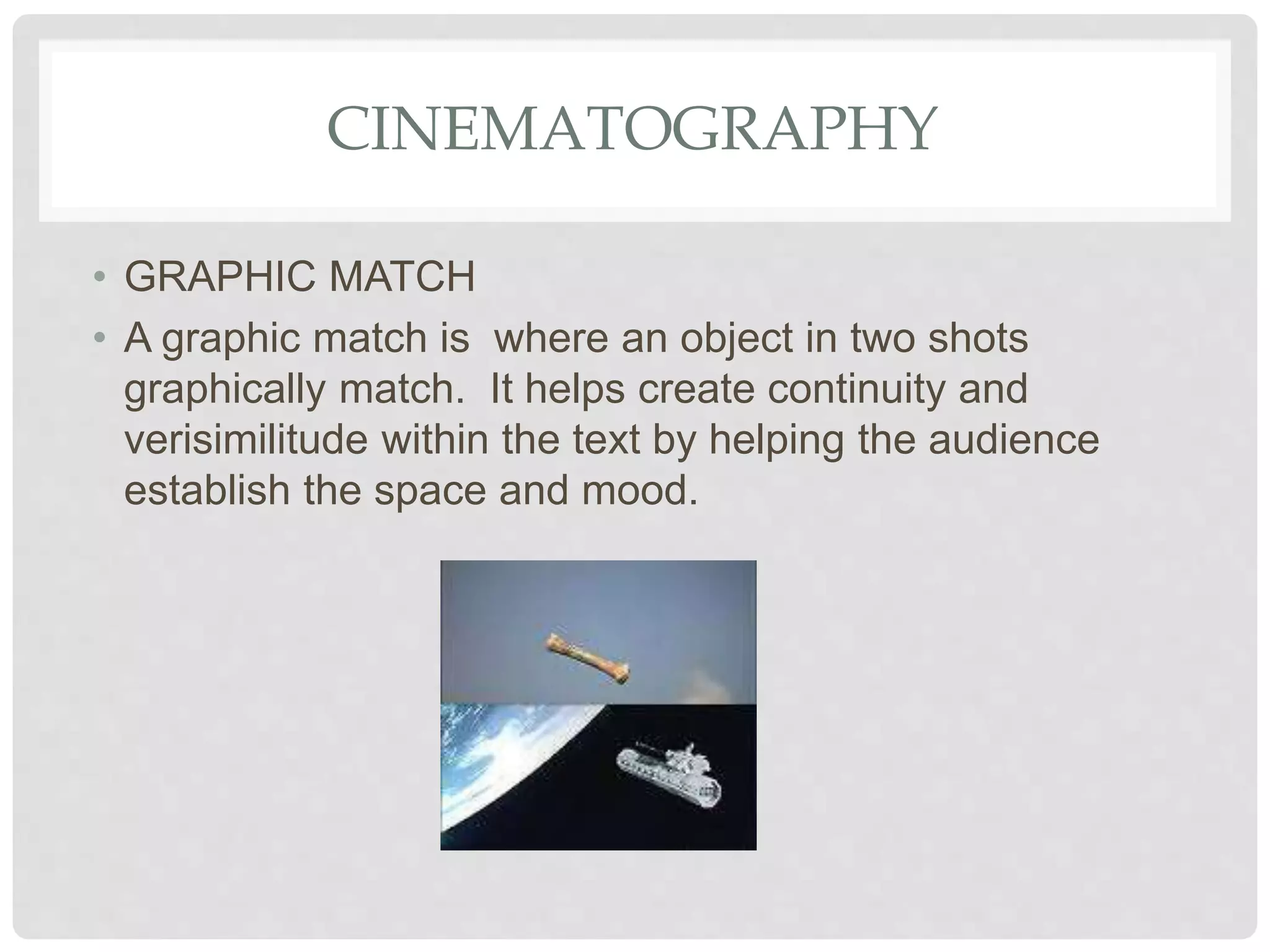
• A graphic match is where an object in two shots
graphically match. It helps create continuity and
verisimilitude within the text by helping the audience
establish the space and mood.
CINEMATOGRAPHY
• EYE LINE MATCH
• An eye line match is where the eye line of different
characters in different shots match in order to create a
relationship between the two characters and create
continuity within the text.
CINEMATOGRAPHY
• POV
• A POV (point of view) shot is used to show the point of
view of the character. This creates a deeper connection
and empathy between the character and the audience as
we put ourselves in their shoes.
CINEMATOGRAPHY
• CUT AWAY
• A cutaway shot is an interrupted shot of a continuously
filmed action. Usually a shot of someone else will be
placed in between the action.
• https://www.youtube.com/watch?v=0Hqa34dZp-E
CINEMATOGRAPHY
• A montage shot is when a number of short clips are
edited together in a short amount of time. Montage clips
are often used to give overviews of previous episodes or
show a lot of things that happened in a short amount of
time.
• https://www.youtube.com/watch?v=BFvs2P8z1Xs

Cinematography

  • 1.
    D I FF E R E N T T Y P E S O F S H O T S CINEMATOGRAPHY
  • 2.
    CINEMATOGRAPHY • PAN • Apan shot is a technique that involves moving the camera left or right horizontally. It is usually used to track an object or movement. You can do the pan shot hand held, however for professional results it is best to use a tripod. The pan shot can also be useful in order to familiarize the audience with the location. • https://www.youtube.com/watch?v=1XZNQP3Abes
  • 3.
    CINEMATOGRAPHY • DOLLY SHOT •A dolly shot is filmed on a moving dolly. The camera is mounted on the dolly (which is a platform with wheels that is pushed along rails) to create a long moving shot.
  • 4.
    CINEMATOGRAPHY • TRACKING SHOT •A tracking shot can often be considered the same as a dolly shot, however tracking shots can be created using a steadicam attachment or even handheld, rather than just using a dolly platform. • https://www.youtube.com/watch?v=3Sr-vxVaY_M
  • 5.
    CINEMATOGRAPHY • TILT • Atilt shot is essentially the same as a pan shot, however it is going up or down vertically instead of left and right horizontally. • https://www.youtube.com/watch?v=UHYFKsZH82o
  • 6.
    CINEMATOGRAPHY • HAND HELD •A hand held shot is pretty self explanatory. It is a shot created by holding the camera in your hand and not using any attachments. These shots are often used in more urban and indie clips. They can also be used to create a personal relationship between the audience and the character on screen. • https://www.youtube.com/watch?v=O2Mpivv-G94
  • 7.
    CINEMATOGRAPHY • HIGH ANGLE/LOW ANGLE. • High angles and low angles are created by either holding/placing the camera at a high angle or a low angle. These shots are often used to show the situation/position the character is in. A high angle can make the character look more vulnerable whereas the low angle can make the character look more dominant.
  • 8.
    CINEMATOGRAPHY • ESTABLISHING SHOT •An establishing shot is used to help the audience establish the location of a new scene. Depending on the mood and setting of the media text a wide angle may be used to show more of the location. Establishing shots are always at the beginning of a text/scene. • https://www.youtube.com/watch?v=Axt0nETgEXo
  • 9.
    CINEMATOGRAPHY • CLOSE UP •A close up shot is between the shoulders and the top of the head. It is often used to create empathy between the audience and the character or identify the character with the audience.
  • 10.
    CINEMATOGRAPHY • EXTREME CLOSEUP • An extreme close up is often used to show the emotion in the characters face. It also creates an intense personal relationship between the audience and the character. Extreme close ups can also be used for other effects e.g. to make the audience feel uncomfortable.
  • 11.
    CINEMATOGRAPHY • PULL FOCUS •Pull focus is when the focus in a shot can be changed in order to put the attention on a specific object. For example: In this picture the focus starts on the flower but then pulls to the girl in the background.
  • 12.
    CINEMATOGRAPHY • SHOT REVERSESHOT • Shot reverse shot is used to create verisimilitude within the diegesis of a media text. It is often used when two people are having a discussion or to make the audience understand that they are in the same location.
  • 13.
    CINEMATOGRAPHY • MATCH ONACTION • Match on action is a continuity shot used to create verisimilitude within a text. The first shot will show the character beginning an action, it will then cut to the next shot where the character will be continuing the same action.
  • 14.
    CINEMATOGRAPHY • GRAPHIC MATCH •A graphic match is where an object in two shots graphically match. It helps create continuity and verisimilitude within the text by helping the audience establish the space and mood.
  • 15.
    CINEMATOGRAPHY • EYE LINEMATCH • An eye line match is where the eye line of different characters in different shots match in order to create a relationship between the two characters and create continuity within the text.
  • 16.
    CINEMATOGRAPHY • POV • APOV (point of view) shot is used to show the point of view of the character. This creates a deeper connection and empathy between the character and the audience as we put ourselves in their shoes.
  • 17.
    CINEMATOGRAPHY • CUT AWAY •A cutaway shot is an interrupted shot of a continuously filmed action. Usually a shot of someone else will be placed in between the action. • https://www.youtube.com/watch?v=0Hqa34dZp-E
  • 18.
    CINEMATOGRAPHY • A montageshot is when a number of short clips are edited together in a short amount of time. Montage clips are often used to give overviews of previous episodes or show a lot of things that happened in a short amount of time. • https://www.youtube.com/watch?v=BFvs2P8z1Xs