Media Terms

        Shannon Bulmer
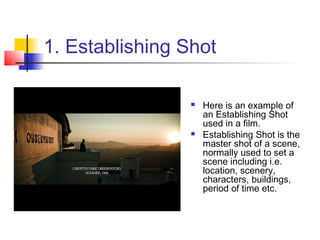
1. Establishing Shot

                    Here is an example of
                     an Establishing Shot
                     used in a film.
                    Establishing Shot is the
                     master shot of a scene,
                     normally used to set a
                     scene including i.e.
                     location, scenery,
                     characters, buildings,
                     period of time etc.
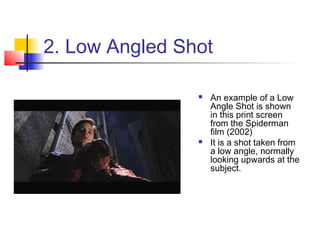
2. Low Angled Shot

                   An example of a Low
                    Angle Shot is shown
                    in this print screen
                    from the Spiderman
                    film (2002)
                   It is a shot taken from
                    a low angle, normally
                    looking upwards at the
                    subject.
3. High Angled Shot

                     A High Angled
                      Shot is a shot
                      taken from above,
                      as if looking down
                      on a subject.
                     Used when
                      showing the
                      size/status of a
                      character i.e.
                      Matilda in this
                      picture (1996)
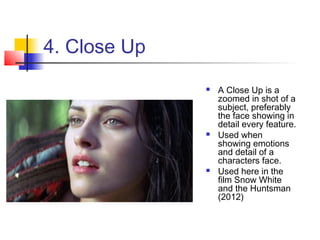
4. Close Up
                 A Close Up is a
                  zoomed in shot of a
                  subject, preferably
                  the face showing in
                  detail every feature.
                 Used when
                  showing emotions
                  and detail of a
                  characters face.
                 Used here in the
                  film Snow White
                  and the Huntsman
                  (2012)
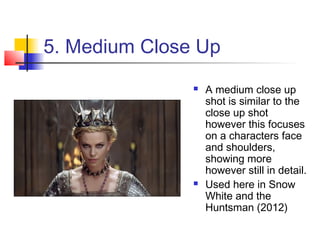
5. Medium Close Up
                  A medium close up
                   shot is similar to the
                   close up shot
                   however this focuses
                   on a characters face
                   and shoulders,
                   showing more
                   however still in detail.
                  Used here in Snow
                   White and the
                   Huntsman (2012)
6. Extreme Close Up

                    Extreme close up is a
                     zoomed in shot of
                     one specific feature
                     on a character or
                     object i.e. nose,
                     eyes, mouth etc.
                    Shows intense detail.
                    Used here in the
                     Harry Potter
                     franchise (2001-
                     2011)
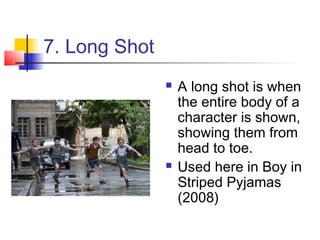
7. Long Shot
                  A long shot is when
                   the entire body of a
                   character is shown,
                   showing them from
                   head to toe.
                  Used here in Boy in
                   Striped Pyjamas
                   (2008)
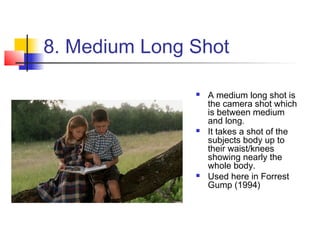
8. Medium Long Shot

                  A medium long shot is
                   the camera shot which
                   is between medium
                   and long.
                  It takes a shot of the
                   subjects body up to
                   their waist/knees
                   showing nearly the
                   whole body.
                  Used here in Forrest
                   Gump (1994)
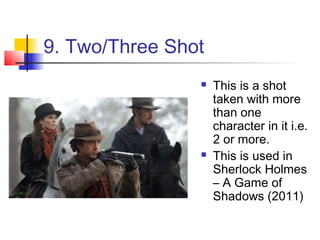
9. Two/Three Shot
                   This is a shot
                    taken with more
                    than one
                    character in it i.e.
                    2 or more.
                   This is used in
                    Sherlock Holmes
                    – A Game of
                    Shadows (2011)
10. Aerial Shot
                     An aerial shot is a
                      over view scene
                      shot used mostly
                      by cranes etc.
                     Used to set the
                      scene, time,
                      location.
11. Point of View
                       Point of view is
                        the camera
                        angle used from
                        a character’s
                        perspective i.e.
                        what they are
                        seeing.
                       Used here in
                        127 Hours
                        (2010)
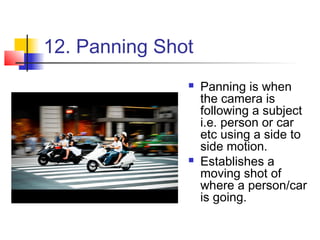
12. Panning Shot
                  Panning is when
                   the camera is
                   following a subject
                   i.e. person or car
                   etc using a side to
                   side motion.
                  Establishes a
                   moving shot of
                   where a person/car
                   is going.
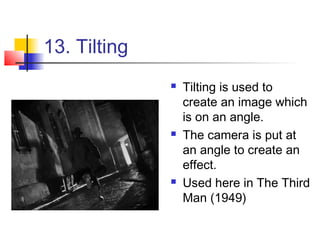
13. Tilting
                 Tilting is used to
                  create an image which
                  is on an angle.
                 The camera is put at
                  an angle to create an
                  effect.
                 Used here in The Third
                  Man (1949)
14. Tracking
                  Tracking is similar to
                   a panning shot
                   where it follows a
                   subject however a
                   tracking shot uses a
                   track which the
                   camera follows, only
                   moving from side to
                   side.
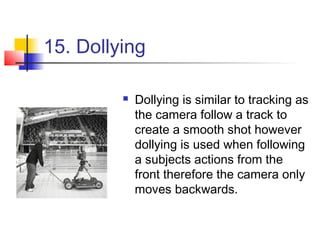
15. Dollying

            Dollying is similar to tracking as
             the camera follow a track to
             create a smooth shot however
             dollying is used when following
             a subjects actions from the
             front therefore the camera only
             moves backwards.
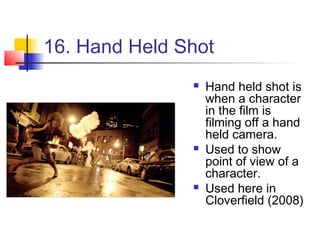
16. Hand Held Shot
                  Hand held shot is
                   when a character
                   in the film is
                   filming off a hand
                   held camera.
                  Used to show
                   point of view of a
                   character.
                  Used here in
                   Cloverfield (2008)
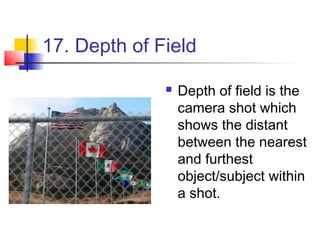
17. Depth of Field

                 Depth of field is the
                  camera shot which
                  shows the distant
                  between the nearest
                  and furthest
                  object/subject within
                  a shot.

Media terms

  • 1.
    Media Terms Shannon Bulmer
  • 2.
    1. Establishing Shot  Here is an example of an Establishing Shot used in a film.  Establishing Shot is the master shot of a scene, normally used to set a scene including i.e. location, scenery, characters, buildings, period of time etc.
  • 3.
    2. Low AngledShot  An example of a Low Angle Shot is shown in this print screen from the Spiderman film (2002)  It is a shot taken from a low angle, normally looking upwards at the subject.
  • 4.
    3. High AngledShot  A High Angled Shot is a shot taken from above, as if looking down on a subject.  Used when showing the size/status of a character i.e. Matilda in this picture (1996)
  • 5.
    4. Close Up  A Close Up is a zoomed in shot of a subject, preferably the face showing in detail every feature.  Used when showing emotions and detail of a characters face.  Used here in the film Snow White and the Huntsman (2012)
  • 6.
    5. Medium CloseUp  A medium close up shot is similar to the close up shot however this focuses on a characters face and shoulders, showing more however still in detail.  Used here in Snow White and the Huntsman (2012)
  • 7.
    6. Extreme CloseUp  Extreme close up is a zoomed in shot of one specific feature on a character or object i.e. nose, eyes, mouth etc.  Shows intense detail.  Used here in the Harry Potter franchise (2001- 2011)
  • 8.
    7. Long Shot  A long shot is when the entire body of a character is shown, showing them from head to toe.  Used here in Boy in Striped Pyjamas (2008)
  • 9.
    8. Medium LongShot  A medium long shot is the camera shot which is between medium and long.  It takes a shot of the subjects body up to their waist/knees showing nearly the whole body.  Used here in Forrest Gump (1994)
  • 10.
    9. Two/Three Shot  This is a shot taken with more than one character in it i.e. 2 or more.  This is used in Sherlock Holmes – A Game of Shadows (2011)
  • 11.
    10. Aerial Shot  An aerial shot is a over view scene shot used mostly by cranes etc.  Used to set the scene, time, location.
  • 12.
    11. Point ofView  Point of view is the camera angle used from a character’s perspective i.e. what they are seeing.  Used here in 127 Hours (2010)
  • 13.
    12. Panning Shot  Panning is when the camera is following a subject i.e. person or car etc using a side to side motion.  Establishes a moving shot of where a person/car is going.
  • 14.
    13. Tilting  Tilting is used to create an image which is on an angle.  The camera is put at an angle to create an effect.  Used here in The Third Man (1949)
  • 15.
    14. Tracking  Tracking is similar to a panning shot where it follows a subject however a tracking shot uses a track which the camera follows, only moving from side to side.
  • 16.
    15. Dollying  Dollying is similar to tracking as the camera follow a track to create a smooth shot however dollying is used when following a subjects actions from the front therefore the camera only moves backwards.
  • 17.
    16. Hand HeldShot  Hand held shot is when a character in the film is filming off a hand held camera.  Used to show point of view of a character.  Used here in Cloverfield (2008)
  • 18.
    17. Depth ofField  Depth of field is the camera shot which shows the distant between the nearest and furthest object/subject within a shot.