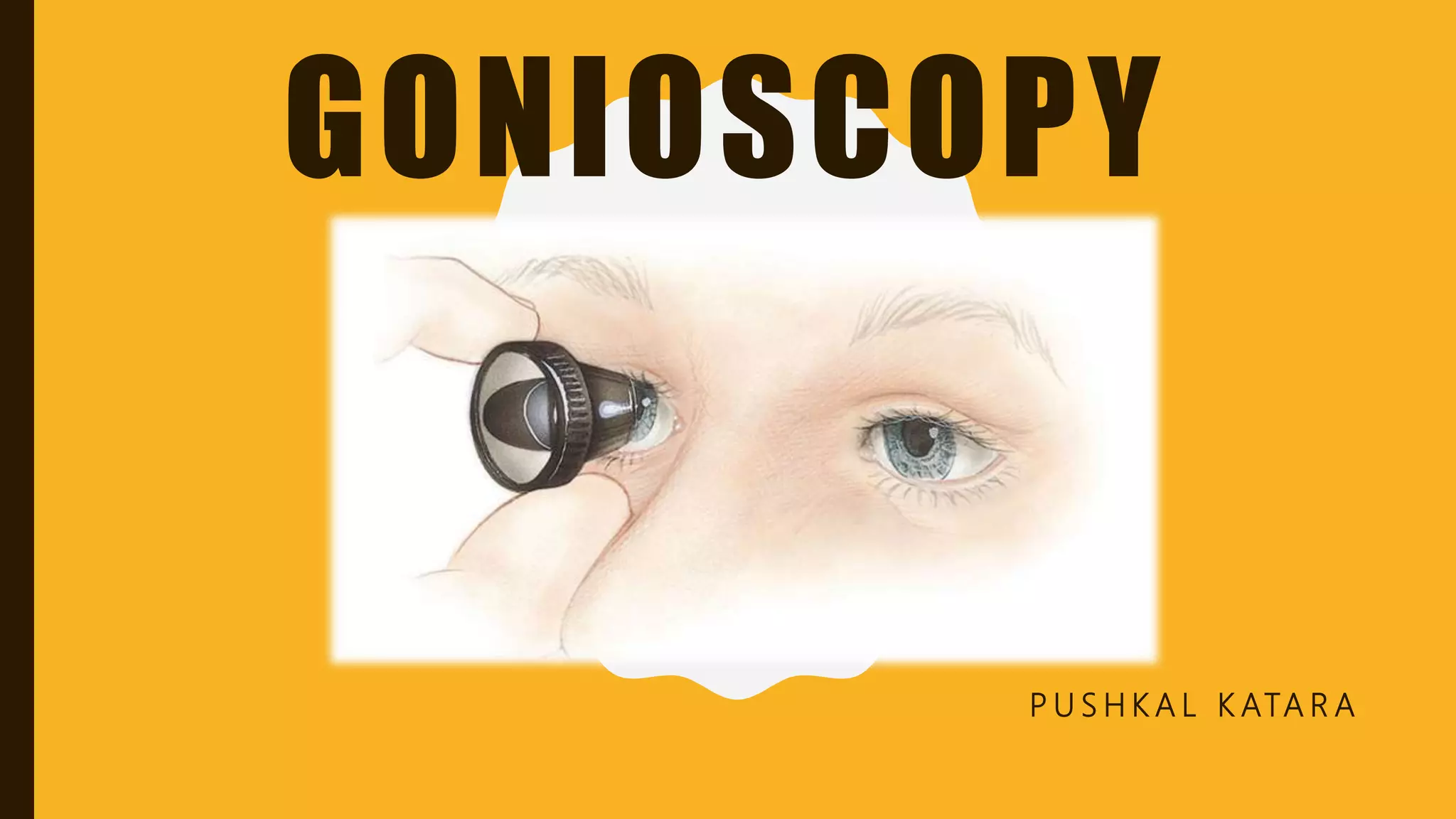
GONIOSCOPY
P U S H K A L K ATA R A
INTRODUCTION
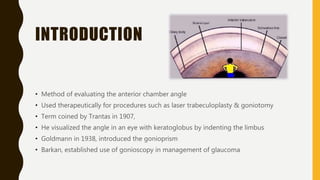
• Method of evaluating the anterior chamber angle
• Used therapeutically for procedures such as laser trabeculoplasty & goniotomy
• Term coined by Trantas in 1907,
• He visualized the angle in an eye with keratoglobus by indenting the limbus
• Goldmann in 1938, introduced the gonioprism
• Barkan, established use of gonioscopy in management of glaucoma
OPTIC PRINCIPLES
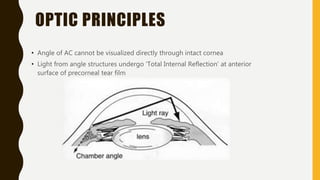
• Angle of AC cannot be visualized directly through intact cornea
• Light from angle structures undergo ‘Total Internal Reflection’ at anterior
surface of precorneal tear film
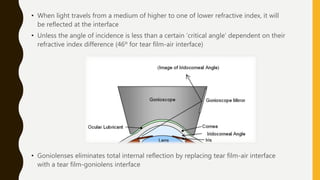
• When light travels from a medium of higher to one of lower refractive index, it will
be reflected at the interface
• Unless the angle of incidence is less than a certain ‘critical angle’ dependent on their
refractive index difference (46º for tear film-air interface)
• Goniolenses eliminates total internal reflection by replacing tear film-air interface
with a tear film-goniolens interface
TYPES
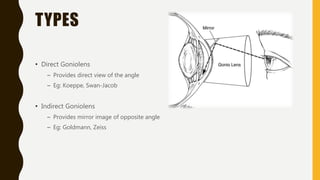
• Direct Goniolens
– Provides direct view of the angle
– Eg: Koeppe, Swan-Jacob
• Indirect Goniolens
– Provides mirror image of opposite angle
– Eg: Goldmann, Zeiss
GENERAL PROCEDURE
• Ambient illumination low-completely dark
• Size & intensity of slit beam to absolute minimum
• Patient seated at slit lam & advised that lens will touch the eye
• Both eyes should remain open
• Drop of local anaesthetic instilled
• Coupling fluid (eg: hypermellose 0.3%) placed on contact surface of lens
• Patient is asked to look upwards & lens is inserted rapidly to avoid loss of coupling
fluid
• Afterwards, lens should be cleaned & sterilized
DIRECT GONIOSCOPY
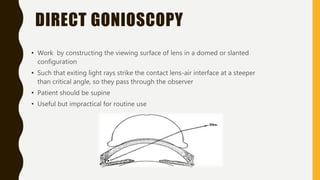
• Work by constructing the viewing surface of lens in a domed or slanted
configuration
• Such that exiting light rays strike the contact lens-air interface at a steeper
than critical angle, so they pass through the observer
• Patient should be supine
• Useful but impractical for routine use
TYPES OF DIRECT GONIOLENS
1. Koeppe
2. Richardson-Shaffer
3. Huskins Barkan
4. Sieback
5. Swan Jacob
6. Layden
7. Worth
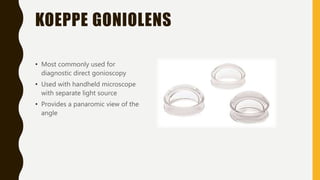
KOEPPE GONIOLENS
• Most commonly used for
diagnostic direct gonioscopy
• Used with handheld microscope
with separate light source
• Provides a panaromic view of the
angle
• Richardson-Shaffers- small Koeppe lens used for infants
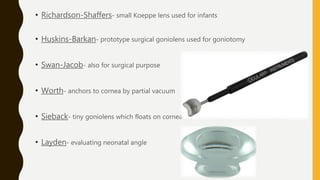
• Huskins-Barkan- prototype surgical goniolens used for goniotomy
• Swan-Jacob- also for surgical purpose
• Worth- anchors to cornea by partial vacuum
• Sieback- tiny goniolens which floats on cornea
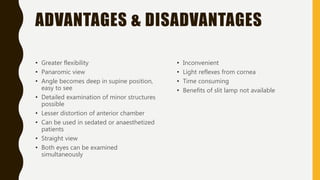
• Layden- evaluating neonatal angle
ADVANTAGES & DISADVANTAGES
• Greater flexibility
• Panaromic view
• Angle becomes deep in supine position,
easy to see
• Detailed examination of minor structures
possible
• Lesser distortion of anterior chamber
• Can be used in sedated or anaesthetized
patients
• Straight view
• Both eyes can be examined
simultaneously
• Inconvenient
• Light reflexes from cornea
• Time consuming
• Benefits of slit lamp not available
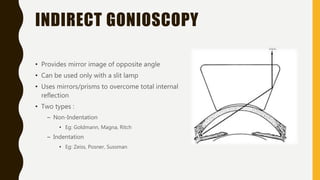
INDIRECT GONIOSCOPY
• Provides mirror image of opposite angle
• Can be used only with a slit lamp
• Uses mirrors/prisms to overcome total internal
reflection
• Two types :
– Non-Indentation
• Eg: Goldmann, Magna, Ritch
– Indentation
• Eg: Zeiss, Posner, Sussman
NON-INDENTATION GONIOSCOPY
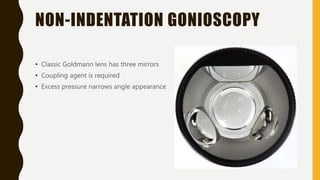
• Classic Goldmann lens has three mirrors
• Coupling agent is required
• Excess pressure narrows angle appearance
NON-INDENTATION GONIOSCOPY
ADVANTAGES
• Easy to use
• Excellent view
• Stabilizes the globe (can be used in
laser trabeculoplasty)
• Peripheral retina can be seen
DISADVANTAGES
• Curvature of lens is more than cornea,
coupling agent required
• Blurs vision & fundus
• Needs to be rotated 360º
INDENTATION GONIOSCOPY
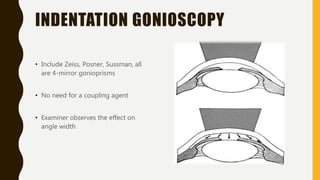
• Include Zeiss, Posner, Sussman, all
are 4-mirror gonioprisms
• No need for a coupling agent
• Examiner observes the effect on
angle width
ZEISS GONIOPRISM
• 4 identical mirrors angled at 64
• allows examination of four quadrants
without rotation
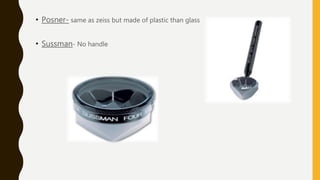
• Posner- same as zeiss but made of plastic than glass
• Sussman- No handle
INDENTATION GONIOSCOPY
ADVANTAGES
• Easy to perform when mastered
• All four quadrants seen
• Allows differentiation of appositional
& synaechial angle closure
• No coupling agent
DISADVANTAGES
• Difficult to master
• Mirror image can be confusing
• May open the angle artificially
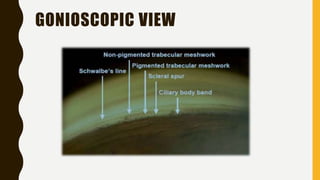
GONIOSCOPIC VIEW
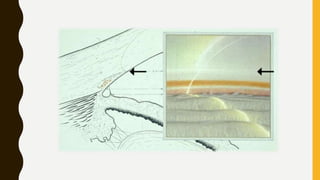
SCHWALBE’S LINE
• Most anterior structure
• Appears whitish to variably pigmented
• Demarcates peripheral termination of Descemets membrane
• Best identified by locating corneal wedge
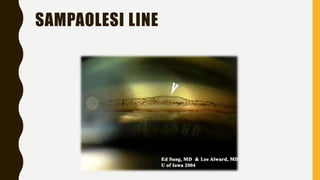
• Sampaolesi line – pigment deposits at or anterior to schwalbes line
– Eg: Pseudoexfoliation syndrome, Pigment Dispersion Syndrome
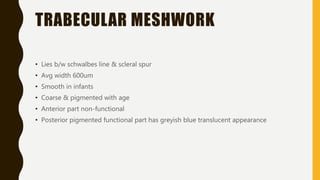
TRABECULAR MESHWORK
• Lies b/w schwalbes line & scleral spur
• Avg width 600um
• Smooth in infants
• Coarse & pigmented with age
• Anterior part non-functional
• Posterior pigmented functional part has greyish blue translucent appearance
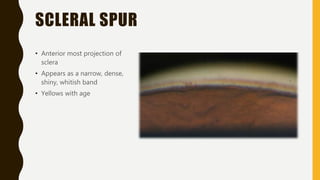
SCLERAL SPUR
• Anterior most projection of
sclera
• Appears as a narrow, dense,
shiny, whitish band
• Yellows with age
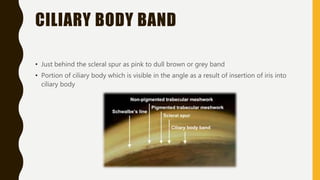
CILIARY BODY BAND
• Just behind the scleral spur as pink to dull brown or grey band
• Portion of ciliary body which is visible in the angle as a result of insertion of iris into
ciliary body
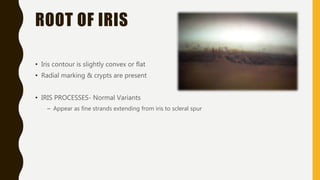
ROOT OF IRIS
• Iris contour is slightly convex or flat
• Radial marking & crypts are present
• IRIS PROCESSES- Normal Variants
– Appear as fine strands extending from iris to scleral spur
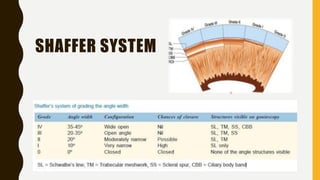
GRADING OF ANGLE WIDTH
1. Shaffer System
2. Scheie Classification
3. Spaeth System
4. Van-Herick Method
SHAFFER SYSTEM
VAN-HERIK METHOD
• Uses the slit lamp alone to estimate the AC angle
SOME GONIOSCOPIC
IMAGES
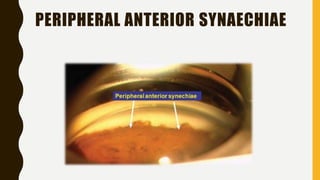
PERIPHERAL ANTERIOR SYNAECHIAE
SAMPAOLESI LINE
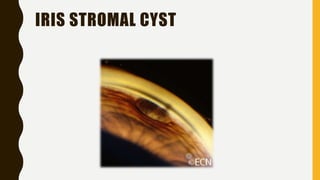
IRIS STROMAL CYST
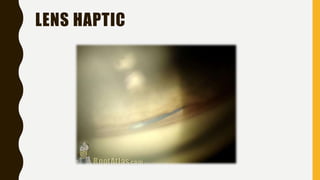
LENS HAPTIC
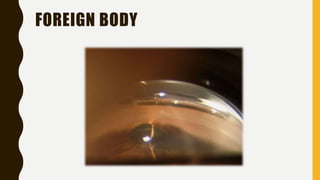
FOREIGN BODY
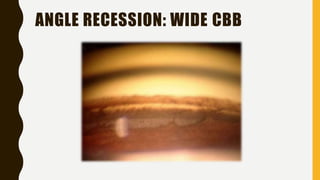
ANGLE RECESSION: WIDE CBB
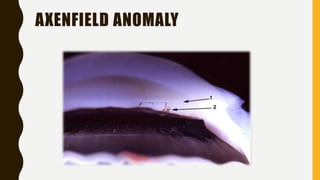
AXENFIELD ANOMALY
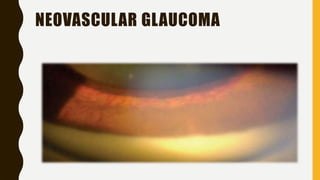
NEOVASCULAR GLAUCOMA
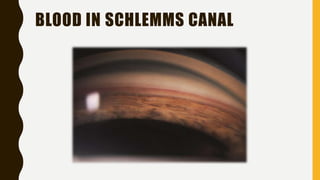
BLOOD IN SCHLEMMS CANAL
Gonioscopy

Gonioscopy

  • 1.
    GONIOSCOPY P U SH K A L K ATA R A
  • 2.
    INTRODUCTION • Method ofevaluating the anterior chamber angle • Used therapeutically for procedures such as laser trabeculoplasty & goniotomy • Term coined by Trantas in 1907, • He visualized the angle in an eye with keratoglobus by indenting the limbus • Goldmann in 1938, introduced the gonioprism • Barkan, established use of gonioscopy in management of glaucoma
  • 3.
    OPTIC PRINCIPLES • Angleof AC cannot be visualized directly through intact cornea • Light from angle structures undergo ‘Total Internal Reflection’ at anterior surface of precorneal tear film
  • 4.
    • When lighttravels from a medium of higher to one of lower refractive index, it will be reflected at the interface • Unless the angle of incidence is less than a certain ‘critical angle’ dependent on their refractive index difference (46º for tear film-air interface) • Goniolenses eliminates total internal reflection by replacing tear film-air interface with a tear film-goniolens interface
  • 5.
    TYPES • Direct Goniolens –Provides direct view of the angle – Eg: Koeppe, Swan-Jacob • Indirect Goniolens – Provides mirror image of opposite angle – Eg: Goldmann, Zeiss
  • 6.
    GENERAL PROCEDURE • Ambientillumination low-completely dark • Size & intensity of slit beam to absolute minimum • Patient seated at slit lam & advised that lens will touch the eye • Both eyes should remain open • Drop of local anaesthetic instilled • Coupling fluid (eg: hypermellose 0.3%) placed on contact surface of lens • Patient is asked to look upwards & lens is inserted rapidly to avoid loss of coupling fluid • Afterwards, lens should be cleaned & sterilized
  • 7.
    DIRECT GONIOSCOPY • Workby constructing the viewing surface of lens in a domed or slanted configuration • Such that exiting light rays strike the contact lens-air interface at a steeper than critical angle, so they pass through the observer • Patient should be supine • Useful but impractical for routine use
  • 8.
    TYPES OF DIRECTGONIOLENS 1. Koeppe 2. Richardson-Shaffer 3. Huskins Barkan 4. Sieback 5. Swan Jacob 6. Layden 7. Worth
  • 9.
    KOEPPE GONIOLENS • Mostcommonly used for diagnostic direct gonioscopy • Used with handheld microscope with separate light source • Provides a panaromic view of the angle
  • 10.
    • Richardson-Shaffers- smallKoeppe lens used for infants • Huskins-Barkan- prototype surgical goniolens used for goniotomy • Swan-Jacob- also for surgical purpose • Worth- anchors to cornea by partial vacuum • Sieback- tiny goniolens which floats on cornea • Layden- evaluating neonatal angle
  • 11.
    ADVANTAGES & DISADVANTAGES •Greater flexibility • Panaromic view • Angle becomes deep in supine position, easy to see • Detailed examination of minor structures possible • Lesser distortion of anterior chamber • Can be used in sedated or anaesthetized patients • Straight view • Both eyes can be examined simultaneously • Inconvenient • Light reflexes from cornea • Time consuming • Benefits of slit lamp not available
  • 12.
    INDIRECT GONIOSCOPY • Providesmirror image of opposite angle • Can be used only with a slit lamp • Uses mirrors/prisms to overcome total internal reflection • Two types : – Non-Indentation • Eg: Goldmann, Magna, Ritch – Indentation • Eg: Zeiss, Posner, Sussman
  • 13.
    NON-INDENTATION GONIOSCOPY • ClassicGoldmann lens has three mirrors • Coupling agent is required • Excess pressure narrows angle appearance
  • 14.
    NON-INDENTATION GONIOSCOPY ADVANTAGES • Easyto use • Excellent view • Stabilizes the globe (can be used in laser trabeculoplasty) • Peripheral retina can be seen DISADVANTAGES • Curvature of lens is more than cornea, coupling agent required • Blurs vision & fundus • Needs to be rotated 360º
  • 15.
    INDENTATION GONIOSCOPY • IncludeZeiss, Posner, Sussman, all are 4-mirror gonioprisms • No need for a coupling agent • Examiner observes the effect on angle width
  • 16.
    ZEISS GONIOPRISM • 4identical mirrors angled at 64 • allows examination of four quadrants without rotation
  • 17.
    • Posner- sameas zeiss but made of plastic than glass • Sussman- No handle
  • 18.
    INDENTATION GONIOSCOPY ADVANTAGES • Easyto perform when mastered • All four quadrants seen • Allows differentiation of appositional & synaechial angle closure • No coupling agent DISADVANTAGES • Difficult to master • Mirror image can be confusing • May open the angle artificially
  • 19.
  • 20.
    SCHWALBE’S LINE • Mostanterior structure • Appears whitish to variably pigmented • Demarcates peripheral termination of Descemets membrane • Best identified by locating corneal wedge • Sampaolesi line – pigment deposits at or anterior to schwalbes line – Eg: Pseudoexfoliation syndrome, Pigment Dispersion Syndrome
  • 22.
    TRABECULAR MESHWORK • Liesb/w schwalbes line & scleral spur • Avg width 600um • Smooth in infants • Coarse & pigmented with age • Anterior part non-functional • Posterior pigmented functional part has greyish blue translucent appearance
  • 23.
    SCLERAL SPUR • Anteriormost projection of sclera • Appears as a narrow, dense, shiny, whitish band • Yellows with age
  • 24.
    CILIARY BODY BAND •Just behind the scleral spur as pink to dull brown or grey band • Portion of ciliary body which is visible in the angle as a result of insertion of iris into ciliary body
  • 25.
    ROOT OF IRIS •Iris contour is slightly convex or flat • Radial marking & crypts are present • IRIS PROCESSES- Normal Variants – Appear as fine strands extending from iris to scleral spur
  • 26.
    GRADING OF ANGLEWIDTH 1. Shaffer System 2. Scheie Classification 3. Spaeth System 4. Van-Herick Method
  • 27.
  • 28.
    VAN-HERIK METHOD • Usesthe slit lamp alone to estimate the AC angle
  • 29.
  • 30.
  • 31.
  • 32.
  • 33.
  • 34.
  • 35.
  • 36.
  • 37.
  • 38.