Anaerobic capacity testing
Dr Noorin Bhimani
1
2
Anaerobic Energy Systems
• Anaerobic energy system = energy system within
the body that does not require the use of oxygen
• It consists of the ATP-PC system and the Lactic
Acid/Anaerobic Glycolysis system
• All three energy pathways (ATP-PC, Lactic Acid &
Aerobic energy systems) operate at any one time
and can overlap. The contribution of each varies
depending on the duration and intensity of the
activity
3
Anaerobic Energy Systems
ATP-PC SYSTEM
• Provides a bulk of ATP required during powerful and
explosive efforts
(Eg: take off in high jump, sprint position in netball)
• Linked with several fitness components
(Eg: muscular strength, anaerobic power, speed)
• Provides up to 10 seconds of energy for maximal effort
• The system relies on muscle stores of both ATP and PC
(phospho-creatine)
4
Anaerobic Energy Systems
LACTIC ACID SYSTEM
• Provides bulk of ATP production during high
intensity, sub-maximal efforts.
• Operates as a dominant supply of ATP from around
15-60 seconds of maximal effort
• Closely linked with several fitness components
(Eg: anaerobic power, speed and muscular power)
• Classic example: 400m run
5
Definitions
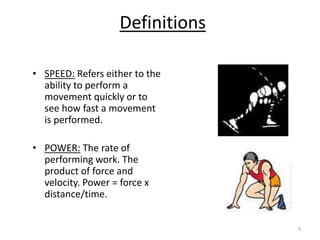
• SPEED: Refers either to the
ability to perform a
movement quickly or to
see how fast a movement
is performed.
• POWER: The rate of
performing work. The
product of force and
velocity. Power = force x
distance/time.
6
Definitions
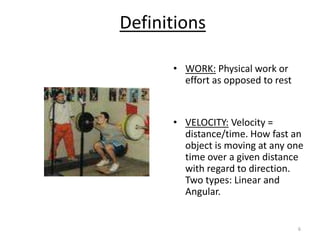
• WORK: Physical work or
effort as opposed to rest
• VELOCITY: Velocity =
distance/time. How fast an
object is moving at any one
time over a given distance
with regard to direction.
Two types: Linear and
Angular.
7
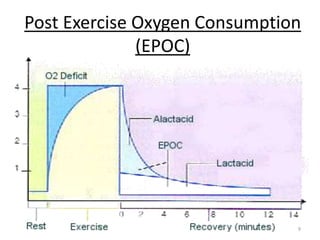
Post Exercise Oxygen Consumption
(EPOC)
• When aerobic exercise begins, the oxygen transport
system does not immediately supply the needed
quantity of oxygen to the active muscles because
oxygen consumption requires several minutes to
reach steady state.
• Because oxygen needs and oxygen supply differs
during the transition from rest to exercise, the body
incurs an oxygen deficit. (eg: getting tired during
warm up)
8
Post Exercise Oxygen Consumption
(EPOC)
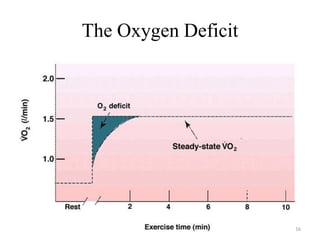
• The oxygen deficit = the difference between the
oxygen required for a given exercise intensity and
the actual oxygen consumption.
• Excess Postexercise Oxygen Consumption (Oxygen
debt) = the elevated levels of oxygen consumption
during the initial minutes of recovery, which exceed
the oxygen usually required at rest.
9
Post Exercise Oxygen Consumption
(EPOC)
10
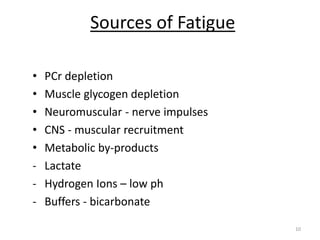
Sources of Fatigue
• PCr depletion
• Muscle glycogen depletion
• Neuromuscular - nerve impulses
• CNS - muscular recruitment
• Metabolic by-products
- Lactate
- Hydrogen Ions – low ph
- Buffers - bicarbonate
11
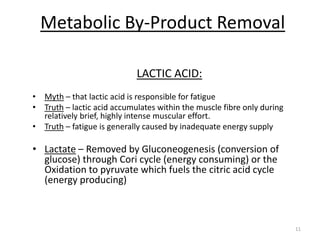
Metabolic By-Product Removal
LACTIC ACID:
• Myth – that lactic acid is responsible for fatigue
• Truth – lactic acid accumulates within the muscle fibre only during
relatively brief, highly intense muscular effort.
• Truth – fatigue is generally caused by inadequate energy supply
• Lactate – Removed by Gluconeogenesis (conversion of
glucose) through Cori cycle (energy consuming) or the
Oxidation to pyruvate which fuels the citric acid cycle
(energy producing)
12
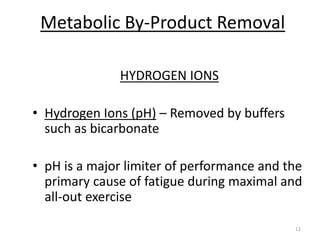
Metabolic By-Product Removal
HYDROGEN IONS
• Hydrogen Ions (pH) – Removed by buffers
such as bicarbonate
• pH is a major limiter of performance and the
primary cause of fatigue during maximal and
all-out exercise
Anaerobic power and
anaerobic capacity
• Anaerobic power: Peak rate of ATP produced via
anaerobic metabolism, difficult to measure
directly
– Usually estimated from peak power output during
all-out sprint-type exercise
• Anaerobic capacity : Maximal amount of ATP
that can be generated through anaerobic
metabolism, during short-duration maximal ex
– Important for 400-1500 m running, 200-400 m
freestyle swimming, 1-4 km track cycling, 2000 m
rowing, 500-1000 m kayaking, team sports
13
Measure anaerobic ATP production
• Muscle biopsy : Changes in muscle metabolites
• Blood lactate after supramaximal exercise
• Oxygen debt after supramaximal exercise
• Total work or mean power output during short-
duration maximal exercise
– Wingate test (30 s all-our cycling), 9-40% ATP
produced aerobically
– Tests < 60 s inadequate to exhaust anaerobic system
• Accumulated oxygen deficit
14
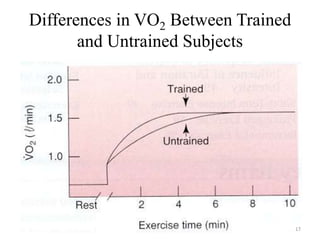
Rest-to-Exercise Transitions
• Oxygen uptake increases rapidly
– Reaches steady state within 1-4 minutes
• Oxygen deficit
– Lag in oxygen uptake at the beginning of
exercise
– Suggests anaerobic pathways contribute to most
ATP production
• After steady state is reached, ATP
requirement is met through aerobic ATP
production
15
The Oxygen Deficit
16
Differences in VO2 Between Trained
and Untrained Subjects
17
accumulated oxygen deficit
• At submaximal exercise: O2 consumption meets
energy demand at steady state, aerobic metabolism
– Linear VO2-power output relationship
• Supramaximal exercise: required ATP from aerobic +
anaerobic metabolism
– Exercise performed at a power output higher than that
achieved at VO2peak
– <60 sec sprint, or 2-4 min at constant power output
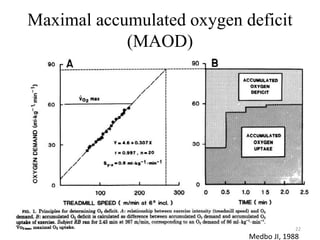
– Accumulated oxygen deficit = calculated accumulated
oxygen demand – measured accumulated oxygen demand
• MAOD: maximally accumulated oxygen deficit
– Valid and reliable measurement for anaerobic capacity 18
Assumption and criteria for MAOD as
good estimation for anaerobic capacity
• Assumption:
– Mechanical efficiency identical in supra- and submaximal
exercise
– the rate of total energy release (i.e. O2 demand) increases
linearly with the exercise intensity
– O2 demand is constant during this type of supramaximal
exercise
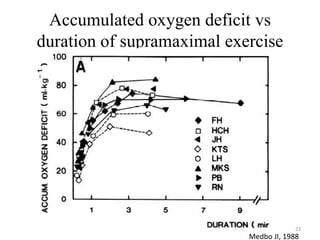
• Leveling off with exercise duration
– Increased with duration of exhaustive exercise until level
off
• Independent of maximal oxygen uptake (VO2max)
19
Procedures
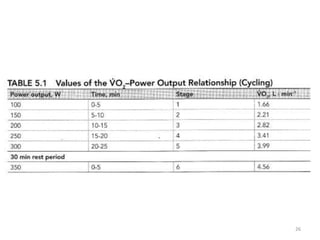
• VO2 – power output relationship
– Originally 10 stages at 10 min per stage
– Modified to fewer stages at 40-70% VO2max with 4
min per stage
• Duration of performance test
– Long enough to allow max anaerobic energy release
– Short enough to minimize aerobic energy production
– Constant power output 115-130% peak VO2
– Or ‘all-out’ for a specific duration or distance
20
Oxygen stores of body
• In transition from rest to exercise, mouth VO2
underestimate tissue VO2
– O2 bind to hemoglobin and myoglobin
– O2 dissolved in body fluids
– O2 in lungs
• Estimated 9% oxygen deficit
• Should be subtracted from absolute MAOD
21
Maximal accumulated oxygen deficit
(MAOD)
Medbo JI, 1988
22
Accumulated oxygen deficit vs
duration of supramaximal exercise
Medbo JI, 1988
23
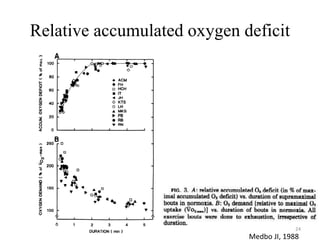
Relative accumulated oxygen deficit
Medbo JI, 1988
24
MAOD range
• 38 ml/kg in middle distance trained athletes, to
100 ml/kg in sprint trained athletes
– 60 kg: 2.3 L O2eq – 6 L O2eq
• MAOD unaffected by inspired O2 concentration
– Independent of aerobic metabolism
25
26
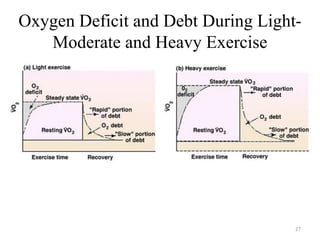
Oxygen Deficit and Debt During Light-
Moderate and Heavy Exercise
27
Recovery From Exercise: Metabolic
Responses
• Oxygen debt
– Elevated VO2 for several minutes immediately following
exercise
– Excess post-exercise oxygen consumption (EPOC)
• “Fast” portion of O2 debt
– Resynthesis of stored PC
– Replacing muscle and blood O2 stores
• “Slow” portion of O2 debt
– Elevated body temperature and catecholamines
– Conversion of lactic acid to glucose (gluconeogenesis)
28
Ways to Examine These Energy
Systems
• Vertical Jump
• Margaria Kalamen
• Wingate
Vertical Jump
• Variables
– Mass of Subject
– Height of Subject
– Height of Jump
• Procedure
– 3 Trials
– No stepping into the jump
– Using arms tends to help
• Calculations
– Absolute Anaerobic Power
(Mean & Average)
– Absolute & Relative Peak
Anaerobic Power
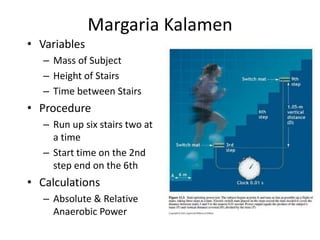
Margaria Kalamen
• Variables
– Mass of Subject
– Height of Stairs
– Time between Stairs
• Procedure
– Run up six stairs two at
a time
– Start time on the 2nd
step end on the 6th
• Calculations
– Absolute & Relative
Anaerobic Power
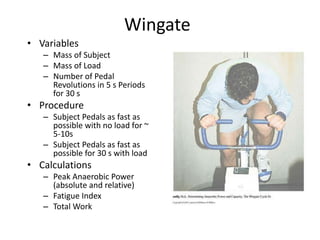
Wingate
• Variables
– Mass of Subject
– Mass of Load
– Number of Pedal
Revolutions in 5 s Periods
for 30 s
• Procedure
– Subject Pedals as fast as
possible with no load for ~
5-10s
– Subject Pedals as fast as
possible for 30 s with load
• Calculations
– Peak Anaerobic Power
(absolute and relative)
– Fatigue Index
– Total Work
Success of Measurements in Studying
the Anaerobic Systems
• All tests are measures of performance
• Variations in these particular tests may have a
lot to do with muscular attributes that are not
related to energy production
• Variables that have the same name are
measures of the same concepts, but not the
same actual values
Problems with Performance Measures
• Daily variance
• Motivation
• Learning effect
• Not a direct measurement of physiological
variables
• Relationships to physiological variables (and
other performance tests) must be determined
and the accuracy of prediction can then be
found
35
Conclusion
• Anaerobic energy system = energy system within the body
that does not require the use of oxygen
• There are two systems = ATP-PC system (lasts from 8-10
seconds) & LACTIC ACID system (operates from 15-60
seconds)
• Excess Postexercise Oxygen Consumption (Oxygen debt) =
the elevated levels of oxygen consumption during the initial
minutes of recovery, which exceed the oxygen usually
required at rest.

anaerobic power testing.pptx

  • 1.
  • 2.
    2 Anaerobic Energy Systems •Anaerobic energy system = energy system within the body that does not require the use of oxygen • It consists of the ATP-PC system and the Lactic Acid/Anaerobic Glycolysis system • All three energy pathways (ATP-PC, Lactic Acid & Aerobic energy systems) operate at any one time and can overlap. The contribution of each varies depending on the duration and intensity of the activity
  • 3.
    3 Anaerobic Energy Systems ATP-PCSYSTEM • Provides a bulk of ATP required during powerful and explosive efforts (Eg: take off in high jump, sprint position in netball) • Linked with several fitness components (Eg: muscular strength, anaerobic power, speed) • Provides up to 10 seconds of energy for maximal effort • The system relies on muscle stores of both ATP and PC (phospho-creatine)
  • 4.
    4 Anaerobic Energy Systems LACTICACID SYSTEM • Provides bulk of ATP production during high intensity, sub-maximal efforts. • Operates as a dominant supply of ATP from around 15-60 seconds of maximal effort • Closely linked with several fitness components (Eg: anaerobic power, speed and muscular power) • Classic example: 400m run
  • 5.
    5 Definitions • SPEED: Referseither to the ability to perform a movement quickly or to see how fast a movement is performed. • POWER: The rate of performing work. The product of force and velocity. Power = force x distance/time.
  • 6.
    6 Definitions • WORK: Physicalwork or effort as opposed to rest • VELOCITY: Velocity = distance/time. How fast an object is moving at any one time over a given distance with regard to direction. Two types: Linear and Angular.
  • 7.
    7 Post Exercise OxygenConsumption (EPOC) • When aerobic exercise begins, the oxygen transport system does not immediately supply the needed quantity of oxygen to the active muscles because oxygen consumption requires several minutes to reach steady state. • Because oxygen needs and oxygen supply differs during the transition from rest to exercise, the body incurs an oxygen deficit. (eg: getting tired during warm up)
  • 8.
    8 Post Exercise OxygenConsumption (EPOC) • The oxygen deficit = the difference between the oxygen required for a given exercise intensity and the actual oxygen consumption. • Excess Postexercise Oxygen Consumption (Oxygen debt) = the elevated levels of oxygen consumption during the initial minutes of recovery, which exceed the oxygen usually required at rest.
  • 9.
    9 Post Exercise OxygenConsumption (EPOC)
  • 10.
    10 Sources of Fatigue •PCr depletion • Muscle glycogen depletion • Neuromuscular - nerve impulses • CNS - muscular recruitment • Metabolic by-products - Lactate - Hydrogen Ions – low ph - Buffers - bicarbonate
  • 11.
    11 Metabolic By-Product Removal LACTICACID: • Myth – that lactic acid is responsible for fatigue • Truth – lactic acid accumulates within the muscle fibre only during relatively brief, highly intense muscular effort. • Truth – fatigue is generally caused by inadequate energy supply • Lactate – Removed by Gluconeogenesis (conversion of glucose) through Cori cycle (energy consuming) or the Oxidation to pyruvate which fuels the citric acid cycle (energy producing)
  • 12.
    12 Metabolic By-Product Removal HYDROGENIONS • Hydrogen Ions (pH) – Removed by buffers such as bicarbonate • pH is a major limiter of performance and the primary cause of fatigue during maximal and all-out exercise
  • 13.
    Anaerobic power and anaerobiccapacity • Anaerobic power: Peak rate of ATP produced via anaerobic metabolism, difficult to measure directly – Usually estimated from peak power output during all-out sprint-type exercise • Anaerobic capacity : Maximal amount of ATP that can be generated through anaerobic metabolism, during short-duration maximal ex – Important for 400-1500 m running, 200-400 m freestyle swimming, 1-4 km track cycling, 2000 m rowing, 500-1000 m kayaking, team sports 13
  • 14.
    Measure anaerobic ATPproduction • Muscle biopsy : Changes in muscle metabolites • Blood lactate after supramaximal exercise • Oxygen debt after supramaximal exercise • Total work or mean power output during short- duration maximal exercise – Wingate test (30 s all-our cycling), 9-40% ATP produced aerobically – Tests < 60 s inadequate to exhaust anaerobic system • Accumulated oxygen deficit 14
  • 15.
    Rest-to-Exercise Transitions • Oxygenuptake increases rapidly – Reaches steady state within 1-4 minutes • Oxygen deficit – Lag in oxygen uptake at the beginning of exercise – Suggests anaerobic pathways contribute to most ATP production • After steady state is reached, ATP requirement is met through aerobic ATP production 15
  • 16.
  • 17.
    Differences in VO2Between Trained and Untrained Subjects 17
  • 18.
    accumulated oxygen deficit •At submaximal exercise: O2 consumption meets energy demand at steady state, aerobic metabolism – Linear VO2-power output relationship • Supramaximal exercise: required ATP from aerobic + anaerobic metabolism – Exercise performed at a power output higher than that achieved at VO2peak – <60 sec sprint, or 2-4 min at constant power output – Accumulated oxygen deficit = calculated accumulated oxygen demand – measured accumulated oxygen demand • MAOD: maximally accumulated oxygen deficit – Valid and reliable measurement for anaerobic capacity 18
  • 19.
    Assumption and criteriafor MAOD as good estimation for anaerobic capacity • Assumption: – Mechanical efficiency identical in supra- and submaximal exercise – the rate of total energy release (i.e. O2 demand) increases linearly with the exercise intensity – O2 demand is constant during this type of supramaximal exercise • Leveling off with exercise duration – Increased with duration of exhaustive exercise until level off • Independent of maximal oxygen uptake (VO2max) 19
  • 20.
    Procedures • VO2 –power output relationship – Originally 10 stages at 10 min per stage – Modified to fewer stages at 40-70% VO2max with 4 min per stage • Duration of performance test – Long enough to allow max anaerobic energy release – Short enough to minimize aerobic energy production – Constant power output 115-130% peak VO2 – Or ‘all-out’ for a specific duration or distance 20
  • 21.
    Oxygen stores ofbody • In transition from rest to exercise, mouth VO2 underestimate tissue VO2 – O2 bind to hemoglobin and myoglobin – O2 dissolved in body fluids – O2 in lungs • Estimated 9% oxygen deficit • Should be subtracted from absolute MAOD 21
  • 22.
    Maximal accumulated oxygendeficit (MAOD) Medbo JI, 1988 22
  • 23.
    Accumulated oxygen deficitvs duration of supramaximal exercise Medbo JI, 1988 23
  • 24.
    Relative accumulated oxygendeficit Medbo JI, 1988 24
  • 25.
    MAOD range • 38ml/kg in middle distance trained athletes, to 100 ml/kg in sprint trained athletes – 60 kg: 2.3 L O2eq – 6 L O2eq • MAOD unaffected by inspired O2 concentration – Independent of aerobic metabolism 25
  • 26.
  • 27.
    Oxygen Deficit andDebt During Light- Moderate and Heavy Exercise 27
  • 28.
    Recovery From Exercise:Metabolic Responses • Oxygen debt – Elevated VO2 for several minutes immediately following exercise – Excess post-exercise oxygen consumption (EPOC) • “Fast” portion of O2 debt – Resynthesis of stored PC – Replacing muscle and blood O2 stores • “Slow” portion of O2 debt – Elevated body temperature and catecholamines – Conversion of lactic acid to glucose (gluconeogenesis) 28
  • 29.
    Ways to ExamineThese Energy Systems • Vertical Jump • Margaria Kalamen • Wingate
  • 30.
    Vertical Jump • Variables –Mass of Subject – Height of Subject – Height of Jump • Procedure – 3 Trials – No stepping into the jump – Using arms tends to help • Calculations – Absolute Anaerobic Power (Mean & Average) – Absolute & Relative Peak Anaerobic Power
  • 31.
    Margaria Kalamen • Variables –Mass of Subject – Height of Stairs – Time between Stairs • Procedure – Run up six stairs two at a time – Start time on the 2nd step end on the 6th • Calculations – Absolute & Relative Anaerobic Power
  • 32.
    Wingate • Variables – Massof Subject – Mass of Load – Number of Pedal Revolutions in 5 s Periods for 30 s • Procedure – Subject Pedals as fast as possible with no load for ~ 5-10s – Subject Pedals as fast as possible for 30 s with load • Calculations – Peak Anaerobic Power (absolute and relative) – Fatigue Index – Total Work
  • 33.
    Success of Measurementsin Studying the Anaerobic Systems • All tests are measures of performance • Variations in these particular tests may have a lot to do with muscular attributes that are not related to energy production • Variables that have the same name are measures of the same concepts, but not the same actual values
  • 34.
    Problems with PerformanceMeasures • Daily variance • Motivation • Learning effect • Not a direct measurement of physiological variables • Relationships to physiological variables (and other performance tests) must be determined and the accuracy of prediction can then be found
  • 35.
    35 Conclusion • Anaerobic energysystem = energy system within the body that does not require the use of oxygen • There are two systems = ATP-PC system (lasts from 8-10 seconds) & LACTIC ACID system (operates from 15-60 seconds) • Excess Postexercise Oxygen Consumption (Oxygen debt) = the elevated levels of oxygen consumption during the initial minutes of recovery, which exceed the oxygen usually required at rest.