© 2013 City and Guilds of London Institute. All rights reserved.
Level 2 Diploma in Painting and Decorating
Colour organisational systems
Unit 230: Creating and applying colour
© 2013 City and Guilds of London Institute. All rights reserved.
Level 2 Diploma in Painting and Decorating
Introduction
• There are many colour referencing systems available.
• This presentation will explain how two of the most widely used
systems in the UK work and why they came into use.
• This will help you to understand these systems and give you the
knowledge and confidence to use them.
© 2013 City and Guilds of London Institute. All rights reserved.
Level 2 Diploma in Painting and Decorating
BS 4800
•BS 4800 (BS 4800 paint colours for building purposes) is a range of
paint codings (known as notations) developed to standardise and
provide a consistency of colours used in the building and construction
industry by the British Standards Institute in 1930.
•Prior to this, paint makers would just make up their own colours based
on trends and demand.
•It began with just ten colours. In 1973 there were 88 colours, now
there are 100, including black and white, which are taken from a larger
range of colours.
© 2013 City and Guilds of London Institute. All rights reserved.
Level 2 Diploma in Painting and Decorating
The coding is made up of three parts:
1. An even number between 2 and 24 that denotes the hue.
2. A letter between A and E that denotes the greyness.
3. A second number between 1 and 56 that denotes the weight.
BS 4800 coding explained
© 2013 City and Guilds of London Institute. All rights reserved.
Level 2 Diploma in Painting and Decorating
Hues
The hues are tints and shades of the 12 colours that you will find on
the colour wheel.
02 Reds/purples 12 Yellow/greens
04 Reds 14 Greens
06 Reds/yellows 16 Green/blues
08 Yellows/reds 18 Blues
10 Yellows 20 Purple/blues
22 Violets 24 Purples
© 2013 City and Guilds of London Institute. All rights reserved.
Level 2 Diploma in Painting and Decorating
Greyness
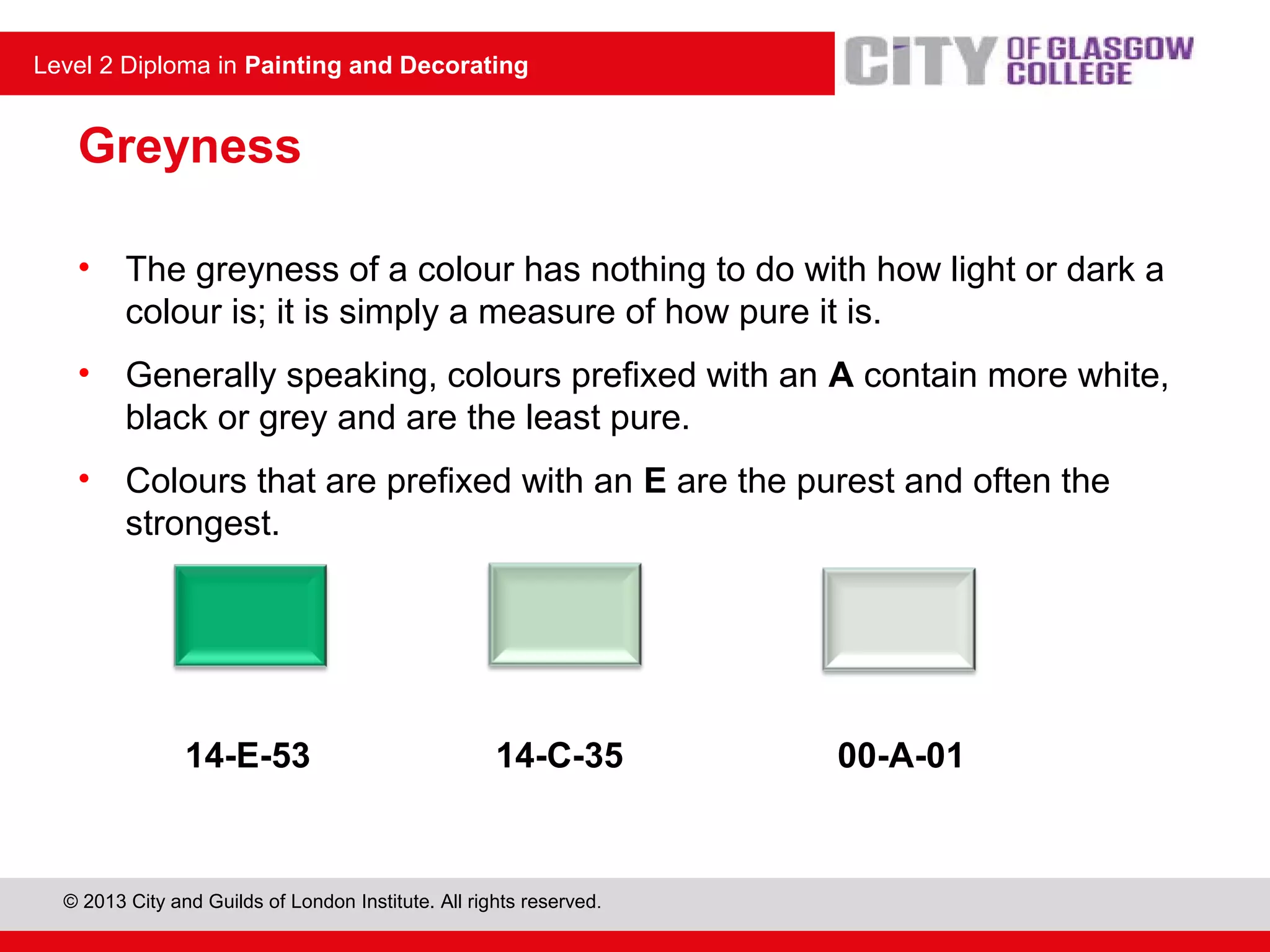
• The greyness of a colour has nothing to do with how light or dark a
colour is; it is simply a measure of how pure it is.
• Generally speaking, colours prefixed with an A contain more white,
black or grey and are the least pure.
• Colours that are prefixed with an E are the purest and often the
strongest.
14-E-53 14-C-35 00-A-01
© 2013 City and Guilds of London Institute. All rights reserved.
Level 2 Diploma in Painting and Decorating
Weight
• The weight of a colour was introduced to overcome the problem of
yellow/red and yellow.green colours looking heavy in relation to
other similar colours.
• With a few exceptions, the weight of a colour is denoted by odd
numbers.
An example of this is the difference between 12-E-51,
which is a yellowy green.
and 12-E 53, which is purer green.
© 2013 City and Guilds of London Institute. All rights reserved.
Level 2 Diploma in Painting and Decorating
The Munsell system
• The Munsell system was developed from earlier studies by Albert H
Munsell in America in the 1930s, in a bid to standardise colour
referencing with a more rational approach to notations.
• It is similar to the BS 4800 system in as much as it is based on hue,
greyness/value and weight but the colour references are based on
the natual order of colour in a three-dimensional shape.
• The word chroma, which is an ancient Greek word for colour,
replaces weight.
© 2013 City and Guilds of London Institute. All rights reserved.
Level 2 Diploma in Painting and Decorating
The colour tree
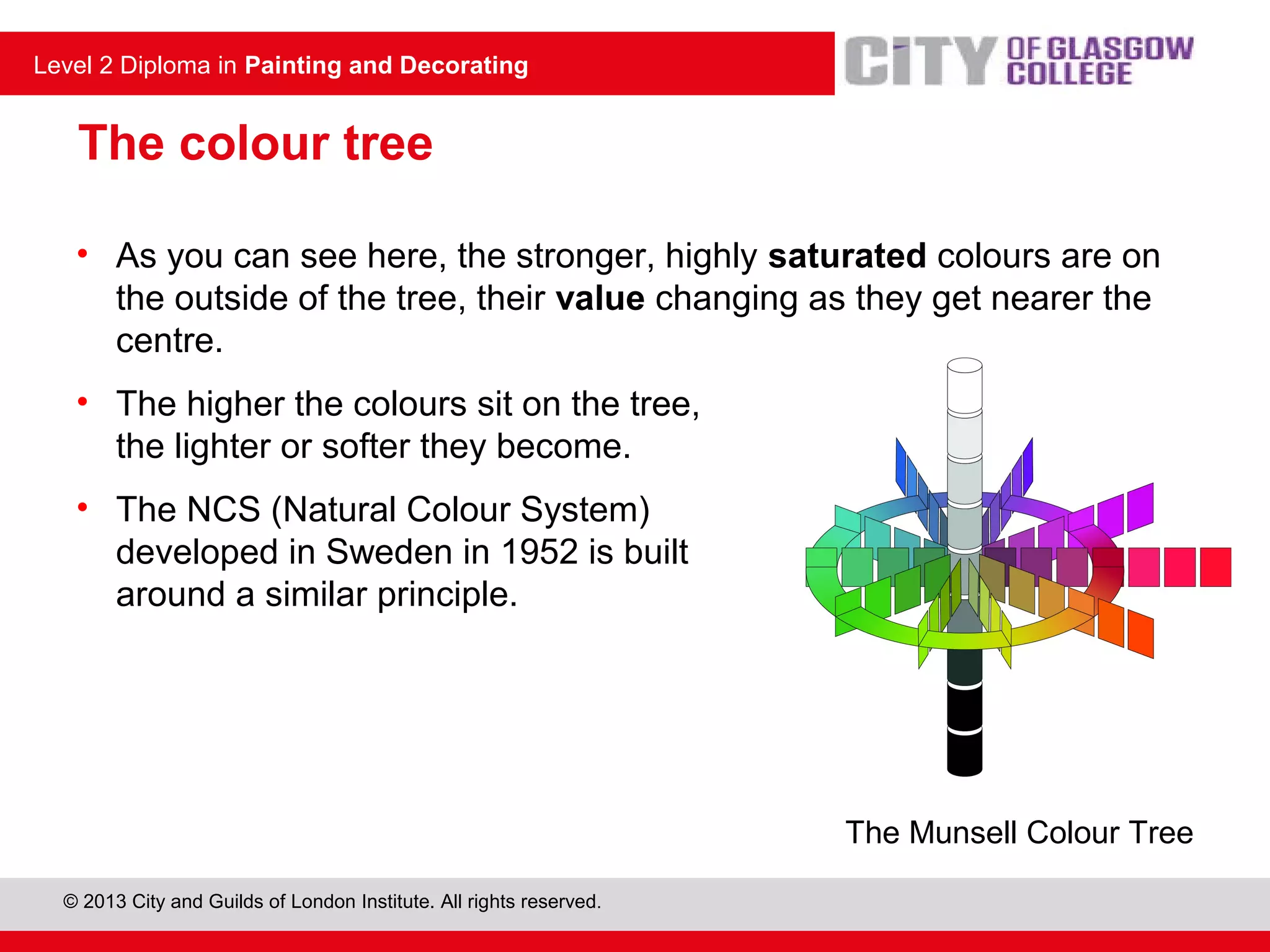
• As you can see here, the stronger, highly saturated colours are on
the outside of the tree, their value changing as they get nearer the
centre.
• The higher the colours sit on the tree,
the lighter or softer they become.
• The NCS (Natural Colour System)
developed in Sweden in 1952 is built
around a similar principle.
The Munsell Colour Tree
230.2
© 2013 City and Guilds of London Institute. All rights reserved.
Level 2 Diploma in Painting and Decorating
How the Munsell system works
Hue and chroma
•The Munsell paint codes – or notations as they are formally known –
are represented by the first letter, often principle hues (colours).
•Red is R Yellow is Y Blue is B
•The chroma (the strength and purity of a colour) is measured on a
scale of 1 to 14 from the outside of the three-dimensional circle (which
is the purest) to the inside (the greyest).
© 2013 City and Guilds of London Institute. All rights reserved.
Level 2 Diploma in Painting and Decorating
How the Munsell system works
Value
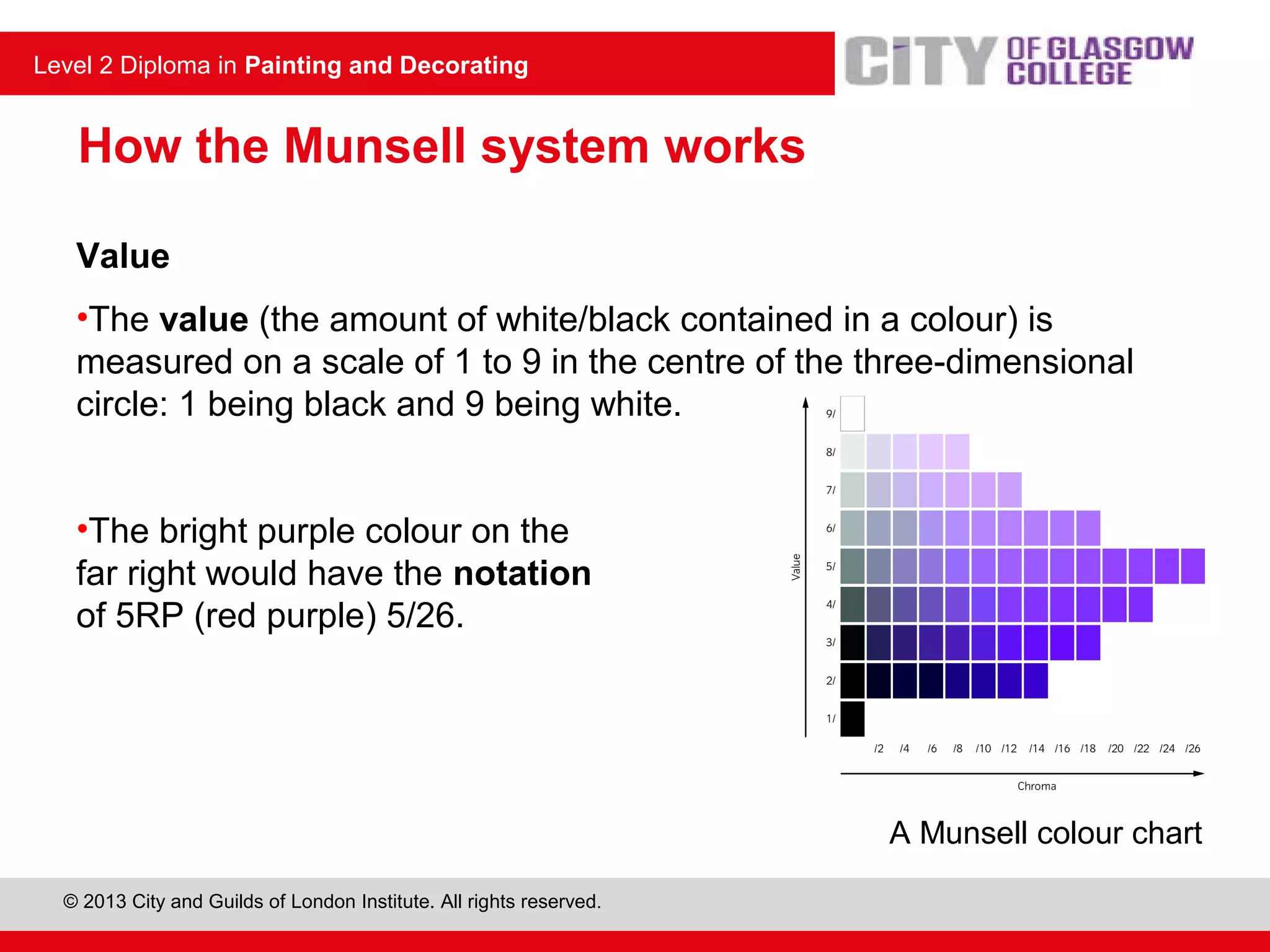
•The value (the amount of white/black contained in a colour) is
measured on a scale of 1 to 9 in the centre of the three-dimensional
circle: 1 being black and 9 being white.
•The bright purple colour on the
far right would have the notation
of 5RP (red purple) 5/26.
A Munsell colour chart
230.1
© 2013 City and Guilds of London Institute. All rights reserved.
Level 2 Diploma in Painting and Decorating
Conclusion
• There are many different organisational systems for colour, the
notations they use may all be different but the colours themselves
are essential all more or less the same.
• The most important thing to remember is that they are all based on
three basic principles – hue, weight/chroma and value.
• This will help you understand how each individual system works and
give you an appreciation of the work that has gone into these
systems over many years.
© 2013 City and Guilds of London Institute. All rights reserved.
Level 2 Diploma in Painting and Decorating
Any questions?

Colour organisational systems 1

  • 1.
    © 2013 Cityand Guilds of London Institute. All rights reserved. Level 2 Diploma in Painting and Decorating Colour organisational systems Unit 230: Creating and applying colour
  • 2.
    © 2013 Cityand Guilds of London Institute. All rights reserved. Level 2 Diploma in Painting and Decorating Introduction • There are many colour referencing systems available. • This presentation will explain how two of the most widely used systems in the UK work and why they came into use. • This will help you to understand these systems and give you the knowledge and confidence to use them.
  • 3.
    © 2013 Cityand Guilds of London Institute. All rights reserved. Level 2 Diploma in Painting and Decorating BS 4800 •BS 4800 (BS 4800 paint colours for building purposes) is a range of paint codings (known as notations) developed to standardise and provide a consistency of colours used in the building and construction industry by the British Standards Institute in 1930. •Prior to this, paint makers would just make up their own colours based on trends and demand. •It began with just ten colours. In 1973 there were 88 colours, now there are 100, including black and white, which are taken from a larger range of colours.
  • 4.
    © 2013 Cityand Guilds of London Institute. All rights reserved. Level 2 Diploma in Painting and Decorating The coding is made up of three parts: 1. An even number between 2 and 24 that denotes the hue. 2. A letter between A and E that denotes the greyness. 3. A second number between 1 and 56 that denotes the weight. BS 4800 coding explained
  • 5.
    © 2013 Cityand Guilds of London Institute. All rights reserved. Level 2 Diploma in Painting and Decorating Hues The hues are tints and shades of the 12 colours that you will find on the colour wheel. 02 Reds/purples 12 Yellow/greens 04 Reds 14 Greens 06 Reds/yellows 16 Green/blues 08 Yellows/reds 18 Blues 10 Yellows 20 Purple/blues 22 Violets 24 Purples
  • 6.
    © 2013 Cityand Guilds of London Institute. All rights reserved. Level 2 Diploma in Painting and Decorating Greyness • The greyness of a colour has nothing to do with how light or dark a colour is; it is simply a measure of how pure it is. • Generally speaking, colours prefixed with an A contain more white, black or grey and are the least pure. • Colours that are prefixed with an E are the purest and often the strongest. 14-E-53 14-C-35 00-A-01
  • 7.
    © 2013 Cityand Guilds of London Institute. All rights reserved. Level 2 Diploma in Painting and Decorating Weight • The weight of a colour was introduced to overcome the problem of yellow/red and yellow.green colours looking heavy in relation to other similar colours. • With a few exceptions, the weight of a colour is denoted by odd numbers. An example of this is the difference between 12-E-51, which is a yellowy green. and 12-E 53, which is purer green.
  • 8.
    © 2013 Cityand Guilds of London Institute. All rights reserved. Level 2 Diploma in Painting and Decorating The Munsell system • The Munsell system was developed from earlier studies by Albert H Munsell in America in the 1930s, in a bid to standardise colour referencing with a more rational approach to notations. • It is similar to the BS 4800 system in as much as it is based on hue, greyness/value and weight but the colour references are based on the natual order of colour in a three-dimensional shape. • The word chroma, which is an ancient Greek word for colour, replaces weight.
  • 9.
    © 2013 Cityand Guilds of London Institute. All rights reserved. Level 2 Diploma in Painting and Decorating The colour tree • As you can see here, the stronger, highly saturated colours are on the outside of the tree, their value changing as they get nearer the centre. • The higher the colours sit on the tree, the lighter or softer they become. • The NCS (Natural Colour System) developed in Sweden in 1952 is built around a similar principle. The Munsell Colour Tree 230.2
  • 10.
    © 2013 Cityand Guilds of London Institute. All rights reserved. Level 2 Diploma in Painting and Decorating How the Munsell system works Hue and chroma •The Munsell paint codes – or notations as they are formally known – are represented by the first letter, often principle hues (colours). •Red is R Yellow is Y Blue is B •The chroma (the strength and purity of a colour) is measured on a scale of 1 to 14 from the outside of the three-dimensional circle (which is the purest) to the inside (the greyest).
  • 11.
    © 2013 Cityand Guilds of London Institute. All rights reserved. Level 2 Diploma in Painting and Decorating How the Munsell system works Value •The value (the amount of white/black contained in a colour) is measured on a scale of 1 to 9 in the centre of the three-dimensional circle: 1 being black and 9 being white. •The bright purple colour on the far right would have the notation of 5RP (red purple) 5/26. A Munsell colour chart 230.1
  • 12.
    © 2013 Cityand Guilds of London Institute. All rights reserved. Level 2 Diploma in Painting and Decorating Conclusion • There are many different organisational systems for colour, the notations they use may all be different but the colours themselves are essential all more or less the same. • The most important thing to remember is that they are all based on three basic principles – hue, weight/chroma and value. • This will help you understand how each individual system works and give you an appreciation of the work that has gone into these systems over many years.
  • 13.
    © 2013 Cityand Guilds of London Institute. All rights reserved. Level 2 Diploma in Painting and Decorating Any questions?

Editor's Notes

  • #2 Linked to worksheet 5 assessment criteria 3.9 – 4.4
  • #9 Linked to worksheet 4 assessment criteria 3.9-3.10
  • #10 Linked to worksheet 4