© 2013 City and Guilds of London Institute. All rights reserved.
Level 2 Diploma in Painting and Decorating
The colour circle/wheel
presentation
Unit 230: Creating and applying colour
© 2013 City and Guilds of London Institute. All rights reserved.
Level 2 Diploma in Painting and Decorating
Introduction
• The colour circle was invented by Sir Issac Newton in around 1666
to explain how colours relate to one another. The principle hasn’t
really changed since.
• It is the basis of all colour theory and is the natural order of colour.
• The following slides will explain how the colour wheel is constructed
and introduce you to the six categories contained within it.
• This will enable you to identify and select schemes based on
specific colour types.
© 2013 City and Guilds of London Institute. All rights reserved.
Level 2 Diploma in Painting and Decorating
The colour wheel
• The colour wheel, or colour circle as it is also known, is basically a
continuous combination of colour featuring all of the colours in the
colour spectrum.
• It has been slightly changed and developed over the years but its
principles remain the same.
• It begins with primary colours, which are mixed together to form
secondary colours, which are then mixed again with the primary
colours either side of them to form tertiary colours.
© 2013 City and Guilds of London Institute. All rights reserved.
Level 2 Diploma in Painting and Decorating
Primary colours
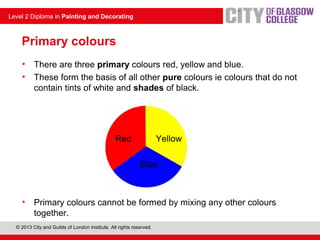
• There are three primary colours red, yellow and blue.
• These form the basis of all other pure colours ie colours that do not
contain tints of white and shades of black.
Red Yellow
Blue
• Primary colours cannot be formed by mixing any other colours
together.
© 2013 City and Guilds of London Institute. All rights reserved.
Level 2 Diploma in Painting and Decorating
Secondary colours
The primary colours are mixed together to form three secondary
colours.
+ =
+ =
+ =
red yellow orange
blue
green
purple
yellow
red
blue
230.9
© 2013 City and Guilds of London Institute. All rights reserved.
Level 2 Diploma in Painting and Decorating
Tertiary colours
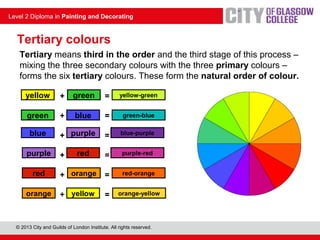
Tertiary means third in the order and the third stage of this process –
mixing the three secondary colours with the three primary colours –
forms the six tertiary colours. These form the natural order of colour.
+ =
+ =
+ =
+ =
+ =
+ =
yellow yellow-green
blue green-bluegreen
blue purple blue-purple
green
purple red purple-red
red orange red-orange
orange yellow orange-yellow
230.10
© 2013 City and Guilds of London Institute. All rights reserved.
Level 2 Diploma in Painting and Decorating
Conclusion
Colour is all around us and is something that should never be
underestimated as it has a massive impact on our everyday lives.
Consider how the previous slides would have looked without colour.
yellow yellow-green
blue green-bluegreen
blue purple blue-purple
green
purple red purple-red
red orange red-orange
orange yellow orange-yellow
© 2013 City and Guilds of London Institute. All rights reserved.
Level 2 Diploma in Painting and Decorating
Any questions?

The colour circlewheel 3

  • 1.
    © 2013 Cityand Guilds of London Institute. All rights reserved. Level 2 Diploma in Painting and Decorating The colour circle/wheel presentation Unit 230: Creating and applying colour
  • 2.
    © 2013 Cityand Guilds of London Institute. All rights reserved. Level 2 Diploma in Painting and Decorating Introduction • The colour circle was invented by Sir Issac Newton in around 1666 to explain how colours relate to one another. The principle hasn’t really changed since. • It is the basis of all colour theory and is the natural order of colour. • The following slides will explain how the colour wheel is constructed and introduce you to the six categories contained within it. • This will enable you to identify and select schemes based on specific colour types.
  • 3.
    © 2013 Cityand Guilds of London Institute. All rights reserved. Level 2 Diploma in Painting and Decorating The colour wheel • The colour wheel, or colour circle as it is also known, is basically a continuous combination of colour featuring all of the colours in the colour spectrum. • It has been slightly changed and developed over the years but its principles remain the same. • It begins with primary colours, which are mixed together to form secondary colours, which are then mixed again with the primary colours either side of them to form tertiary colours.
  • 4.
    © 2013 Cityand Guilds of London Institute. All rights reserved. Level 2 Diploma in Painting and Decorating Primary colours • There are three primary colours red, yellow and blue. • These form the basis of all other pure colours ie colours that do not contain tints of white and shades of black. Red Yellow Blue • Primary colours cannot be formed by mixing any other colours together.
  • 5.
    © 2013 Cityand Guilds of London Institute. All rights reserved. Level 2 Diploma in Painting and Decorating Secondary colours The primary colours are mixed together to form three secondary colours. + = + = + = red yellow orange blue green purple yellow red blue 230.9
  • 6.
    © 2013 Cityand Guilds of London Institute. All rights reserved. Level 2 Diploma in Painting and Decorating Tertiary colours Tertiary means third in the order and the third stage of this process – mixing the three secondary colours with the three primary colours – forms the six tertiary colours. These form the natural order of colour. + = + = + = + = + = + = yellow yellow-green blue green-bluegreen blue purple blue-purple green purple red purple-red red orange red-orange orange yellow orange-yellow 230.10
  • 7.
    © 2013 Cityand Guilds of London Institute. All rights reserved. Level 2 Diploma in Painting and Decorating Conclusion Colour is all around us and is something that should never be underestimated as it has a massive impact on our everyday lives. Consider how the previous slides would have looked without colour. yellow yellow-green blue green-bluegreen blue purple blue-purple green purple red purple-red red orange red-orange orange yellow orange-yellow
  • 8.
    © 2013 Cityand Guilds of London Institute. All rights reserved. Level 2 Diploma in Painting and Decorating Any questions?

Editor's Notes

  • #2 Related to worksheet 3 assessment criteria 1-12
  • #3 Linked to worksheet 4 a/c 3.9-3.10 worksheet 3 a/c 1-12
  • #8 Linked to worksheet 3
  • #9 Linked to worksheet 3