+
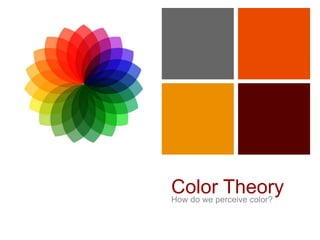
Color TheoryHow do we perceive color?
+
Color
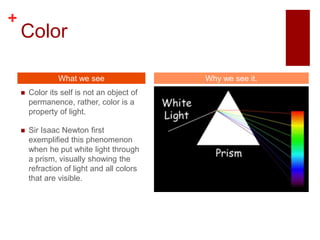
 Color its self is not an object of
permanence, rather, color is a
property of light.
 Sir Isaac Newton first
exemplified this phenomenon
when he put white light through
a prism, visually showing the
refraction of light and all colors
that are visible.
What we see Why we see it.
+
How do we distinguish between
colors?
 Colors are simply the
absorption of light.
 What does that mean?
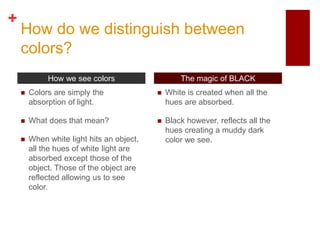
 When white light hits an object,
all the hues of white light are
absorbed except those of the
object. Those of the object are
reflected allowing us to see
color.
 White is created when all the
hues are absorbed.
 Black however, reflects all the
hues creating a muddy dark
color we see.
How we see colors The magic of BLACK
+
The Color Wheel
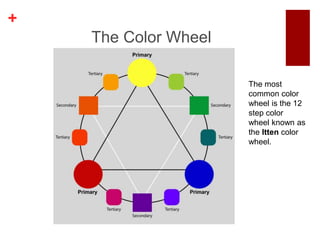
The most
common color
wheel is the 12
step color
wheel known as
the Itten color
wheel.
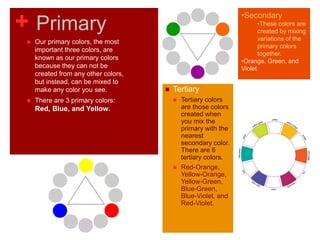
+ Primary
 Our primary colors, the most
important three colors, are
known as our primary colors
because they can not be
created from any other colors,
but instead, can be mixed to
make any color you see.
 There are 3 primary colors:
Red, Blue, and Yellow.
 Tertiary
 Tertiary colors
are those colors
created when
you mix the
primary with the
nearest
secondary color.
There are 6
tertiary colors.
 Red-Orange,
Yellow-Orange,
Yellow-Green,
Blue-Green,
Blue-Violet, and
Red-Violet.
•Secondary
•These colors are
created by mixing
variations of the
primary colors
together.
•Orange, Green, and
Violet.
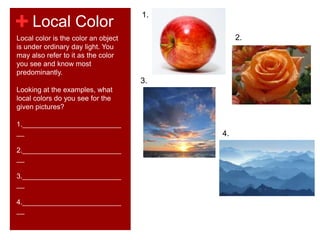
+ Local Color
Local color is the color an object
is under ordinary day light. You
may also refer to it as the color
you see and know most
predominantly.
Looking at the examples, what
local colors do you see for the
given pictures?
1._________________________
__
2._________________________
__
3._________________________
__
4._________________________
__
1.
4.
3.
2.
+
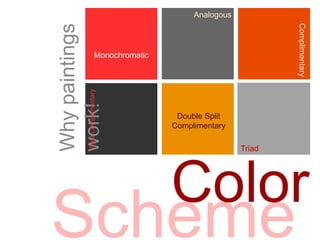
Scheme
Color
Whypaintings
work!
Monochromatic
Triad
Complimentary
Double Split
Complimentary
SplitComplimentary
Analogous
+
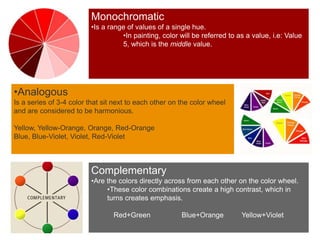
•Analogous
Is a series of 3-4 color that sit next to each other on the color wheel
and are considered to be harmonious.
Yellow, Yellow-Orange, Orange, Red-Orange
Blue, Blue-Violet, Violet, Red-Violet
asdfasdf Monochromatic
•Is a range of values of a single hue.
•In painting, color will be referred to as a value, i.e: Value
5, which is the middle value.
Complementary
•Are the colors directly across from each other on the color wheel.
•These color combinations create a high contrast, which in
turns creates emphasis.
Red+Green Blue+Orange Yellow+Violet
+
•Double Split Complementary
The split of two opposite colors.
i.e.: Split between Blue and Orange
The color scheme would consist of: Blue-Green, Blue Violet AND
Yellow-Orange, Red-Orange
asdfasdf Split Complementary
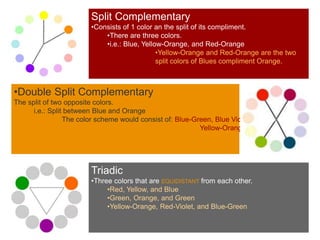
•Consists of 1 color an the split of its compliment.
•There are three colors.
•i.e.: Blue, Yellow-Orange, and Red-Orange
•Yellow-Orange and Red-Orange are the two
split colors of Blues compliment Orange.
Triadic
•Three colors that are EQUIDISTANT from each other.
•Red, Yellow, and Blue
•Green, Orange, and Green
•Yellow-Orange, Red-Violet, and Blue-Green
+
The Three
Properties
of Color
Value
Intensity
Hue
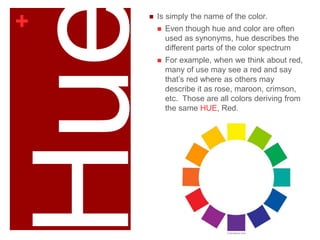
+  Is simply the name of the color.
 Even though hue and color are often
used as synonyms, hue describes the
different parts of the color spectrum
 For example, when we think about red,
many of use may see a red and say
that’s red where as others may
describe it as rose, maroon, crimson,
etc. Those are all colors deriving from
the same HUE, Red.
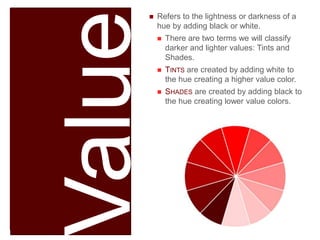
+  Refers to the lightness or darkness of a
hue by adding black or white.
 There are two terms we will classify
darker and lighter values: Tints and
Shades.
 TINTS are created by adding white to
the hue creating a higher value color.
 SHADES are created by adding black to
the hue creating lower value colors.
Value
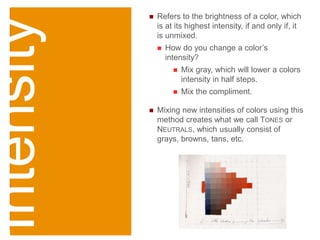
+  Refers to the brightness of a color, which
is at its highest intensity, if and only if, it
is unmixed.
 How do you change a color’s
intensity?
 Mix gray, which will lower a colors
intensity in half steps.
 Mix the compliment.
 Mixing new intensities of colors using this
method creates what we call TONES or
NEUTRALS, which usually consist of
grays, browns, tans, etc.
Intensity
+
The Three Viscosities of Paint
Translucent
Transparent
Opaque
+
The Three Viscosities
of Paint
Translucent
•Translucent paints have the ability to allow the
materials and images behind it to show through,
but not enough that you can distinguish whole
forms.
Transparent
•Paints that are
translucent allow for
everything to be seen
underneath it. This is
the most typical style
of paint used in oil
painting when
painting over an
underpainting. That
process is known as
glazing.
Opaque
•Paint is considered
opaque when it hides all
other colors or surfaces
below it. Acrylic when first
applied is an opaque color
unless stated on the tube.

Color Theory

  • 1.
    + Color TheoryHow dowe perceive color?
  • 2.
    + Color  Color itsself is not an object of permanence, rather, color is a property of light.  Sir Isaac Newton first exemplified this phenomenon when he put white light through a prism, visually showing the refraction of light and all colors that are visible. What we see Why we see it.
  • 3.
    + How do wedistinguish between colors?  Colors are simply the absorption of light.  What does that mean?  When white light hits an object, all the hues of white light are absorbed except those of the object. Those of the object are reflected allowing us to see color.  White is created when all the hues are absorbed.  Black however, reflects all the hues creating a muddy dark color we see. How we see colors The magic of BLACK
  • 4.
    + The Color Wheel Themost common color wheel is the 12 step color wheel known as the Itten color wheel.
  • 5.
    + Primary  Ourprimary colors, the most important three colors, are known as our primary colors because they can not be created from any other colors, but instead, can be mixed to make any color you see.  There are 3 primary colors: Red, Blue, and Yellow.  Tertiary  Tertiary colors are those colors created when you mix the primary with the nearest secondary color. There are 6 tertiary colors.  Red-Orange, Yellow-Orange, Yellow-Green, Blue-Green, Blue-Violet, and Red-Violet. •Secondary •These colors are created by mixing variations of the primary colors together. •Orange, Green, and Violet.
  • 6.
    + Local Color Localcolor is the color an object is under ordinary day light. You may also refer to it as the color you see and know most predominantly. Looking at the examples, what local colors do you see for the given pictures? 1._________________________ __ 2._________________________ __ 3._________________________ __ 4._________________________ __ 1. 4. 3. 2.
  • 7.
  • 8.
    + •Analogous Is a seriesof 3-4 color that sit next to each other on the color wheel and are considered to be harmonious. Yellow, Yellow-Orange, Orange, Red-Orange Blue, Blue-Violet, Violet, Red-Violet asdfasdf Monochromatic •Is a range of values of a single hue. •In painting, color will be referred to as a value, i.e: Value 5, which is the middle value. Complementary •Are the colors directly across from each other on the color wheel. •These color combinations create a high contrast, which in turns creates emphasis. Red+Green Blue+Orange Yellow+Violet
  • 9.
    + •Double Split Complementary Thesplit of two opposite colors. i.e.: Split between Blue and Orange The color scheme would consist of: Blue-Green, Blue Violet AND Yellow-Orange, Red-Orange asdfasdf Split Complementary •Consists of 1 color an the split of its compliment. •There are three colors. •i.e.: Blue, Yellow-Orange, and Red-Orange •Yellow-Orange and Red-Orange are the two split colors of Blues compliment Orange. Triadic •Three colors that are EQUIDISTANT from each other. •Red, Yellow, and Blue •Green, Orange, and Green •Yellow-Orange, Red-Violet, and Blue-Green
  • 10.
  • 11.
    +  Issimply the name of the color.  Even though hue and color are often used as synonyms, hue describes the different parts of the color spectrum  For example, when we think about red, many of use may see a red and say that’s red where as others may describe it as rose, maroon, crimson, etc. Those are all colors deriving from the same HUE, Red.
  • 12.
    +  Refersto the lightness or darkness of a hue by adding black or white.  There are two terms we will classify darker and lighter values: Tints and Shades.  TINTS are created by adding white to the hue creating a higher value color.  SHADES are created by adding black to the hue creating lower value colors. Value
  • 13.
    +  Refersto the brightness of a color, which is at its highest intensity, if and only if, it is unmixed.  How do you change a color’s intensity?  Mix gray, which will lower a colors intensity in half steps.  Mix the compliment.  Mixing new intensities of colors using this method creates what we call TONES or NEUTRALS, which usually consist of grays, browns, tans, etc. Intensity
  • 14.
    + The Three Viscositiesof Paint Translucent Transparent Opaque
  • 15.
    + The Three Viscosities ofPaint Translucent •Translucent paints have the ability to allow the materials and images behind it to show through, but not enough that you can distinguish whole forms. Transparent •Paints that are translucent allow for everything to be seen underneath it. This is the most typical style of paint used in oil painting when painting over an underpainting. That process is known as glazing. Opaque •Paint is considered opaque when it hides all other colors or surfaces below it. Acrylic when first applied is an opaque color unless stated on the tube.