The Colour
      General characteristics


Arts & Crafts 3rd grade (ESO)   Oskia Alvarez
                                 @oskiaisuri
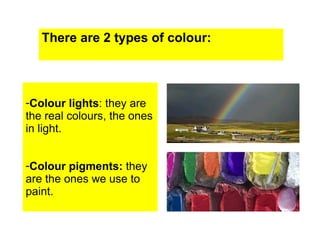
There are 2 types of colour:


-Colour lights: they are
the real colours, the ones
in light.


-Colour pigments: they
are the ones we use to
paint.
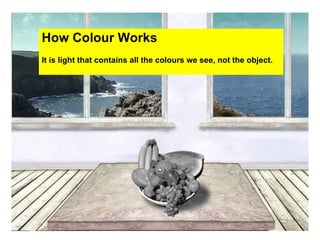
How Colour Works
It is light that contains all the colours we see, not the object.
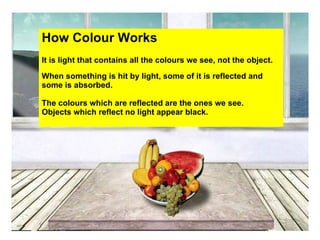
How Colour Works
It is light that contains all the colours we see, not the object.
When something is hit by light, some of it is reflected and
some is absorbed.

The colours which are reflected are the ones we see.
Objects which reflect no light appear black.
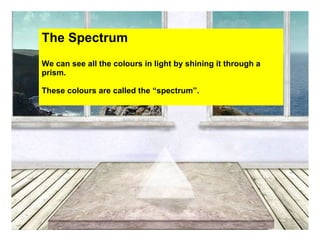
The Spectrum
We can see all the colours in light by shining it through a
prism.

These colours are called the “spectrum”.
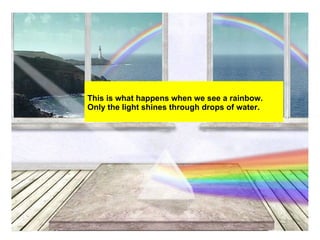
This is what happens when we see a rainbow.
Only the light shines through drops of water.
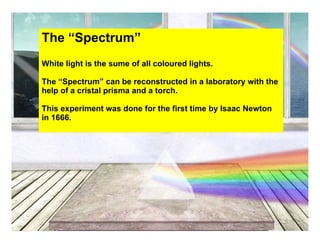
The “Spectrum”
White light is the sume of all coloured lights.

The “Spectrum” can be reconstructed in a laboratory with the
help of a cristal prisma and a torch.

This experiment was done for the first time by Isaac Newton
in 1666.
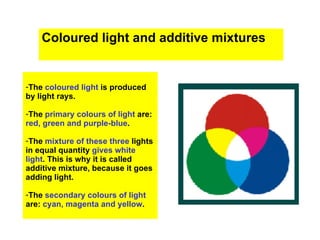
Coloured light and additive mixtures


-The coloured light is produced
by light rays.

-The primary colours of light are:
red, green and purple-blue.

-The mixture of these three lights
in equal quantity gives white
light. This is why it is called
additive mixture, because it goes
adding light.

-The secondary colours of light
are: cyan, magenta and yellow.
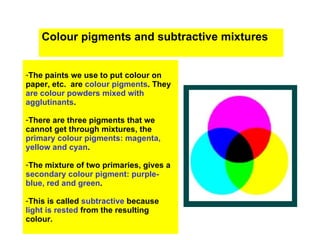
Colour pigments and subtractive mixtures


-The paints we use to put colour on
paper, etc. are colour pigments. They
are colour powders mixed with
agglutinants.

-There are three pigments that we
cannot get through mixtures, the
primary colour pigments: magenta,
yellow and cyan.

-The mixture of two primaries, gives a
secondary colour pigment: purple-
blue, red and green.

-This is called subtractive because
light is rested from the resulting
colour.
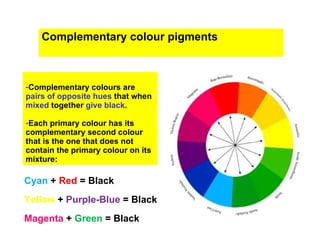
Complementary colour pigments


-Complementary colours are
pairs of opposite hues that when
mixed together give black.

-Each primary colour has its
complementary second colour
that is the one that does not
contain the primary colour on its
mixture:

Cyan + Red = Black
Yellow + Purple-Blue = Black
Magenta + Green = Black
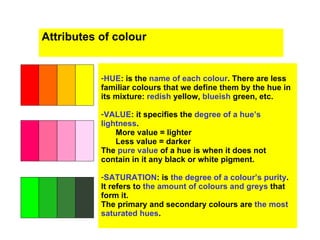
Attributes of colour


           -HUE: is the name of each colour. There are less
           familiar colours that we define them by the hue in
           its mixture: redish yellow, blueish green, etc.

           -VALUE: it specifies the degree of a hue’s
           lightness.
               More value = lighter
               Less value = darker
           The pure value of a hue is when it does not
           contain in it any black or white pigment.

           -SATURATION: is the degree of a colour’s purity.
           It refers to the amount of colours and greys that
           form it.
           The primary and secondary colours are the most
           saturated hues.
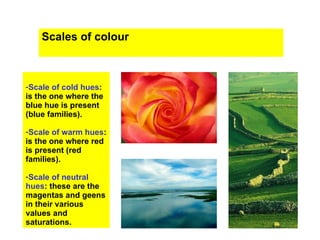
Scales of colour


-Scale of cold hues:
is the one where the
blue hue is present
(blue families).

-Scale of warm hues:
is the one where red
is present (red
families).

-Scale of neutral
hues: these are the
magentas and geens
in their various
values and
saturations.
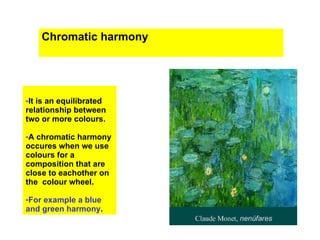
Chromatic harmony


-It is an equilibrated
relationship between
two or more colours.

-A chromatic harmony
occures when we use
colours for a
composition that are
close to eachother on
the colour wheel.

-For example a blue
and green harmony.
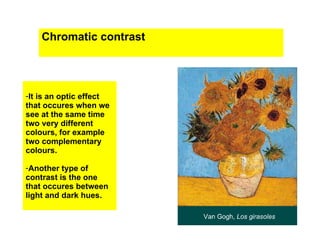
Chromatic contrast


-It is an optic effect
that occures when we
see at the same time
two very different
colours, for example
two complementary
colours.

-Another type of
contrast is the one
that occures between
light and dark hues.
This presentation is based on:


-    Lucía Alvarez, “El color. Características generales” a Slideshare
     presentation.


-    “Explore colour” an activity in www.artisancam.org.uk website.

The colour

  • 1.
    The Colour General characteristics Arts & Crafts 3rd grade (ESO) Oskia Alvarez @oskiaisuri
  • 2.
    There are 2types of colour: -Colour lights: they are the real colours, the ones in light. -Colour pigments: they are the ones we use to paint.
  • 3.
    How Colour Works Itis light that contains all the colours we see, not the object.
  • 4.
    How Colour Works Itis light that contains all the colours we see, not the object. When something is hit by light, some of it is reflected and some is absorbed. The colours which are reflected are the ones we see. Objects which reflect no light appear black.
  • 5.
    The Spectrum We cansee all the colours in light by shining it through a prism. These colours are called the “spectrum”.
  • 6.
    This is whathappens when we see a rainbow. Only the light shines through drops of water.
  • 7.
    The “Spectrum” White lightis the sume of all coloured lights. The “Spectrum” can be reconstructed in a laboratory with the help of a cristal prisma and a torch. This experiment was done for the first time by Isaac Newton in 1666.
  • 8.
    Coloured light andadditive mixtures -The coloured light is produced by light rays. -The primary colours of light are: red, green and purple-blue. -The mixture of these three lights in equal quantity gives white light. This is why it is called additive mixture, because it goes adding light. -The secondary colours of light are: cyan, magenta and yellow.
  • 9.
    Colour pigments andsubtractive mixtures -The paints we use to put colour on paper, etc. are colour pigments. They are colour powders mixed with agglutinants. -There are three pigments that we cannot get through mixtures, the primary colour pigments: magenta, yellow and cyan. -The mixture of two primaries, gives a secondary colour pigment: purple- blue, red and green. -This is called subtractive because light is rested from the resulting colour.
  • 10.
    Complementary colour pigments -Complementarycolours are pairs of opposite hues that when mixed together give black. -Each primary colour has its complementary second colour that is the one that does not contain the primary colour on its mixture: Cyan + Red = Black Yellow + Purple-Blue = Black Magenta + Green = Black
  • 11.
    Attributes of colour -HUE: is the name of each colour. There are less familiar colours that we define them by the hue in its mixture: redish yellow, blueish green, etc. -VALUE: it specifies the degree of a hue’s lightness. More value = lighter Less value = darker The pure value of a hue is when it does not contain in it any black or white pigment. -SATURATION: is the degree of a colour’s purity. It refers to the amount of colours and greys that form it. The primary and secondary colours are the most saturated hues.
  • 12.
    Scales of colour -Scaleof cold hues: is the one where the blue hue is present (blue families). -Scale of warm hues: is the one where red is present (red families). -Scale of neutral hues: these are the magentas and geens in their various values and saturations.
  • 13.
    Chromatic harmony -It isan equilibrated relationship between two or more colours. -A chromatic harmony occures when we use colours for a composition that are close to eachother on the colour wheel. -For example a blue and green harmony.
  • 14.
    Chromatic contrast -It isan optic effect that occures when we see at the same time two very different colours, for example two complementary colours. -Another type of contrast is the one that occures between light and dark hues.
  • 15.
    This presentation isbased on: - Lucía Alvarez, “El color. Características generales” a Slideshare presentation. - “Explore colour” an activity in www.artisancam.org.uk website.