In this unit, you will learn about
exploration and colonization from 1400-
1600
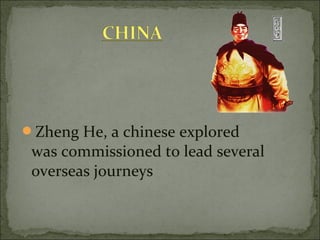
Zheng He, a chinese explored
was commissioned to lead several
overseas journeys
Practiced isolationism (isolated the nation
from the rest of the world)
expelled Christian missionaries
burned Western books
allowed only Chinese and Dutch trade
Flourishing with
Renaissance art,
literature, ideas, etc.
Looked for new
ways to make money
and many powerful
Kings decided to….go
exploring!
1. Looking for new sources of wealth
2. Traded spices
 Nutmeg, ginger, pepper, cinnamon
1. Looked for trade routes directly to
Asia
2. “Glory, Gold, God”—explorers
journeyed for money, fame, and
Christianity
Eventually explorers found a new sea
route to Asia.
Portugal dominated exploration
initially
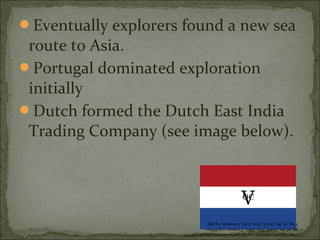
Dutch formed the Dutch East India
Trading Company (see image below).
http://upload.wikimedia.org/wikipedia/commons/thumb/8/81/Fl
ag_of_the_Dutch_East_India_Company.svg/800px-
Flag_of_the_Dutch_East_India_Company.svg.png
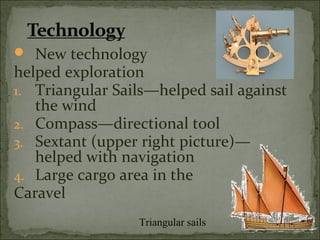
 New technology
helped exploration
1. Triangular Sails—helped sail against
the wind
2. Compass—directional tool
3. Sextant (upper right picture)—
helped with navigation
4. Large cargo area in the
Caravel
Triangular sails
Bartolomeu Dias; sailed for Portugal; explored
and reached southern tip of Africa
Vasco Da Gama; sailed for Portugal; rounded tip
of Africa
Zheng He; sailed for China China; explored Asia
and Eastern Africa
Christopher Columbus; sailed for Spain; explored
Caribbean (Bahamas)
Hernando Cortes; sailed for Spain; colonized
regions in Mexico, US, South America
Prince Henry of Portugal;
founded school of navigation to
train explorers
Amerigo Vespucci; sailed for
Portugal; South America
Ferdinand Magellan; sailed for
Spain; rounded the tip of South
America, Guam, Philippines
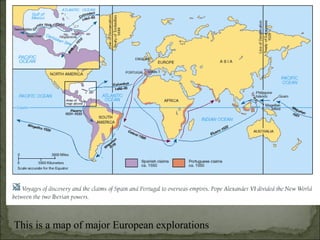
This is a map of major European explorations
http://wps.ablongman.com/wps/media/objects/262/268312/art/figures/KISH_12_271.gif
Colonize means to create colonies (settlers who live in
one territory and are ruled by a “parent” country)
Spanish conquerors (conquistadors) destroyed the
Aztecs and Incans of S. America
Native-Americans had no weapons to challenge Spanish
conquerors
80%-95% of Native Americans died
Spanish and Portuguese Kings became RICH!—Spanish
created an Empire
Continents became interdependent on
one another
Imports (goods brought into a
country) and exports (good sent out of
a country) began
Joint stock corporations developed—
similar to stock market today
Slave trade developed (Triangular
Trade)
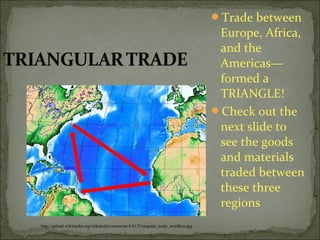
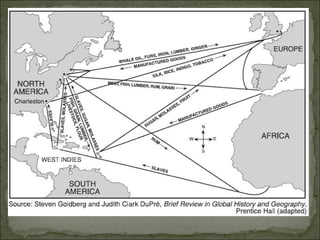
Trade between
Europe, Africa,
and the
Americas—
formed a
TRIANGLE!
Check out the
next slide to
see the goods
and materials
traded between
these three
regions
http://upload.wikimedia.org/wikipedia/commons/4/41/Triangular_trade_wordless.jpg
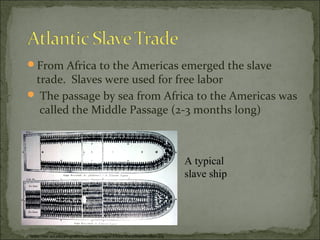
From Africa to the Americas emerged the slave
trade. Slaves were used for free labor
 The passage by sea from Africa to the Americas was
called the Middle Passage (2-3 months long)
A typical
slave ship
https://eee.uci.edu/programs/humcore/images/Africa/SlaveShipBrookes.jpg
Colonization powerpoint

Colonization powerpoint

  • 1.
    In this unit,you will learn about exploration and colonization from 1400- 1600
  • 3.
    Zheng He, achinese explored was commissioned to lead several overseas journeys
  • 4.
    Practiced isolationism (isolatedthe nation from the rest of the world) expelled Christian missionaries burned Western books allowed only Chinese and Dutch trade
  • 5.
    Flourishing with Renaissance art, literature,ideas, etc. Looked for new ways to make money and many powerful Kings decided to….go exploring!
  • 6.
    1. Looking fornew sources of wealth 2. Traded spices  Nutmeg, ginger, pepper, cinnamon 1. Looked for trade routes directly to Asia 2. “Glory, Gold, God”—explorers journeyed for money, fame, and Christianity
  • 7.
    Eventually explorers founda new sea route to Asia. Portugal dominated exploration initially Dutch formed the Dutch East India Trading Company (see image below). http://upload.wikimedia.org/wikipedia/commons/thumb/8/81/Fl ag_of_the_Dutch_East_India_Company.svg/800px- Flag_of_the_Dutch_East_India_Company.svg.png
  • 8.
     New technology helpedexploration 1. Triangular Sails—helped sail against the wind 2. Compass—directional tool 3. Sextant (upper right picture)— helped with navigation 4. Large cargo area in the Caravel Triangular sails
  • 9.
    Bartolomeu Dias; sailedfor Portugal; explored and reached southern tip of Africa Vasco Da Gama; sailed for Portugal; rounded tip of Africa Zheng He; sailed for China China; explored Asia and Eastern Africa Christopher Columbus; sailed for Spain; explored Caribbean (Bahamas) Hernando Cortes; sailed for Spain; colonized regions in Mexico, US, South America
  • 10.
    Prince Henry ofPortugal; founded school of navigation to train explorers Amerigo Vespucci; sailed for Portugal; South America Ferdinand Magellan; sailed for Spain; rounded the tip of South America, Guam, Philippines
  • 11.
    This is amap of major European explorations http://wps.ablongman.com/wps/media/objects/262/268312/art/figures/KISH_12_271.gif
  • 12.
    Colonize means tocreate colonies (settlers who live in one territory and are ruled by a “parent” country) Spanish conquerors (conquistadors) destroyed the Aztecs and Incans of S. America Native-Americans had no weapons to challenge Spanish conquerors 80%-95% of Native Americans died Spanish and Portuguese Kings became RICH!—Spanish created an Empire
  • 13.
    Continents became interdependenton one another Imports (goods brought into a country) and exports (good sent out of a country) began Joint stock corporations developed— similar to stock market today Slave trade developed (Triangular Trade)
  • 14.
    Trade between Europe, Africa, andthe Americas— formed a TRIANGLE! Check out the next slide to see the goods and materials traded between these three regions http://upload.wikimedia.org/wikipedia/commons/4/41/Triangular_trade_wordless.jpg
  • 16.
    From Africa tothe Americas emerged the slave trade. Slaves were used for free labor  The passage by sea from Africa to the Americas was called the Middle Passage (2-3 months long) A typical slave ship https://eee.uci.edu/programs/humcore/images/Africa/SlaveShipBrookes.jpg

Editor's Notes