1. First Americans-----Pre-Columbian
notes
•Pre-
Columbian
time period.
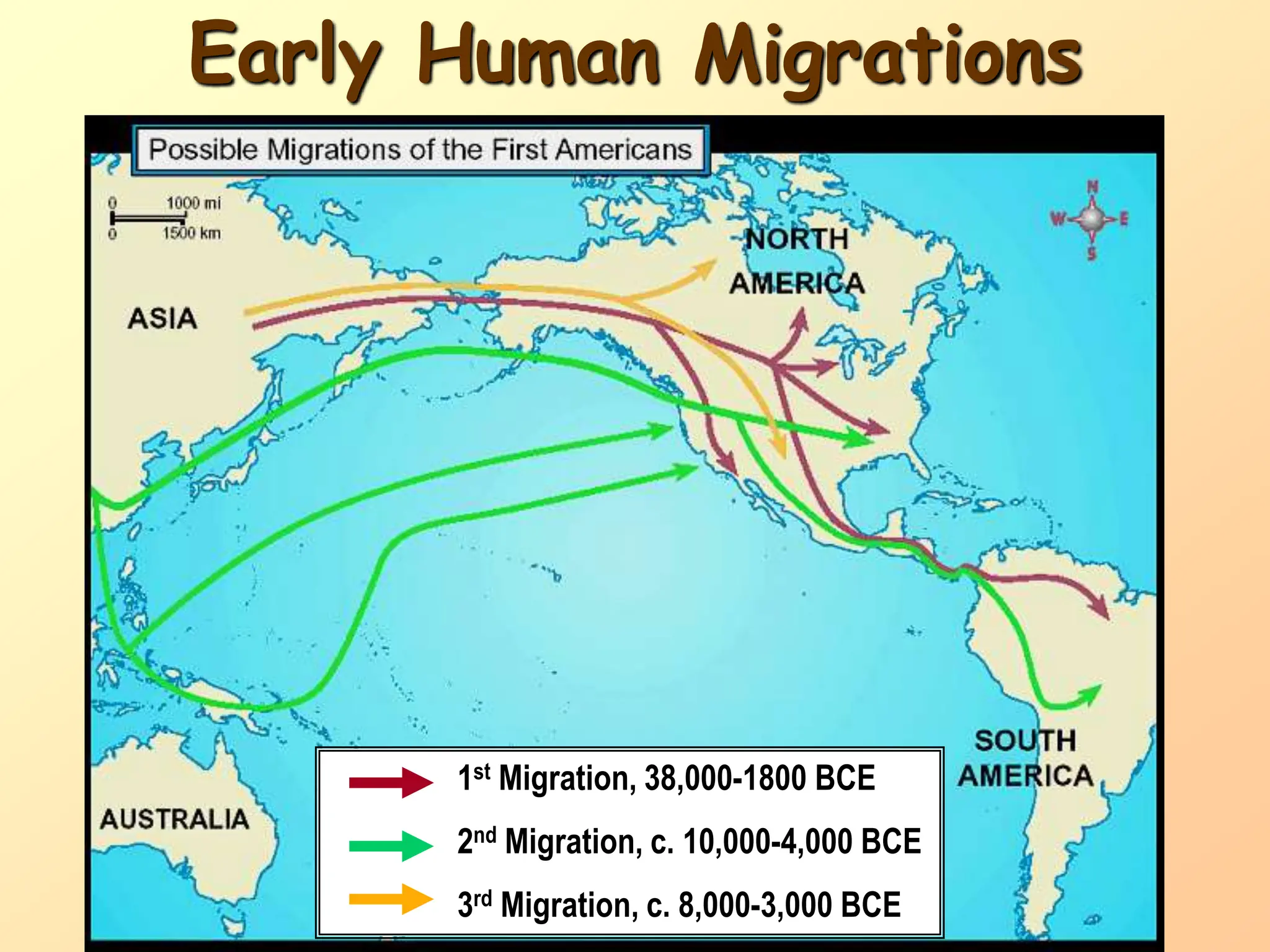
•First
Americans
came from
Asia
•Crossed the
Bering Strait
during the Ice
Age
•Following a
food source
•Gradual
migration
Early Human Migrations
1st Migration, 38,000-1800 BCE
2nd Migration, c. 10,000-4,000 BCE
3rd Migration, c. 8,000-3,000 BCE
Culture area
clash
WHITE EUROPEANS
•Used the land for economic needs
•Clearing the land, destroying hunting areas and fencing it off into
private property
•Divided the land and selling it for monetary value.
NATIVE AMERICANS
•Relationship with environment as part of their religion
•Need to hunt for survival
•Ownership meant access to the things the land produced, not
ownership of the land itself.
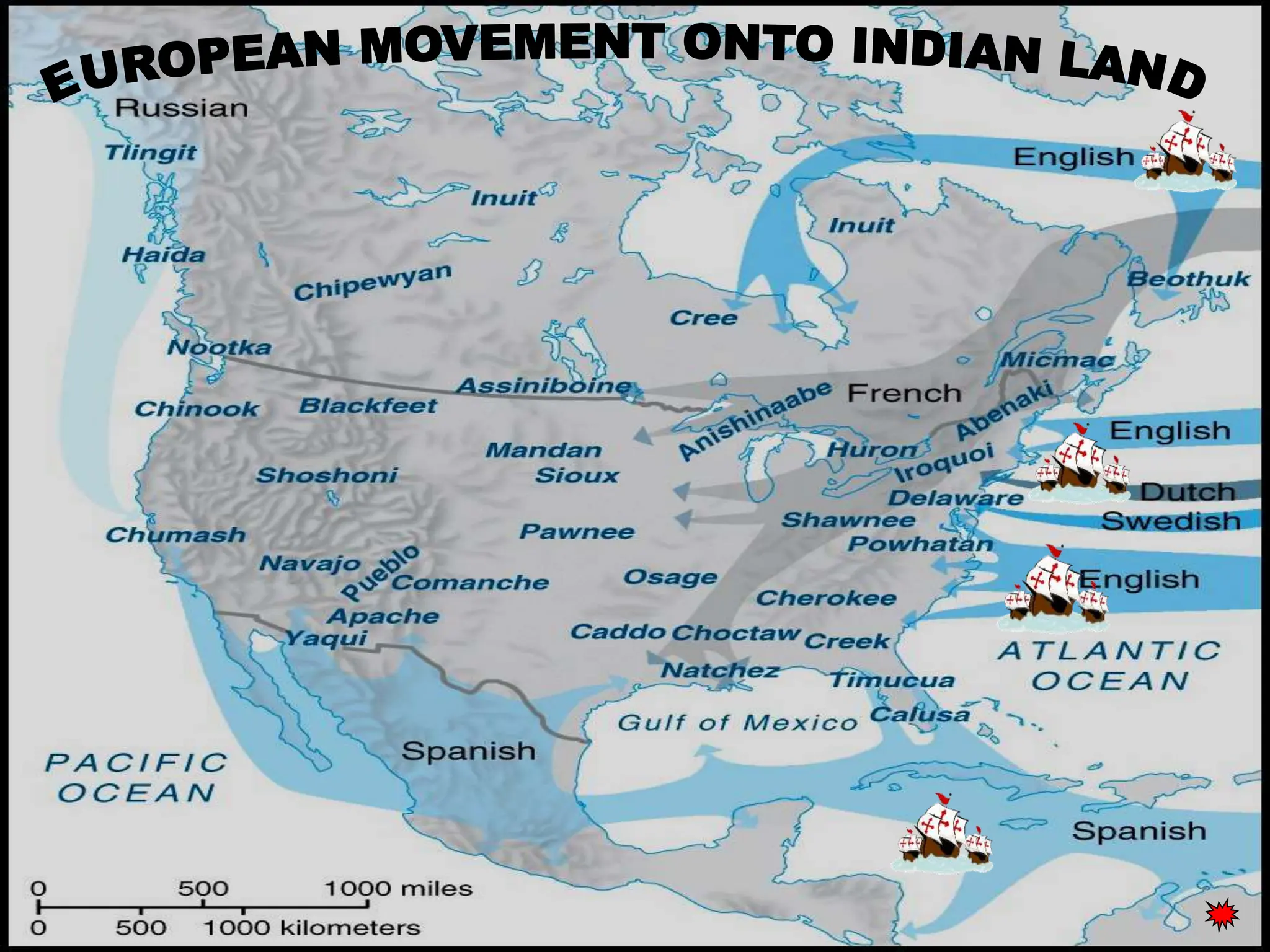
European
movement
1. First Americans-----Pre-Columbian
2. Europe Exploration
• Causes
• Indirect
• Direct
• Effects
notes
Earlier Explorations
1. Islam & the Spice Trade  Silk
Road
2. New Player  Europe
Nicolo, Maffeo, & Marco Polo,
1271
Expansion becomes a state
enterprise  monarchs had the
authority & the resources.
Better seaworthy ships.
Motives for European
Exploration
1. Crusades  by-pass intermediaries
to get to Asia.
2. Renaissance  curiosity about other
lands and peoples.
3. Reformation  refugees &
missionaries.
4. Monarchs seeking new sources of
revenue.
5. Technological advances.
6. Fame and fortune.
New Maritime Technologies
Hartman Astrolabe
(1532)
Better Maps
[Portulan]
Sextant
Mariner’s Compass
New Weapons
Technology
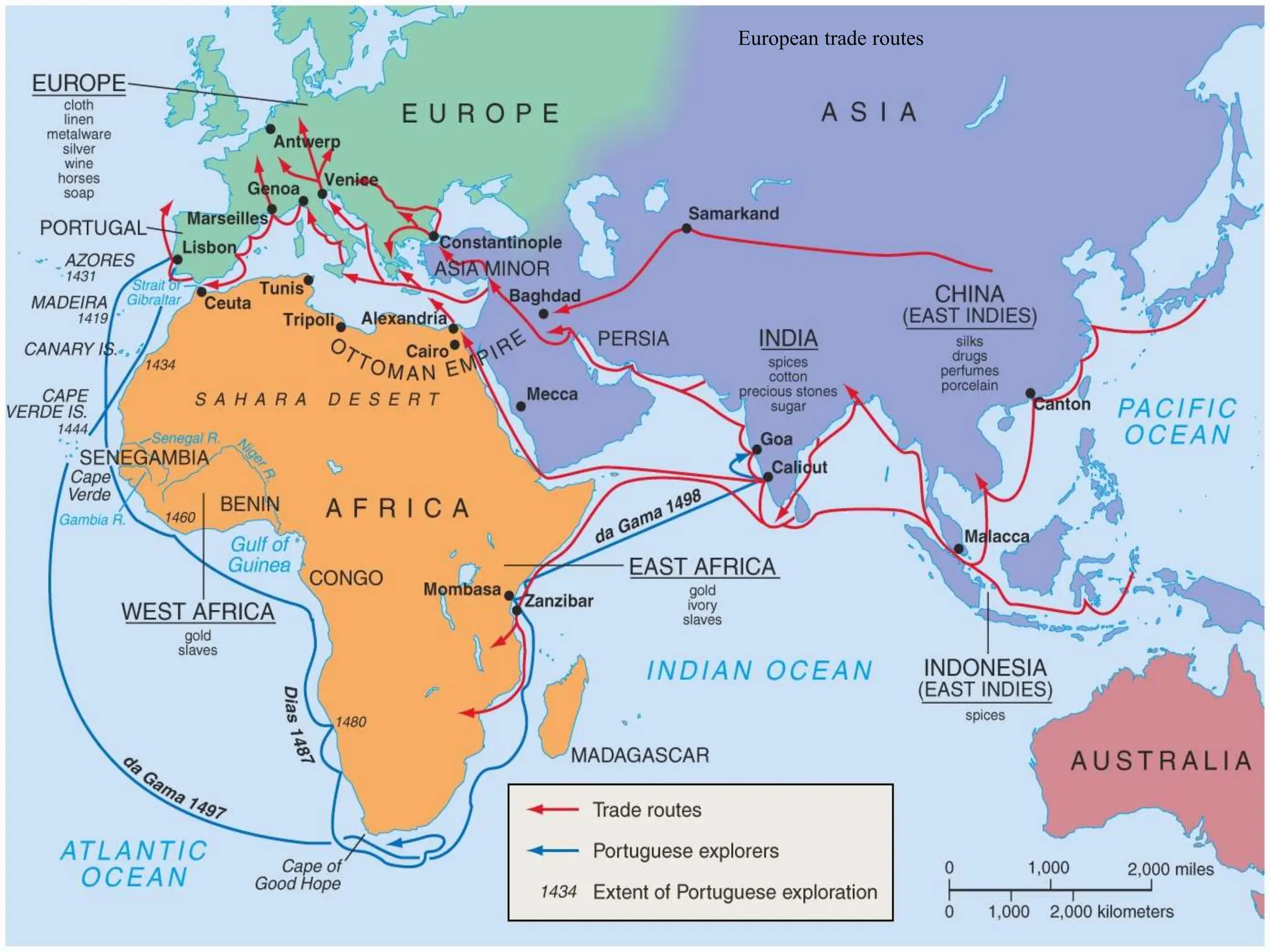
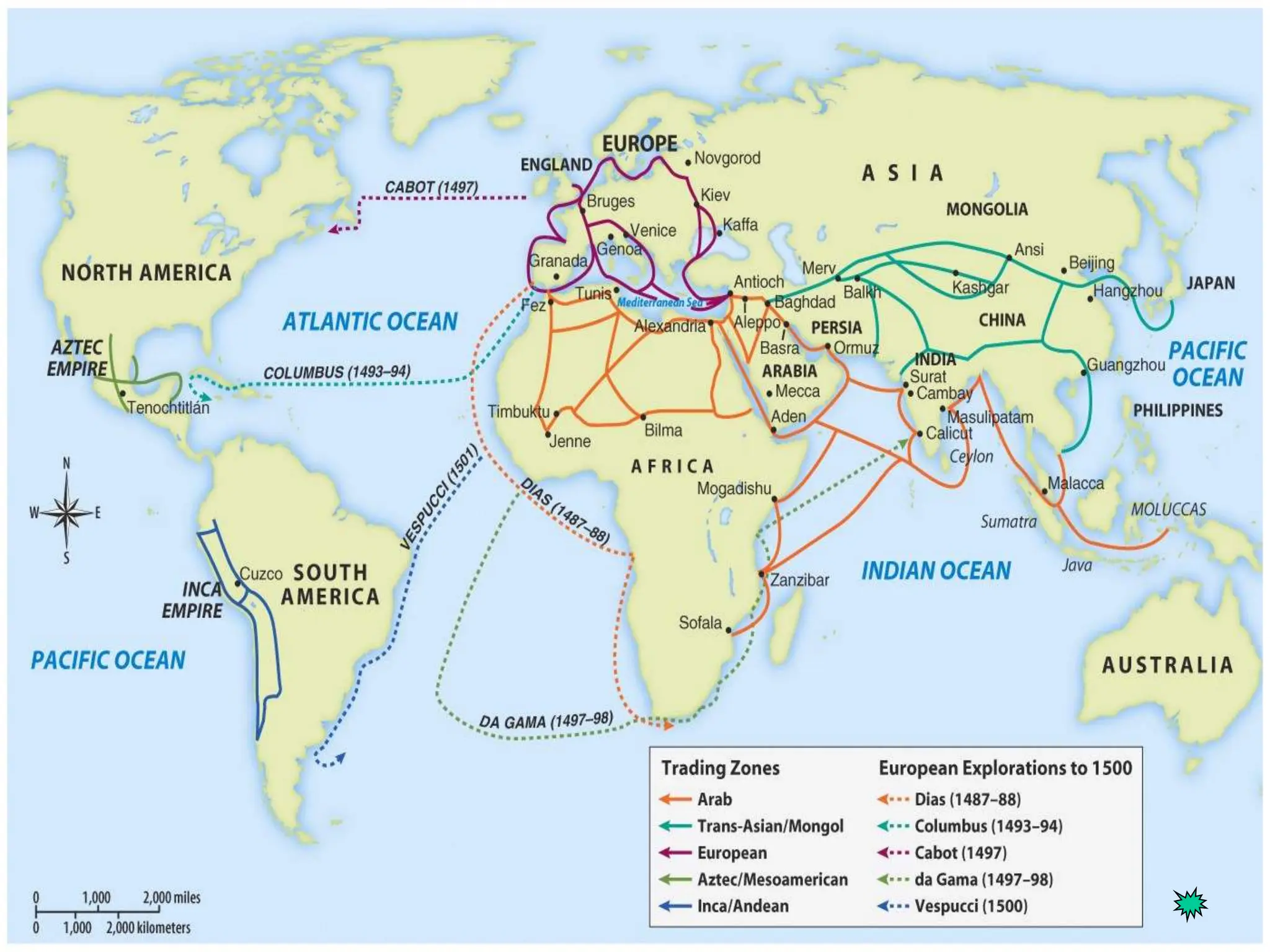
15th century
trade routes
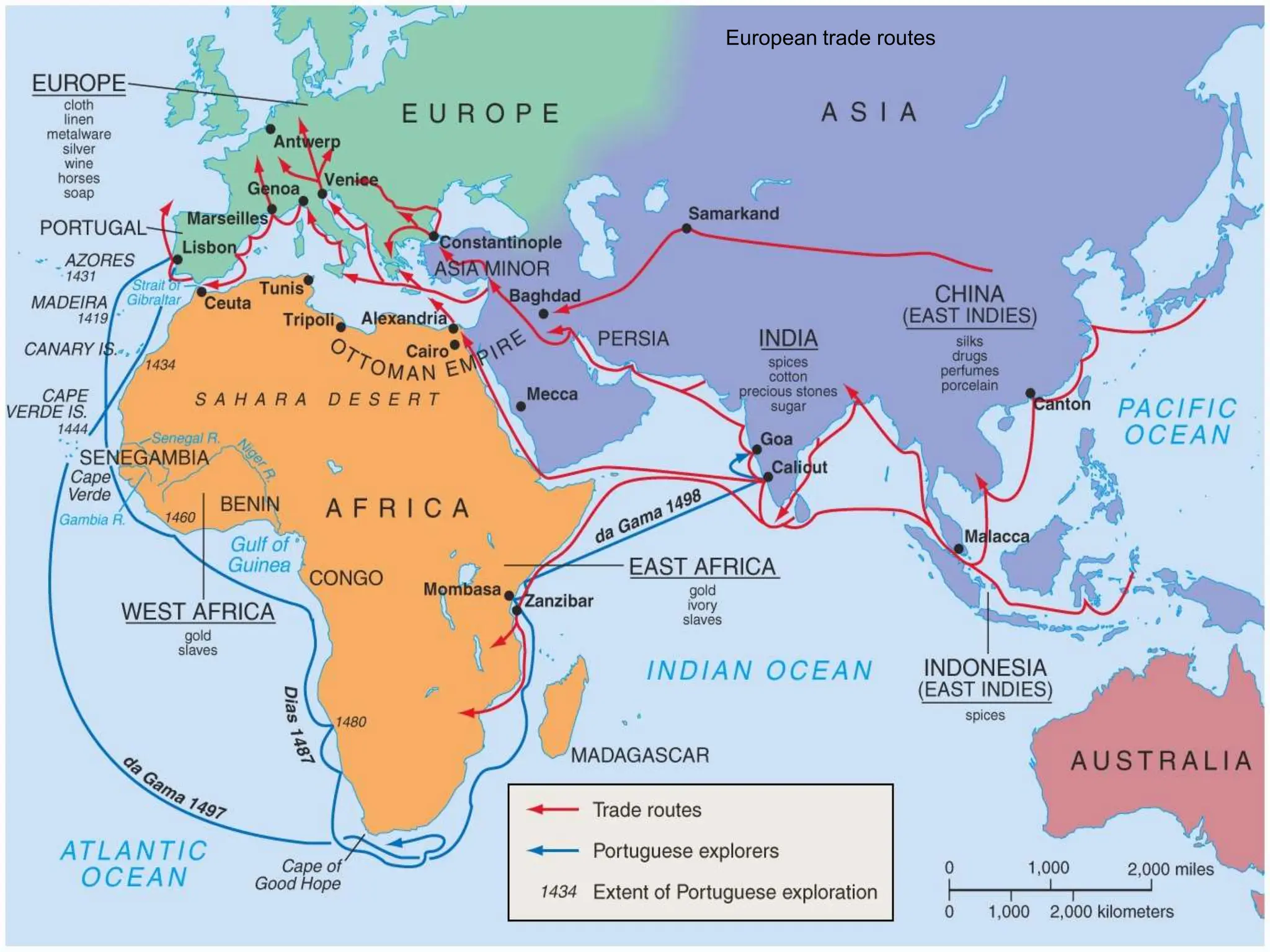
European trade routes
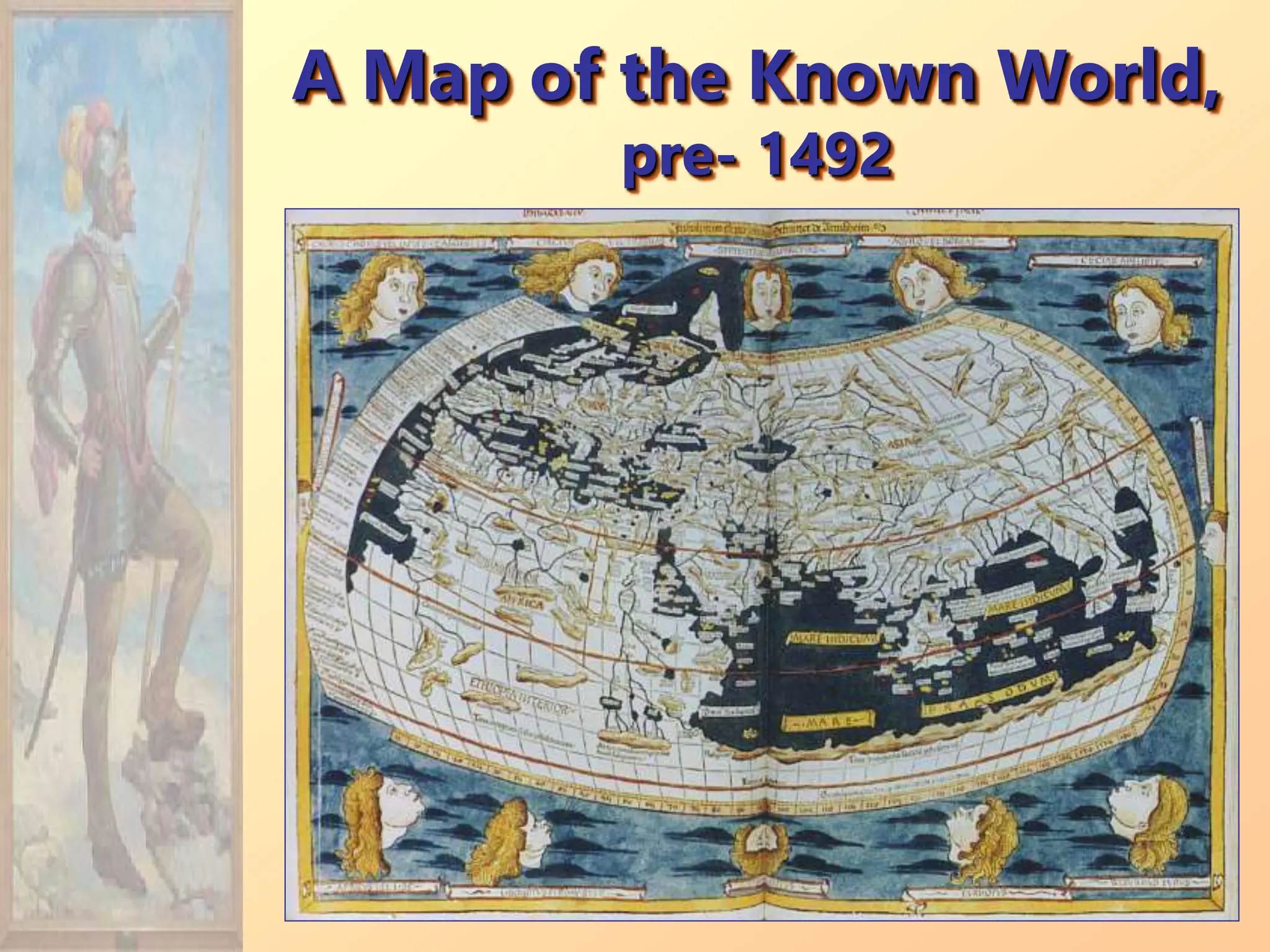
A Map of the Known World,
pre- 1492
• Political: Become a world power through gaining
wealth and land. (GLORY)
• Economic: Search for new trade routes with
direct access to Asian/African luxury goods would
enrich individuals and their nations (GOLD)
• Religious: spread Christianity and weaken
Middle Eastern Muslims. (GOD)
The 3 motives reinforce each other
Direct Causes = 3 G’s
Treasures
from the Americas!
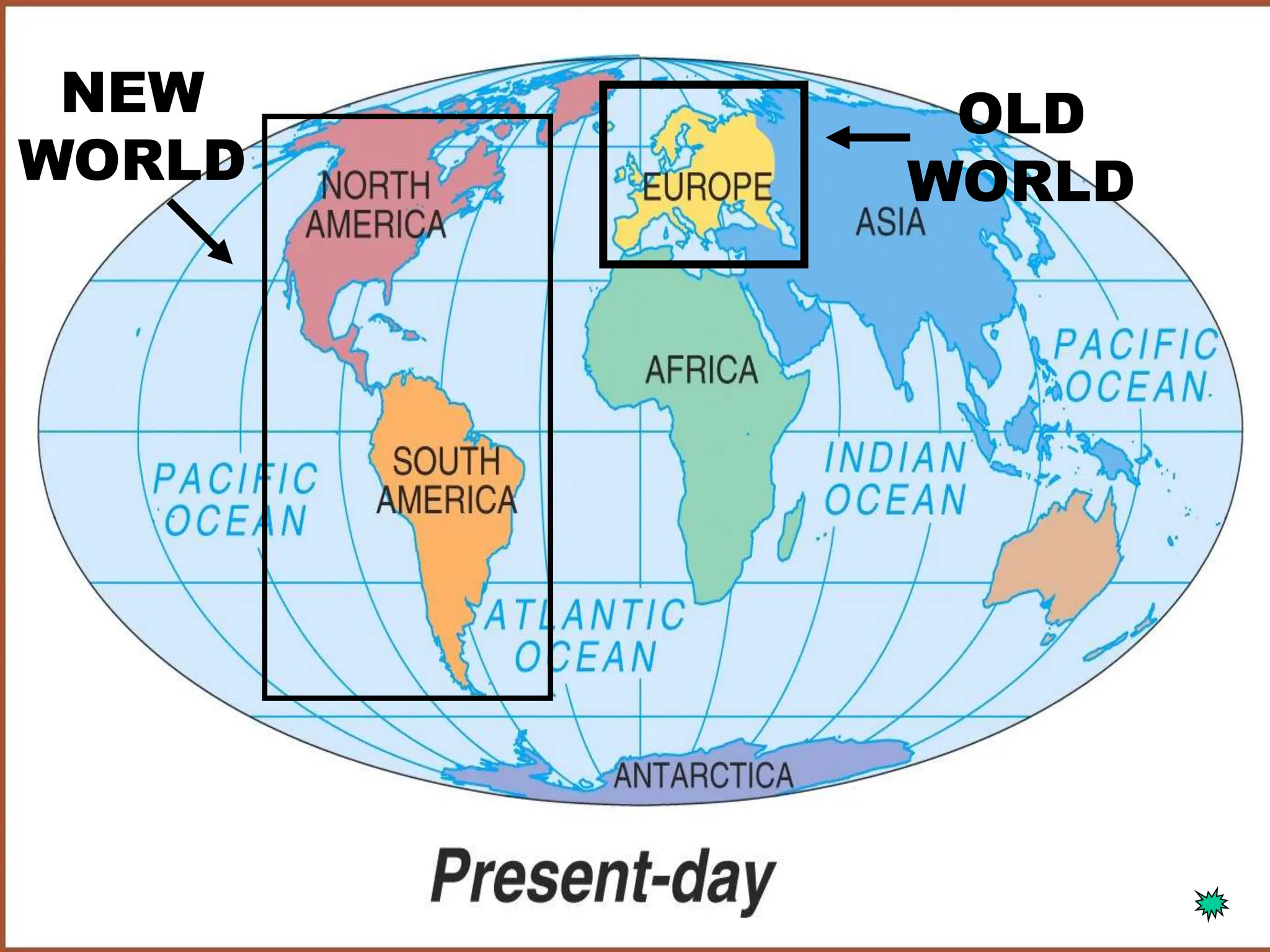
NEW
WORLD
OLD
WORLD
European
explore
EFFECTS
•Europeans reach and settle Americas
•Expanded knowledge of world geography
•Growth of trade, mercantilism and
capitalism
•Indian conflicts over land and impact of
disease on Indian populations
•Introduction of the institution of slavery
•Columbian Exchange
explorers
explorers1
* Squash * Avocado * Peppers * Sweet Potatoes
* Turkey * Pumpkin * Tobacco * Quinine
* Cocoa * Pineapple * Cassava * POTATO
* Peanut * Tomato * Vanilla * MAIZE * Syphillis
* Olive * Coffee Beans * Banana * Rice
* Onion * Turnip * Honeybee * Barley
* Grape * Peach * Sugar Cane * Oats
* Citrus Fruits * Pear * Wheat * HORSE
* Cattle * Sheep * Pig * Smallpox
* Flu * Typhus * Measles * Malaria
* Diptheria * Whooping Cough
Columbian Exchange or the transfer of goods
involved 3 continents, Americas, Europe and Africa
1. First Americans-----Pre-Columbian
2. Europe Exploration
• Causes
• Indirect
• Direct
• Effects
3. European Colonization
• Spain
• Portugal
• France
• Dutch
notes
European Colonization
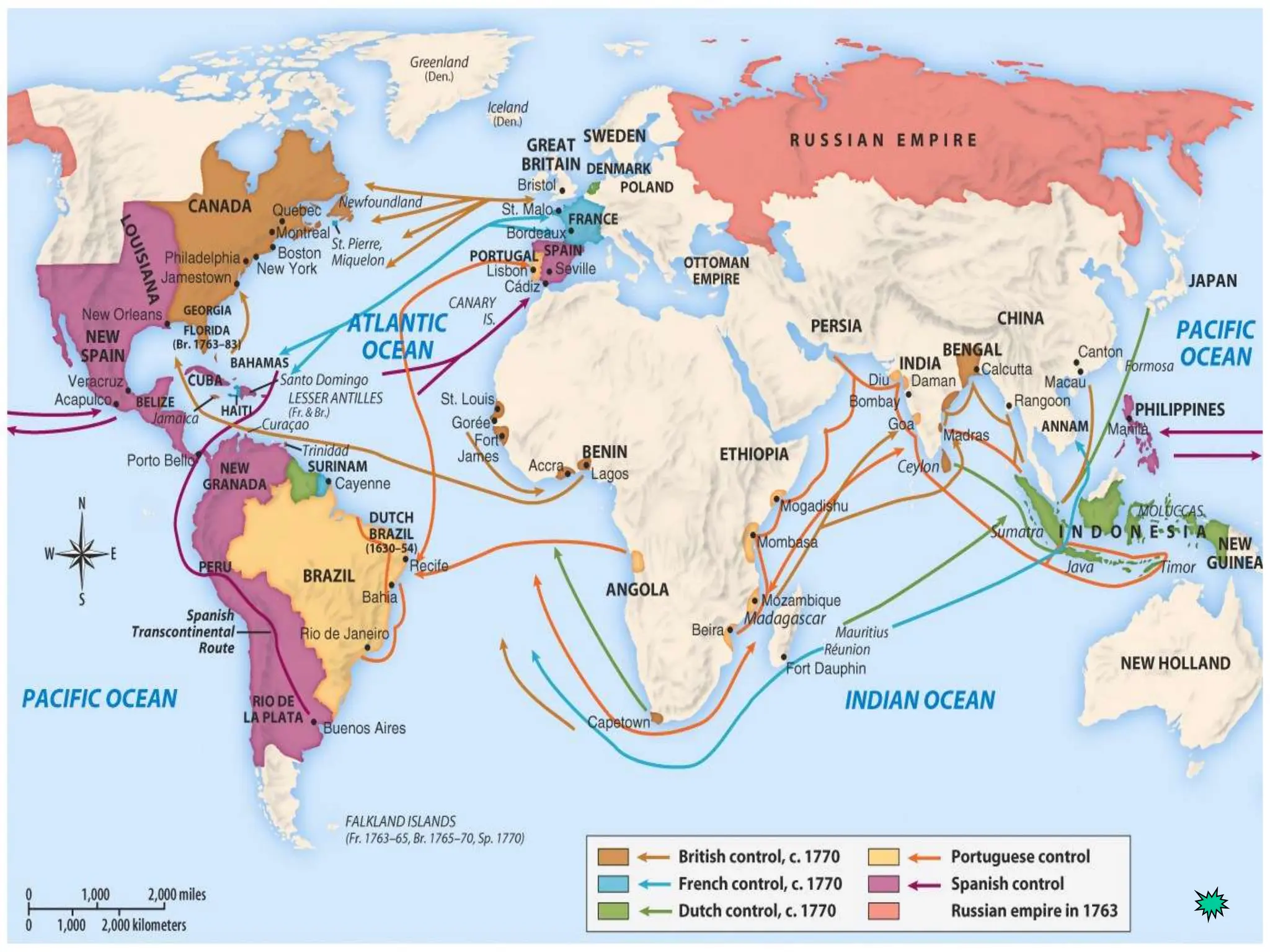
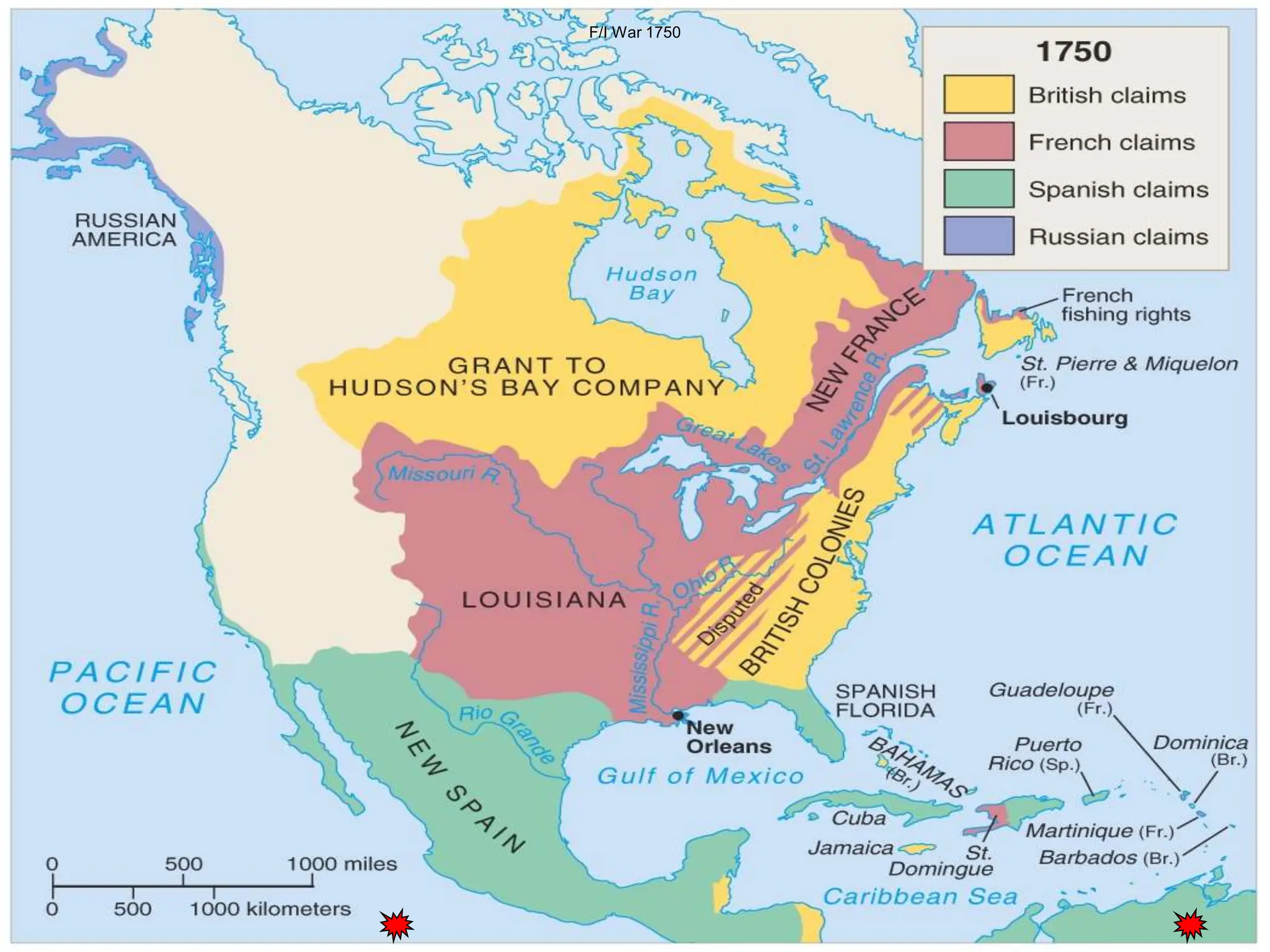
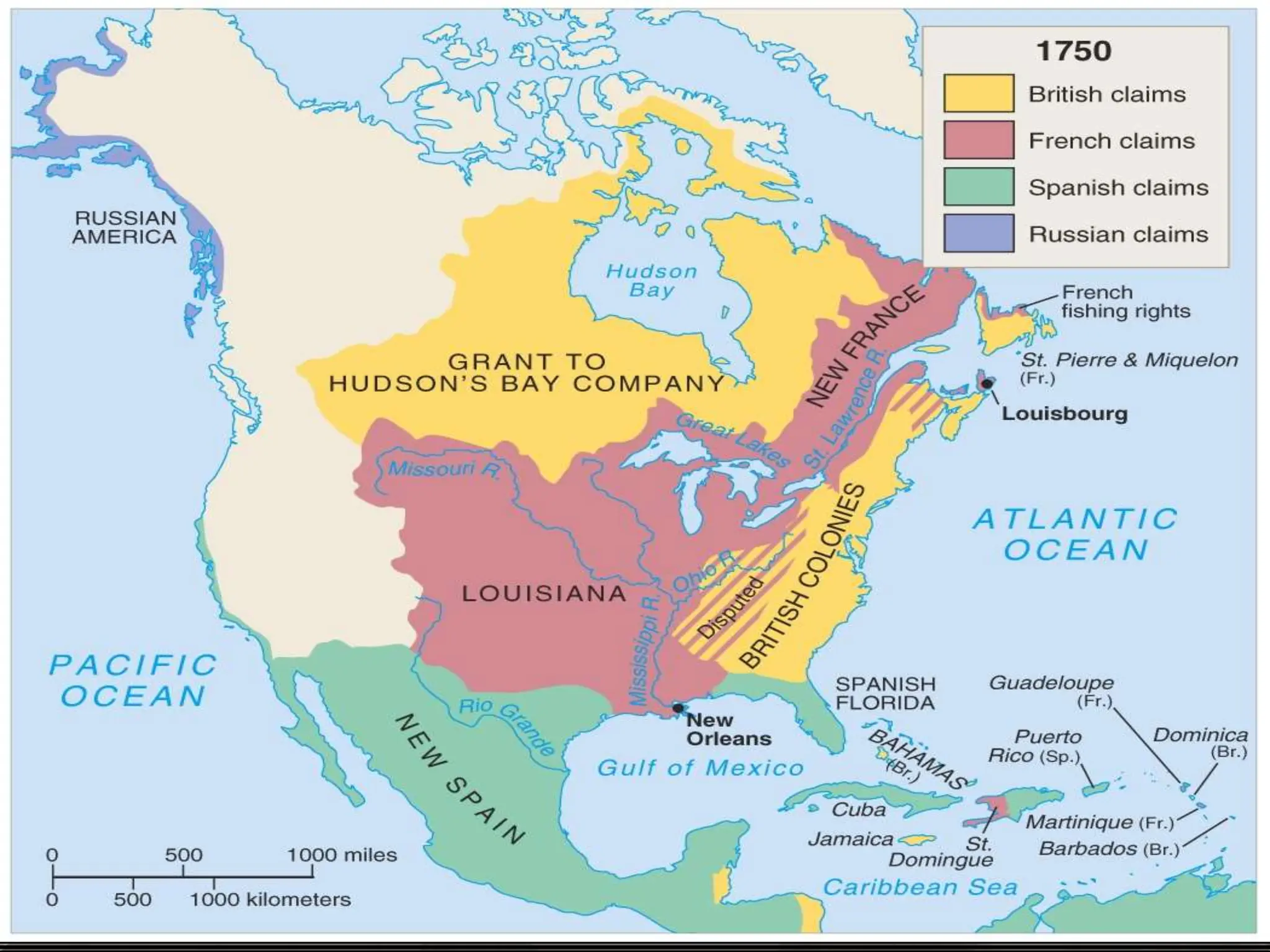
• Once the New World is discovered, the Big 4 four
European countries begin competing for control of
North America and the world….
– Spain
– England
– France
– Portugal
• This power struggle ultimately leads to several
wars.
European Colonization
F/I War 1750
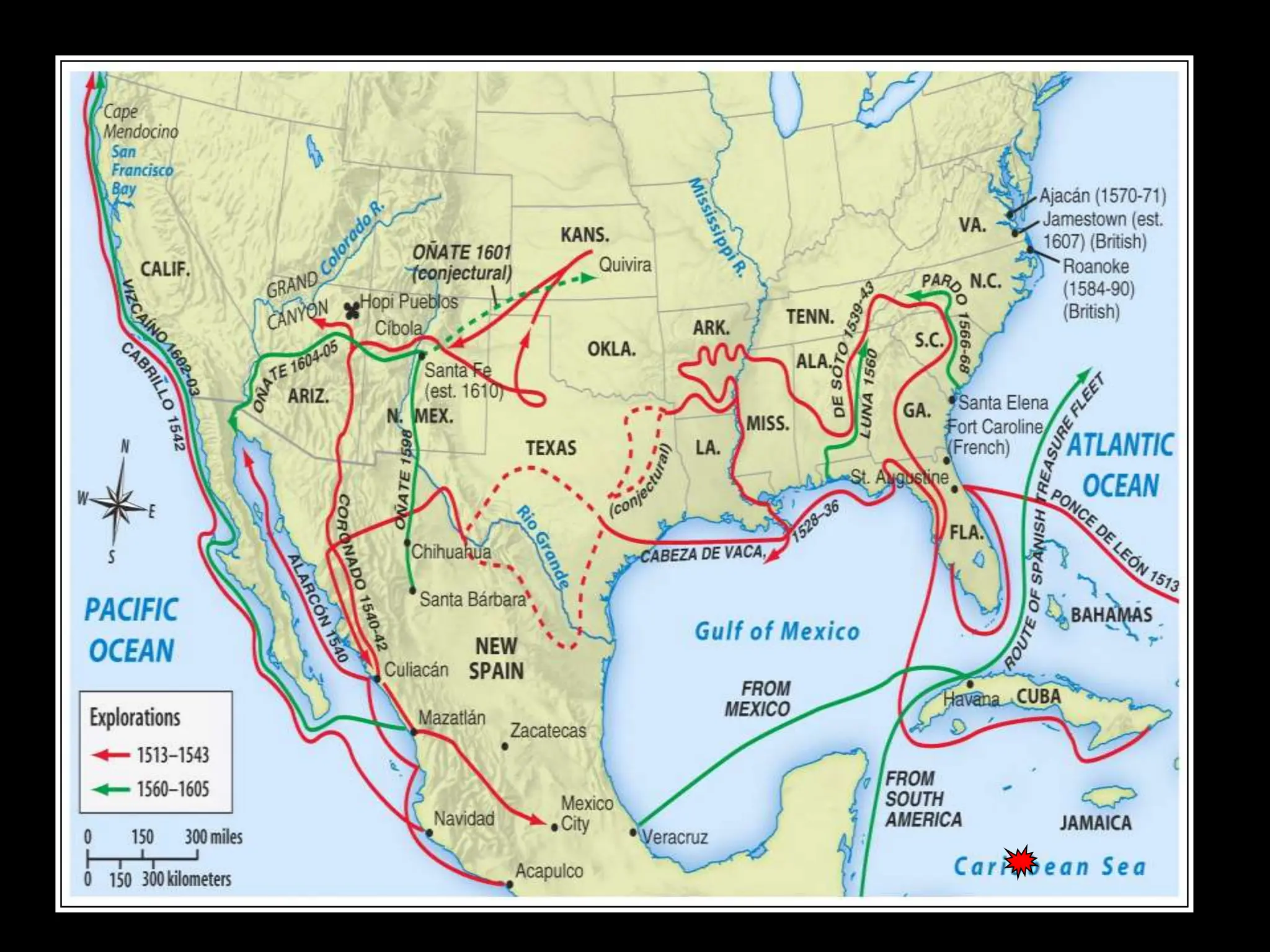
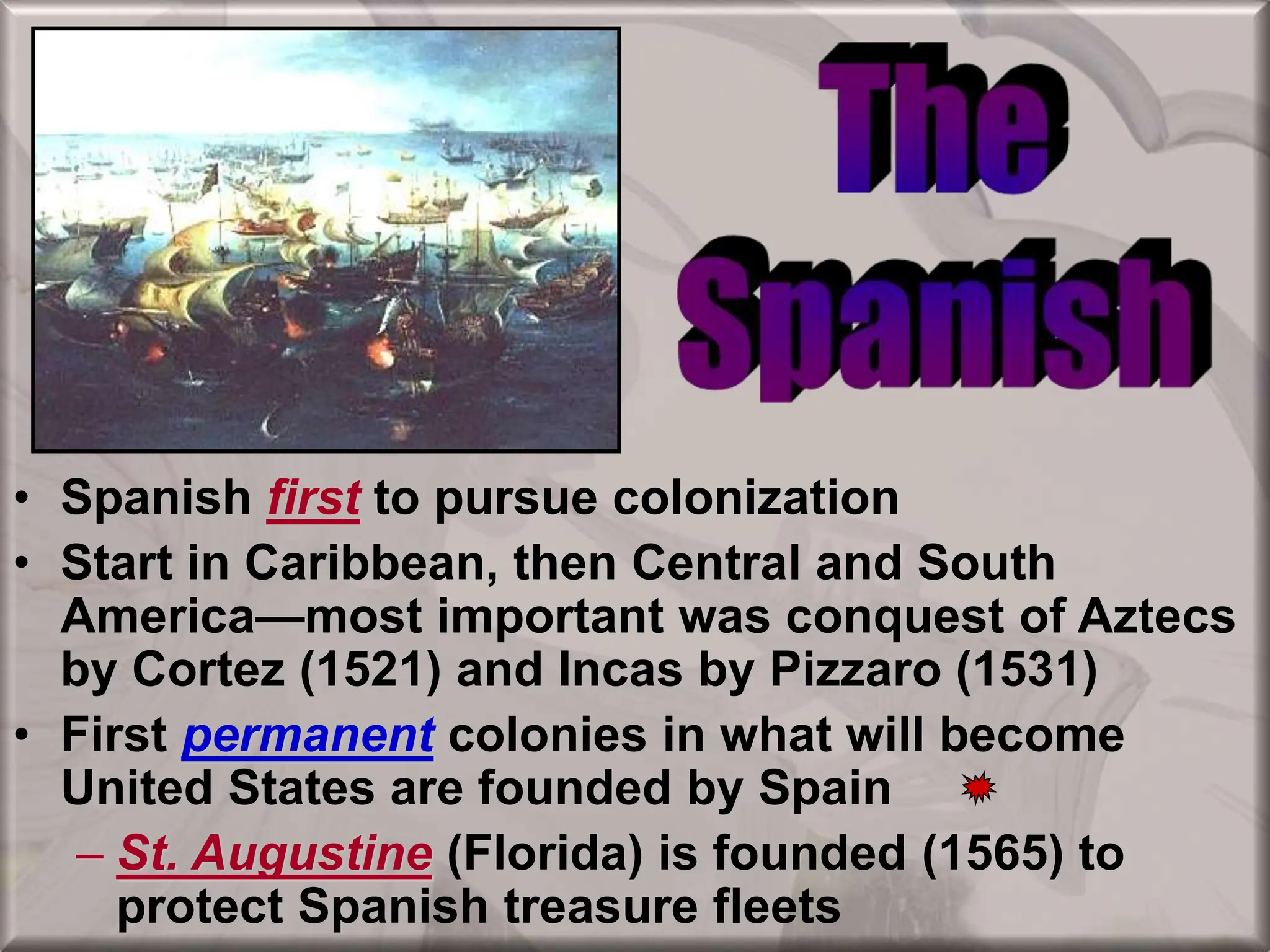
• Spanish first to pursue colonization
• Start in Caribbean, then Central and South
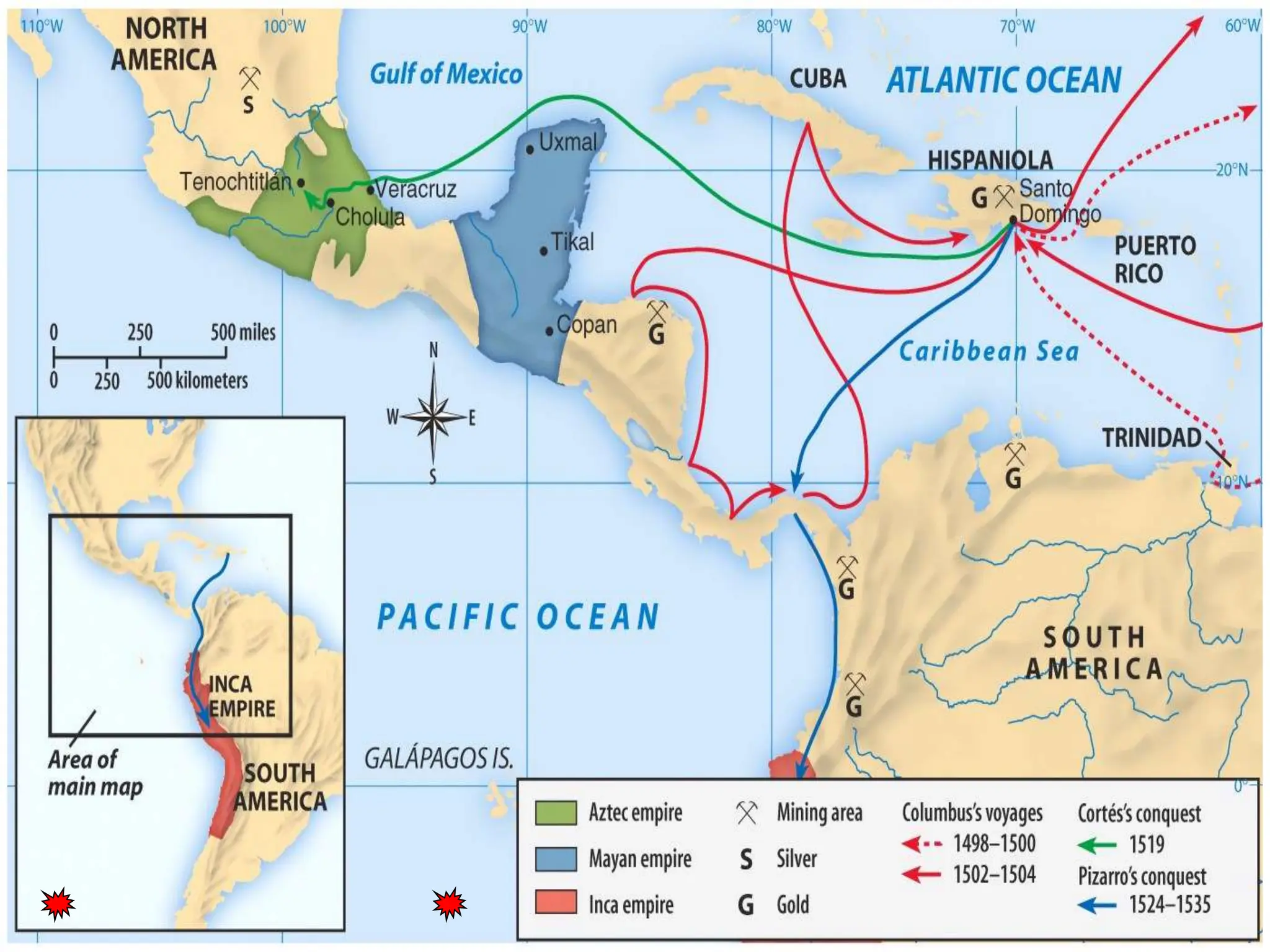
America—most important was conquest of Aztecs
by Cortez (1521) and Incas by Pizzaro (1531)
• First permanent colonies in what will become
United States are founded by Spain
– St. Augustine (Florida) is founded (1565) to
protect Spanish treasure fleets
Explorers Sailing For Spain
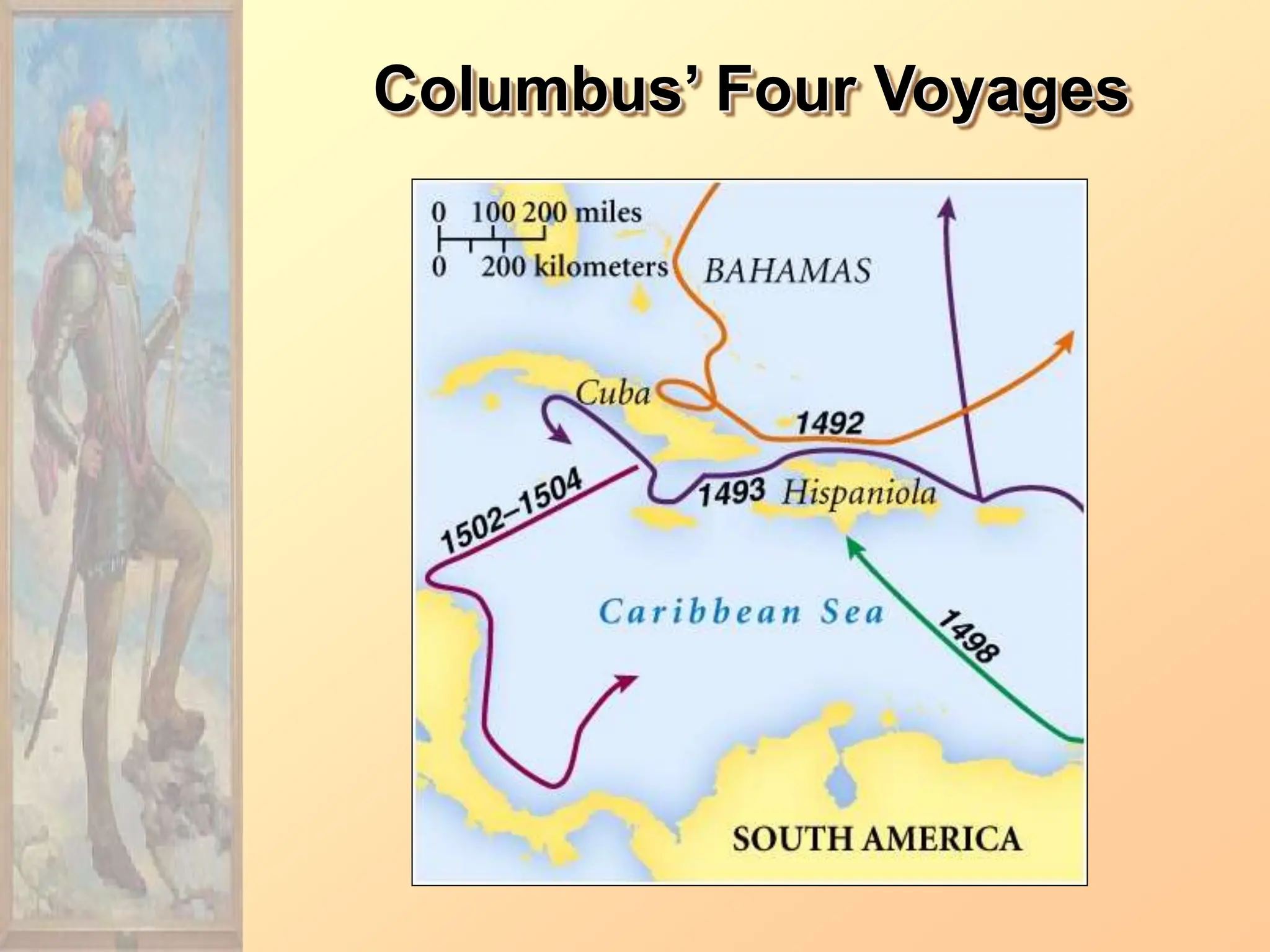
• Columbus - Italian sailing for Spain -
Landed in the “West Indies” - 1492
• Magellan - Portuguese sailing for Spain
- 1st to circumnavigate the world - 1522
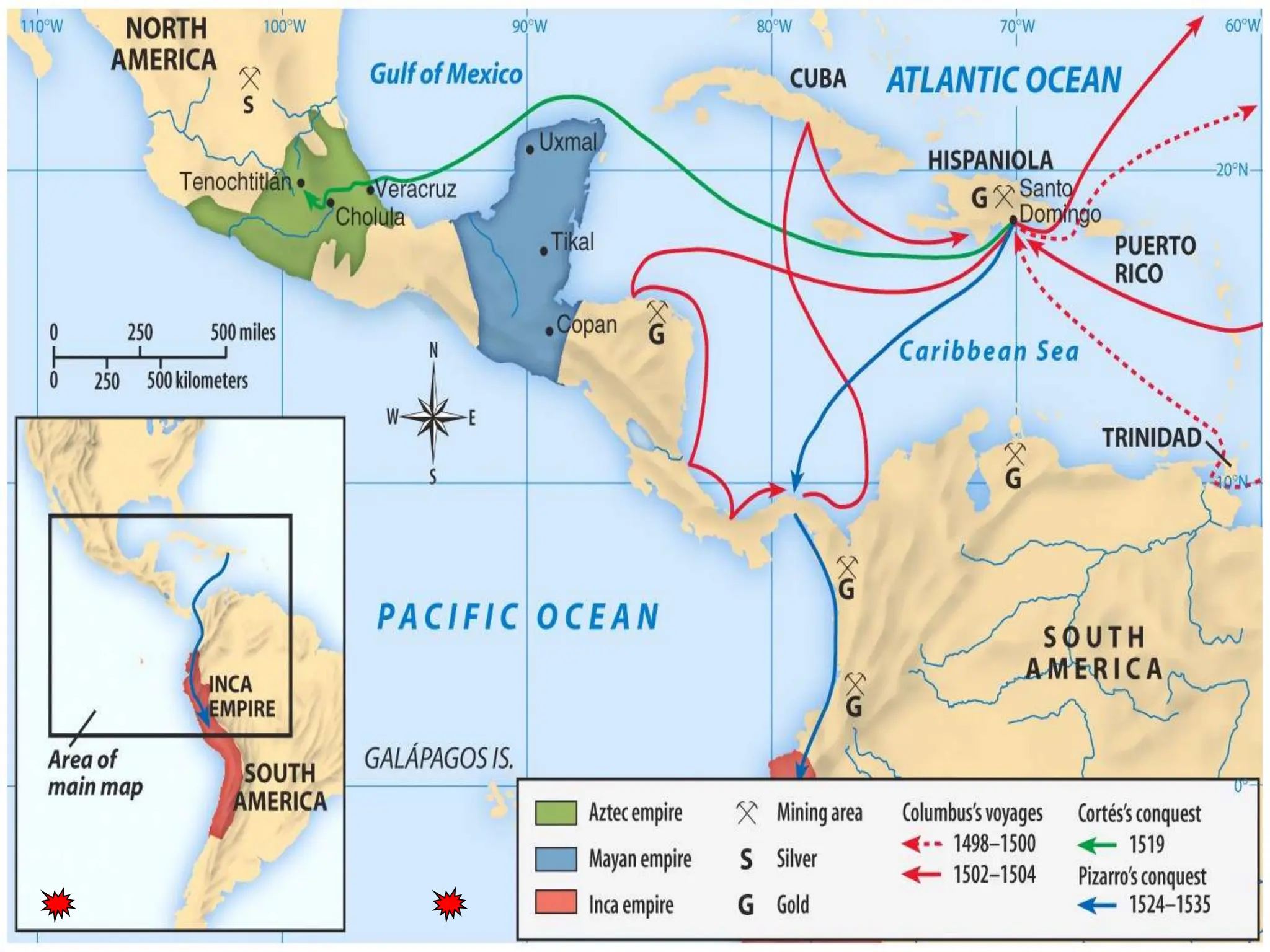
Columbus’ Four Voyages
Ferdinand Magellan & the First
Circumnavigation of the World
Explorers Sailing From
Hispaniola
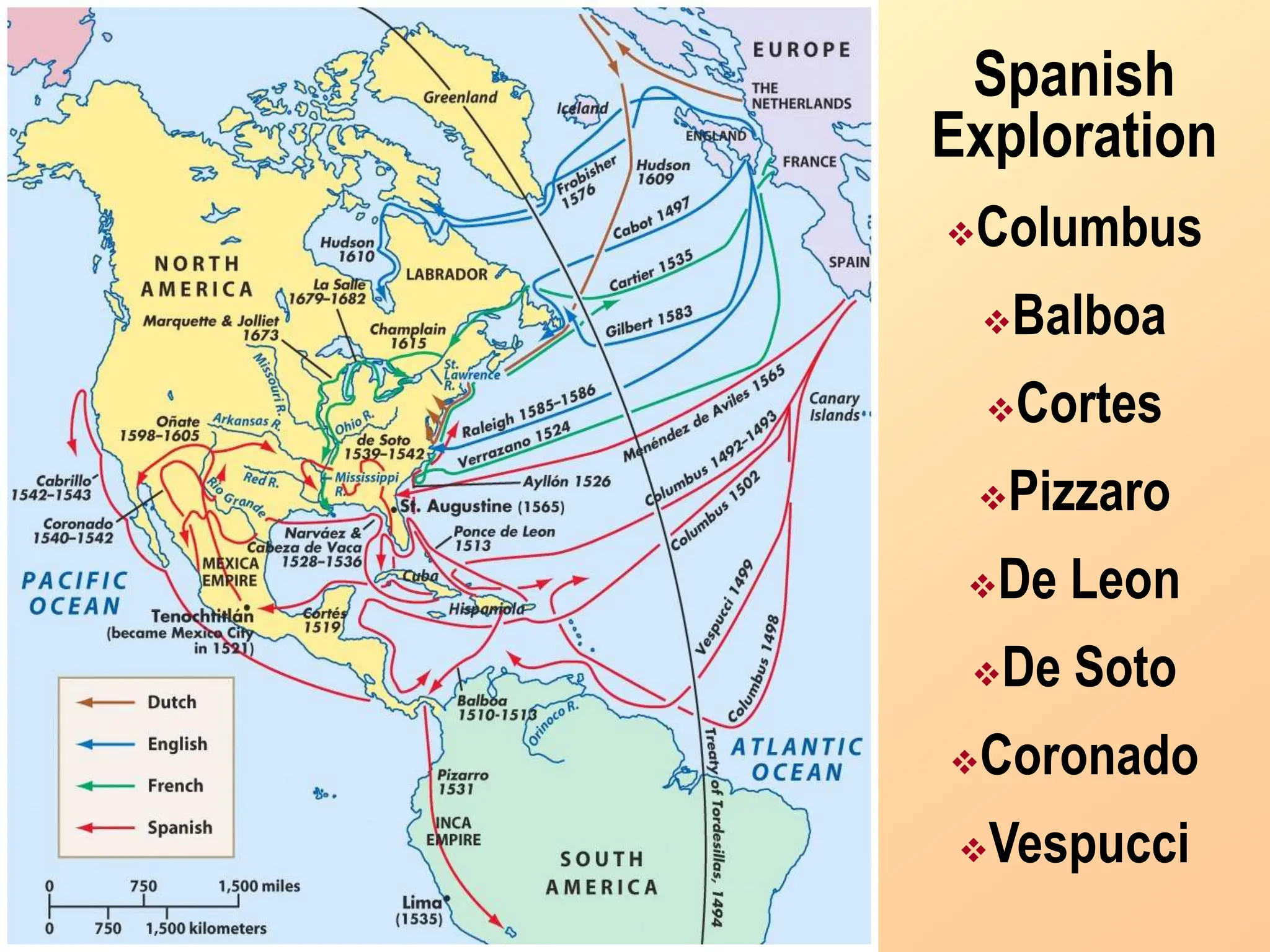
• De Leon - colonist of Hispaniola - Established colony
at Puerto Rico - Sailed north looking for Fountain of
Youth - Discovered Florida - 1508
• Balboa - colonist of Hispaniola - Established
settlement in Panama - 1st European to see Pacific
Ocean - 1513
• de Coronado - Spain - Explored north from Mexico; up
Colorado River; saw Grand Canyon -1540
• de Soto - Spain - Explored Florida into Carolina’s and
west to the Mississippi River - 1541
Explorers Sailing For Spain &
Portugal
• Vespucci - Italian sailing for both Spain
and Portugal - Sailed to the America’s -
Amerigo is his first name (where we get
“America”) - 1501
Spanish
Exploration
Columbus
Balboa
Cortes
Pizzaro
De Leon
De Soto
Coronado
Vespucci
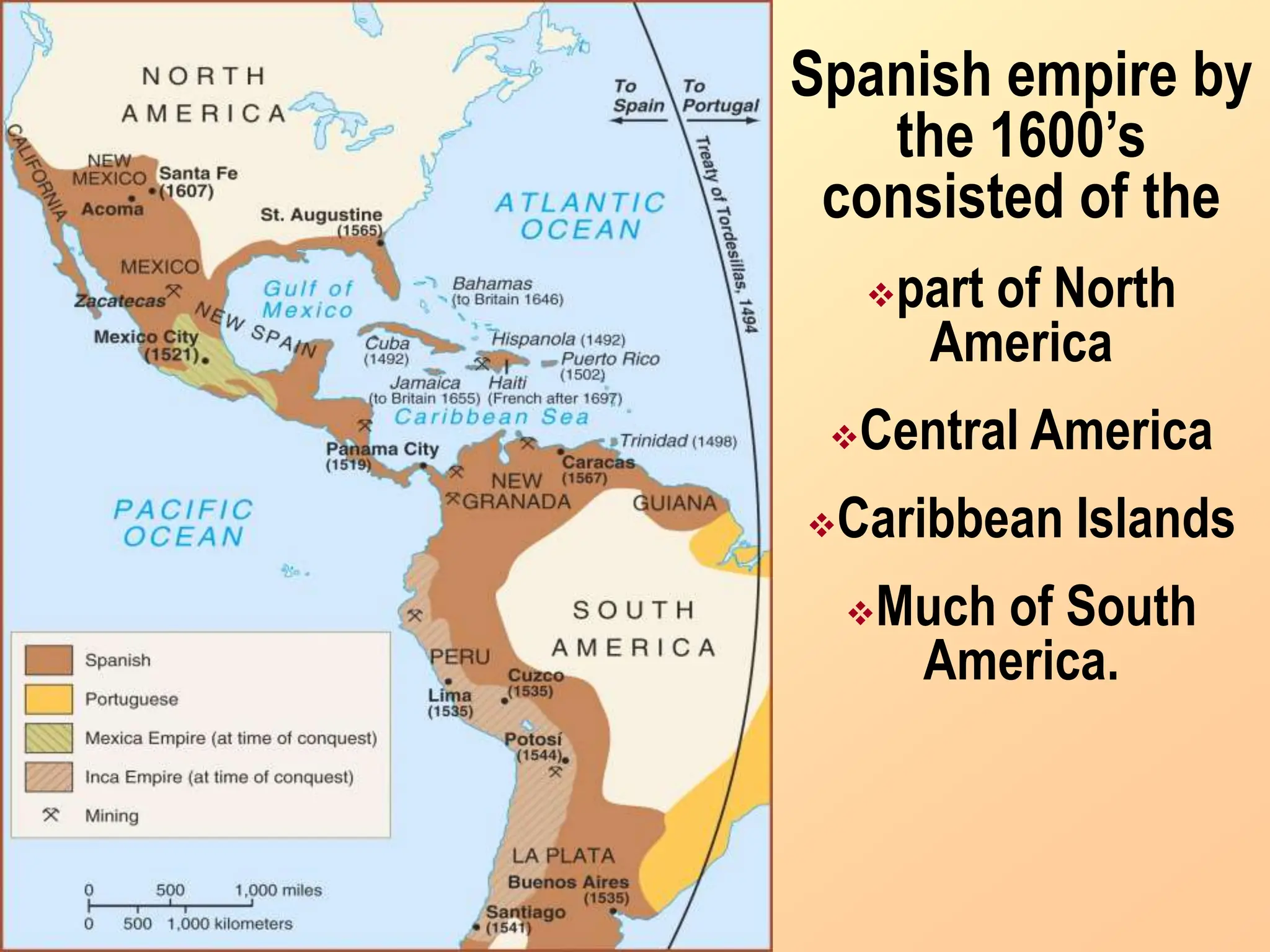
Spanish empire by
the 1600’s
consisted of the
part of North
America
Central America
Caribbean Islands
Much of South
America.
Hernando Cortés
First Spanish Conquests: The Aztecs
Cortes conquered Aztec Empire in 1519
and took control of modern day Mexico.
Montezuma II
vs.
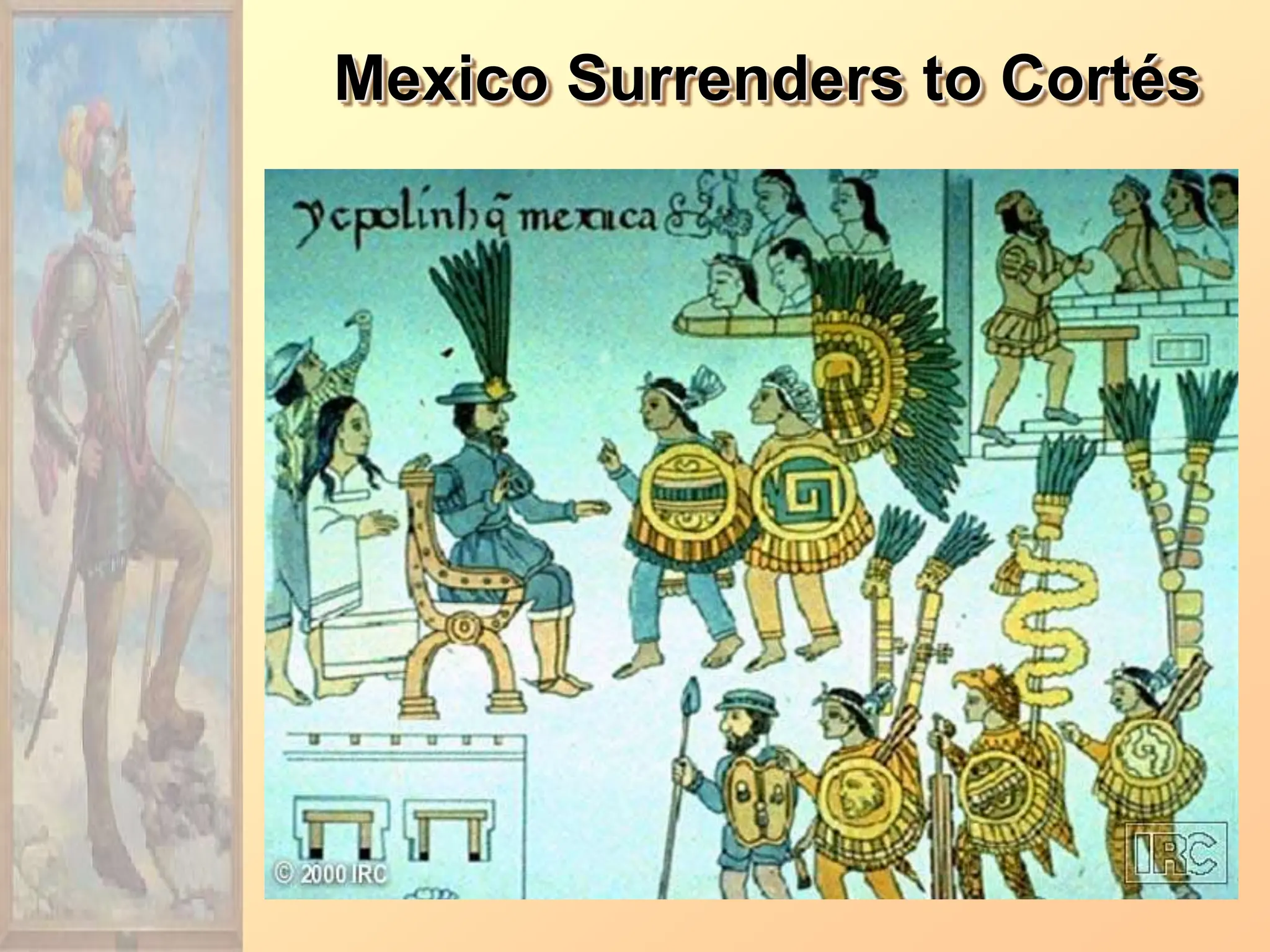
Mexico Surrenders to Cortés
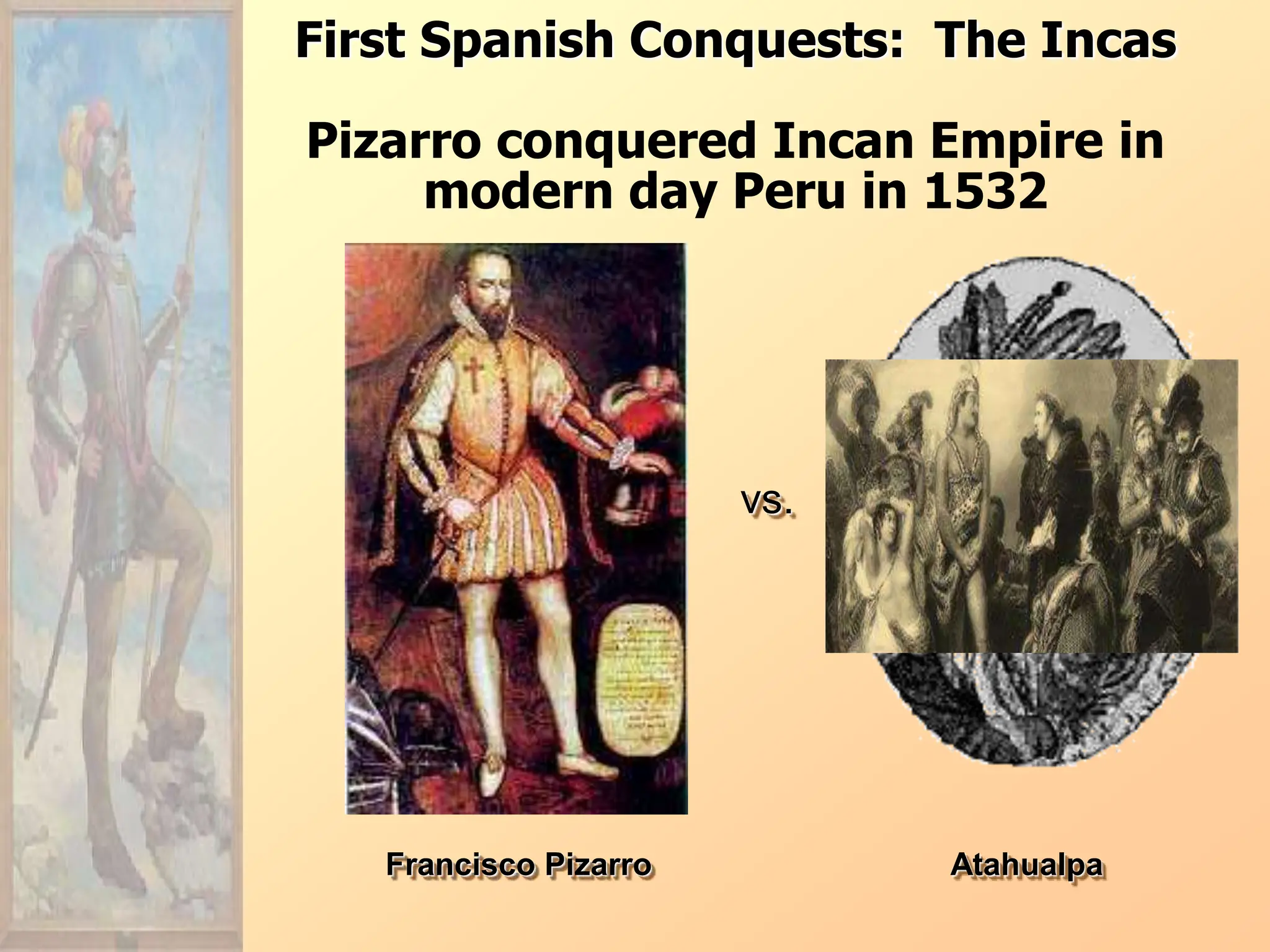
Francisco Pizarro
First Spanish Conquests: The Incas
Pizarro conquered Incan Empire in
modern day Peru in 1532
Atahualpa
vs.
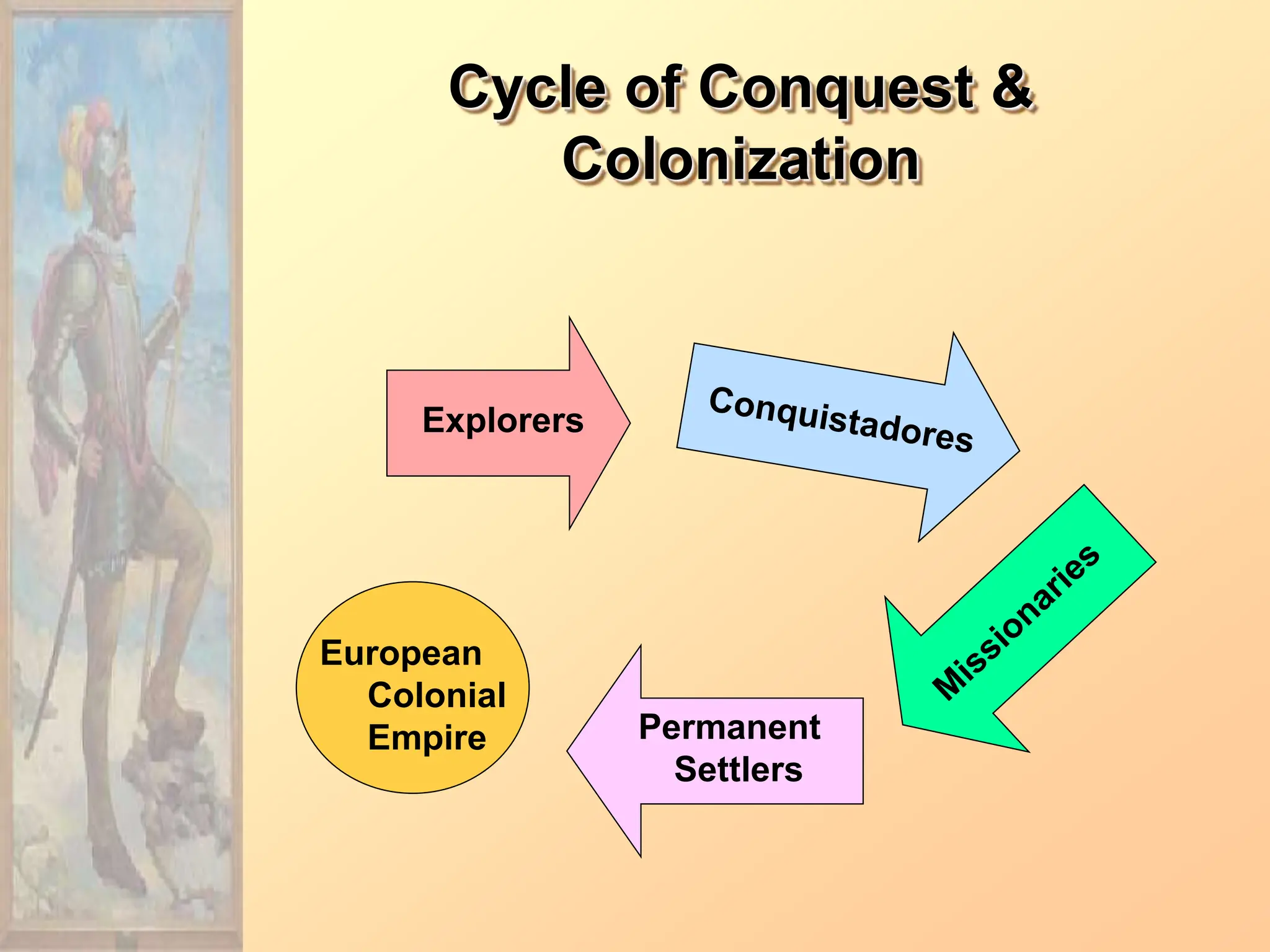
Cycle of Conquest &
Colonization
Explorers
Permanent
Settlers
European
Colonial
Empire
The Colonial Class System
Peninsulares
Spanish
ancestory
Creoles
Spanish and
Black
mixture.
Mestizos
Spanish
and Indian
mixture
Mulattos
White
American
and Black
mixture
Native Indians Black Slaves
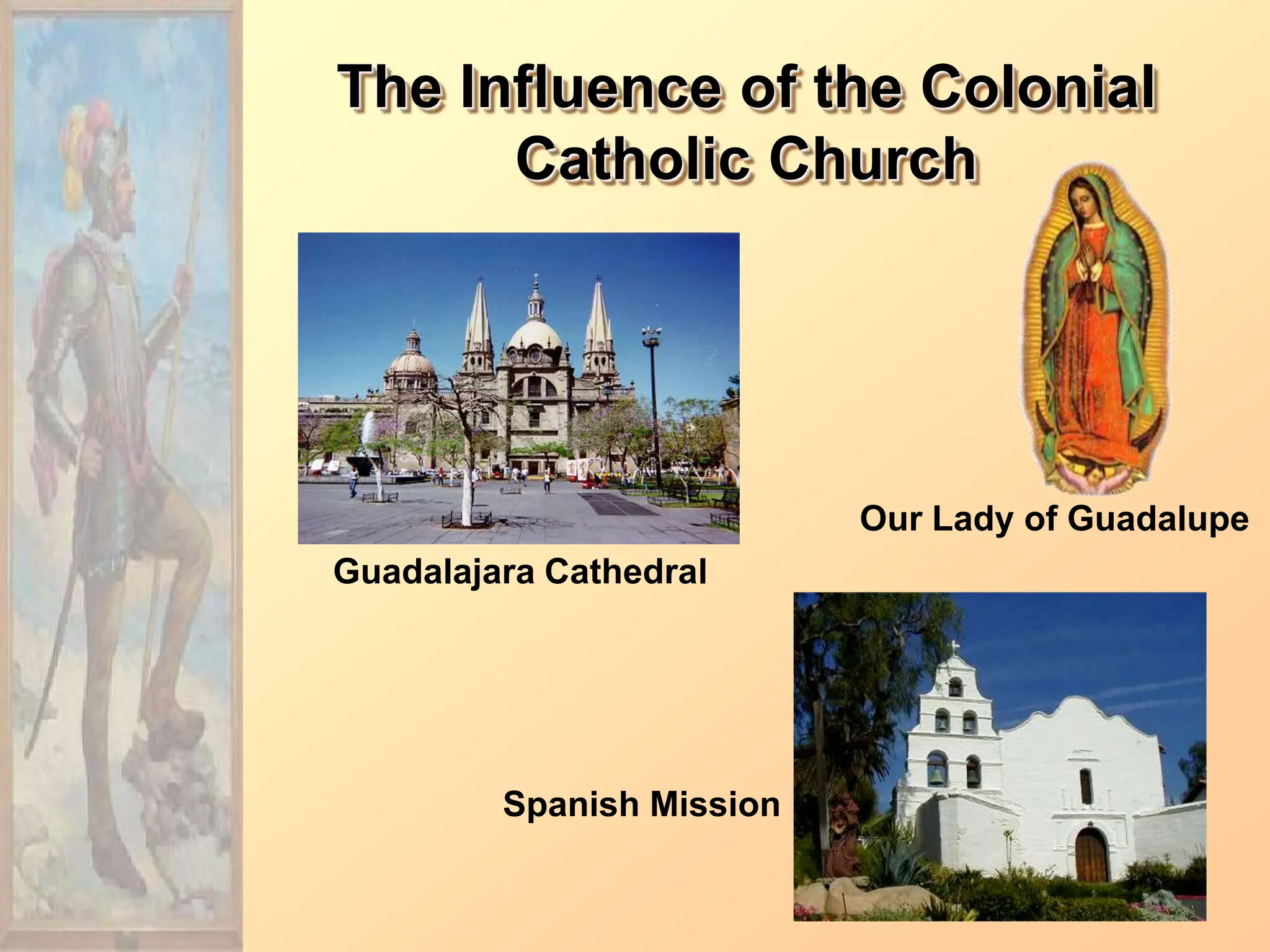
The Influence of the Colonial
Catholic Church
Guadalajara Cathedral
Our Lady of Guadalupe
Spanish Mission
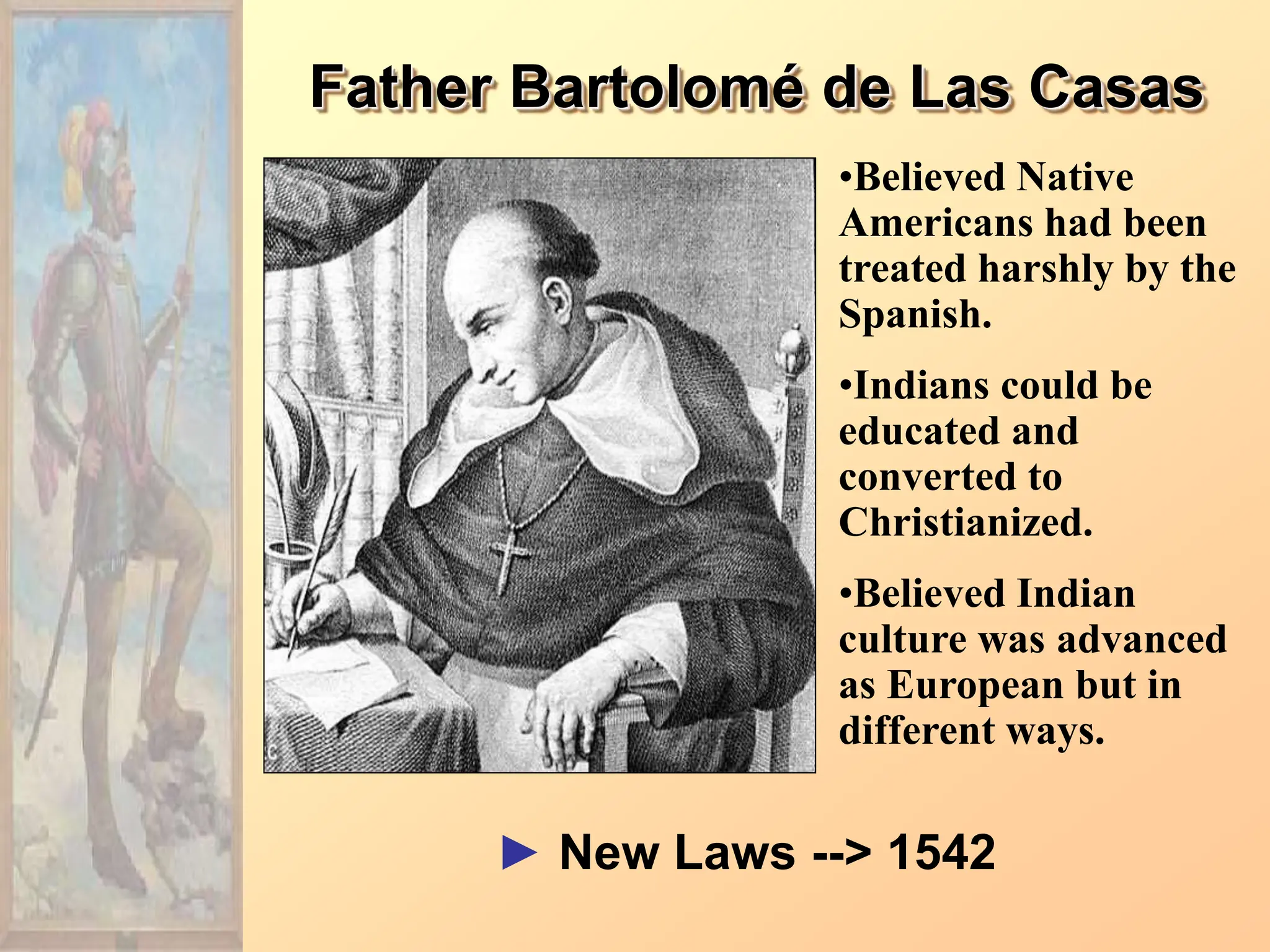
Father Bartolomé de Las Casas
► New Laws --> 1542
•Believed Native
Americans had been
treated harshly by the
Spanish.
•Indians could be
educated and
converted to
Christianized.
•Believed Indian
culture was advanced
as European but in
different ways.
1. Spanish practice of securing an adequate and
cheap labor supply = FEUDALISM
•“granted” to deserving subjects of the King
2. Conquistador controlled Indian populations
•Required Indians to pay tribute from their lands
•Indians often rendered personal services as well.
3. In return the conquistador was obligated to
•protect his wards
•instruct them in the Christian faith
•defend their right to use the to live off the land
4. Encomienda system eventually decimated
Indian population.
5. The King prevented the encomienda with the
New Laws (1542) supported by de Las Casas, the
system gradually died out.
European Colonization
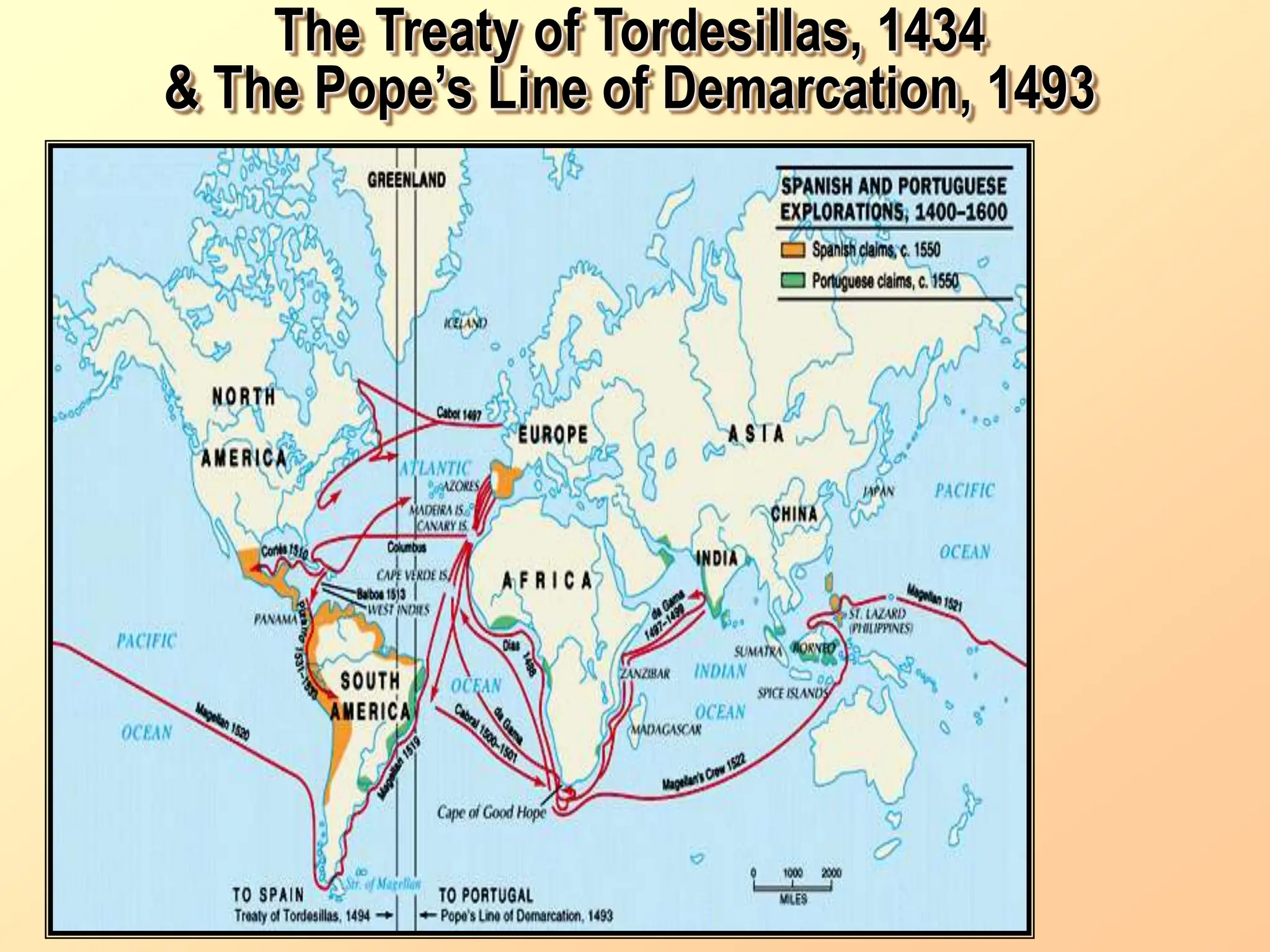
• The Portuguese were the first to
begin searching for an all water
route to Asia…..
– Prince Henry the Navigator – 1450’s
• Colonized the South America in the
area of what would become Brazil
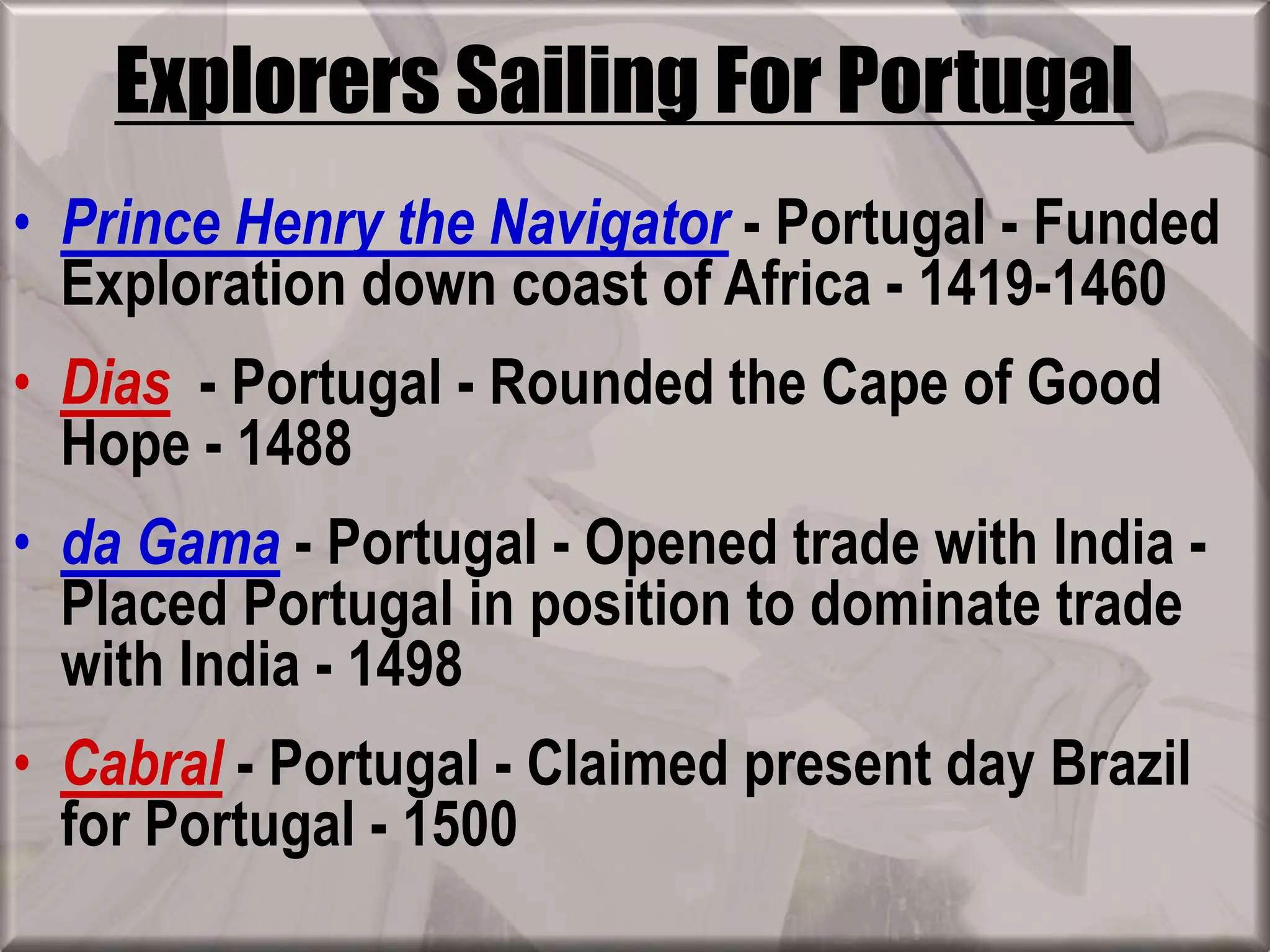
Explorers Sailing For Portugal
• Prince Henry the Navigator - Portugal - Funded
Exploration down coast of Africa - 1419-1460
• Dias - Portugal - Rounded the Cape of Good
Hope - 1488
• da Gama - Portugal - Opened trade with India -
Placed Portugal in position to dominate trade
with India - 1498
• Cabral - Portugal - Claimed present day Brazil
for Portugal - 1500
European trade routes
The Treaty of Tordesillas, 1434
& The Pope’s Line of Demarcation, 1493
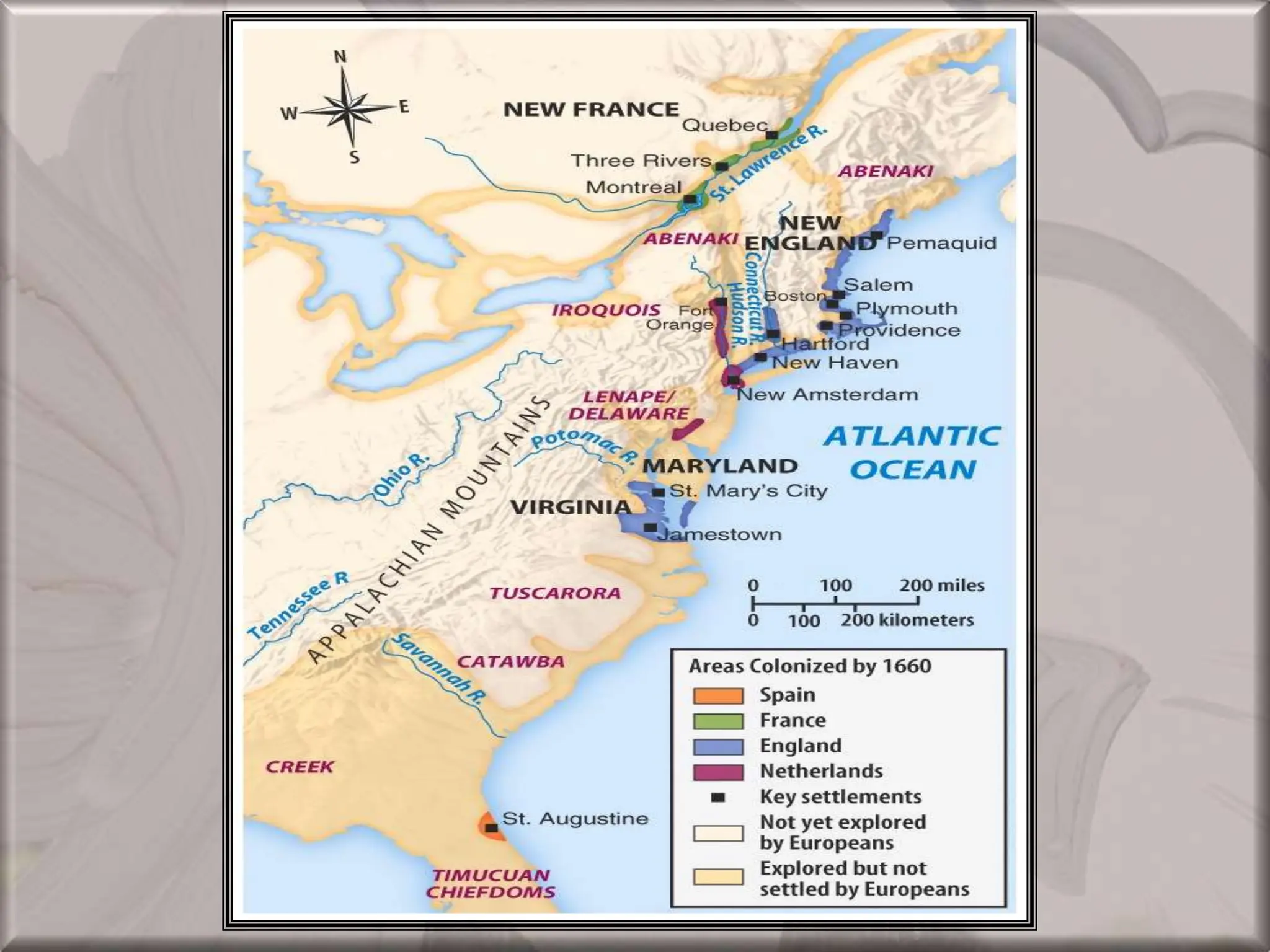
• French settle Quebec (1608) & Montreal
(1642) and what would become Canada
– Control St. Lawrence River & access to
interior of North America
– Develop a fur trade
– Couier do Bois
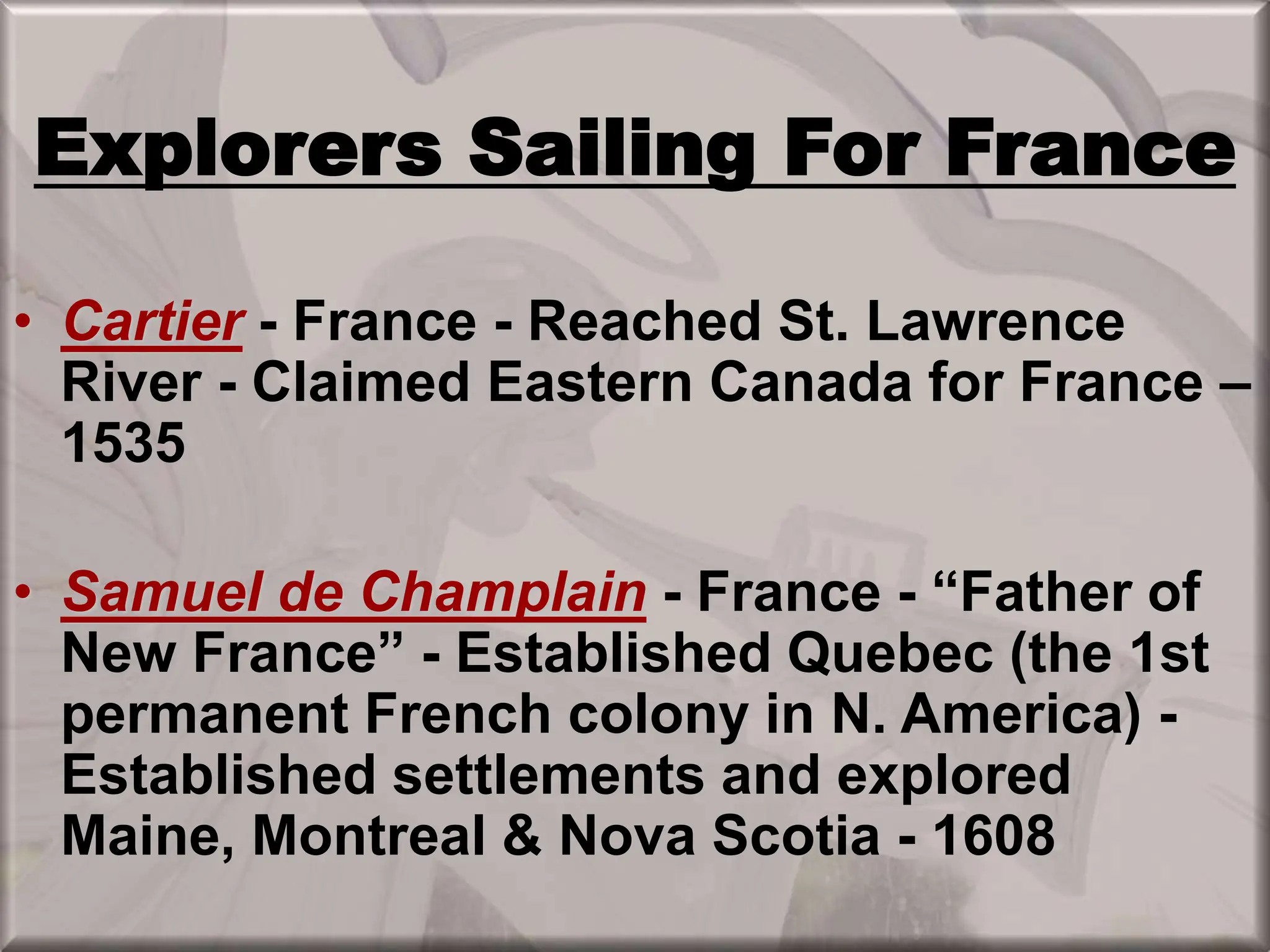
Explorers Sailing For France
• Cartier - France - Reached St. Lawrence
River - Claimed Eastern Canada for France –
1535
• Samuel de Champlain - France - “Father of
New France” - Established Quebec (the 1st
permanent French colony in N. America) -
Established settlements and explored
Maine, Montreal & Nova Scotia - 1608
European Colonization
• Like French, Dutch focus on fur trade &
send only a few men to settlements
– Found Albany (New York, 1614) on Hudson
River
– New Netherland (becomes New York) is an
extension of the Dutch global trade system
• Dutch & French form alliances with Native
Americans—increase warfare & Iroquois
(Dutch ally) defeat Hurons
Explorers Sailing For The
Netherlands
• Henry Hudson - English sailing for the
Dutch - Searching for Northwest Passage -
Claimed Hudson River - Settlers established
New Netherlands (New York) - 1609
01_Discovery_and_Settlement_of_a_New_World.ppt

01_Discovery_and_Settlement_of_a_New_World.ppt

  • 1.
  • 2.
    •Pre- Columbian time period. •First Americans came from Asia •Crossedthe Bering Strait during the Ice Age •Following a food source •Gradual migration
  • 3.
    Early Human Migrations 1stMigration, 38,000-1800 BCE 2nd Migration, c. 10,000-4,000 BCE 3rd Migration, c. 8,000-3,000 BCE
  • 4.
  • 6.
    clash WHITE EUROPEANS •Used theland for economic needs •Clearing the land, destroying hunting areas and fencing it off into private property •Divided the land and selling it for monetary value. NATIVE AMERICANS •Relationship with environment as part of their religion •Need to hunt for survival •Ownership meant access to the things the land produced, not ownership of the land itself.
  • 7.
  • 8.
    1. First Americans-----Pre-Columbian 2.Europe Exploration • Causes • Indirect • Direct • Effects notes
  • 10.
    Earlier Explorations 1. Islam& the Spice Trade  Silk Road 2. New Player  Europe Nicolo, Maffeo, & Marco Polo, 1271 Expansion becomes a state enterprise  monarchs had the authority & the resources. Better seaworthy ships.
  • 11.
    Motives for European Exploration 1.Crusades  by-pass intermediaries to get to Asia. 2. Renaissance  curiosity about other lands and peoples. 3. Reformation  refugees & missionaries. 4. Monarchs seeking new sources of revenue. 5. Technological advances. 6. Fame and fortune.
  • 12.
    New Maritime Technologies HartmanAstrolabe (1532) Better Maps [Portulan] Sextant Mariner’s Compass
  • 13.
  • 14.
  • 15.
  • 16.
    A Map ofthe Known World, pre- 1492
  • 17.
    • Political: Becomea world power through gaining wealth and land. (GLORY) • Economic: Search for new trade routes with direct access to Asian/African luxury goods would enrich individuals and their nations (GOLD) • Religious: spread Christianity and weaken Middle Eastern Muslims. (GOD) The 3 motives reinforce each other Direct Causes = 3 G’s
  • 19.
  • 24.
  • 25.
    European explore EFFECTS •Europeans reach andsettle Americas •Expanded knowledge of world geography •Growth of trade, mercantilism and capitalism •Indian conflicts over land and impact of disease on Indian populations •Introduction of the institution of slavery •Columbian Exchange
  • 27.
  • 28.
  • 30.
    * Squash *Avocado * Peppers * Sweet Potatoes * Turkey * Pumpkin * Tobacco * Quinine * Cocoa * Pineapple * Cassava * POTATO * Peanut * Tomato * Vanilla * MAIZE * Syphillis * Olive * Coffee Beans * Banana * Rice * Onion * Turnip * Honeybee * Barley * Grape * Peach * Sugar Cane * Oats * Citrus Fruits * Pear * Wheat * HORSE * Cattle * Sheep * Pig * Smallpox * Flu * Typhus * Measles * Malaria * Diptheria * Whooping Cough Columbian Exchange or the transfer of goods involved 3 continents, Americas, Europe and Africa
  • 31.
    1. First Americans-----Pre-Columbian 2.Europe Exploration • Causes • Indirect • Direct • Effects 3. European Colonization • Spain • Portugal • France • Dutch notes
  • 32.
    European Colonization • Oncethe New World is discovered, the Big 4 four European countries begin competing for control of North America and the world…. – Spain – England – France – Portugal • This power struggle ultimately leads to several wars. European Colonization
  • 33.
  • 34.
    • Spanish firstto pursue colonization • Start in Caribbean, then Central and South America—most important was conquest of Aztecs by Cortez (1521) and Incas by Pizzaro (1531) • First permanent colonies in what will become United States are founded by Spain – St. Augustine (Florida) is founded (1565) to protect Spanish treasure fleets
  • 36.
    Explorers Sailing ForSpain • Columbus - Italian sailing for Spain - Landed in the “West Indies” - 1492 • Magellan - Portuguese sailing for Spain - 1st to circumnavigate the world - 1522
  • 37.
  • 38.
    Ferdinand Magellan &the First Circumnavigation of the World
  • 39.
    Explorers Sailing From Hispaniola •De Leon - colonist of Hispaniola - Established colony at Puerto Rico - Sailed north looking for Fountain of Youth - Discovered Florida - 1508 • Balboa - colonist of Hispaniola - Established settlement in Panama - 1st European to see Pacific Ocean - 1513 • de Coronado - Spain - Explored north from Mexico; up Colorado River; saw Grand Canyon -1540 • de Soto - Spain - Explored Florida into Carolina’s and west to the Mississippi River - 1541
  • 40.
    Explorers Sailing ForSpain & Portugal • Vespucci - Italian sailing for both Spain and Portugal - Sailed to the America’s - Amerigo is his first name (where we get “America”) - 1501
  • 41.
  • 42.
    Spanish empire by the1600’s consisted of the part of North America Central America Caribbean Islands Much of South America.
  • 43.
    Hernando Cortés First SpanishConquests: The Aztecs Cortes conquered Aztec Empire in 1519 and took control of modern day Mexico. Montezuma II vs.
  • 44.
  • 45.
    Francisco Pizarro First SpanishConquests: The Incas Pizarro conquered Incan Empire in modern day Peru in 1532 Atahualpa vs.
  • 47.
    Cycle of Conquest& Colonization Explorers Permanent Settlers European Colonial Empire
  • 48.
    The Colonial ClassSystem Peninsulares Spanish ancestory Creoles Spanish and Black mixture. Mestizos Spanish and Indian mixture Mulattos White American and Black mixture Native Indians Black Slaves
  • 49.
    The Influence ofthe Colonial Catholic Church Guadalajara Cathedral Our Lady of Guadalupe Spanish Mission
  • 50.
    Father Bartolomé deLas Casas ► New Laws --> 1542 •Believed Native Americans had been treated harshly by the Spanish. •Indians could be educated and converted to Christianized. •Believed Indian culture was advanced as European but in different ways.
  • 51.
    1. Spanish practiceof securing an adequate and cheap labor supply = FEUDALISM •“granted” to deserving subjects of the King 2. Conquistador controlled Indian populations •Required Indians to pay tribute from their lands •Indians often rendered personal services as well. 3. In return the conquistador was obligated to •protect his wards •instruct them in the Christian faith •defend their right to use the to live off the land 4. Encomienda system eventually decimated Indian population. 5. The King prevented the encomienda with the New Laws (1542) supported by de Las Casas, the system gradually died out.
  • 52.
    European Colonization • ThePortuguese were the first to begin searching for an all water route to Asia….. – Prince Henry the Navigator – 1450’s • Colonized the South America in the area of what would become Brazil
  • 53.
    Explorers Sailing ForPortugal • Prince Henry the Navigator - Portugal - Funded Exploration down coast of Africa - 1419-1460 • Dias - Portugal - Rounded the Cape of Good Hope - 1488 • da Gama - Portugal - Opened trade with India - Placed Portugal in position to dominate trade with India - 1498 • Cabral - Portugal - Claimed present day Brazil for Portugal - 1500
  • 54.
  • 56.
    The Treaty ofTordesillas, 1434 & The Pope’s Line of Demarcation, 1493
  • 57.
    • French settleQuebec (1608) & Montreal (1642) and what would become Canada – Control St. Lawrence River & access to interior of North America – Develop a fur trade – Couier do Bois
  • 59.
    Explorers Sailing ForFrance • Cartier - France - Reached St. Lawrence River - Claimed Eastern Canada for France – 1535 • Samuel de Champlain - France - “Father of New France” - Established Quebec (the 1st permanent French colony in N. America) - Established settlements and explored Maine, Montreal & Nova Scotia - 1608
  • 61.
    European Colonization • LikeFrench, Dutch focus on fur trade & send only a few men to settlements – Found Albany (New York, 1614) on Hudson River – New Netherland (becomes New York) is an extension of the Dutch global trade system • Dutch & French form alliances with Native Americans—increase warfare & Iroquois (Dutch ally) defeat Hurons
  • 62.
    Explorers Sailing ForThe Netherlands • Henry Hudson - English sailing for the Dutch - Searching for Northwest Passage - Claimed Hudson River - Settlers established New Netherlands (New York) - 1609