SSWH10: The student will analyze the
impact of the age of discovery and
expansion into the Americas, Africa and
Asia.
The Age of Exploration!
Magellan
Why did Exploration happen when it did?
1. A variety of factors all came together to make the
time period (1450-1700) the "age of Exploration"
2. Some of these factors were pushes, external forces
acting on Europe
3. Some of the factors were pulls, motivations and
things that attracted the Europeans
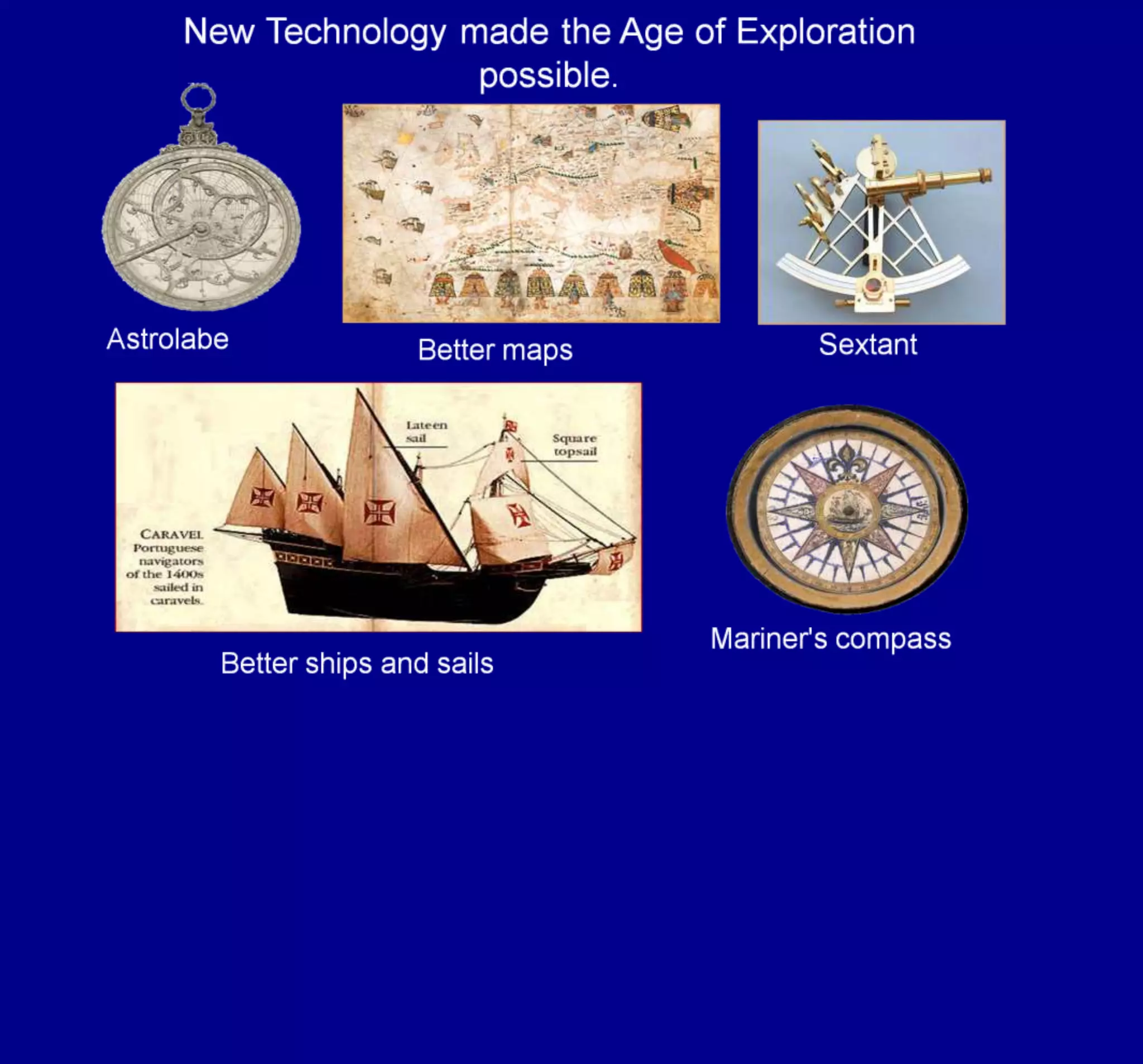
The Scientific revolution gave the ​Europeans
the devices they would ​need for long distance
travel and ​exploration. Some of the most
​important inventions were:
The Caravel --
The Magnetic compass --
The astrolabe --
6th Century BC Map
Map from the 1570's
The European maritime exploration that
followed 1450 upset the known world, ending
American isolation and bringing about greater
global interaction.
It began with Prince Henry “The Navigator” of
Portugal who encouraged his country's
maritime exploration to the South, aiming to sail
around Africa to gain access to the Asian spice
trade.
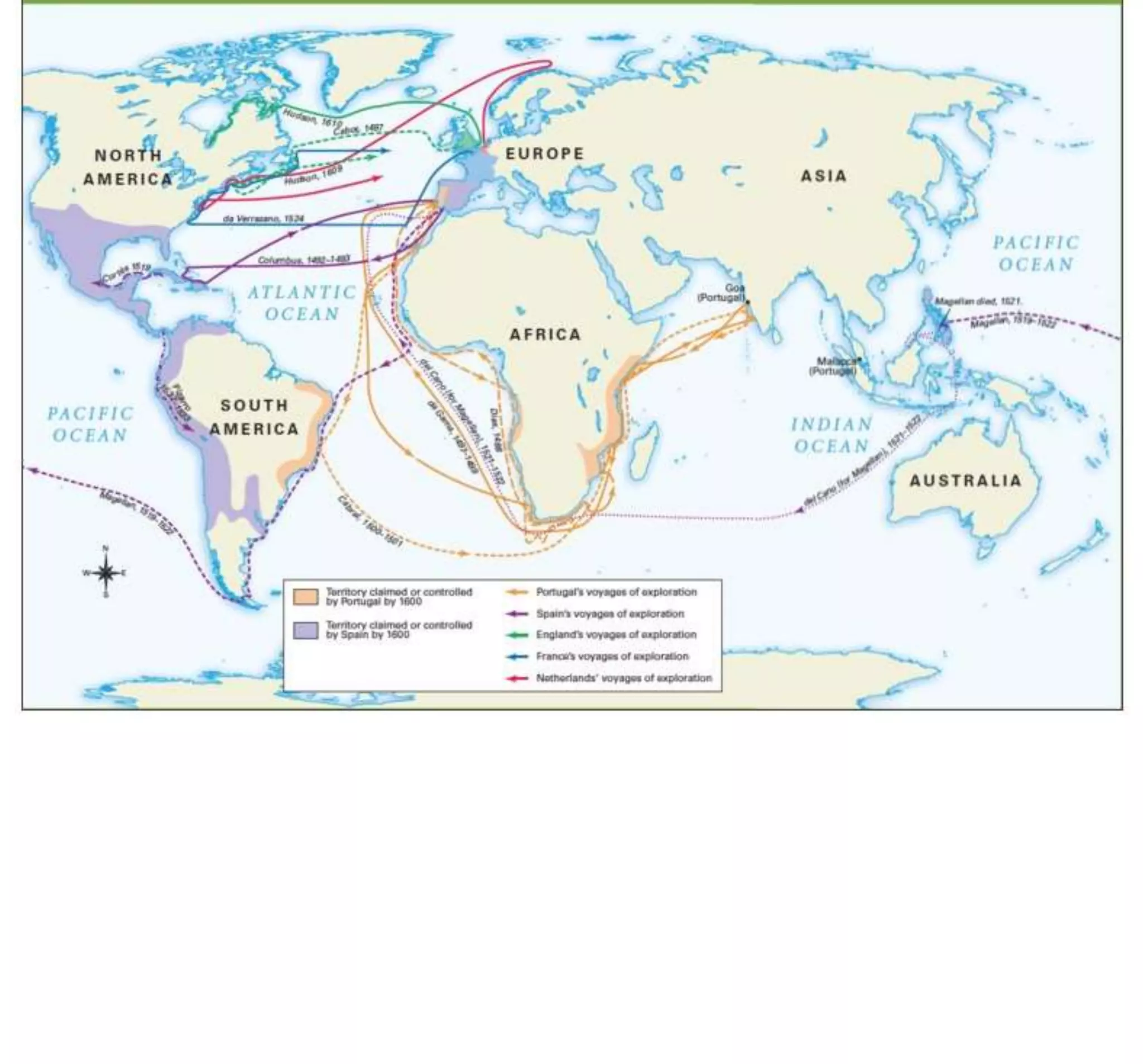
Portugal led the way for exploration and used their fleets
beginning in Africa. In 1488, Bartolomeu Dias sailed
around the southern tip of Africa, followed by Vasco
DaGama who sailed into the Indian Ocean, reaching India
in 1498. There DaGama established direct trade with
India, bypassing the Italian and Muslim merchants who
controlled the overland trade routes.
Portuguese Trading Empire
Europeans began to expand, first Portugal
and Spain, then Dutch, England and France.
One of the main reasons for exploration was
to expand trade, another was for religious
reasons and the last was for the glory of their
country. "God, glory and gold"
Motives and Means
The First G: Gold
Gold was a hot item that explorers were looking for, but
remember that it is really wealth, not just literal gold that
explorers were after.
Europeans also desired spices and other natural resources
that would come to be sold for profit as well (timber, sugar,
tobacco, ivory, etc.)
The Second G: Glory
Came out of the Renaissance ideal of ​Humanism, and the
focus on individual ​achievement
With the rise of the printing press, the ​idea of gaining fame
for one's actions was ​possible
Also, individual kings wanted glory for ​their kingdoms,
competition spreads
The Third G: God
As members of a universalizing religion, ​Europeans
had always seen spreading ​Christianity as a good
thing
Colonization will become a race to ​convert native
peoples to a particular brand of Christianity
Jesuits (Catholics) are some of the ​most active
missionaries
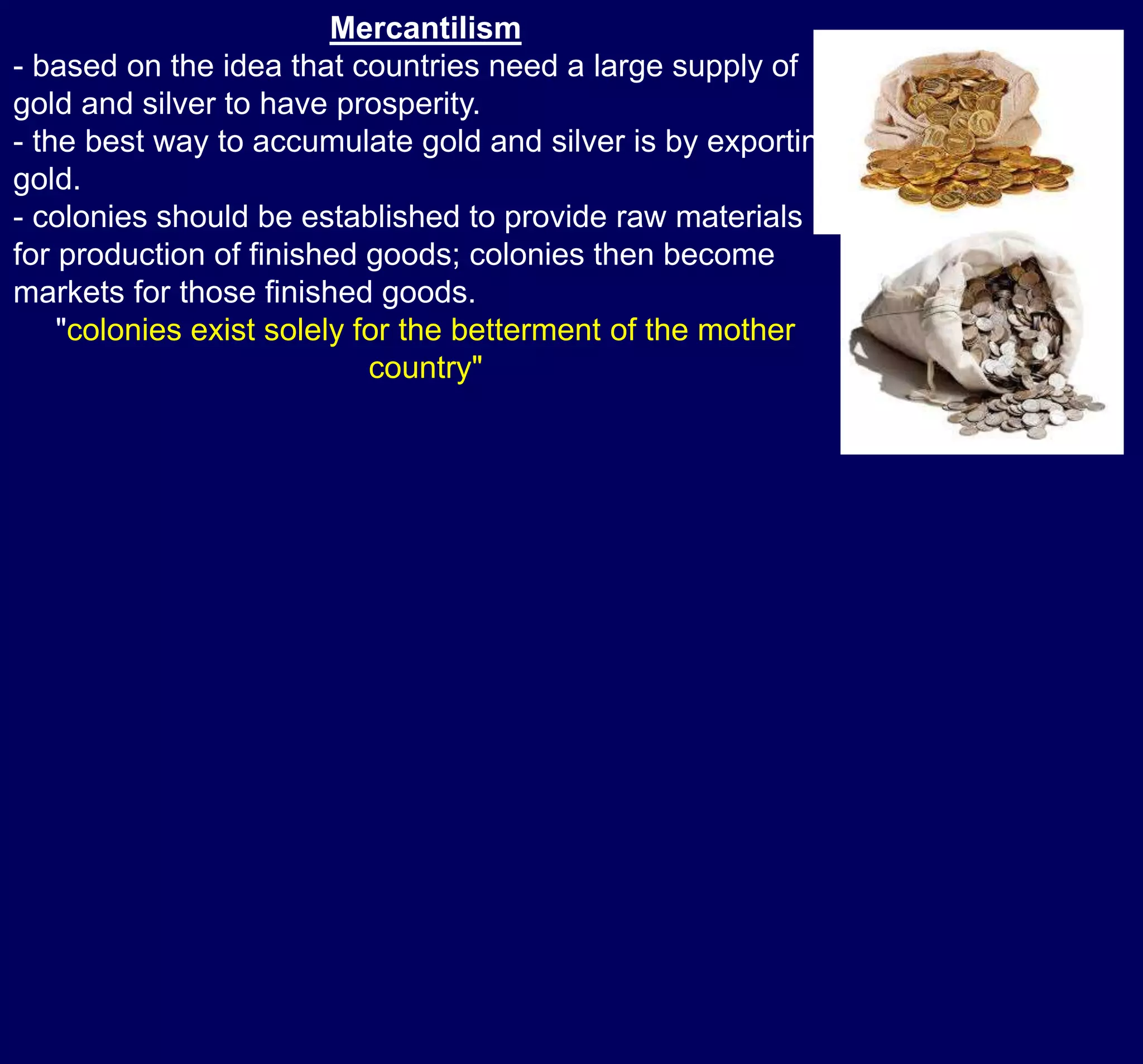
Mercantilism
- based on the idea that countries need a large supply of
gold and silver to have prosperity.
- the best way to accumulate gold and silver is by exporting
gold.
- colonies should be established to provide raw materials
for production of finished goods; colonies then become
markets for those finished goods.
"colonies exist solely for the betterment of the mother
country"
Lets take a minute to write!
Answer the following questions fully and in AT LEAST a
paragraph!
1. Of the three primary motives for European Exploration
which do you feel is most important? Least important? Why?
2. Which of the three do you think had the greatest historical
impact? Why?
(turn in when you are done!)
Inspired by Portugal's maritime success,
Christopher Columbus looked for a shorter
route to India by heading West through the
Atlantic instead of South around Africa. Once
others realized he had discovered new land
there was a race to claim it.
Voyages to America
Columbus's travels
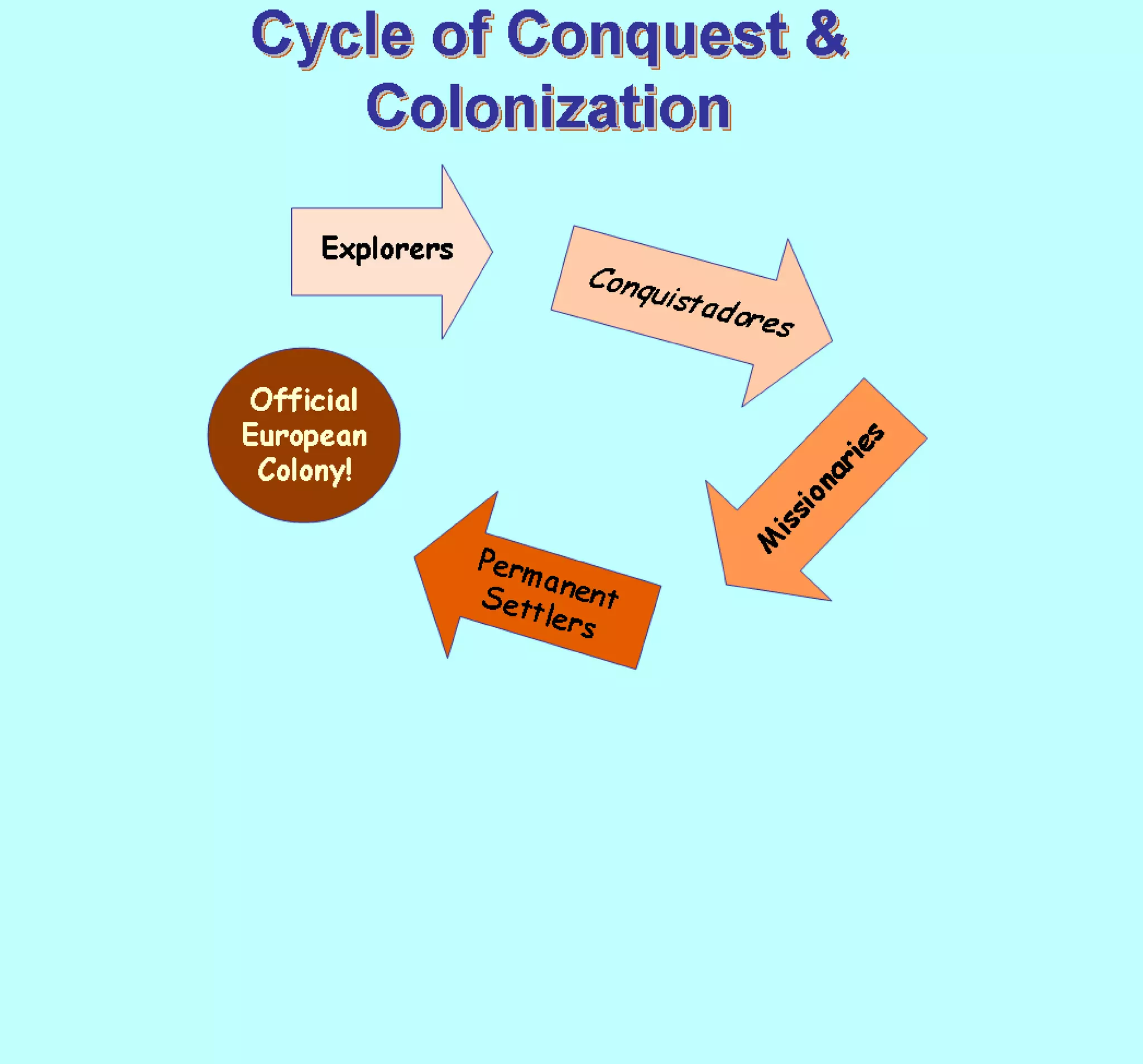
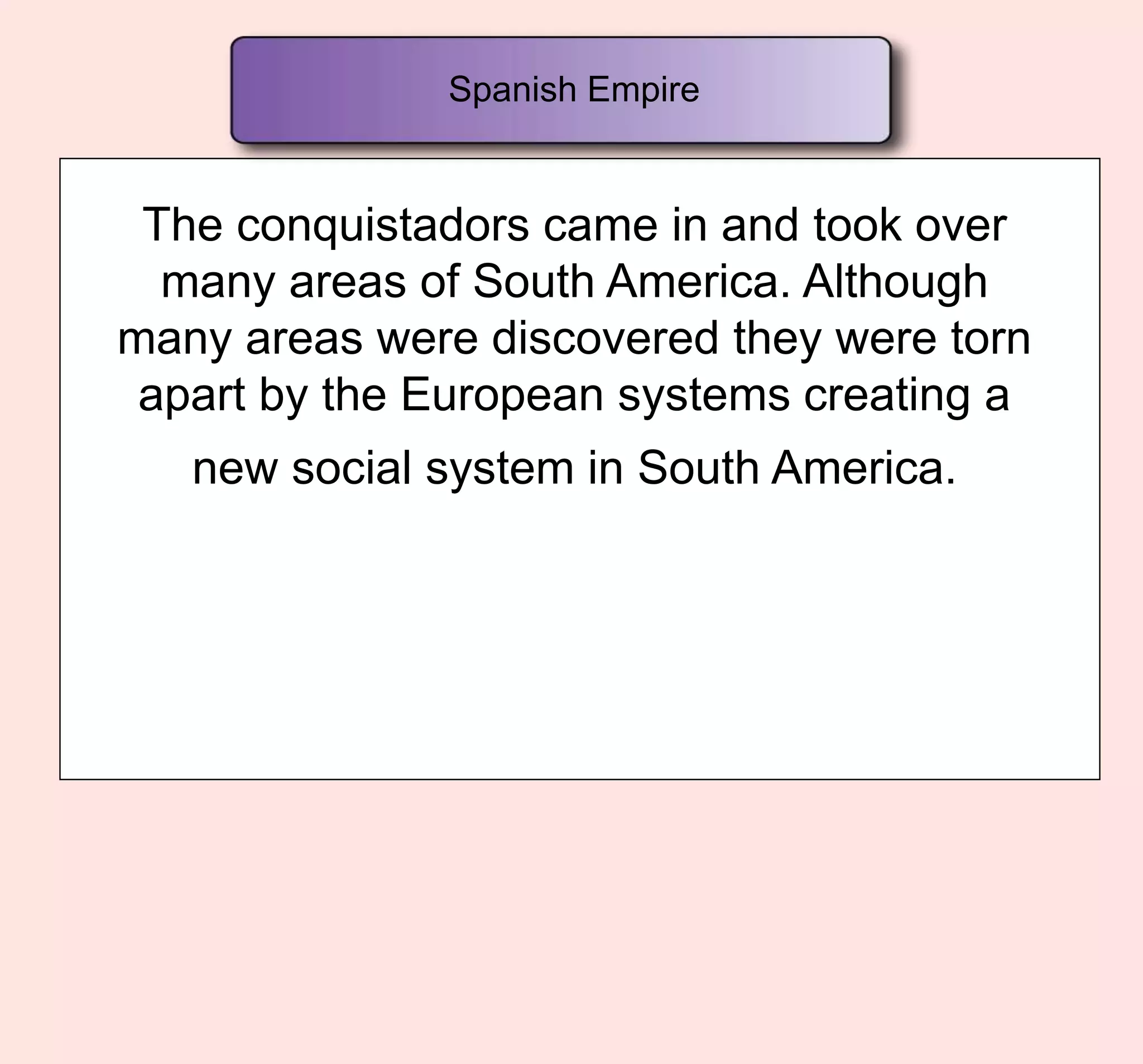
The conquistadors came in and took over
many areas of South America. Although
many areas were discovered they were torn
apart by the European systems creating a
new social system in South America.
Spanish Empire
In 1519, Hernan Cortez sailed to Mexico and conquered the
Aztecs. Francisco Pizarro traveled south to conquer the Incan
Empire, claiming land for Spain from Ecuador to Chile.
These unlikely victories were made possible with the help of
local dissidents, guns, horses, and a smallpox epidemic that
severely weakened the Amerindians.
These conquests were notable for the ways the Spanish
plundered resources and forced conversion to Christianity.
Spanish Empire
Columbian Exchange
The Columbian Exchange refers to the large-scale exchange of
plants, diseases, animals, and people between the eastern and
western hemispheres following Columbus’ first voyage to what
would become known as the Americas.
For example, mainstay crops of many countries around the world
were not found in those countries prior to the Columbian
Exchange.
Important Explorers!
Christopher Columbus: Italian who sailed for Spain. Credited for discovering
America, he thought he was in India. He sailed longer without making landfall
than any other documented European explorer of the time. He helped establish a
permanent European settlement on the island of Hispaniola and facilitated contact
between Europe and the inhabitants of what would become the Americas.
Vasco da Gama: Portugal, credited with discovering a route through the Cape of
Good Hope, around the tip of Africa. Helped Portugal establish strategic positions
along the Indian Ocean in order to control trade routes in the region
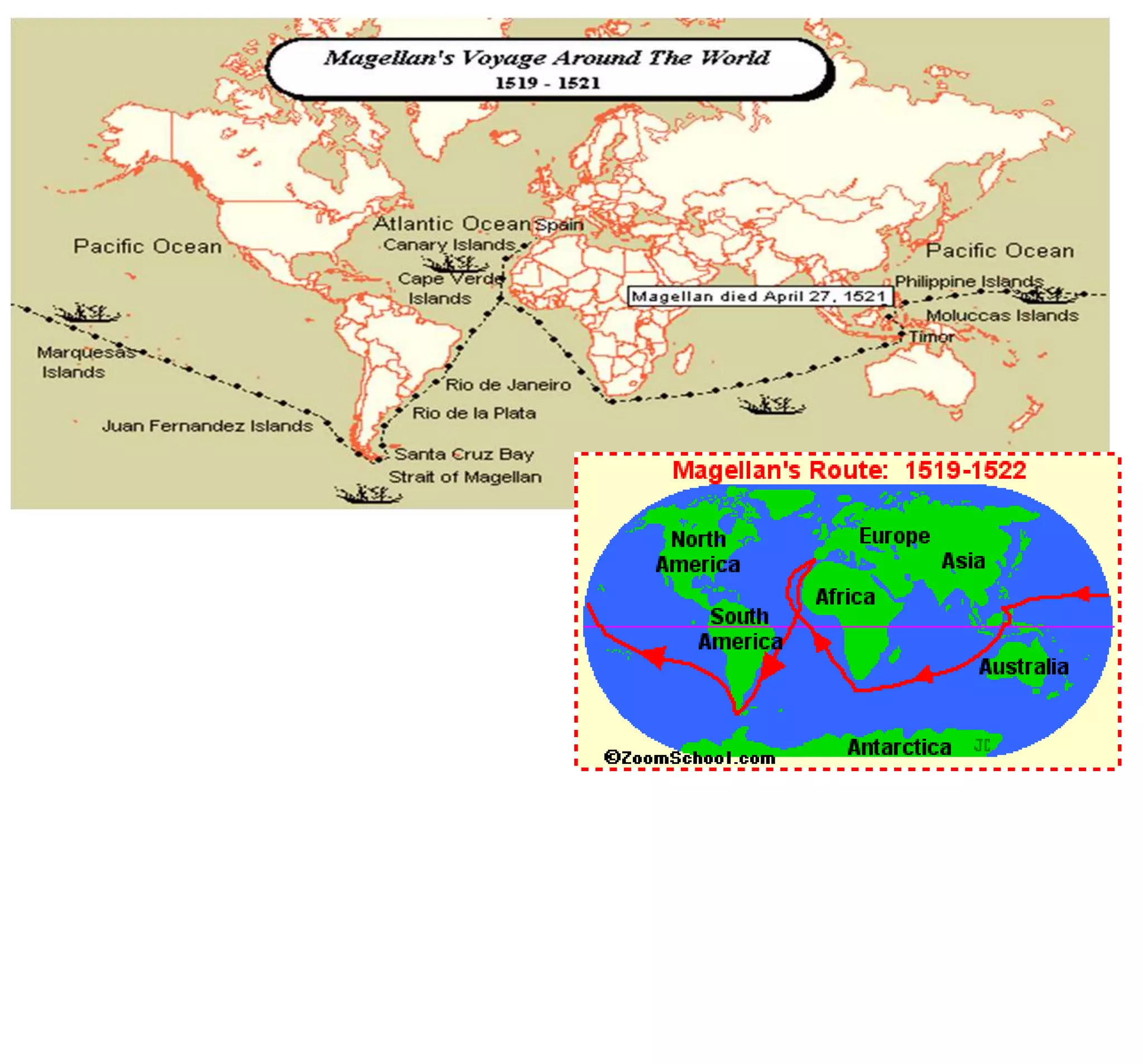
Ferdinand Magellan: Portuguese, sailed for Spain. Credited
with being the first person to circumnavigate the globe. Provided
proof for the widely held belief that the world was spherical.
Magellan himself did not complete the journey; he was killed in
the Philippines
James Cook: Britain; in the late 1700s, claimed Australia and
New Zealand for Britain
Click
​me
Important Explorers!
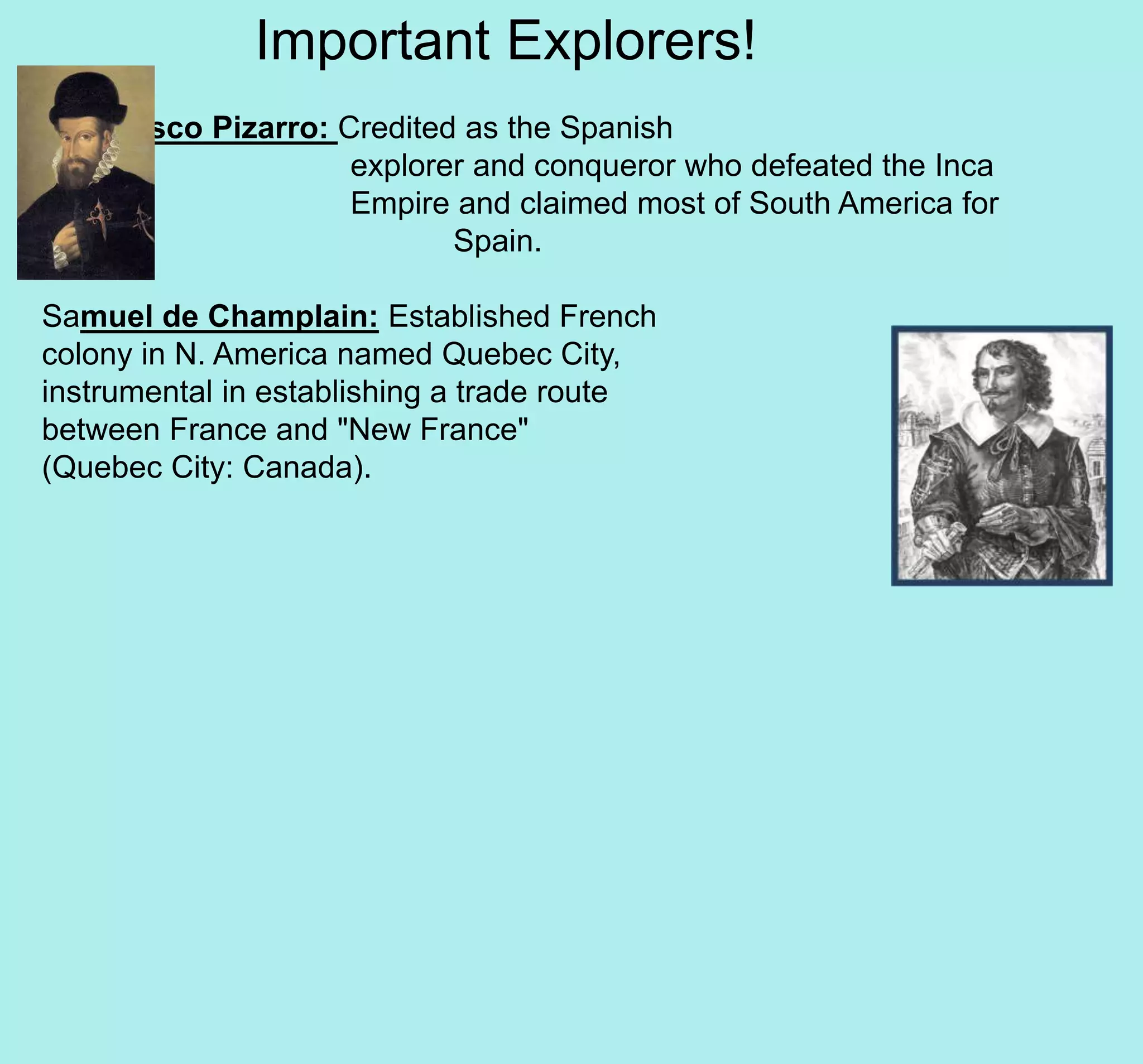
Francisco Pizarro: Credited as the Spanish
explorer and conqueror who defeated the Inca
Empire and claimed most of South America for
Spain.
Samuel de Champlain: Established French
colony in N. America named Quebec City,
instrumental in establishing a trade route
between France and "New France"
(Quebec City: Canada).
Important Explorers!
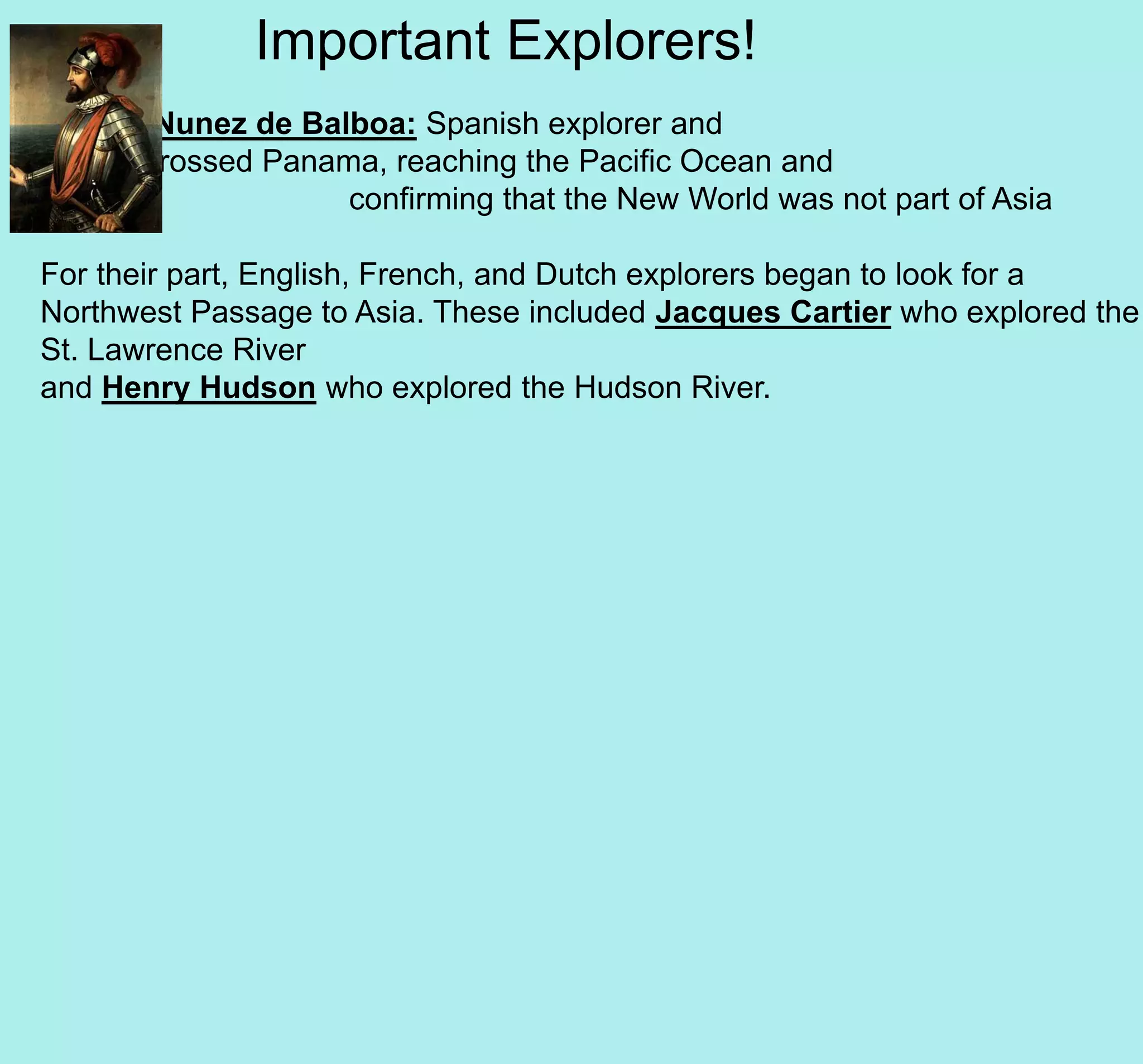
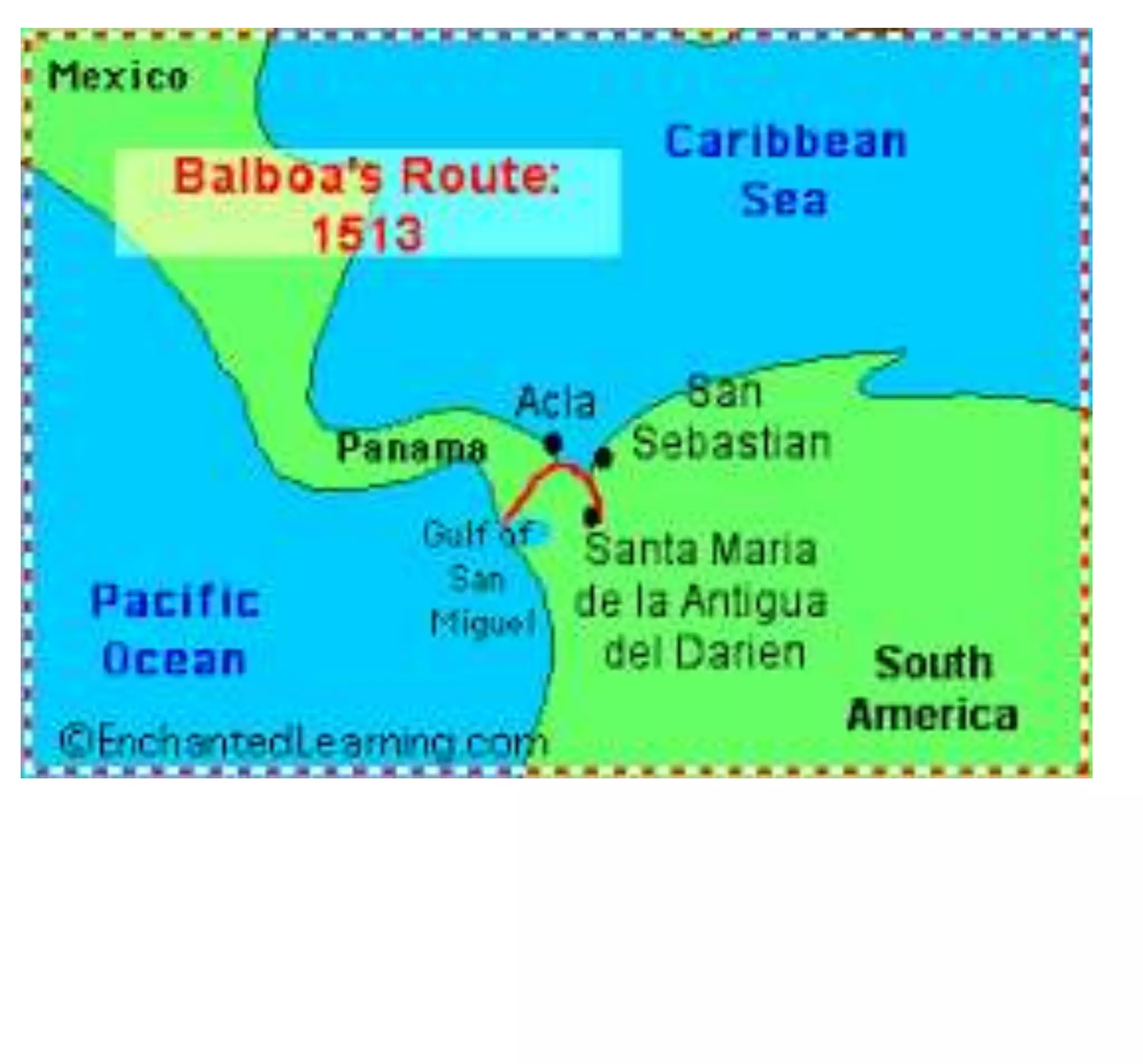
Vasco Nunez de Balboa: Spanish explorer and
crossed Panama, reaching the Pacific Ocean and
confirming that the New World was not part of Asia
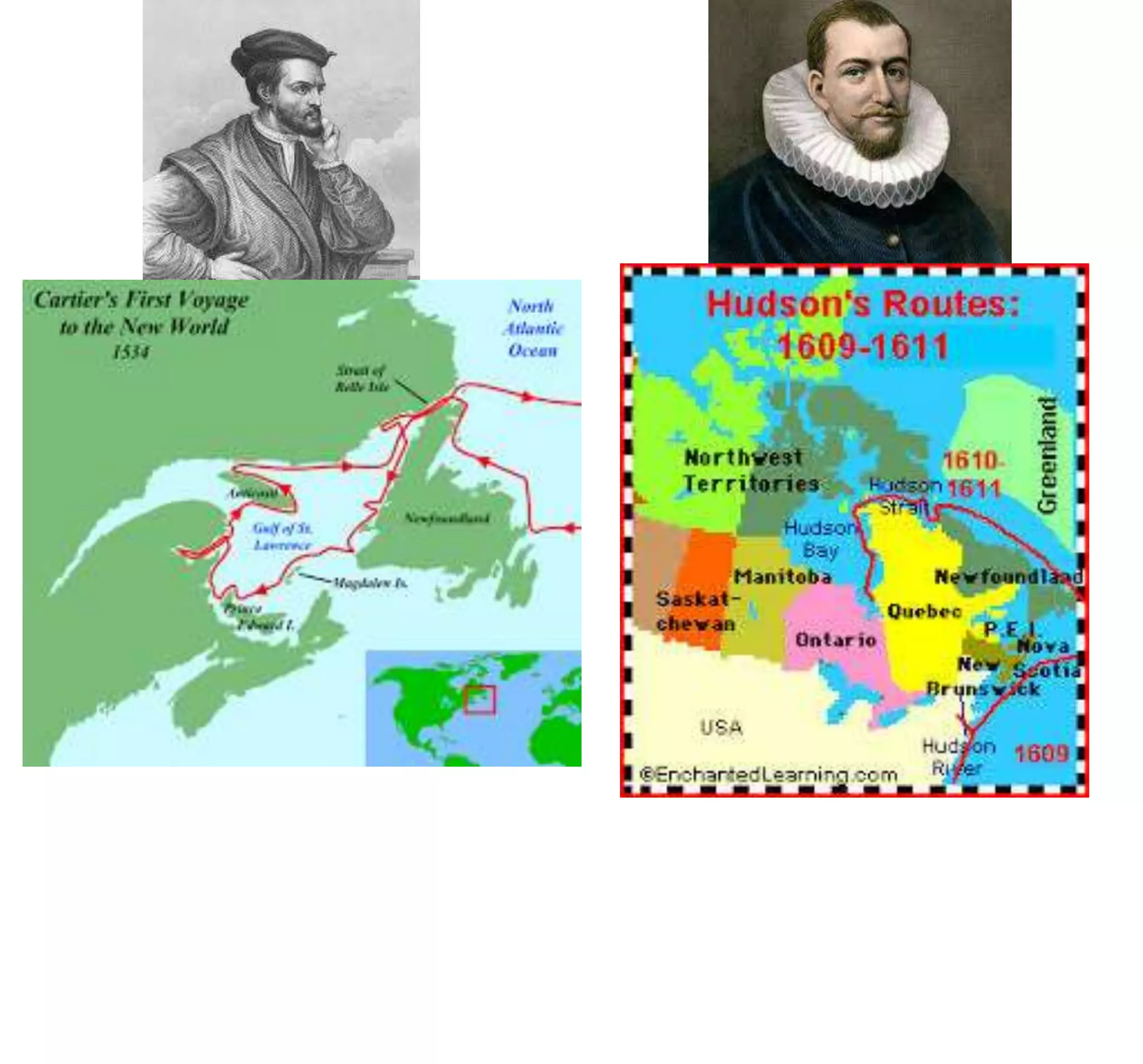
For their part, English, French, and Dutch explorers began to look for a
Northwest Passage to Asia. These included Jacques Cartier who explored the
St. Lawrence River
and Henry Hudson who explored the Hudson River.
Zheng He: China; between 1405 and 1433,
Zheng He led the massive Chinese fleet (62 ships measuring
400 feet) on voyages to show off the Emperor’s wealth and
power to Africa, India, and Southeast Asia
Each ship was 400’ long and 160’ wide!
Vasco da Gama
Christopher Columbus
Samuel de Champlain
Ferdinand Magellan.
Francisco Pizarro.
Vasco Nunez de Balboa
Vasco da Gama's route
Slave Trade Videos on the stars!
Slave Trade was not new; it existed in Africa before the Europeans. Grew in the 15th
Century
Slaves were used primarily on plantations in the beginning the plantations grew
sugarcane
The journey from Africa to the Americas was known as the middle passage
The desire for Africa to constantly provide slaves led to warfare in Africa
About 10 million Africans were shipped to the Americas between the 16th-19th
Centuries
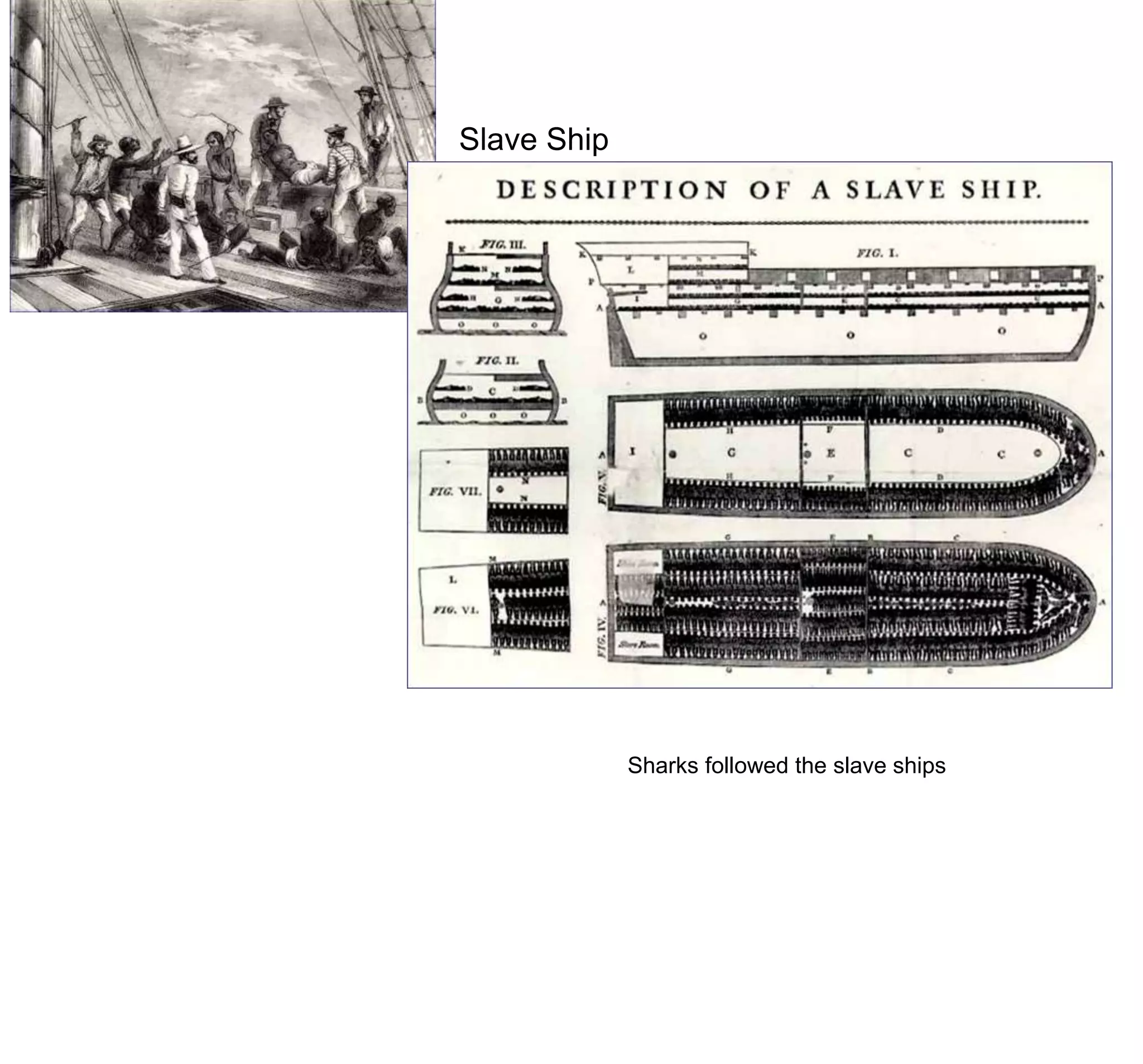
Sharks followed the slave ships
Slave Ship
Slaves Working in a Sugar Mill
1. What was distinctive about the Atlantic slave trade?
2. What did it share with other patterns of slave owning and slave
trading?
3. What explains the rise of Atlantic slave trade?
4. What roles did Europeans and Africans play in the unfolding of the
Atlantic slave trade?
5. In what different ways did the Atlantic slave trade transform African
societies?
Lets Answer together...
Southeast Asia in the Era of the Spice Trade
Areas the Portuguese took over became small settlements along
the “spice Islands”
The Dutch came in and took over the trade power the Portuguese
had
There were many mainland states but they could not come
together to drive the Europeans out
Because of trade the religions of southeast Asia began to change
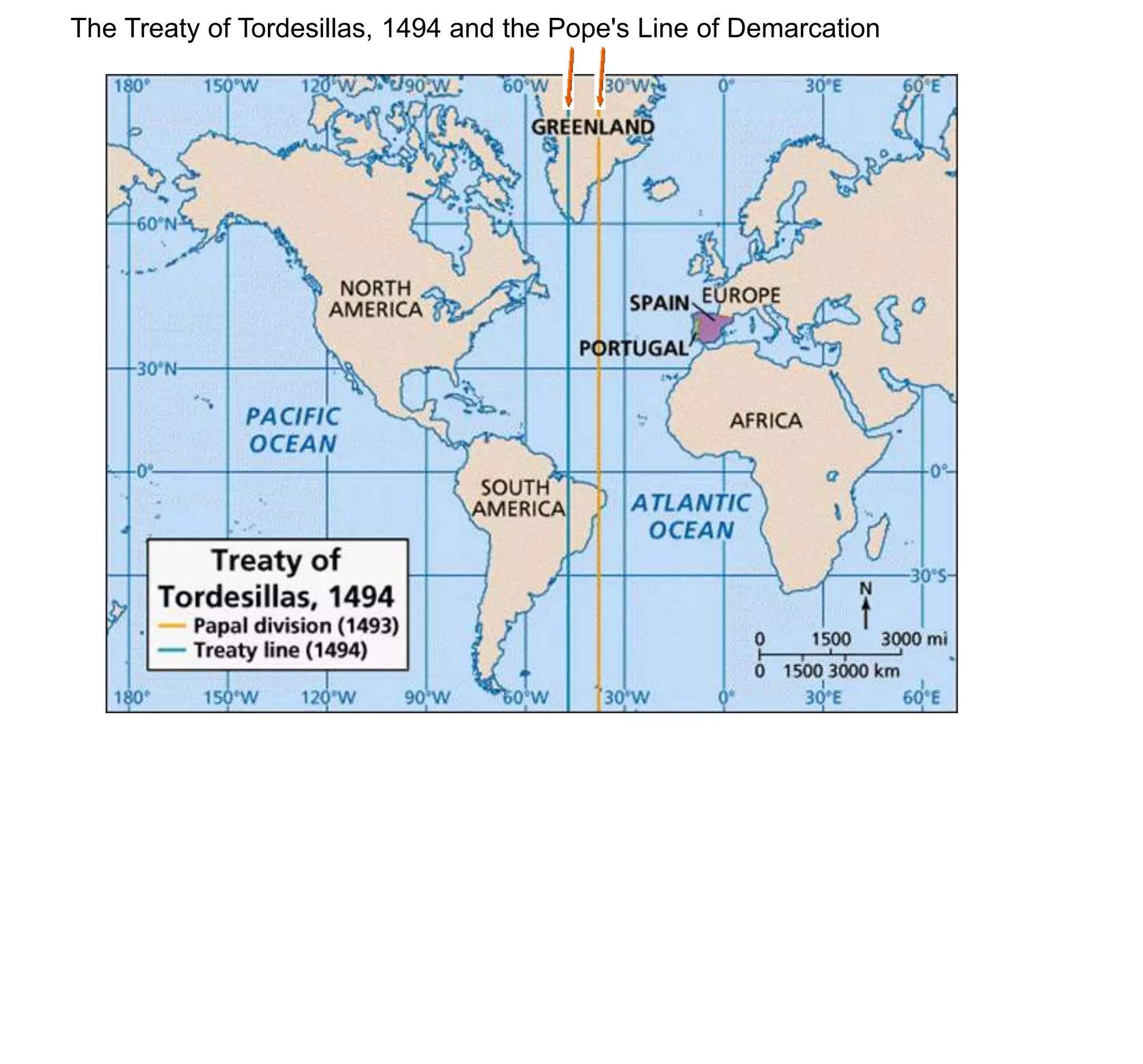
The Treaty of Tordesillas, 1494 and the Pope's Line of Demarcation
America named after Amerigo Vespucci
Native populations ravaged by disease.
Influx of gold, and especially silver, into Europe created
an inflationary economic climate. [“Price Revolution”]
New products introduced across the continents
[“Columbian Exchange”].
Deepened colonial rivalries.
Impact of European Expansion
Attachments
Introducing_Ferdinand_Magellan_and_the_Great_Age_of_Exploration.asf
The_Shipyards_of_Portugal.asf
The Columbian Exchange_ Crash Course World History #23.mp4
Animaniacs - The Ballad of Magellan.mp4
The_Slave_Trade.asf

SSWH10.ppt

  • 1.
    SSWH10: The studentwill analyze the impact of the age of discovery and expansion into the Americas, Africa and Asia.
  • 2.
    The Age ofExploration! Magellan
  • 3.
    Why did Explorationhappen when it did? 1. A variety of factors all came together to make the time period (1450-1700) the "age of Exploration" 2. Some of these factors were pushes, external forces acting on Europe 3. Some of the factors were pulls, motivations and things that attracted the Europeans
  • 4.
    The Scientific revolutiongave the ​Europeans the devices they would ​need for long distance travel and ​exploration. Some of the most ​important inventions were: The Caravel -- The Magnetic compass -- The astrolabe --
  • 6.
  • 7.
  • 8.
    The European maritimeexploration that followed 1450 upset the known world, ending American isolation and bringing about greater global interaction. It began with Prince Henry “The Navigator” of Portugal who encouraged his country's maritime exploration to the South, aiming to sail around Africa to gain access to the Asian spice trade.
  • 10.
    Portugal led theway for exploration and used their fleets beginning in Africa. In 1488, Bartolomeu Dias sailed around the southern tip of Africa, followed by Vasco DaGama who sailed into the Indian Ocean, reaching India in 1498. There DaGama established direct trade with India, bypassing the Italian and Muslim merchants who controlled the overland trade routes. Portuguese Trading Empire
  • 11.
    Europeans began toexpand, first Portugal and Spain, then Dutch, England and France. One of the main reasons for exploration was to expand trade, another was for religious reasons and the last was for the glory of their country. "God, glory and gold" Motives and Means
  • 12.
    The First G:Gold Gold was a hot item that explorers were looking for, but remember that it is really wealth, not just literal gold that explorers were after. Europeans also desired spices and other natural resources that would come to be sold for profit as well (timber, sugar, tobacco, ivory, etc.)
  • 14.
    The Second G:Glory Came out of the Renaissance ideal of ​Humanism, and the focus on individual ​achievement With the rise of the printing press, the ​idea of gaining fame for one's actions was ​possible Also, individual kings wanted glory for ​their kingdoms, competition spreads
  • 15.
    The Third G:God As members of a universalizing religion, ​Europeans had always seen spreading ​Christianity as a good thing Colonization will become a race to ​convert native peoples to a particular brand of Christianity Jesuits (Catholics) are some of the ​most active missionaries
  • 16.
    Mercantilism - based onthe idea that countries need a large supply of gold and silver to have prosperity. - the best way to accumulate gold and silver is by exporting gold. - colonies should be established to provide raw materials for production of finished goods; colonies then become markets for those finished goods. "colonies exist solely for the betterment of the mother country"
  • 17.
    Lets take aminute to write! Answer the following questions fully and in AT LEAST a paragraph! 1. Of the three primary motives for European Exploration which do you feel is most important? Least important? Why? 2. Which of the three do you think had the greatest historical impact? Why? (turn in when you are done!)
  • 18.
    Inspired by Portugal'smaritime success, Christopher Columbus looked for a shorter route to India by heading West through the Atlantic instead of South around Africa. Once others realized he had discovered new land there was a race to claim it. Voyages to America
  • 19.
  • 21.
    The conquistadors camein and took over many areas of South America. Although many areas were discovered they were torn apart by the European systems creating a new social system in South America. Spanish Empire
  • 22.
    In 1519, HernanCortez sailed to Mexico and conquered the Aztecs. Francisco Pizarro traveled south to conquer the Incan Empire, claiming land for Spain from Ecuador to Chile. These unlikely victories were made possible with the help of local dissidents, guns, horses, and a smallpox epidemic that severely weakened the Amerindians. These conquests were notable for the ways the Spanish plundered resources and forced conversion to Christianity. Spanish Empire
  • 24.
    Columbian Exchange The ColumbianExchange refers to the large-scale exchange of plants, diseases, animals, and people between the eastern and western hemispheres following Columbus’ first voyage to what would become known as the Americas. For example, mainstay crops of many countries around the world were not found in those countries prior to the Columbian Exchange.
  • 27.
    Important Explorers! Christopher Columbus:Italian who sailed for Spain. Credited for discovering America, he thought he was in India. He sailed longer without making landfall than any other documented European explorer of the time. He helped establish a permanent European settlement on the island of Hispaniola and facilitated contact between Europe and the inhabitants of what would become the Americas. Vasco da Gama: Portugal, credited with discovering a route through the Cape of Good Hope, around the tip of Africa. Helped Portugal establish strategic positions along the Indian Ocean in order to control trade routes in the region
  • 28.
    Ferdinand Magellan: Portuguese,sailed for Spain. Credited with being the first person to circumnavigate the globe. Provided proof for the widely held belief that the world was spherical. Magellan himself did not complete the journey; he was killed in the Philippines James Cook: Britain; in the late 1700s, claimed Australia and New Zealand for Britain Click ​me
  • 29.
    Important Explorers! Francisco Pizarro:Credited as the Spanish explorer and conqueror who defeated the Inca Empire and claimed most of South America for Spain. Samuel de Champlain: Established French colony in N. America named Quebec City, instrumental in establishing a trade route between France and "New France" (Quebec City: Canada).
  • 30.
    Important Explorers! Vasco Nunezde Balboa: Spanish explorer and crossed Panama, reaching the Pacific Ocean and confirming that the New World was not part of Asia For their part, English, French, and Dutch explorers began to look for a Northwest Passage to Asia. These included Jacques Cartier who explored the St. Lawrence River and Henry Hudson who explored the Hudson River.
  • 31.
    Zheng He: China;between 1405 and 1433, Zheng He led the massive Chinese fleet (62 ships measuring 400 feet) on voyages to show off the Emperor’s wealth and power to Africa, India, and Southeast Asia Each ship was 400’ long and 160’ wide!
  • 32.
    Vasco da Gama ChristopherColumbus Samuel de Champlain Ferdinand Magellan. Francisco Pizarro. Vasco Nunez de Balboa
  • 34.
  • 38.
    Slave Trade Videoson the stars! Slave Trade was not new; it existed in Africa before the Europeans. Grew in the 15th Century Slaves were used primarily on plantations in the beginning the plantations grew sugarcane The journey from Africa to the Americas was known as the middle passage The desire for Africa to constantly provide slaves led to warfare in Africa About 10 million Africans were shipped to the Americas between the 16th-19th Centuries
  • 40.
    Sharks followed theslave ships Slave Ship
  • 41.
    Slaves Working ina Sugar Mill
  • 42.
    1. What wasdistinctive about the Atlantic slave trade? 2. What did it share with other patterns of slave owning and slave trading? 3. What explains the rise of Atlantic slave trade? 4. What roles did Europeans and Africans play in the unfolding of the Atlantic slave trade? 5. In what different ways did the Atlantic slave trade transform African societies? Lets Answer together...
  • 43.
    Southeast Asia inthe Era of the Spice Trade Areas the Portuguese took over became small settlements along the “spice Islands” The Dutch came in and took over the trade power the Portuguese had There were many mainland states but they could not come together to drive the Europeans out Because of trade the religions of southeast Asia began to change
  • 44.
    The Treaty ofTordesillas, 1494 and the Pope's Line of Demarcation
  • 46.
    America named afterAmerigo Vespucci
  • 48.
    Native populations ravagedby disease. Influx of gold, and especially silver, into Europe created an inflationary economic climate. [“Price Revolution”] New products introduced across the continents [“Columbian Exchange”]. Deepened colonial rivalries. Impact of European Expansion
  • 49.
    Attachments Introducing_Ferdinand_Magellan_and_the_Great_Age_of_Exploration.asf The_Shipyards_of_Portugal.asf The Columbian Exchange_Crash Course World History #23.mp4 Animaniacs - The Ballad of Magellan.mp4 The_Slave_Trade.asf