The African Kingdoms of
Kush and Askum
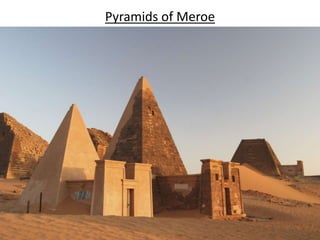
Pyramids of Meroe
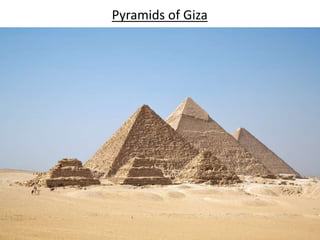
Pyramids of Giza
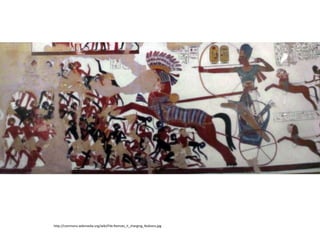
http://commons.wikimedia.org/wiki/File:Ramses_II_charging_Nubians.jpg
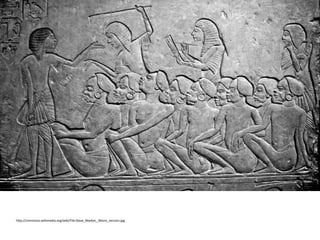
http://commons.wikimedia.org/wiki/File:Slave_Market,_Mono_version.jpg
The Interaction of Egypt and Nubia (Kush)
• From about 2000 to 1000 B.C., Egypt dominated Nubia
and the Nubian kingdom of Kush, which was south of
Egypt.
• Kush, and other Nubian kingdoms, lay between the
Blue Nile, and the White Nile, and served as a trade
corridor that linked Egypt and the Mediterranean
world to the interior of Africa, and to the Red Sea.
• Goods and ideas flowed back and forth along the river
for centuries.
The Rise of the Kingdom of Axum
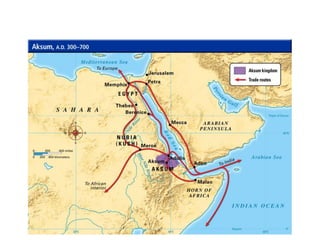
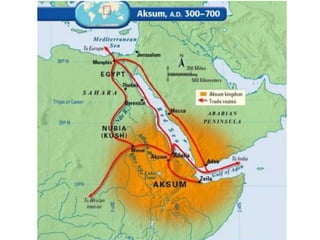
• Aksum (Axum) was located to the south of Kush, and
on a rugged plateau on the Red Sea, in what are now
the countries of Eritrea and Ethiopia.
• The area is known as the, “Horn of Africa.” Arab
traders crossed the Red Sea, and established trading
settlements in Aksum. They sought ivory to trade in
Persia and farther east in the Indian Ocean trade.
They brought silks, textiles, and spices from eastern
trade routes.
Location, Location, Location
• Aksum’s location and expansion made it a trading
hub for caravan routes to Egypt and Meroe. Access
to sea trade on the Mediterranean Sea and Indian
Ocean helped Aksum become an international
trading power.
• Traders from Egypt, Arabia, Persia, India, Greece and
the Roman Empire crowded Aksum’s chief seaport,
Adulis, which was a deep water port on the Red Sea.
International Culture Develops
• Diverse culture, Arabs from across the Red Sea, and
Kushites
• Attracted people from all over the ancient world, as
Axum became a powerful trading center.
• Port city of Adulis was cosmopolitan.
Religion
• Aksumites believed in one god, and believed
their king was directly descended from him.
• They were also animists, and worshipped the
spirits of nature and honored their dead
ancestors.
• Christianity, which began in Judea about A.D.
30, spread to Axum by merchants.
• Ezana ruled, and converted to Christianity.
Aksumite innovations
• Developed a written language
• Minted its own coins.
• Adapted to rugged terrain, hilly terrain.
They created terrace farming, and dug
canals to channel water from the
mountain streams into the fields.
• Build dams and cisterns to store water.
The Fall of Aksum
• Lasted 800 years.
• Muslim invaders conquered Aksum between
632 and 750.
• Aksum’s rulers moved their capital over the
mountains into what is now northern Ethiopia
to escape Islam.
• New geographic location, and depletion of
forests and soil erosion led to its decline.

Kush and Aksum

  • 1.
    The African Kingdomsof Kush and Askum
  • 4.
  • 5.
  • 6.
  • 7.
  • 8.
    The Interaction ofEgypt and Nubia (Kush) • From about 2000 to 1000 B.C., Egypt dominated Nubia and the Nubian kingdom of Kush, which was south of Egypt. • Kush, and other Nubian kingdoms, lay between the Blue Nile, and the White Nile, and served as a trade corridor that linked Egypt and the Mediterranean world to the interior of Africa, and to the Red Sea. • Goods and ideas flowed back and forth along the river for centuries.
  • 9.
    The Rise ofthe Kingdom of Axum • Aksum (Axum) was located to the south of Kush, and on a rugged plateau on the Red Sea, in what are now the countries of Eritrea and Ethiopia. • The area is known as the, “Horn of Africa.” Arab traders crossed the Red Sea, and established trading settlements in Aksum. They sought ivory to trade in Persia and farther east in the Indian Ocean trade. They brought silks, textiles, and spices from eastern trade routes.
  • 10.
    Location, Location, Location •Aksum’s location and expansion made it a trading hub for caravan routes to Egypt and Meroe. Access to sea trade on the Mediterranean Sea and Indian Ocean helped Aksum become an international trading power. • Traders from Egypt, Arabia, Persia, India, Greece and the Roman Empire crowded Aksum’s chief seaport, Adulis, which was a deep water port on the Red Sea.
  • 11.
    International Culture Develops •Diverse culture, Arabs from across the Red Sea, and Kushites • Attracted people from all over the ancient world, as Axum became a powerful trading center. • Port city of Adulis was cosmopolitan.
  • 12.
    Religion • Aksumites believedin one god, and believed their king was directly descended from him. • They were also animists, and worshipped the spirits of nature and honored their dead ancestors. • Christianity, which began in Judea about A.D. 30, spread to Axum by merchants. • Ezana ruled, and converted to Christianity.
  • 13.
    Aksumite innovations • Developeda written language • Minted its own coins. • Adapted to rugged terrain, hilly terrain. They created terrace farming, and dug canals to channel water from the mountain streams into the fields. • Build dams and cisterns to store water.
  • 14.
    The Fall ofAksum • Lasted 800 years. • Muslim invaders conquered Aksum between 632 and 750. • Aksum’s rulers moved their capital over the mountains into what is now northern Ethiopia to escape Islam. • New geographic location, and depletion of forests and soil erosion led to its decline.